English

Coretta Scott King
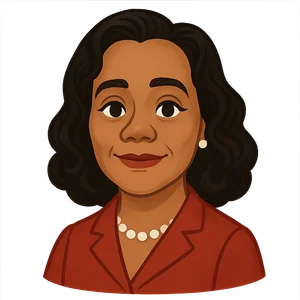
Coretta Scott King was an American author, activist, and civil rights leader.
Reads at Grades 6–8 Listens at Grades 4–8
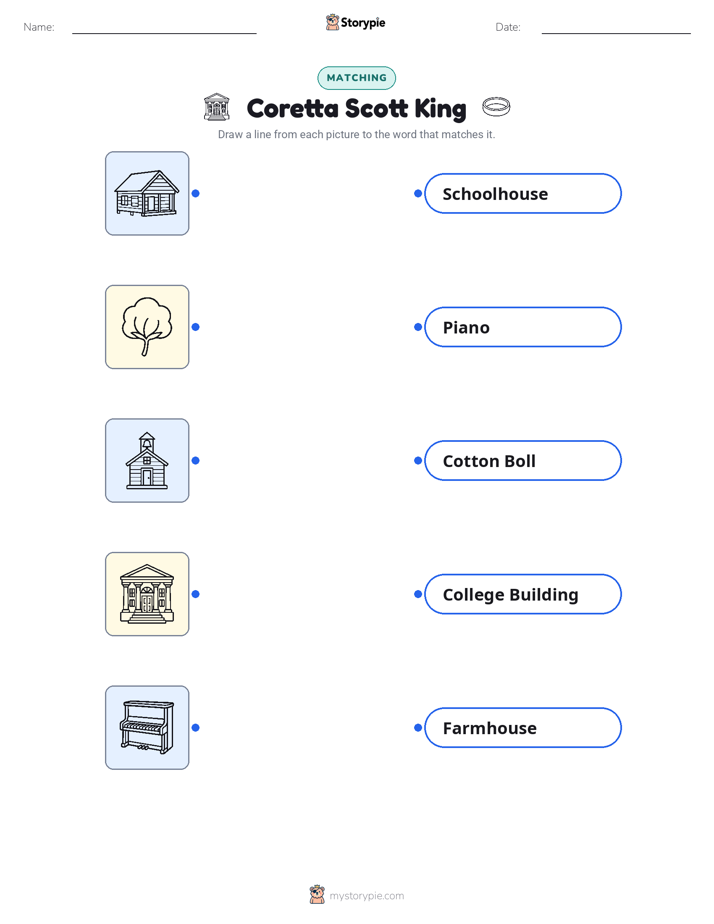
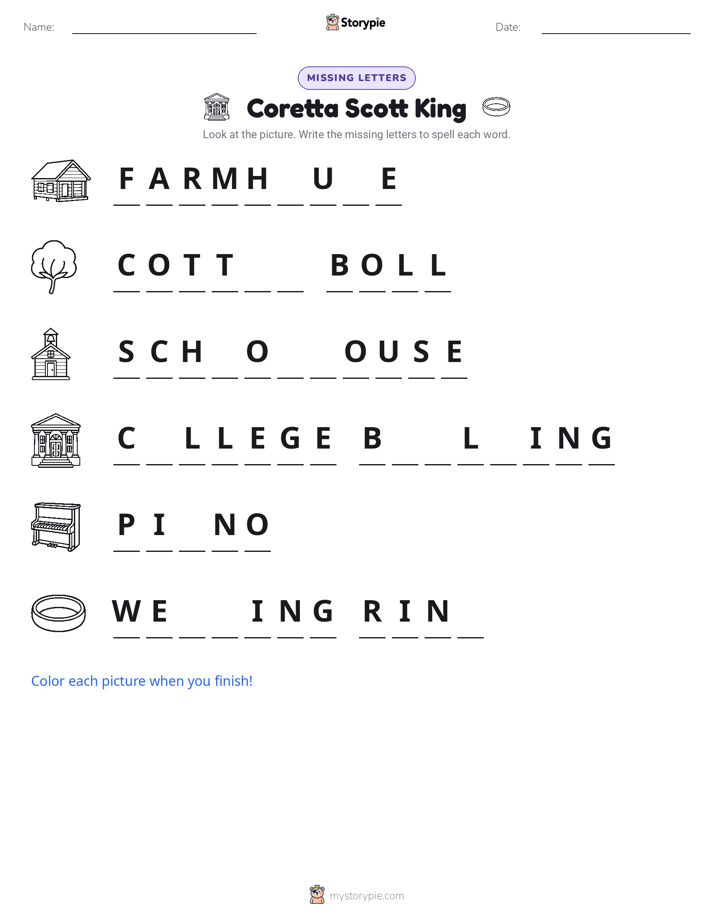
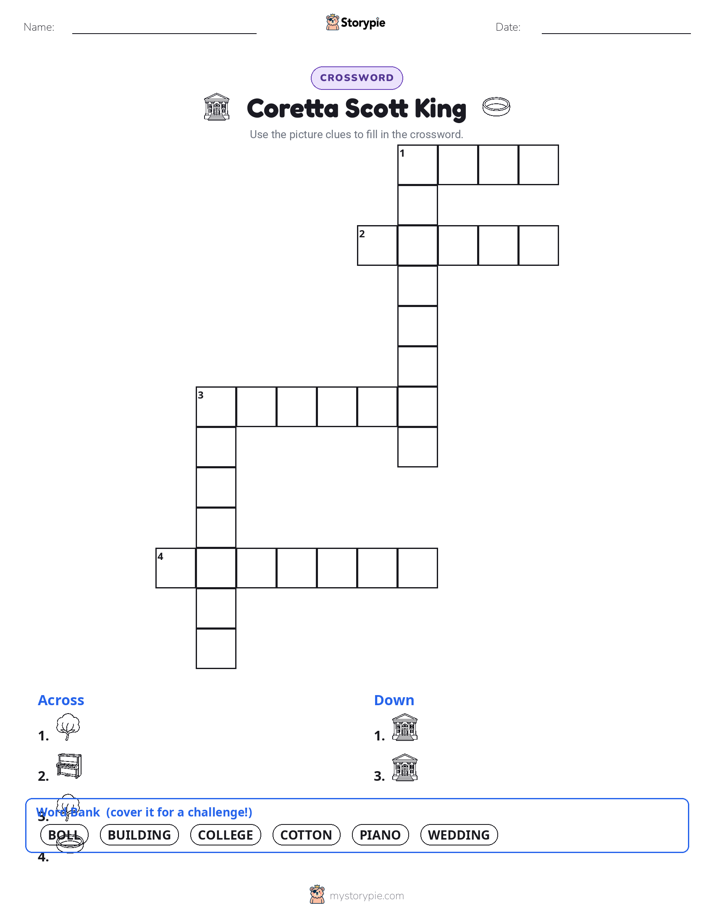
Print & create
Answer keys·No prep·Free with an account
28 worksheets · answer keys · full story · quiz · Ages 10-12 · CEFR B2
Plus adds 164,000+ more stories in 27 languages, audio for every one, and printables for all of them.
Just want Coretta Scott King?
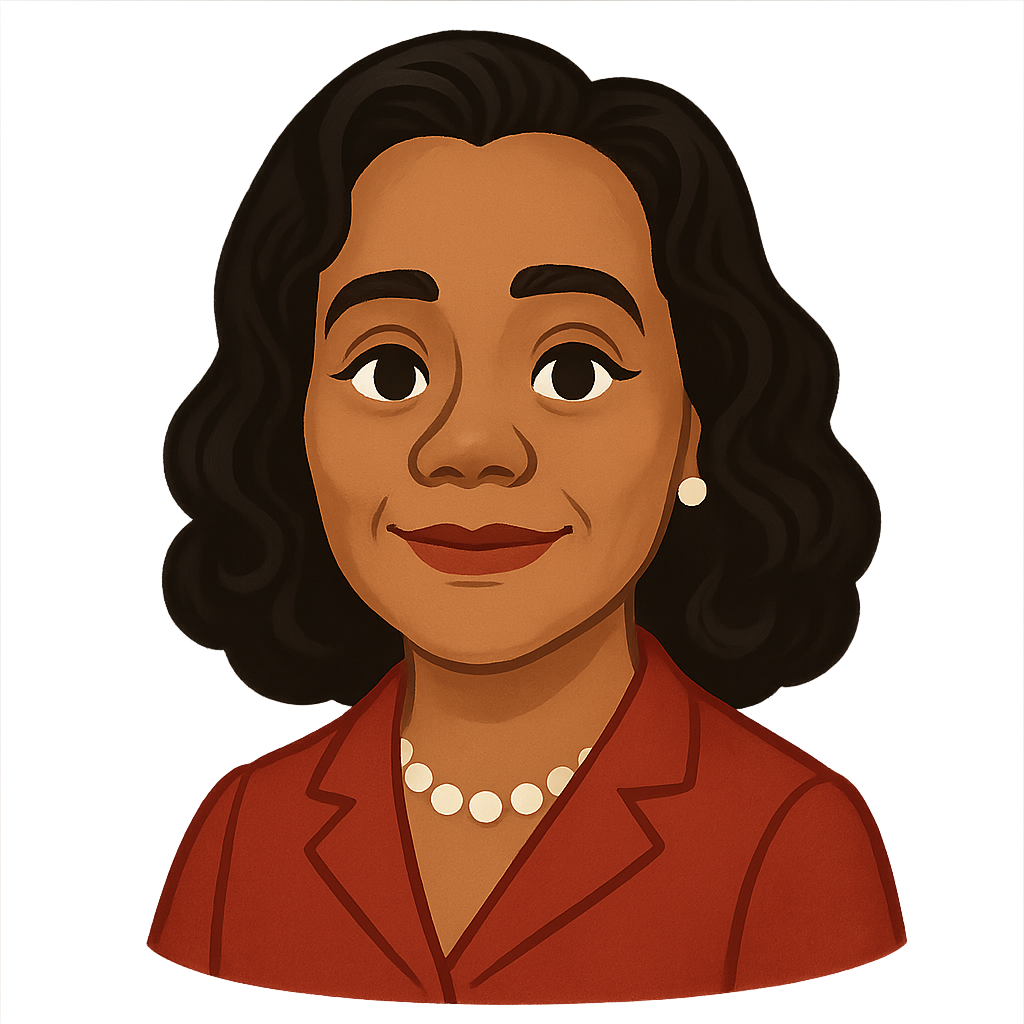
Hello, my name is Coretta Scott, and I want to share my story with you. My journey began in a small town called Heiberger, Alabama, where I was born on April 27th, 1927. Life was not always easy. I grew up on my family's farm, and from my parents, I learned the importance of strength and dignity. The world around me was governed by segregation, an unfair system that kept people apart based on the color of their skin. This meant that the schools I attended were separate and had fewer resources than the schools for white children. Despite these challenges, I discovered a deep love for both music and learning. I dreamed of using my voice, not just for singing, but for speaking out against injustice. I worked hard in my studies, and in 1945, I graduated as the valedictorian of my class from Lincoln Normal School. I knew then that my education was a powerful tool, and I was determined to use it to help make a difference in the world.
My desire for education led me far from my home in Alabama. I first traveled north to Ohio to attend Antioch College, where I earned my degree in 1951. My studies were not over, though, as my passion for music brought me to the New England Conservatory of Music in Boston. It was there, in the city of Boston in 1952, that my life changed forever. I met a brilliant and passionate young man who was studying to become a minister. His name was Martin Luther King Jr. We connected instantly, discovering that we both shared a powerful dream for a world where every person would be judged by the content of their character, not the color of their skin. We fell in love, and on June 18th, 1953, we were married. We could have stayed in the North, but we both felt a strong calling. We knew the struggle for equality was most intense in the South, and we made the important decision to move to Montgomery, Alabama, because we believed that was where we were needed most.
Coretta Scott King: A Voice for Equality
Hello, my name is Coretta Scott, and I want to share my story with you. My journey began in a small town called Heiberger, Alabama, where I was born on April 27th, 1927. Life was not always easy. I grew up on my family's farm, and from my parents, I learned the importance of strength and dignity. The world around me was governed by segregation, an unfair system that kept people apart based on the color of their skin. This meant that the schools I attended were separate and had fewer resources than the schools for white children. Despite these challenges, I discovered a deep love for both music and learning. I dreamed of using my voice, not just for singing, but for speaking out against injustice. I worked hard in my studies, and in 1945, I graduated as the valedictorian of my class from Lincoln Normal School. I knew then that my education was a powerful tool, and I was determined to use it to help make a difference in the world.
My desire for education led me far from my home in Alabama. I first traveled north to Ohio to attend Antioch College, where I earned my degree in 1951. My studies were not over, though, as my passion for music brought me to the New England Conservatory of Music in Boston. It was there, in the city of Boston in 1952, that my life changed forever. I met a brilliant and passionate young man who was studying to become a minister. His name was Martin Luther King Jr. We connected instantly, discovering that we both shared a powerful dream for a world where every person would be judged by the content of their character, not the color of their skin. We fell in love, and on June 18th, 1953, we were married. We could have stayed in the North, but we both felt a strong calling. We knew the struggle for equality was most intense in the South, and we made the important decision to move to Montgomery, Alabama, because we believed that was where we were needed most.
Our life in Montgomery quickly placed us at the very center of the Civil Rights Movement. In 1955, the Montgomery Bus Boycott began, a powerful and peaceful protest against segregation on public buses, and our home became a central place for leaders to meet and organize. I knew I had a role to play, and I used my talents to support the cause. I was a trained singer, so I began performing in 'Freedom Concerts.' These were special performances where I combined singing and speaking to tell the story of the movement, raising both money and spirits for our work. During these very busy and often dangerous years, Martin and I also started our family and raised our four children. We faced constant threats, but our commitment to nonviolence never wavered. We believed in the power of peaceful protest to create lasting change, a principle that guided us all the way to the historic March on Washington in 1963, where Martin delivered his famous 'I Have a Dream' speech.
Our journey together was filled with hope, but also with great sorrow. On the terrible day of April 4th, 1968, my husband's life was taken by an assassin's bullet. The world felt a deep sense of loss, and in my own sadness, I knew one thing for certain: his dream of peace and equality had to continue. I felt it was my duty to carry our shared work forward. That same year, in 1968, I founded The Martin Luther King Jr. Center for Nonviolent Social Change in Atlanta to serve as a living memorial to his vision. I also believed his life and message should be honored by our entire country. For years, I worked tirelessly to convince the nation's leaders to recognize his contribution. It was a long and determined effort, but it finally succeeded in 1983 when my husband's birthday was officially designated as a national holiday, a day for all Americans to remember the importance of justice and service to others.
After Martin's death, my work expanded to address injustice wherever I saw it. I traveled the world to fight for human rights, speaking out firmly against the apartheid system of segregation in South Africa and advocating for the rights and dignity of all people. I lived to be 78 years old, and I spent my life working for the causes of peace and justice that I held so dear. I hope my story reminds you that a dream for a better world is a powerful force. Remember that every single person, including you, has a voice that can be used to help build a future filled with peace and equality for everyone.
Wow facts
About
Coretta Scott King was an American author, activist, and civil rights leader. As the wife of Martin Luther King Jr., she was a central figure in the Civil Rights Movement and dedicated her life to advancing human rights and nonviolent social change.
Take a Quiz
Question 1 of 5
What was the main conflict or problem that Coretta Scott King and her husband worked to resolve throughout their lives?
Explore next



Want to do even more?
Go beyond exploring. Unlock tools that turn every story into real learning.

Storypie Plus for families
Full stories, quizzes, and printables. Nights and car rides, sorted.
- Unlimited audio stories
- Create Mode: your child stars in the story
- Offline downloads
- Printable worksheets & coloring pages

Why Storypie for Schools
Students engaged. Prep in seconds. Evenings back to you.
- Worksheets & Quizzes
- Classroom Management
- Formative Assessment
- Custom Curriculum & Lesson Plans
- 27 Languages

Why Storypie for Homeschool
Curriculum done. They'll ask for more. Hours back in your day.
- Worksheet Generator
- First-Person Audio Stories
- Built-in Comprehension Quizzes
- Custom Curriculum & Lesson Plans
- Print & Go Activities