English

Diophantus of Alexandria
Diophantus of Alexandria was a Hellenistic Greek mathematician known as a pioneering figure in algebra for…
Reads at Grades 6–8 Listens at Grades 4–8
Print & create
Answer keys·No prep·Free with an account
28 worksheets · answer keys · full story · quiz · Ages 10-12 · CEFR B2
Plus adds 208,000+ more stories in 27 languages, audio for every one, and printables for all of them.
Just want Diophantus of Alexandria?
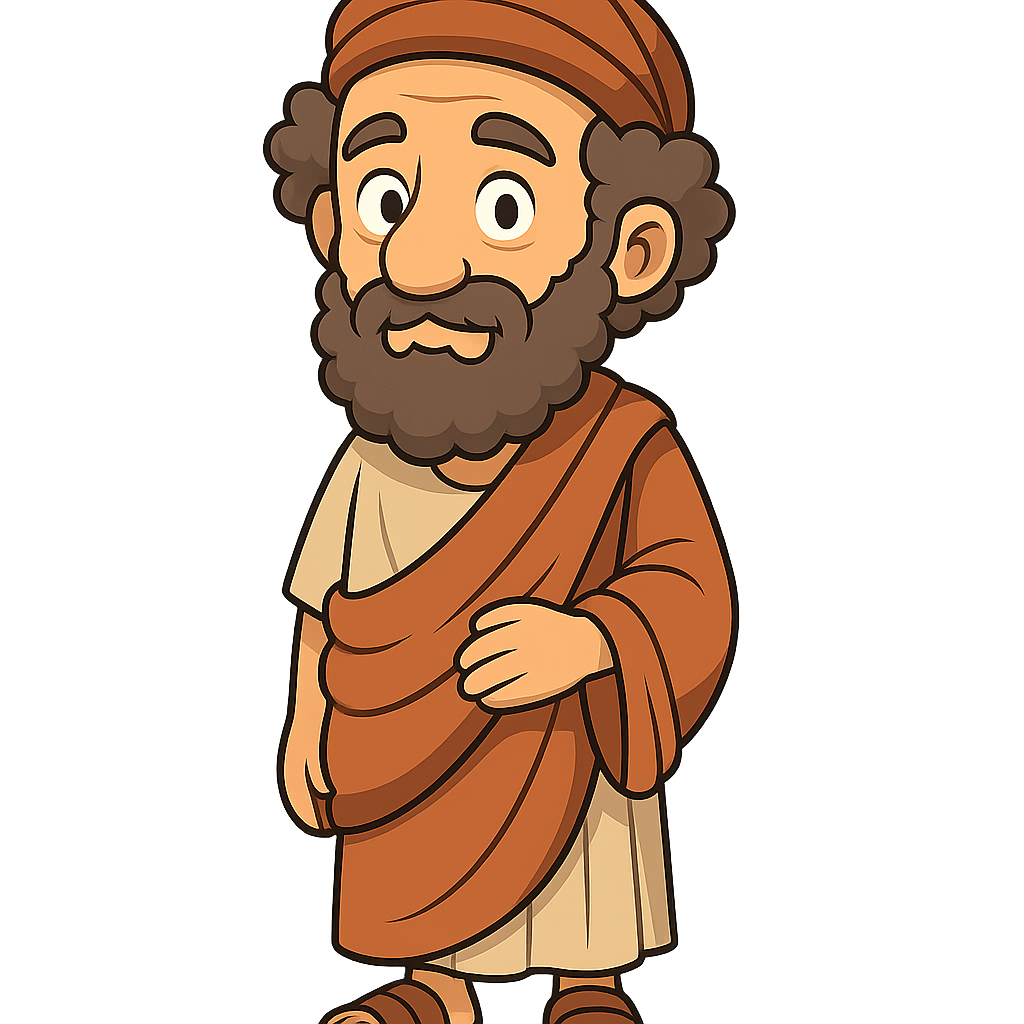
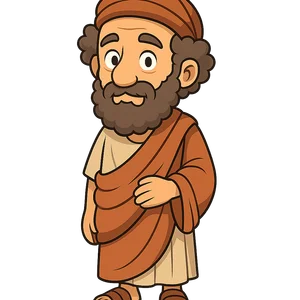
Hello! My name is Diophantus, and I lived many, many years ago in the bustling city of Alexandria. My home was in a province of the Roman Empire that is now part of Egypt. Around the year 250 CE, my city was one of the most exciting places in the world for a thinker like me. It had the greatest library you could imagine, filled with scrolls of knowledge from all over the known world. While others were interested in the busy trade routes or constructing grand buildings, my passion was for numbers. I didn't just see them as tools for counting money or measuring land; to me, they were beautiful puzzles just waiting to be solved. I felt a deep desire to find a new way to work with them, to create a language of numbers that could solve mysteries that words alone could not.
In my time, when people had a math problem involving an unknown quantity, they had to write everything out in long, descriptive sentences. Imagine trying to solve a puzzle by writing, 'A certain number, when added to five, gives a result of twelve.' It was so clumsy and time-consuming! I was convinced there had to be a better, more efficient way. This led me to begin using symbols to represent ideas. I created a special symbol for the unknown number, which today you might call a variable, like 'x'. I didn't stop there; I also developed symbols for subtraction and for powers of the unknown number, like squared or cubed. This was a truly revolutionary idea for the time. It was like inventing a shorthand for mathematics, a new language that could express complex ideas with just a few marks. This system, where we use symbols to stand for numbers and the operations between them, is the very beginning of what we now call algebra.
Diophantus of Alexandria
Hello! My name is Diophantus, and I lived many, many years ago in the bustling city of Alexandria. My home was in a province of the Roman Empire that is now part of Egypt. Around the year 250 CE, my city was one of the most exciting places in the world for a thinker like me. It had the greatest library you could imagine, filled with scrolls of knowledge from all over the known world. While others were interested in the busy trade routes or constructing grand buildings, my passion was for numbers. I didn't just see them as tools for counting money or measuring land; to me, they were beautiful puzzles just waiting to be solved. I felt a deep desire to find a new way to work with them, to create a language of numbers that could solve mysteries that words alone could not.
In my time, when people had a math problem involving an unknown quantity, they had to write everything out in long, descriptive sentences. Imagine trying to solve a puzzle by writing, 'A certain number, when added to five, gives a result of twelve.' It was so clumsy and time-consuming! I was convinced there had to be a better, more efficient way. This led me to begin using symbols to represent ideas. I created a special symbol for the unknown number, which today you might call a variable, like 'x'. I didn't stop there; I also developed symbols for subtraction and for powers of the unknown number, like squared or cubed. This was a truly revolutionary idea for the time. It was like inventing a shorthand for mathematics, a new language that could express complex ideas with just a few marks. This system, where we use symbols to stand for numbers and the operations between them, is the very beginning of what we now call algebra.
I poured all of my ideas and methods into my greatest work, a series of books I called Arithmetica. I believe I wrote thirteen books in total around the middle of the 3rd century CE, but sadly, through the passage of time, only some of them have survived to the present day. In these books, I presented hundreds of problems for my readers to ponder. These weren't simple addition or subtraction questions. They were complex equations with unknown numbers, many of which had more than one possible answer. Today, problems of this type are named in my honor; they are called 'Diophantine equations.' For each problem in Arithmetica, I carefully showed how to use my new symbolic method to find a solution. My goal wasn't just to provide the answer, but to demonstrate a clear and logical way of thinking that anyone could follow. My book was meant to be a guidebook for solving the most fascinating number puzzles imaginable.
It seems fitting that my love for number puzzles even followed me to the very end. A riddle, written by one of my admirers long after I was gone, tells the story of my life using mathematics. The riddle says that my boyhood lasted for one-sixth of my life, my beard grew after one-twelfth more, and I married after another one-seventh of my life had passed. It continues by stating that a son was born five years after my marriage, but tragically, he lived to be only half of my final age. The riddle concludes by saying that I spent the last four years of my life in deep sorrow after my son's passing. If you set up the equation and solve this puzzle, you will discover exactly how long I lived. It is a unique and clever tribute to a life spent in the company of numbers.
By solving that final riddle, you will discover that I lived to be 84 years old. Though my life in ancient Alexandria ended long ago, my ideas traveled through time and across cultures. Scholars in the Islamic Golden Age carefully studied my Arithmetica and built upon the foundations I had laid. Hundreds of years later, in the 1600s, a brilliant French mathematician named Pierre de Fermat was so inspired by the problems in my book that it led him to his own famous discovery, known as Fermat's Last Theorem. Because of my work in using symbols to represent unknown numbers, many people today call me 'The Father of Algebra.' I am so proud that my love for number puzzles helped build a foundation for the mathematics that students all over the world learn and use today.
Wow facts
About
Diophantus of Alexandria was a Hellenistic Greek mathematician known as a pioneering figure in algebra for his influential work, Arithmetica, which introduced an abbreviated form of notation for unknowns and their powers, marking a step toward symbolic algebra.
Take a Quiz
Question 1 of 5
What is Diophantus most famous for contributing to mathematics?
Explore next





Want to do even more?
Go beyond exploring. Unlock tools that turn every story into real learning.

Storypie Plus for families
Full stories, quizzes, and printables. Nights and car rides, sorted.
- Unlimited audio stories
- Create Mode: your child stars in the story
- Offline downloads
- Printable worksheets & coloring pages

Why Storypie for Schools
Students engaged. Prep in seconds. Evenings back to you.
- Worksheets & Quizzes
- Classroom Management
- Formative Assessment
- Custom Curriculum & Lesson Plans
- 27 Languages

Why Storypie for Homeschool
Curriculum done. They'll ask for more. Hours back in your day.
- Worksheet Generator
- First-Person Audio Stories
- Built-in Comprehension Quizzes
- Custom Curriculum & Lesson Plans
- Print & Go Activities