English

Dolores Huerta
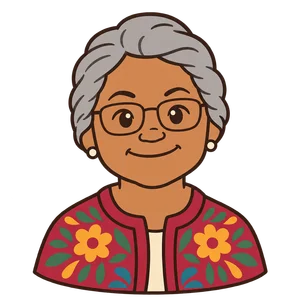
Dolores Huerta is a renowned American labor leader and civil rights activist who, with Gilbert Padilla…
Reads at Grades 6–8 Listens at Grades 4–8
Print & create
Answer keys·No prep·Free with an account
28 worksheets · answer keys · full story · quiz · Ages 10-12 · CEFR B2
Plus adds 290,000+ more stories in 27 languages, audio for every one, and printables for all of them.
Just want Dolores Huerta?
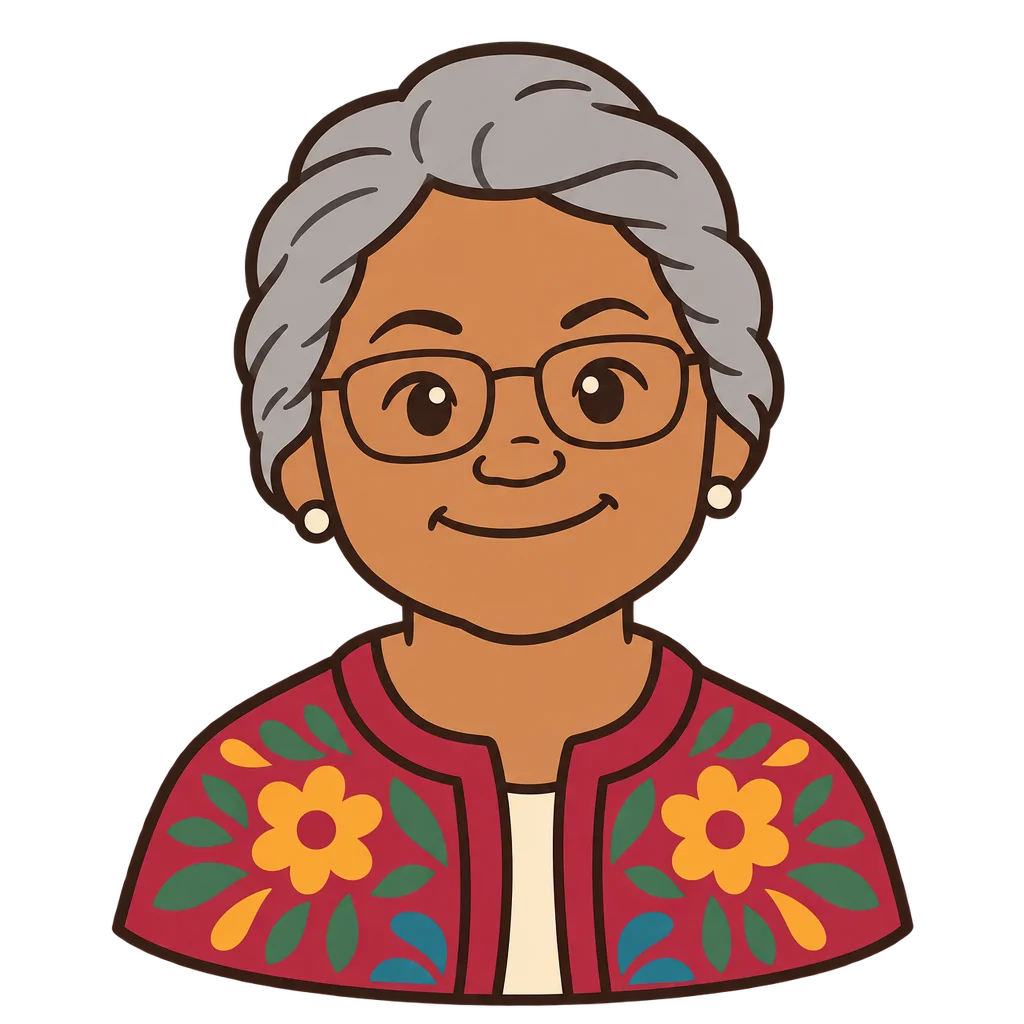
Hello, my name is Dolores Huerta. My story begins on April 10th, 1930, when I was born in a small mining town called Dawson, New Mexico. But the place that truly shaped me was Stockton, California, where my family moved when I was a young child. My parents divorced, and I was raised in a vibrant community by my independent mother, Alicia. She owned a hotel and a restaurant and was known for her kindness to all people, especially families who were struggling. She taught me to be strong and to care for others. My father, Juan, was a farmworker and a union activist who later became a state legislator in New Mexico. Though I didn't see him as often, hearing about his work planted a seed in my mind about the importance of fighting for people's rights. Growing up, I saw that not everyone was treated fairly. I experienced prejudice in school, where a teacher once accused me of cheating simply because she didn't believe a Latina student could get good grades. That moment hurt, but it also lit a fire in me. It was a fire for justice, a deep desire to stand up against unfairness wherever I saw it. This passion guided me through school and eventually led me to become a teacher in the 1950s, where I hoped I could make a difference in the lives of children.
My classroom was filled with the children of farmworkers, and what I saw there changed my life forever. Many of my students would come to school hungry. Some didn't even have shoes to wear. Their clothes were often thin and worn, and I could see the exhaustion in their small faces. I realized that I couldn't truly help them by just teaching them to read and write. How could a child learn if their stomach was empty? How could they focus on a lesson when their parents were working long hours in the fields for wages that were barely enough to survive? I knew that the real problem wasn't in my classroom; it was in the fields where their families toiled. It was then that I decided I had to do more. I left my job as a teacher because, as I often said, I couldn't stand seeing kids come to class hungry and needing shoes. I felt I could do more by organizing farmworkers than by trying to teach their hungry children. In 1955, I joined an organization called the Community Service Organization, or CSO, which was co-founded by an organizer named Fred Ross. He taught me how to organize communities, how to register people to vote, and how to fight for local improvements. It was through the CSO, in the late 1950s, that I met a quiet, determined man named César Chávez. We shared the same passion for helping farmworkers, and we knew that together, we could build a movement.
Dolores Huerta: The Voice for Farmworkers
Hello, my name is Dolores Huerta. My story begins on April 10th, 1930, when I was born in a small mining town called Dawson, New Mexico. But the place that truly shaped me was Stockton, California, where my family moved when I was a young child. My parents divorced, and I was raised in a vibrant community by my independent mother, Alicia. She owned a hotel and a restaurant and was known for her kindness to all people, especially families who were struggling. She taught me to be strong and to care for others. My father, Juan, was a farmworker and a union activist who later became a state legislator in New Mexico. Though I didn't see him as often, hearing about his work planted a seed in my mind about the importance of fighting for people's rights. Growing up, I saw that not everyone was treated fairly. I experienced prejudice in school, where a teacher once accused me of cheating simply because she didn't believe a Latina student could get good grades. That moment hurt, but it also lit a fire in me. It was a fire for justice, a deep desire to stand up against unfairness wherever I saw it. This passion guided me through school and eventually led me to become a teacher in the 1950s, where I hoped I could make a difference in the lives of children.
My classroom was filled with the children of farmworkers, and what I saw there changed my life forever. Many of my students would come to school hungry. Some didn't even have shoes to wear. Their clothes were often thin and worn, and I could see the exhaustion in their small faces. I realized that I couldn't truly help them by just teaching them to read and write. How could a child learn if their stomach was empty? How could they focus on a lesson when their parents were working long hours in the fields for wages that were barely enough to survive? I knew that the real problem wasn't in my classroom; it was in the fields where their families toiled. It was then that I decided I had to do more. I left my job as a teacher because, as I often said, I couldn't stand seeing kids come to class hungry and needing shoes. I felt I could do more by organizing farmworkers than by trying to teach their hungry children. In 1955, I joined an organization called the Community Service Organization, or CSO, which was co-founded by an organizer named Fred Ross. He taught me how to organize communities, how to register people to vote, and how to fight for local improvements. It was through the CSO, in the late 1950s, that I met a quiet, determined man named César Chávez. We shared the same passion for helping farmworkers, and we knew that together, we could build a movement.
In 1962, César and I took a leap of faith. We left the CSO to start our own organization, which we called the National Farm Workers Association (NFWA). Our goal was simple but incredibly difficult: to build a union for the farmworkers who picked the fruits and vegetables for the entire country. These workers faced terrible conditions. They were paid very little, had no access to clean drinking water or bathrooms in the fields, and were often exposed to dangerous pesticides. They had no power to change their situation. We knew we had to use nonviolent methods, inspired by leaders like Mahatma Gandhi and Martin Luther King Jr. We organized strikes, where workers would refuse to work, and boycotts, where we asked the public not to buy certain products. Our biggest fight began in 1965, with the Delano Grape Strike. Thousands of Filipino and Mexican-American workers walked out of the grape fields to demand better pay and working conditions. As the lead negotiator for the union, which eventually became the United Farm Workers (UFW), I traveled across the country to convince people to support our boycott of grapes. It was a long and difficult struggle. During a rally in Arizona in 1972, I came up with a phrase to counter those who said our goals were impossible. I shouted, '¡Sí, se puede!', which means, 'Yes, it can be done!'. That phrase became our powerful motto. Finally, after five years of striking and boycotting, our hard work paid off. In 1970, the grape growers signed their first contracts with our union, granting the workers better wages and protections.
The victory in the grape fields was a huge step, but I knew our work was far from over. For the rest of my life, I have continued the fight for justice. I kept organizing and negotiating for the UFW, always pushing for better contracts for farmworkers. But my work also grew to include other causes I believed in deeply. I became a strong voice for women's rights, fighting for equality and encouraging more women to become leaders in their communities. I also became an advocate for environmental justice, speaking out against the use of dangerous pesticides that harm both the workers in the fields and the food we all eat. A big part of my mission has been to get more Latinos and women involved in politics. I believe that our government should look like the people it represents, and I have worked hard to help elect people who will fight for our communities. To make sure this work would continue for generations to come, I started the Dolores Huerta Foundation in 2002. The foundation's goal is to train new community organizers and activists, giving them the skills they need to create positive change, just as I learned to do so many years ago.
Even today, in my nineties, I am still an activist. The fight for justice is a lifelong commitment, and my energy comes from the people I meet and the hope I see in young leaders. In 2012, I received one of our country's highest honors when President Barack Obama awarded me the Presidential Medal of Freedom. It was a powerful moment, not just for me, but for all the farmworkers and organizers who stood with me over the decades. It showed that our fight for dignity and respect had been seen and honored at the highest level. My message to you is simple: you have power. You have a voice. You can make a difference in your school, your community, and the world. Never let anyone tell you that something is impossible. Always remember our call to action, the words that have fueled our movement for so long: '¡Sí, se puede!' Yes, it can be done.
Wow facts
About
Dolores Huerta is a renowned American labor leader and civil rights activist who, with Gilbert Padilla, founded the National Farmworkers Association, which later became the United Farm Workers (UFW). César Chávez joined the National Farm Workers Association shortly after it was started by Dolores Huerta and Gilbert Padilla.
Take a Quiz
Question 1 of 5
What problem did Dolores see as a teacher that made her decide to become a full-time activist?
Explore next





Want to do even more?
Go beyond exploring. Unlock tools that turn every story into real learning.

Storypie Plus for families
Full stories, quizzes, and printables. Nights and car rides, sorted.
- Unlimited audio stories
- Create Mode: your child stars in the story
- Offline downloads
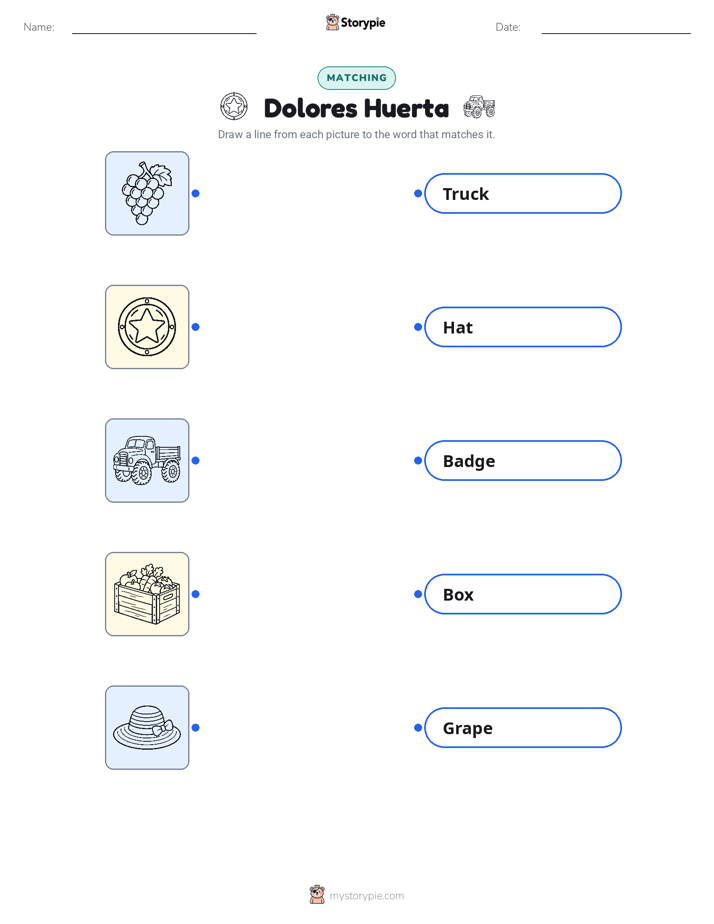
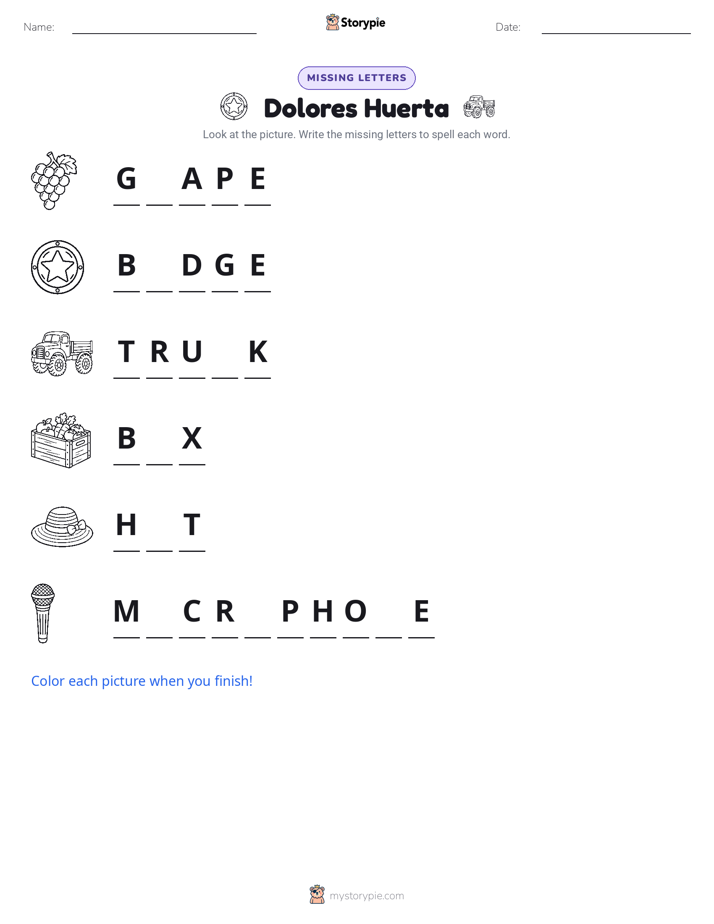
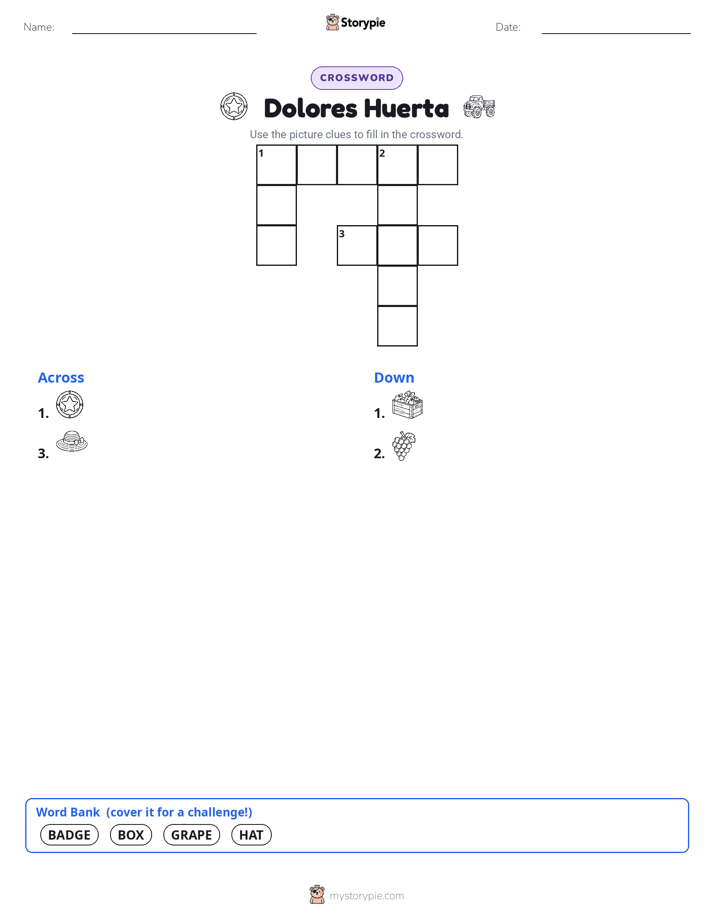
- Printable worksheets & coloring pages

Why Storypie for Schools
Students engaged. Prep in seconds. Evenings back to you.
- Worksheets & Quizzes
- Classroom Management
- Formative Assessment
- Custom Curriculum & Lesson Plans
- 27 Languages

Why Storypie for Homeschool
Curriculum done. They'll ask for more. Hours back in your day.
- Worksheet Generator
- First-Person Audio Stories
- Built-in Comprehension Quizzes
- Custom Curriculum & Lesson Plans
- Print & Go Activities