English

Dorothea Dix
Dorothea Dix was a 19th-century American activist who became a powerful advocate for the indigent mentally…
Reads at Grades 6–8 Listens at Grades 4–8
Print & create
Answer keys·No prep·Free with an account
28 worksheets · answer keys · full story · quiz · Ages 10-12 · CEFR B2
Plus adds 290,000+ more stories in 27 languages, audio for every one, and printables for all of them.
Just want Dorothea Dix?
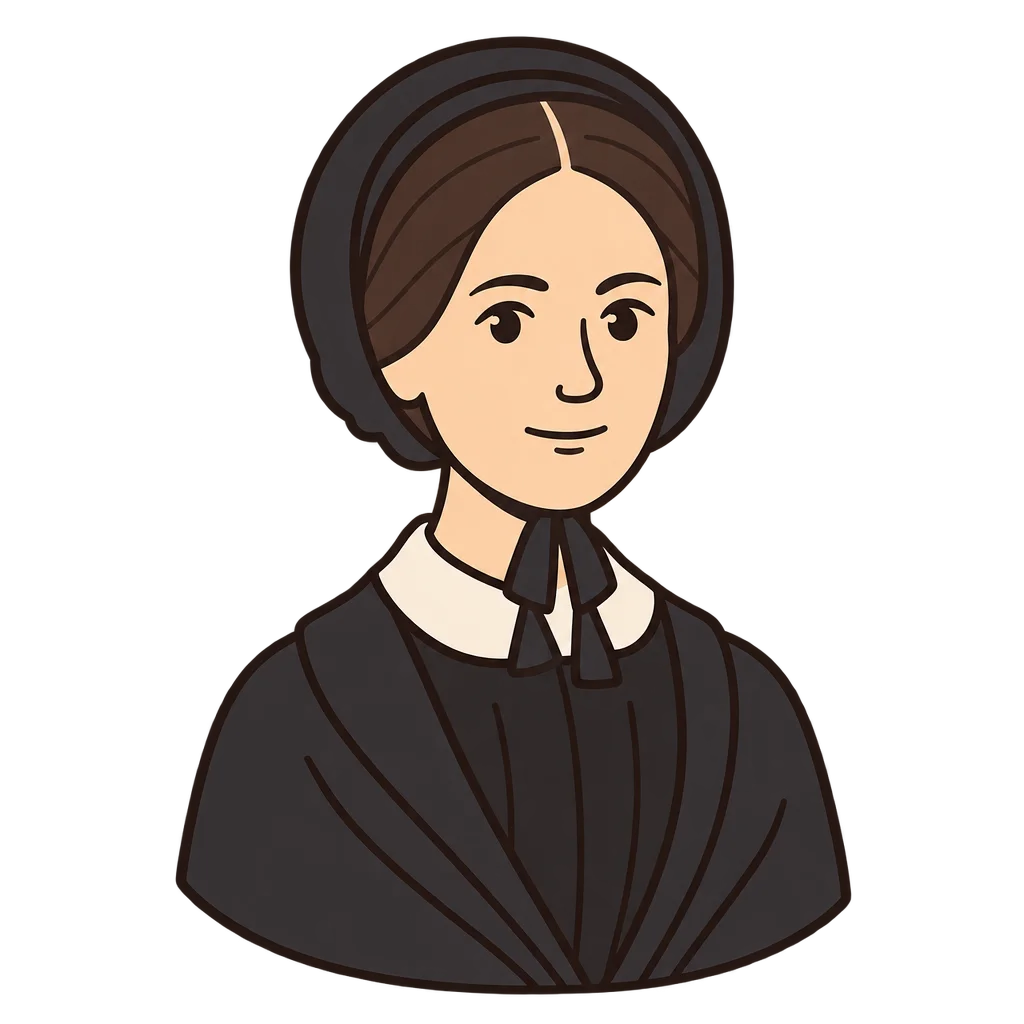
Hello, my name is Dorothea Lynde Dix. I want to tell you my story. I was born on April 4th, 1802, in a small town called Hampden, Maine. My childhood wasn't always easy, and I often felt lonely. To escape, I would lose myself in books. Reading and learning were my greatest comforts. When I was 12, around the year 1814, I moved to Boston to live with my wealthy grandmother. It was a big change, but it gave me the chance to get a good education, which was a rare opportunity for a girl back then. I decided very early on that I wanted to share my love of learning with others by becoming a teacher.
My dream of teaching came true quickly. In 1821, when I was only nineteen, I opened my own school for girls right in Boston. I even ran a free school for poor children out of my grandmother's barn because I believed everyone deserved a chance to learn. Besides teaching, I loved to write. In 1824, I published a textbook called 'Conversations on Common Things,' which was very popular. My life was busy, but I often struggled with poor health, which sometimes forced me to stop working and rest. It was during one of these breaks that my life's true purpose would be revealed to me.
Everything changed on a cold day in March of 1841. I agreed to teach a Sunday school class to a group of women at the East Cambridge Jail in Massachusetts. What I saw there horrified me. Locked away in the dark, freezing-cold basement, I found people who were not criminals but were suffering from mental illnesses. They were chained, barely clothed, and lived in filthy conditions with no heat. People at the time didn't understand mental illness and simply locked these individuals away, treating them worse than animals. My heart broke for them. I knew in that moment that I could not turn away. I had to do something to help.
Dorothea Dix
Hello, my name is Dorothea Lynde Dix. I want to tell you my story. I was born on April 4th, 1802, in a small town called Hampden, Maine. My childhood wasn't always easy, and I often felt lonely. To escape, I would lose myself in books. Reading and learning were my greatest comforts. When I was 12, around the year 1814, I moved to Boston to live with my wealthy grandmother. It was a big change, but it gave me the chance to get a good education, which was a rare opportunity for a girl back then. I decided very early on that I wanted to share my love of learning with others by becoming a teacher.
My dream of teaching came true quickly. In 1821, when I was only nineteen, I opened my own school for girls right in Boston. I even ran a free school for poor children out of my grandmother's barn because I believed everyone deserved a chance to learn. Besides teaching, I loved to write. In 1824, I published a textbook called 'Conversations on Common Things,' which was very popular. My life was busy, but I often struggled with poor health, which sometimes forced me to stop working and rest. It was during one of these breaks that my life's true purpose would be revealed to me.
Everything changed on a cold day in March of 1841. I agreed to teach a Sunday school class to a group of women at the East Cambridge Jail in Massachusetts. What I saw there horrified me. Locked away in the dark, freezing-cold basement, I found people who were not criminals but were suffering from mental illnesses. They were chained, barely clothed, and lived in filthy conditions with no heat. People at the time didn't understand mental illness and simply locked these individuals away, treating them worse than animals. My heart broke for them. I knew in that moment that I could not turn away. I had to do something to help.
I immediately began a mission. For the next two years, I traveled all over Massachusetts, visiting every jail, poorhouse, and cellar where people with mental illnesses were kept. I took careful notes, documenting every shocking detail of their mistreatment. In 1843, I presented my findings to the Massachusetts state legislature in a powerful report called a 'Memorial.' Many lawmakers were shocked and moved by what I had uncovered. My investigation led to a law being passed to expand the state's mental hospital in Worcester, providing more space and humane care for patients. It was my first major victory, and it proved that one person's voice could make a difference.
My work in Massachusetts was just the beginning. I knew these terrible conditions existed everywhere, so I took my crusade to other states. I traveled thousands of miles by train, carriage, and boat, from New Jersey to Illinois to North Carolina, investigating conditions and demanding reform. I would present my detailed reports to each state's leaders, urging them to build proper hospitals. My work helped create a movement. I even went to Washington, D.C., in the early 1850s to ask the federal government for help. I convinced Congress to pass a bill that would set aside millions of acres of land to fund mental health hospitals, but in 1854, President Franklin Pierce vetoed it. It was a great disappointment, but I did not give up. I even took my fight to Europe, where I helped improve hospitals in Scotland, Italy, and other countries.
When the American Civil War began in 1861, I knew I had to serve my country. In June of that year, I was appointed the Superintendent of Army Nurses for the Union Army. It was a huge job. I was in charge of recruiting and training thousands of women to care for wounded soldiers. I set very high standards for my nurses because I wanted to make sure our soldiers received the best possible care. Some people thought I was too strict, but my focus was always on the well-being of the men who were fighting for our nation. We worked tirelessly in difficult and often dangerous conditions, bringing comfort and medical aid to the battlefield.
After the war ended in 1865, I returned to the work that was my life's passion: advocating for those with mental illness. I continued to travel and fight for better care for many more years. I lived to be 85 years old, and I spent my final days in a special apartment at a hospital in New Jersey that I had helped to found decades earlier. People remember me today because my work completely changed how society views and treats people with mental health challenges. I helped establish or improve more than 30 hospitals across the United States and showed the world that a single, determined voice can speak for thousands who cannot speak for themselves.
Wow facts
About
Dorothea Dix was a 19th-century American activist who became a powerful advocate for the indigent mentally ill, leading to widespread reforms and the creation of the first American mental asylums.
Take a Quiz
Question 1 of 5
What was the main problem Dorothea Dix discovered in 1841, and what was her first major step to solve it?
Explore next






Want to do even more?
Go beyond exploring. Unlock tools that turn every story into real learning.

Storypie Plus for families
Full stories, quizzes, and printables. Nights and car rides, sorted.
- Unlimited audio stories
- Create Mode: your child stars in the story
- Offline downloads
- Printable worksheets & coloring pages

Why Storypie for Schools
Students engaged. Prep in seconds. Evenings back to you.
- Worksheets & Quizzes
- Classroom Management
- Formative Assessment
- Custom Curriculum & Lesson Plans
- 27 Languages

Why Storypie for Homeschool
Curriculum done. They'll ask for more. Hours back in your day.
- Worksheet Generator
- First-Person Audio Stories
- Built-in Comprehension Quizzes
- Custom Curriculum & Lesson Plans
- Print & Go Activities