English

Eadweard Muybridge
Eadweard Muybridge was an English photographer and inventor who is considered one of the fathers of the…
Reads at Grades 3–5 Listens at Grades 1–5
Print & create
Answer keys·No prep·Free with an account
28 worksheets · answer keys · full story · quiz · Ages 8-10 · CEFR B1
Plus adds 244,000+ more stories in 27 languages, audio for every one, and printables for all of them.
Just want Eadweard Muybridge?
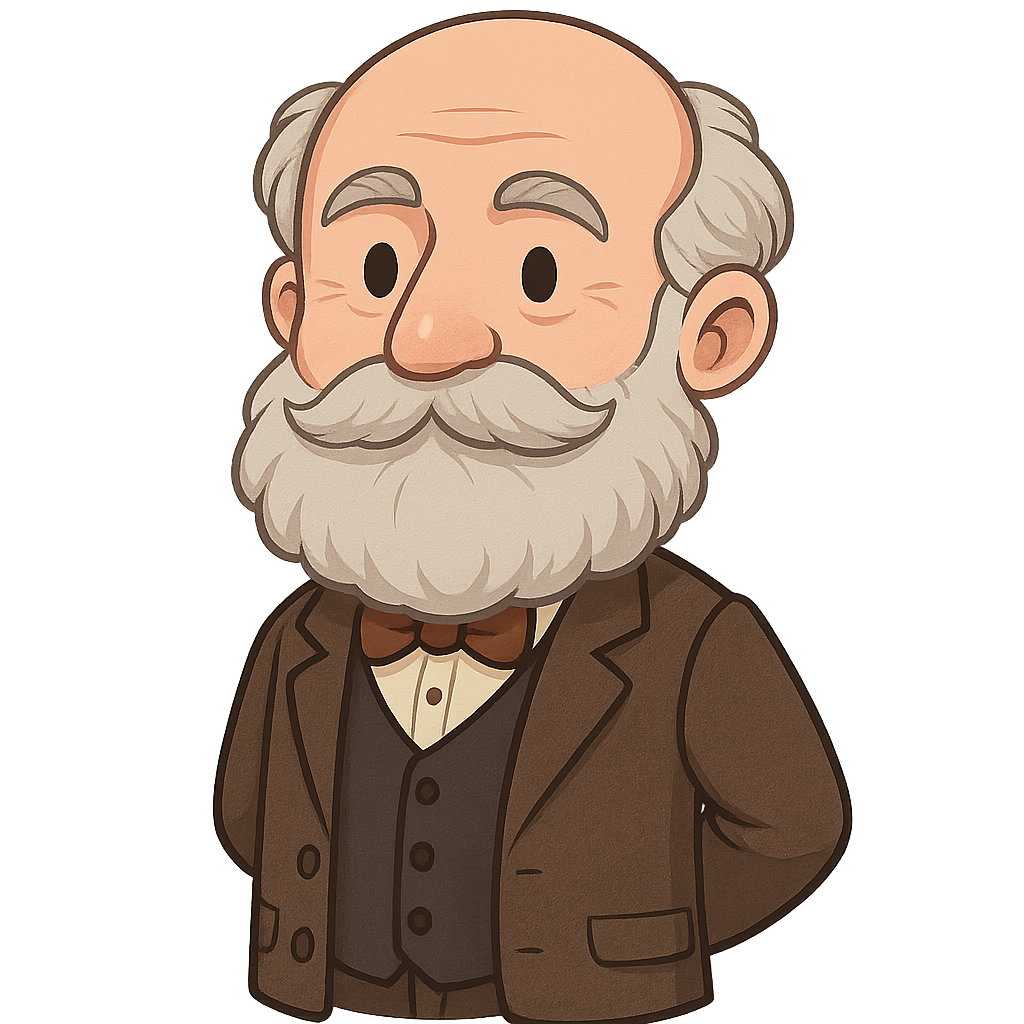
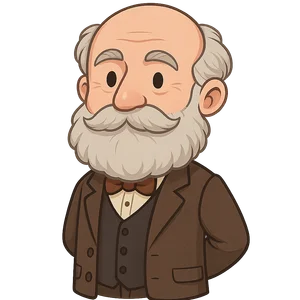
Hello there. My name is Eadweard Muybridge, and I am known for being a photographer and an inventor who first figured out how to make pictures look like they were moving. I was born with a different name, though: Edward James Muggeridge. I came into the world on April 9th, 1830, in a town in England called Kingston upon Thames. As I grew up, I felt that my name was a bit plain for the kind of life I wanted to live. I wanted a name that was as unique and adventurous as I felt inside, so I changed it. I had big dreams of seeing the world beyond my small town. In the 1850s, I finally got my chance and sailed across the great ocean to America, ready for a new chapter in my life.
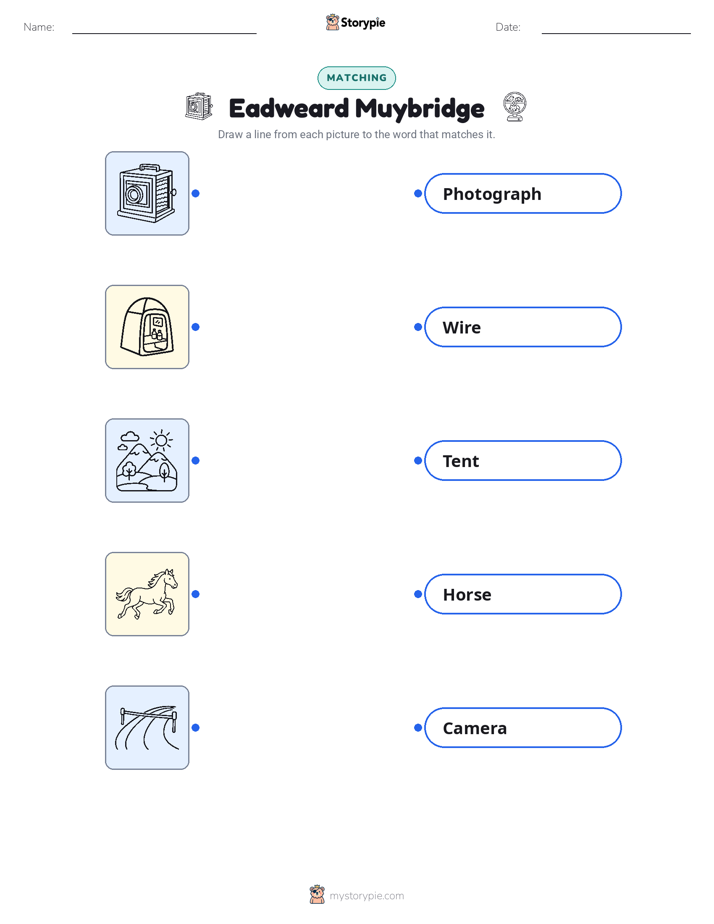
A difficult and unexpected event changed my life forever. In 1860, I was in a terrible stagecoach accident that left me with a serious head injury. It took a long time for me to recover, and when I did, I felt like I saw the world differently. I needed a new direction for my life. Around 1867, I found that new path: photography. It felt like magic to be able to capture a single moment in time and hold it still forever. I decided to take my camera to some of the most beautiful and wild places I could find. I traveled to a place called Yosemite Valley with my huge camera, which I nicknamed 'Helios.' There, I took breathtaking pictures of giant mountains and rushing waterfalls, capturing their power and beauty on film.
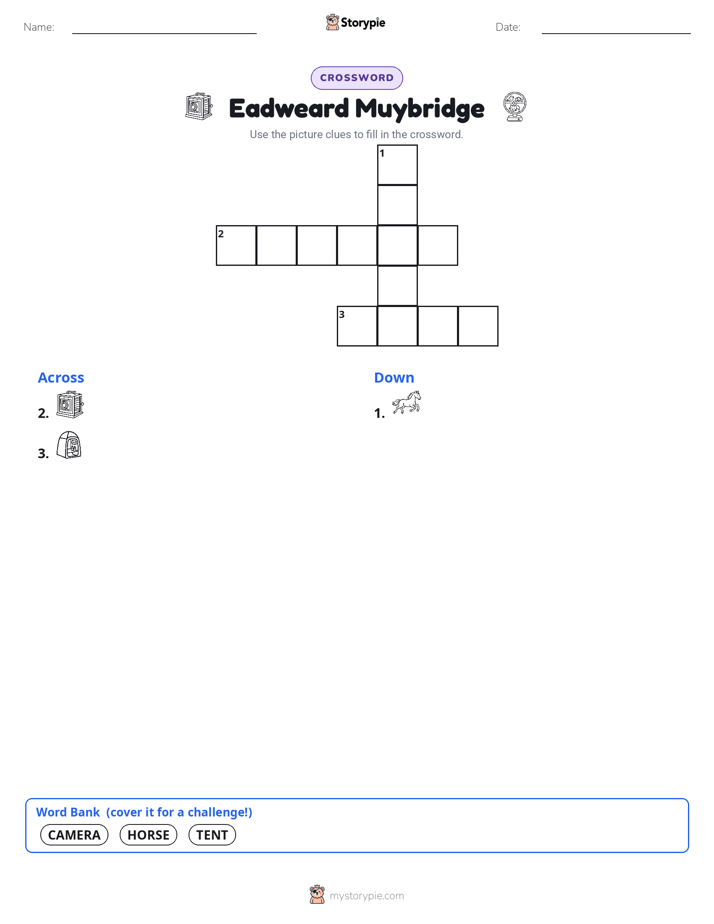
My work as a photographer led me to a very interesting challenge in 1872. A man named Leland Stanford came to me with a question that no one had been able to answer. He wanted to know: when a horse gallops, do all four of its hooves ever leave the ground at the very same time? It happens so fast that our eyes can't catch it. I thought about it for a long time and came up with a clever plan. In 1878, I set up 24 special cameras in a long row beside a racetrack. I attached a string to each camera and stretched it across the track. Then, a horse named Sallie Gardner galloped down the path. As she ran, her legs broke the strings one by one, and each camera snapped a picture at the perfect moment. When I looked at the photos, the answer was clear. There it was, in one of the pictures—Sallie Gardner was completely in the air, with all four hooves off the ground. For just a split second, the horse was flying!
Eadweard Muybridge: The Man Who Made Pictures Move
Hello there. My name is Eadweard Muybridge, and I am known for being a photographer and an inventor who first figured out how to make pictures look like they were moving. I was born with a different name, though: Edward James Muggeridge. I came into the world on April 9th, 1830, in a town in England called Kingston upon Thames. As I grew up, I felt that my name was a bit plain for the kind of life I wanted to live. I wanted a name that was as unique and adventurous as I felt inside, so I changed it. I had big dreams of seeing the world beyond my small town. In the 1850s, I finally got my chance and sailed across the great ocean to America, ready for a new chapter in my life.
A difficult and unexpected event changed my life forever. In 1860, I was in a terrible stagecoach accident that left me with a serious head injury. It took a long time for me to recover, and when I did, I felt like I saw the world differently. I needed a new direction for my life. Around 1867, I found that new path: photography. It felt like magic to be able to capture a single moment in time and hold it still forever. I decided to take my camera to some of the most beautiful and wild places I could find. I traveled to a place called Yosemite Valley with my huge camera, which I nicknamed 'Helios.' There, I took breathtaking pictures of giant mountains and rushing waterfalls, capturing their power and beauty on film.
My work as a photographer led me to a very interesting challenge in 1872. A man named Leland Stanford came to me with a question that no one had been able to answer. He wanted to know: when a horse gallops, do all four of its hooves ever leave the ground at the very same time? It happens so fast that our eyes can't catch it. I thought about it for a long time and came up with a clever plan. In 1878, I set up 24 special cameras in a long row beside a racetrack. I attached a string to each camera and stretched it across the track. Then, a horse named Sallie Gardner galloped down the path. As she ran, her legs broke the strings one by one, and each camera snapped a picture at the perfect moment. When I looked at the photos, the answer was clear. There it was, in one of the pictures—Sallie Gardner was completely in the air, with all four hooves off the ground. For just a split second, the horse was flying!
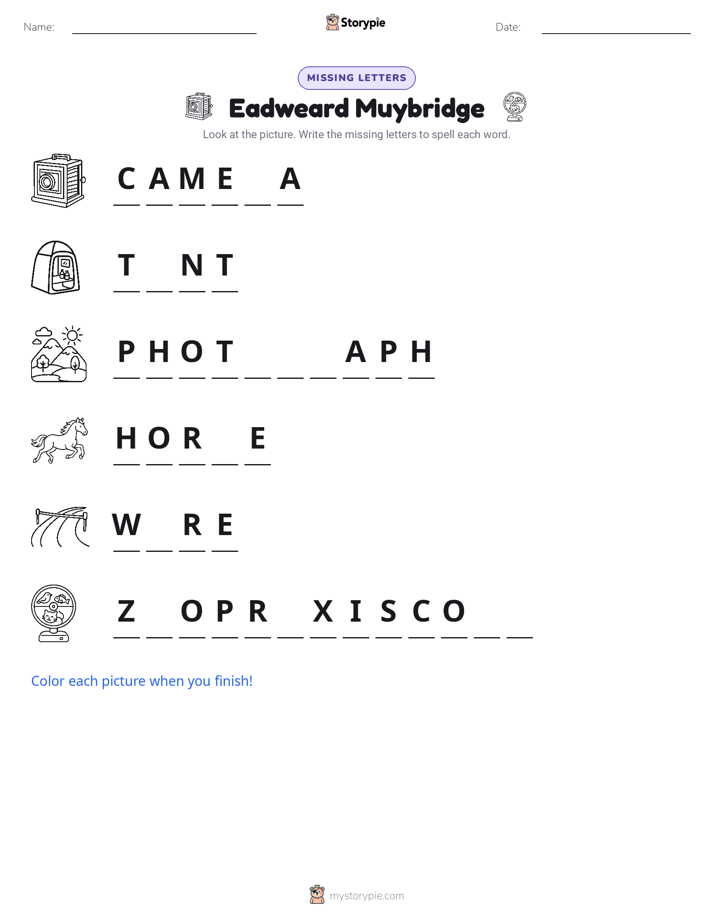
After solving the great horse debate, an even bigger and more exciting idea sparked in my mind. I had all these pictures of the horse in order, showing every step of her gallop. I wondered, what if I could show the pictures so quickly, one after another, that they would look like they were actually moving? In 1879, I built a machine to do just that. I called it the Zoopraxiscope. It was a special kind of projector that used a spinning glass disc. I carefully painted my photographs onto the disc. When I turned it on, a light shined through the spinning pictures, and suddenly, there on the wall, was an image of a horse that looked like it was really galloping. It was one of the very first movies ever created.
I lived to be 74 years old. People remember me as the man who froze time with his camera and then taught pictures how to move. My experiments with photography and motion helped pave the way for the movies and animated cartoons we all enjoy today. Every time you watch a film, you're seeing a little piece of the magic I helped start long ago.
Wow facts
About
Eadweard Muybridge was an English photographer and inventor who is considered one of the fathers of the motion picture for his pioneering work in chronophotography and his invention of the zoopraxiscope.
Take a Quiz
Question 1 of 5
Why did I set up 24 cameras along a racetrack in 1878?
Explore next




Want to do even more?
Go beyond exploring. Unlock tools that turn every story into real learning.

Storypie Plus for families
Full stories, quizzes, and printables. Nights and car rides, sorted.
- Unlimited audio stories
- Create Mode: your child stars in the story
- Offline downloads
- Printable worksheets & coloring pages

Why Storypie for Schools
Students engaged. Prep in seconds. Evenings back to you.
- Worksheets & Quizzes
- Classroom Management
- Formative Assessment
- Custom Curriculum & Lesson Plans
- 27 Languages

Why Storypie for Homeschool
Curriculum done. They'll ask for more. Hours back in your day.
- Worksheet Generator
- First-Person Audio Stories
- Built-in Comprehension Quizzes
- Custom Curriculum & Lesson Plans
- Print & Go Activities