English

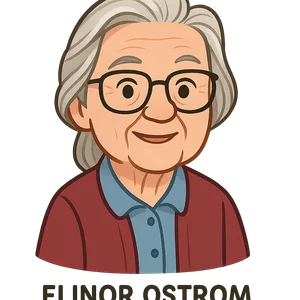
Elinor Ostrom
Elinor Ostrom was an American political economist who was the first woman to win the Nobel Memorial Prize in…
Reads at Grades 6–8 Listens at Grades 4–8
Print & create
Answer keys·No prep·Free with an account
28 worksheets · answer keys · full story · quiz · Ages 10-12 · CEFR B2
Plus adds 244,000+ more stories in 27 languages, audio for every one, and printables for all of them.
Just want Elinor Ostrom?
Hello! My name is Elinor Ostrom, but my friends called me Lin. I was born on August 7th, 1933, in Los Angeles, California. The world was in the middle of a difficult time called the Great Depression, which taught my family and me to be very resourceful. We had a large garden where we grew our own food, and I learned how to can fruits and vegetables so that nothing ever went to waste. This taught me the value of managing resources carefully. In high school, I decided to join the debate team. This was a big challenge for me because I had a stutter, which sometimes made speaking difficult. But I was determined. I worked hard, practiced constantly, and learned how to research topics deeply to form strong, evidence-based arguments. This experience was incredibly important because it showed me that even the most complex problems could be understood if you were willing to look at them from all sides. It sparked a question in my mind that would guide my entire life: how do groups of people successfully work together to solve common problems?
When I began college at the University of California, Los Angeles, also known as UCLA, in the early 1950s, it wasn't very common for women to pursue advanced degrees, especially in fields like political science. I was often discouraged and told that certain subjects weren't meant for women, but I refused to let that stop me. My love for learning was too strong. I earned my bachelor's degree in 1954 and continued my studies, eventually receiving my Ph.D. in political science in 1965. For my final research project, I chose to study something that might not sound exciting at first: the management of underground water basins in Southern California. These were vast, shared sources of water that entire communities depended on. At the time, the prevailing theory was that without strict government regulation or private ownership, people would inevitably overuse the water until it was all gone. But as I studied these communities, I discovered something remarkable. They hadn't depleted the water at all. Instead, they had developed their own complex sets of rules and agreements to share the water fairly and ensure it would be there for future generations. This discovery became the foundation of my life's work.
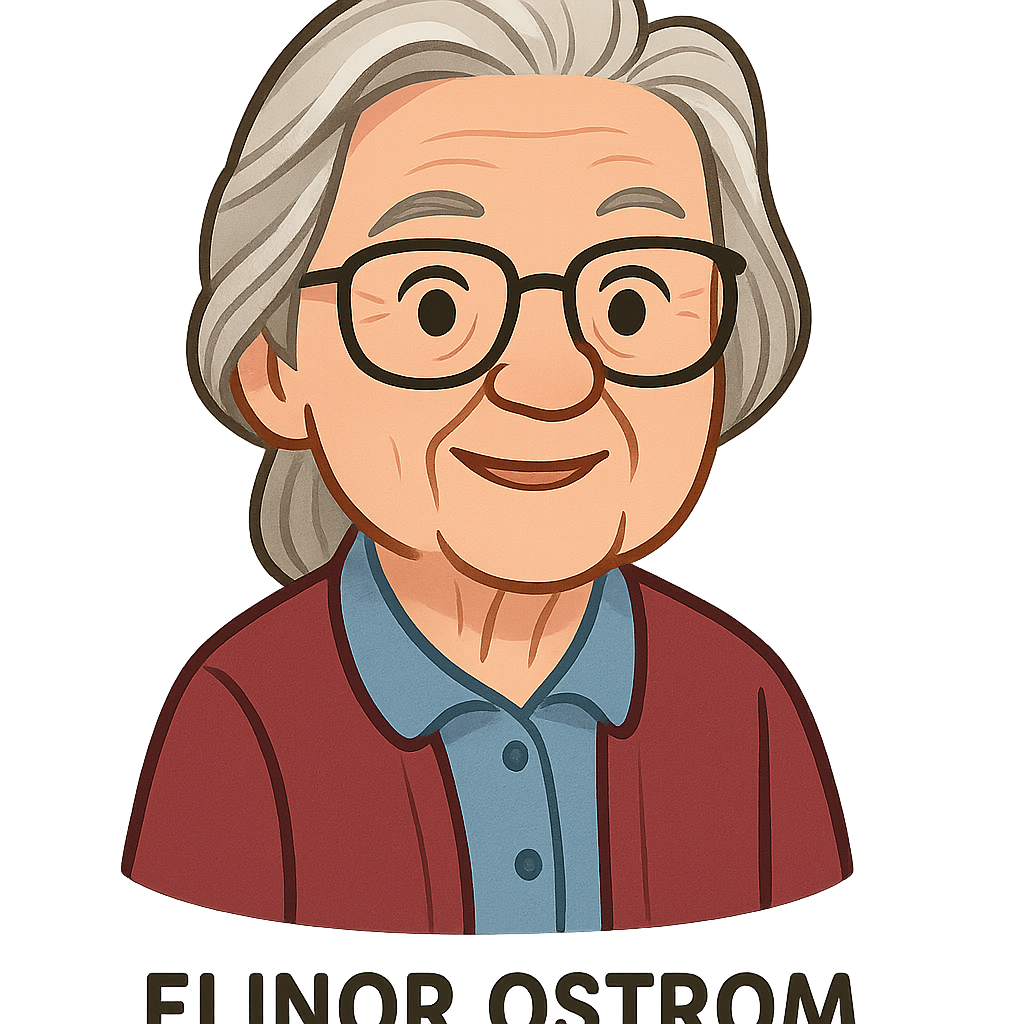
Elinor Ostrom
Hello! My name is Elinor Ostrom, but my friends called me Lin. I was born on August 7th, 1933, in Los Angeles, California. The world was in the middle of a difficult time called the Great Depression, which taught my family and me to be very resourceful. We had a large garden where we grew our own food, and I learned how to can fruits and vegetables so that nothing ever went to waste. This taught me the value of managing resources carefully. In high school, I decided to join the debate team. This was a big challenge for me because I had a stutter, which sometimes made speaking difficult. But I was determined. I worked hard, practiced constantly, and learned how to research topics deeply to form strong, evidence-based arguments. This experience was incredibly important because it showed me that even the most complex problems could be understood if you were willing to look at them from all sides. It sparked a question in my mind that would guide my entire life: how do groups of people successfully work together to solve common problems?
When I began college at the University of California, Los Angeles, also known as UCLA, in the early 1950s, it wasn't very common for women to pursue advanced degrees, especially in fields like political science. I was often discouraged and told that certain subjects weren't meant for women, but I refused to let that stop me. My love for learning was too strong. I earned my bachelor's degree in 1954 and continued my studies, eventually receiving my Ph.D. in political science in 1965. For my final research project, I chose to study something that might not sound exciting at first: the management of underground water basins in Southern California. These were vast, shared sources of water that entire communities depended on. At the time, the prevailing theory was that without strict government regulation or private ownership, people would inevitably overuse the water until it was all gone. But as I studied these communities, I discovered something remarkable. They hadn't depleted the water at all. Instead, they had developed their own complex sets of rules and agreements to share the water fairly and ensure it would be there for future generations. This discovery became the foundation of my life's work.
A very famous idea in social science was called the 'Tragedy of the Commons.' This theory argued that whenever a group of people shares a resource, like a pasture for grazing cattle or a lake for fishing, they will always act in their own self-interest, leading to the resource's destruction. But my research on the water basins in California made me question this idea. I thought, 'That’s not what I saw happen!' So, I set out to see if I could find other examples around the world. In 1973, my husband, Vincent Ostrom, who was also my closest research partner, and I founded the Workshop in Political Theory and Policy Analysis at Indiana University. This became our base for studying how communities govern themselves. I traveled the globe, from the high mountain pastures of Switzerland to the community-managed forests of Japan and the ancient irrigation systems of Nepal. In my 1990 book, 'Governing the Commons,' I presented my findings. I showed case after case where local communities had successfully created their own rules to manage shared resources sustainably, proving that the 'Tragedy of the Commons' was not a universal law.
I spent decades dedicated to this research, not because I was seeking awards or recognition, but because I was genuinely fascinated by how people could organize themselves to cooperate and solve difficult problems. I believed in the power of communities. Then, one morning in October of 2009, I received a completely unexpected phone call. I was being awarded the Nobel Memorial Prize in Economic Sciences. I was stunned. I became the very first woman in history to receive this prestigious honor. The prize was awarded for my work demonstrating that shared resources can be successfully managed by the groups of people who use them, without needing top-down control from a government or private company. It was a wonderful moment, not just for me, but as an acknowledgment of the wisdom of all the communities whose clever, cooperative solutions I had the privilege to study. It proved that the best answers to big problems can often be found with the people closest to them, working together.
I continued my research, writing, and teaching for the rest of my life, always curious to learn more about human cooperation. I lived to be 78 years old, passing away on June 12th, 2012. Today, people remember my work for offering a more hopeful and accurate view of how humans can work together. I showed the world that we are not doomed to destroy our shared resources, whether they are oceans, forests, the air we breathe, or even shared knowledge on the internet. My story is a reminder that when we trust one another and collaborate, we have the power to solve even the world's biggest challenges.
Wow facts
About
Elinor Ostrom was an American political economist who was the first woman to win the Nobel Memorial Prize in Economic Sciences in 2009 for her groundbreaking research on how communities can successfully manage shared resources, known as 'the commons'.
Take a Quiz
Question 1 of 5
What is the main idea of the story about my life's work?
Explore next






Want to do even more?
Go beyond exploring. Unlock tools that turn every story into real learning.

Storypie Plus for families
Full stories, quizzes, and printables. Nights and car rides, sorted.
- Unlimited audio stories
- Create Mode: your child stars in the story
- Offline downloads
- Printable worksheets & coloring pages

Why Storypie for Schools
Students engaged. Prep in seconds. Evenings back to you.
- Worksheets & Quizzes
- Classroom Management
- Formative Assessment
- Custom Curriculum & Lesson Plans
- 27 Languages

Why Storypie for Homeschool
Curriculum done. They'll ask for more. Hours back in your day.
- Worksheet Generator
- First-Person Audio Stories
- Built-in Comprehension Quizzes
- Custom Curriculum & Lesson Plans
- Print & Go Activities