English

George Stephenson
George Stephenson was a British civil and mechanical engineer known as the 'Father of Railways.' He pioneered…
Reads at Grades 6–8 Listens at Grades 4–8
Print & create
Answer keys·No prep·Free with an account
28 worksheets · answer keys · full story · quiz · Ages 10-12 · CEFR B2
Plus adds 208,000+ more stories in 27 languages, audio for every one, and printables for all of them.
Just want George Stephenson?
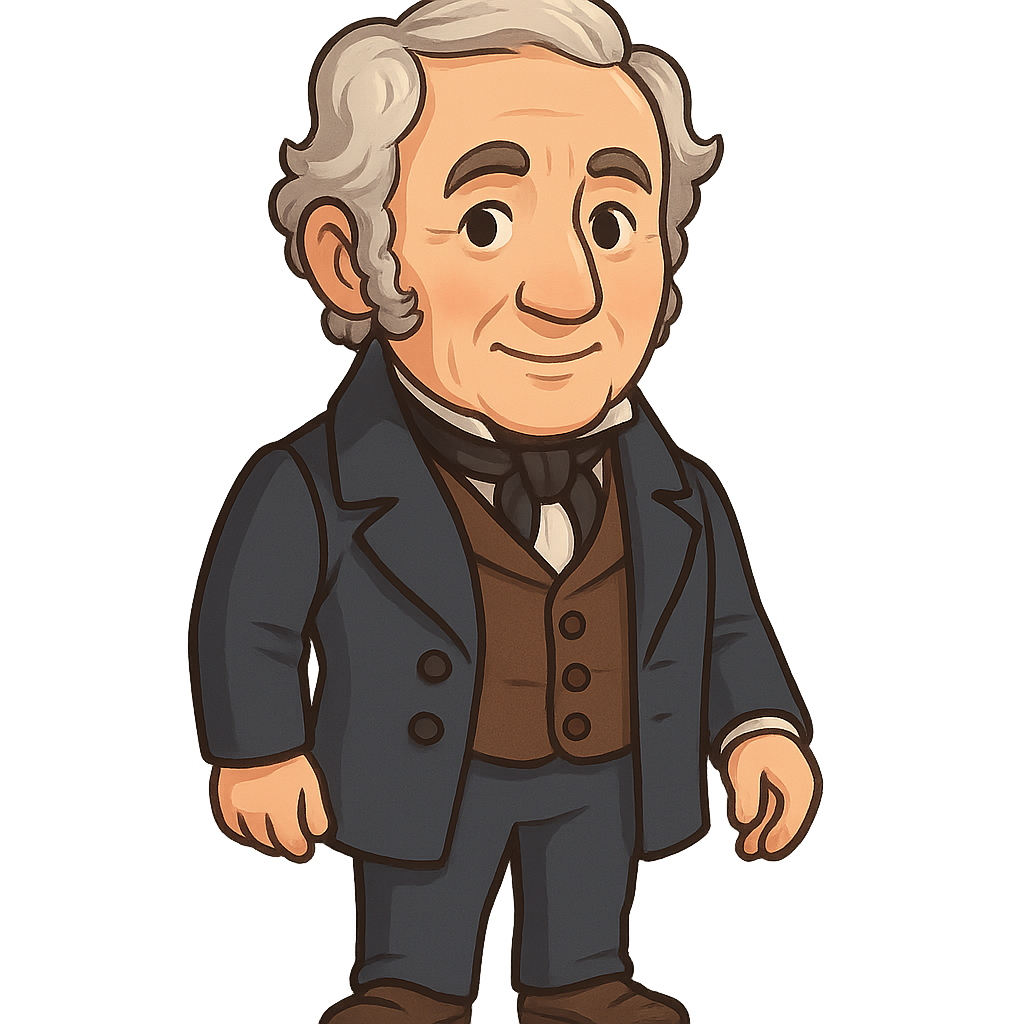
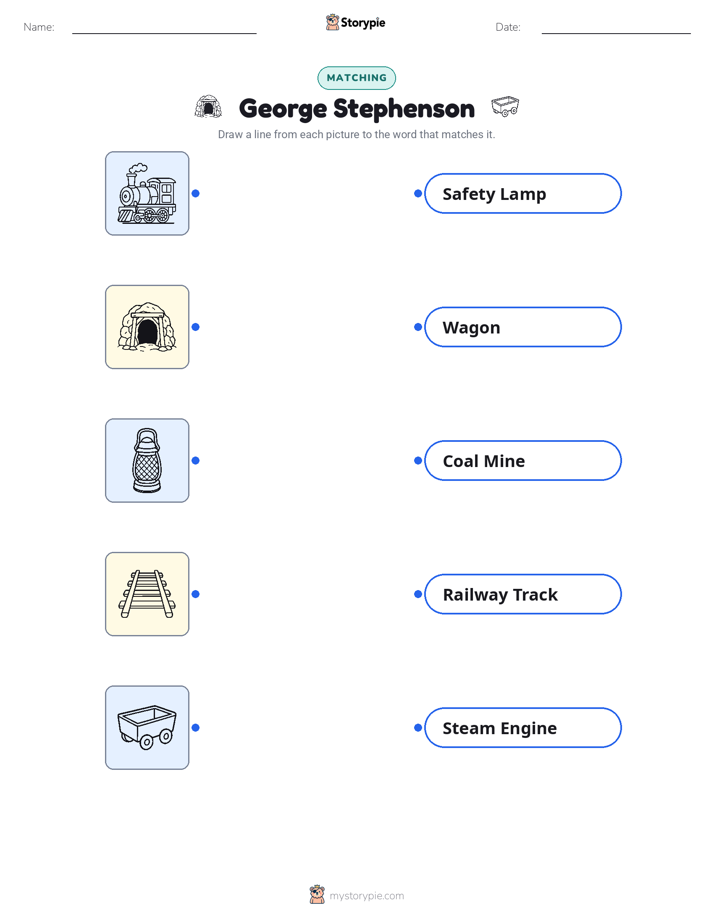
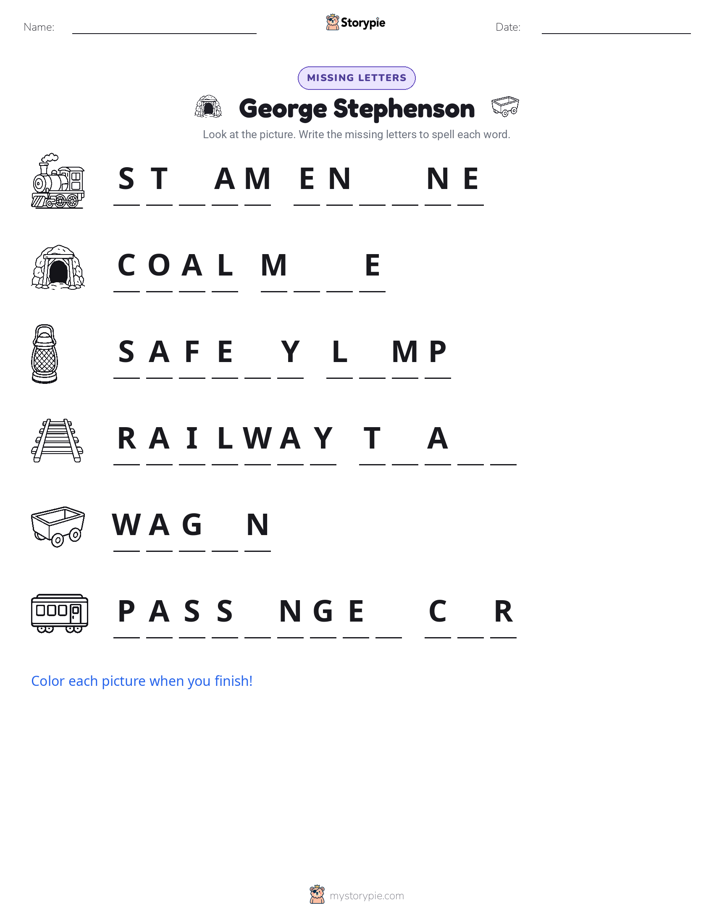
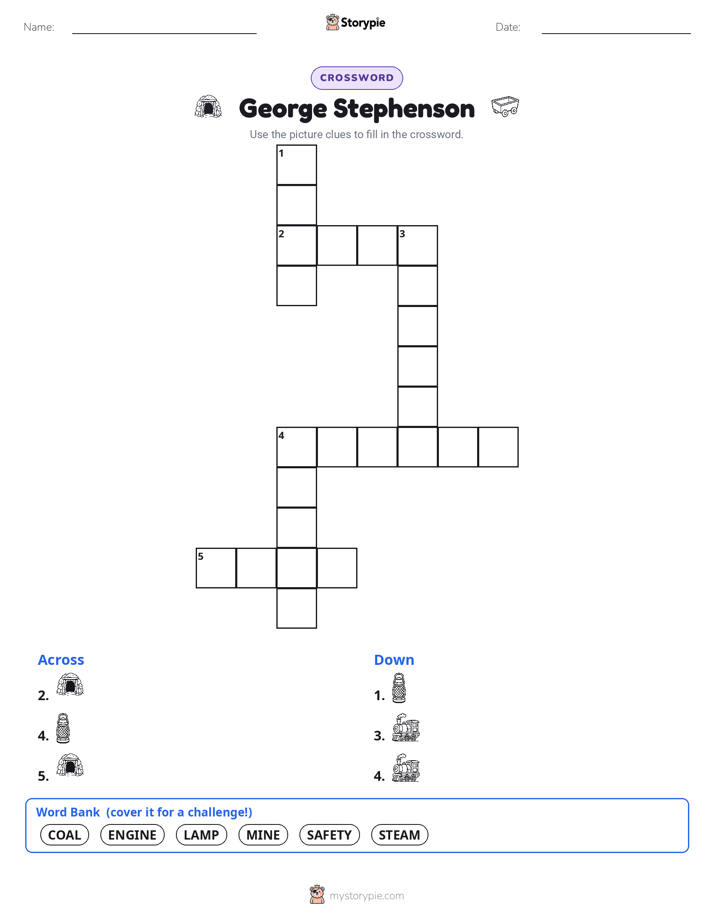
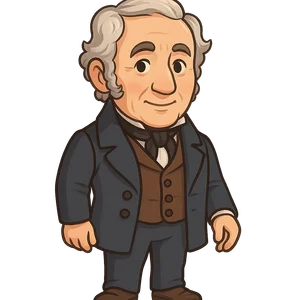
Hello, my name is George Stephenson, and many people know me as the 'Father of Railways.' My story begins in a small stone cottage in Wylam, Northumberland, England, where I was born on June 9th, 1781. My family was quite poor, as my father worked long hours in the local coal mines, and we simply did not have the money to send me to school. So, instead of learning in a classroom, I learned from the world around me. I was completely fascinated by the noisy, powerful steam engines that worked at the mines. They were called 'fire-engines' back then, and their job was to pump water out of the deep mining tunnels. I would spend hours just watching them, listening to their hissing steam and clanking parts. I wasn't just watching, though; I was studying them. I took them apart in my mind, trying to figure out how each gear, piston, and lever worked together to create such incredible power.
As soon as I was old enough, I began working in the mines myself, starting as a fireman's assistant for one of the steam engines I had admired for so long. While I loved the hands-on work, I knew that observing the engines could only teach me so much. I had a deep hunger for more knowledge, and I realized I needed to be able to read engineering books and understand mathematical calculations. So, around the year 1799, when I was 18 years old, I made a decision that changed my life. After finishing my long, exhausting days at the colliery, I would walk to a nearby village to attend night school. There, I finally learned how to read, write, and do arithmetic. My hard work paid off. By 1812, my knowledge of engines was so extensive that I was promoted to the important position of 'enginewright' at Killingworth Colliery. This meant I was now responsible for maintaining and repairing all the steam engines in the entire mine.
George Stephenson: Father of Railways
Hello, my name is George Stephenson, and many people know me as the 'Father of Railways.' My story begins in a small stone cottage in Wylam, Northumberland, England, where I was born on June 9th, 1781. My family was quite poor, as my father worked long hours in the local coal mines, and we simply did not have the money to send me to school. So, instead of learning in a classroom, I learned from the world around me. I was completely fascinated by the noisy, powerful steam engines that worked at the mines. They were called 'fire-engines' back then, and their job was to pump water out of the deep mining tunnels. I would spend hours just watching them, listening to their hissing steam and clanking parts. I wasn't just watching, though; I was studying them. I took them apart in my mind, trying to figure out how each gear, piston, and lever worked together to create such incredible power.
As soon as I was old enough, I began working in the mines myself, starting as a fireman's assistant for one of the steam engines I had admired for so long. While I loved the hands-on work, I knew that observing the engines could only teach me so much. I had a deep hunger for more knowledge, and I realized I needed to be able to read engineering books and understand mathematical calculations. So, around the year 1799, when I was 18 years old, I made a decision that changed my life. After finishing my long, exhausting days at the colliery, I would walk to a nearby village to attend night school. There, I finally learned how to read, write, and do arithmetic. My hard work paid off. By 1812, my knowledge of engines was so extensive that I was promoted to the important position of 'enginewright' at Killingworth Colliery. This meant I was now responsible for maintaining and repairing all the steam engines in the entire mine.
Working as an enginewright brought new challenges. The coal mines were dangerous places, not just because of collapses, but because of an invisible, explosive gas called 'firedamp.' I was determined to make the mines safer for the workers. In 1815, after many experiments, I invented a new safety lamp that would not ignite the dangerous gas. We called it the 'Geordie lamp,' and it saved many lives. During this time, I was also developing another powerful idea. I believed that the steam engines used for pumping water could be put on wheels to do something more: they could pull heavy loads. In 1814, I put my theory into practice and built my very first steam locomotive, which I named the 'Blücher.' It was designed specifically to haul wagons of coal from the mine. It was a slow but mighty machine, capable of pulling 30 tons of coal at a steady speed of four miles per hour. It was the first step toward a revolution in transportation.
My work with the 'Blücher' caught the attention of some very forward-thinking businessmen. In 1821, I was given the opportunity of a lifetime when I was hired as the chief engineer for a new project: the Stockton and Darlington Railway. This was not just another track for a coal mine; it was planned to be the world's first public railway designed to use steam locomotives for transport. The excitement on its grand opening day, September 27th, 1825, was incredible. My engine, 'Locomotion No. 1,' pulled the first train, which was loaded with wagons of coal and, for the first time ever, cars full of brave passengers. The journey was a tremendous success and proved that my vision was possible. This achievement led directly to an even bigger challenge. I was asked to engineer the Liverpool and Manchester Railway, a much more ambitious project that had to cross difficult terrain like swamps and valleys, requiring new bridges and tunnels that had never been built before.
To ensure the Liverpool and Manchester Railway had the best possible engine, the railway's owners decided to hold a major competition in October of 1829. It was called the Rainhill Trials, and inventors from all over the country were invited to enter their locomotives to see which was the fastest and most reliable. For this crucial contest, I worked closely with my talented son, Robert. Together, we designed and built an entirely new locomotive, which we named the 'Rocket.' It was lighter and more efficient than any engine built before. During the trials, the 'Rocket' performed flawlessly. It not only proved its reliability, but it also stunned the crowds by reaching an incredible speed of 30 miles per hour. We easily won the competition. The victory of the 'Rocket' was a turning point, proving to the entire world that steam-powered railways were the definitive future of travel and transport.
Looking back, one of the most important decisions I ever made was establishing a 'standard gauge' of 4 feet 8½ inches for the width of the railway tracks. This might seem like a small detail, but it meant that trains from different lines could all run on the same tracks, connecting cities and towns into a true national network. I am immensely proud to have helped begin what is now known as the 'Railway Age,' a time of great change that transformed the world. I lived a full and busy life, and I was 67 years old when I passed away on August 12th, 1848. Today, people remember me as the 'Father of Railways,' and I am happy that my iron horses helped connect people and build the modern world.
Wow facts
About
George Stephenson was a British civil and mechanical engineer known as the 'Father of Railways.' He pioneered rail transport, building the first public inter-city railway line and overseeing the design of the famous locomotive 'The Rocket,' which set the standard for steam engines for over a century.
Take a Quiz
Question 1 of 5
What does the word 'colliery' mean in the context of George Stephenson's life?
Explore next



Want to do even more?
Go beyond exploring. Unlock tools that turn every story into real learning.

Storypie Plus for families
Full stories, quizzes, and printables. Nights and car rides, sorted.
- Unlimited audio stories
- Create Mode: your child stars in the story
- Offline downloads
- Printable worksheets & coloring pages

Why Storypie for Schools
Students engaged. Prep in seconds. Evenings back to you.
- Worksheets & Quizzes
- Classroom Management
- Formative Assessment
- Custom Curriculum & Lesson Plans
- 27 Languages

Why Storypie for Homeschool
Curriculum done. They'll ask for more. Hours back in your day.
- Worksheet Generator
- First-Person Audio Stories
- Built-in Comprehension Quizzes
- Custom Curriculum & Lesson Plans
- Print & Go Activities