English

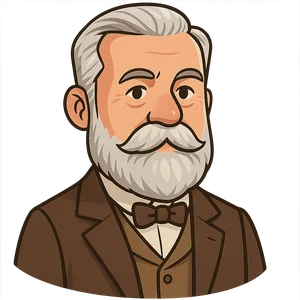
George Westinghouse Jr.
George Westinghouse Jr.
Reads at Grades 6–8 Listens at Grades 4–8
Print & create
Answer keys·No prep·Free with an account
28 worksheets · answer keys · full story · quiz · Ages 10-12 · CEFR B2
Plus adds 102,000+ more stories in 27 languages, audio for every one, and printables for all of them.
Just want George Westinghouse Jr.?
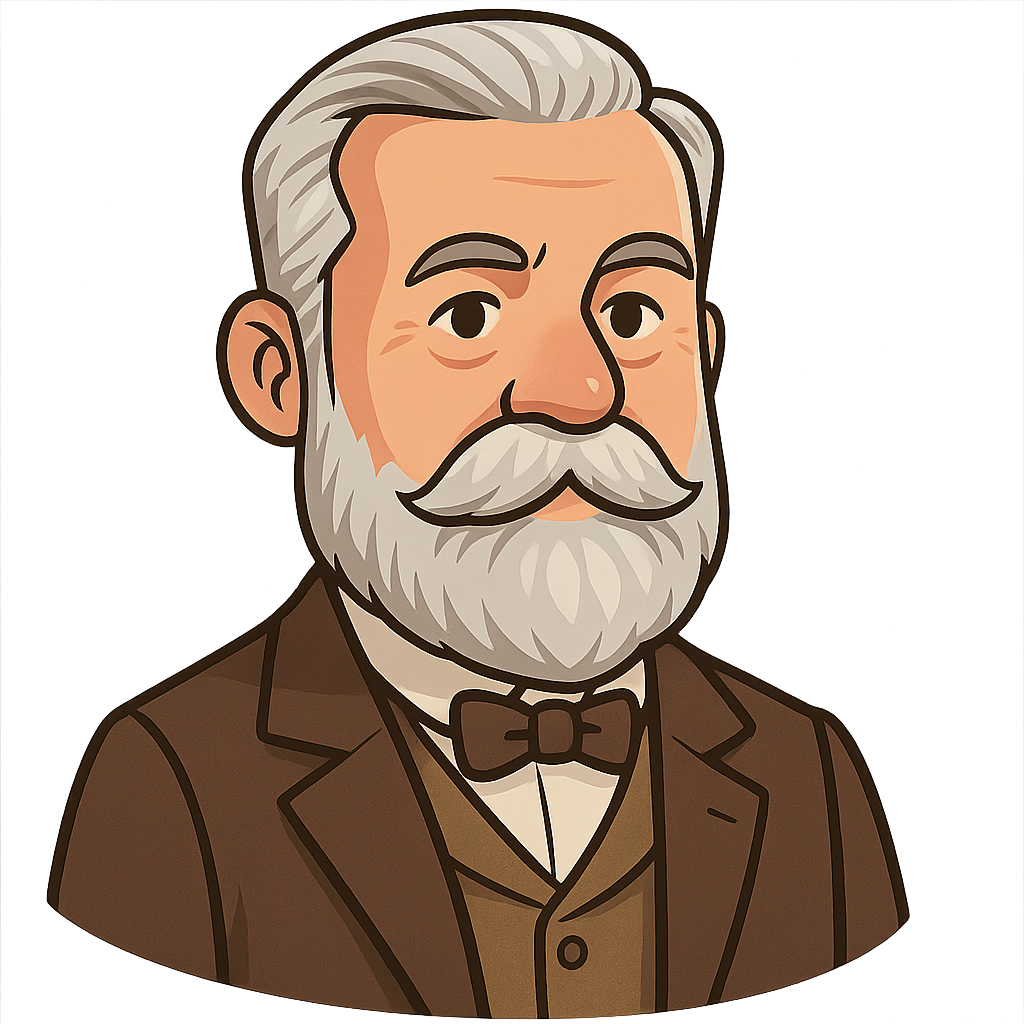
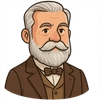
Hello, my name is George Westinghouse Jr., and I am an inventor who helped change the way we use electricity. My story begins on October 6th, 1846, when I was born in Central Bridge, New York. The world was a very different place then, powered mostly by steam and muscle. My father was a great influence on me; he owned a workshop where he designed and built farm machinery. I spent countless hours there, fascinated by how gears, belts, and engines all worked together. I wasn't just watching, I was learning and creating. By 1862, when I was only 15 years old, I had already designed my very own rotary steam engine. My youth wasn't just about inventing, though. When the Civil War began, I felt a duty to serve my country. From 1863 to 1865, I served in both the Union Army and Navy. Those years taught me a great deal about discipline and the importance of creating practical solutions to real-world problems.
After the war ended, I returned to civilian life with a new focus. I was traveling by train one day when I witnessed a terrible crash between two trains. It was a horrifying sight, and it made me determined to find a way to make train travel safer. In those days, trains were incredibly dangerous to stop. Each car had its own brake that had to be applied by hand by a person called a brakeman. When the engineer wanted to stop, he would signal, and the brakemen would run from car to car, turning wheels to apply the brakes. This process was slow, inefficient, and often led to accidents. I knew there had to be a better way. My moment of inspiration came from an unlikely place: an article about engineers using compressed air to drill through a mountain tunnel. An idea sparked in my mind. What if compressed air could be used to control a train's brakes? In 1869, I received a patent for my invention: the railway air brake. This system used a series of pipes and hoses to connect every car to the engineer's locomotive, allowing the engineer to apply all the brakes at once using the force of compressed air. That same year, I founded the Westinghouse Air Brake Company to manufacture my invention, which soon became a standard feature on railways, saving countless lives.
George Westinghouse Jr.: The Power of an Idea
Hello, my name is George Westinghouse Jr., and I am an inventor who helped change the way we use electricity. My story begins on October 6th, 1846, when I was born in Central Bridge, New York. The world was a very different place then, powered mostly by steam and muscle. My father was a great influence on me; he owned a workshop where he designed and built farm machinery. I spent countless hours there, fascinated by how gears, belts, and engines all worked together. I wasn't just watching, I was learning and creating. By 1862, when I was only 15 years old, I had already designed my very own rotary steam engine. My youth wasn't just about inventing, though. When the Civil War began, I felt a duty to serve my country. From 1863 to 1865, I served in both the Union Army and Navy. Those years taught me a great deal about discipline and the importance of creating practical solutions to real-world problems.
After the war ended, I returned to civilian life with a new focus. I was traveling by train one day when I witnessed a terrible crash between two trains. It was a horrifying sight, and it made me determined to find a way to make train travel safer. In those days, trains were incredibly dangerous to stop. Each car had its own brake that had to be applied by hand by a person called a brakeman. When the engineer wanted to stop, he would signal, and the brakemen would run from car to car, turning wheels to apply the brakes. This process was slow, inefficient, and often led to accidents. I knew there had to be a better way. My moment of inspiration came from an unlikely place: an article about engineers using compressed air to drill through a mountain tunnel. An idea sparked in my mind. What if compressed air could be used to control a train's brakes? In 1869, I received a patent for my invention: the railway air brake. This system used a series of pipes and hoses to connect every car to the engineer's locomotive, allowing the engineer to apply all the brakes at once using the force of compressed air. That same year, I founded the Westinghouse Air Brake Company to manufacture my invention, which soon became a standard feature on railways, saving countless lives.
My next great challenge was in the new and exciting field of electricity. Another brilliant inventor, Thomas Edison, had already begun lighting up cities with his system of Direct Current, or DC. While it was a remarkable achievement, DC power had a major weakness: it could not travel very far from the power plant. This meant that every neighborhood needed its own power station, which was expensive and impractical. I became convinced that a different type of electricity, known as Alternating Current (AC), was the true future. AC power could be easily 'stepped up' to a high voltage to travel efficiently over hundreds of miles and then 'stepped down' to a safer, lower voltage for use in homes and businesses. In 1886, I established the Westinghouse Electric Company to develop and promote AC power systems. I soon found a remarkable partner in Nikola Tesla, an inventive genius who had designed powerful and efficient AC motors. I bought his patents in 1888, and we began working together to perfect the AC system. Mr. Edison, however, was a fierce competitor and publicly argued that his DC system was superior and that my AC system was dangerous. This intense rivalry became known as the 'war of the currents.' Our chance to prove the power and safety of AC came when we won the prestigious contract to light the entire 1893 Chicago World's Fair. Our display was magnificent, illuminating the fairgrounds with more light than had ever been seen in one place. It was a stunning success that clearly demonstrated the advantages of AC to the world.
Our victory at the Chicago World's Fair was a major turning point, and it led directly to our most ambitious project yet: harnessing the immense natural power of Niagara Falls. For centuries, people had dreamed of capturing the energy of the mighty falls, and with our AC technology, that dream could finally become a reality. In 1893, my company was awarded the contract to build the world's first large-scale hydroelectric power plant at Niagara. It was an enormous engineering challenge, but my team and I were confident we could succeed. We designed and built massive generators that would convert the force of the falling water into electricity. By 1896, the plant was complete, and we achieved a historic milestone: the first-ever long-distance transmission of high-voltage electricity, sending power over 20 miles away to the city of Buffalo, New York. This accomplishment proved once and for all that AC was the superior standard for electrical power distribution. While I am most known for my work in electricity and train brakes, I never stopped inventing. Over the course of my life, I was granted more than 360 patents for a wide range of ideas, including systems for safely piping natural gas into homes and shock absorbers for the newly invented automobile.
I lived a very full and exciting life, filled with challenges and discovery. I lived to be 67 years old. Today, I am remembered as an inventor and an industrialist who helped shape the modern world. The AC electrical system that I championed is the very same system that powers your homes, schools, and communities today. Every time you flip a light switch or charge a device, you are using the technology that my team and I fought so hard for. I hope my story shows you that with curiosity and determination, you can find new solutions to big problems and make the world a better place.
Wow facts
About
George Westinghouse Jr. was an American inventor, engineer, and industrialist who invented the railway air brake and was a pioneer of the electrical industry, championing alternating current (AC) for power distribution.
Take a Quiz
Question 1 of 5
In your own words, describe the main events of the 'war of the currents,' including the key people involved and the final outcome.
Explore next



Want to do even more?
Go beyond exploring. Unlock tools that turn every story into real learning.

Storypie Plus for families
Full stories, quizzes, and printables. Nights and car rides, sorted.
- Unlimited audio stories
- Create Mode: your child stars in the story
- Offline downloads
- Printable worksheets & coloring pages

Why Storypie for Schools
Students engaged. Prep in seconds. Evenings back to you.
- Worksheets & Quizzes
- Classroom Management
- Formative Assessment
- Custom Curriculum & Lesson Plans
- 27 Languages

Why Storypie for Homeschool
Curriculum done. They'll ask for more. Hours back in your day.
- Worksheet Generator
- First-Person Audio Stories
- Built-in Comprehension Quizzes
- Custom Curriculum & Lesson Plans
- Print & Go Activities