English

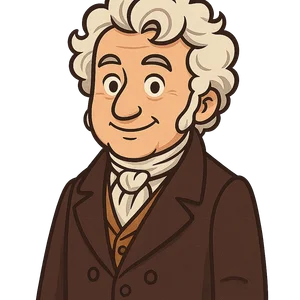
Georges Cuvier
French naturalist and zoologist, known as the "father of paleontology…
Reads at Grades 6–8 Listens at Grades 4–8
Print & create
Answer keys·No prep·Free with an account
28 worksheets · answer keys · full story · quiz · Ages 10-12 · CEFR B2
Plus adds 244,000+ more stories in 27 languages, audio for every one, and printables for all of them.
Just want Georges Cuvier?
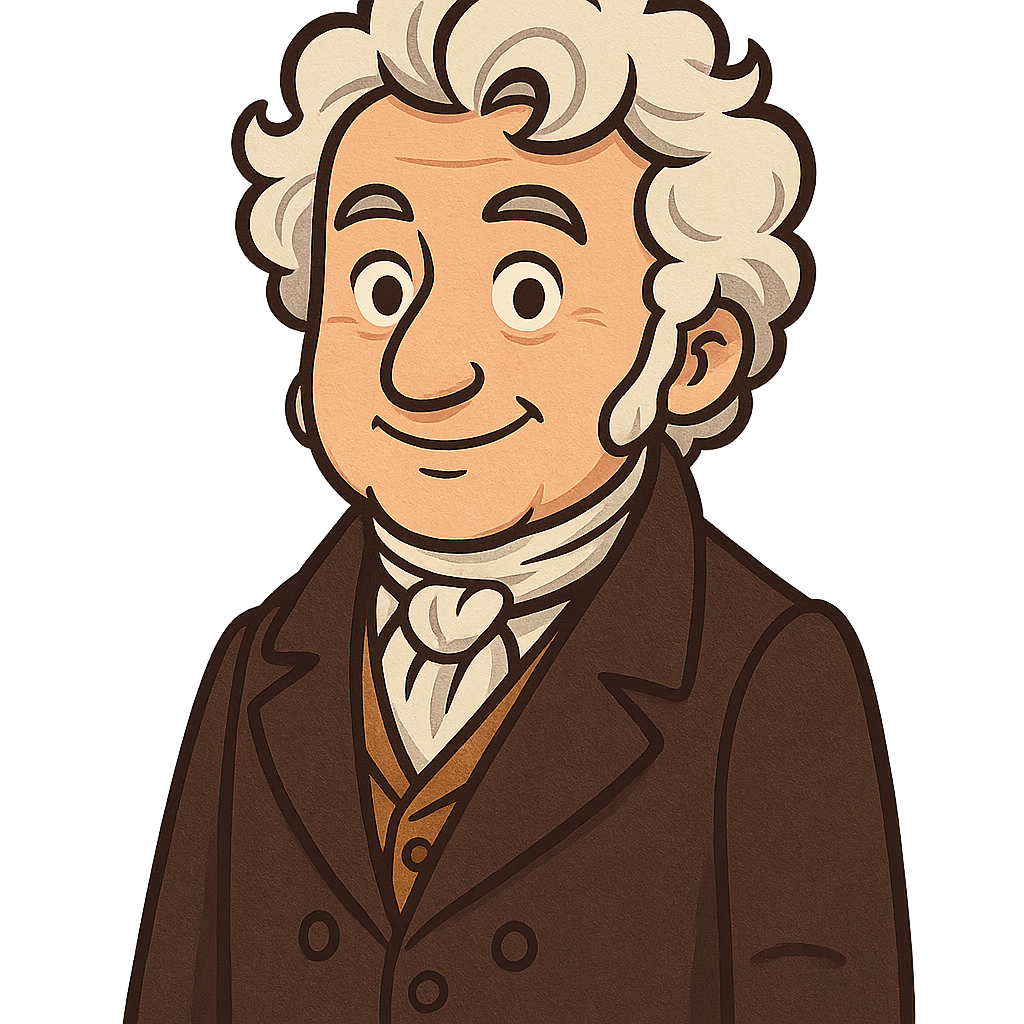
Hello, my name is Georges Cuvier, and I am known for changing the way we understand the history of life on Earth. My story begins in a town called Montbéliard, where I was born on August 23rd, 1769. From my earliest days, I was captivated by the natural world. Instead of playing games like other children, I spent countless hours lost in books about animals. I wasn't just a reader; I was a careful observer. I would study the illustrations for hours, then take out my pencils and try to draw the creatures myself, paying close attention to every scale, feather, and bone. This wasn't just a hobby; it was the beginning of my life's passion. When I was old enough, I left home to study. In 1784, I began attending the Caroline Academy in Stuttgart. There, surrounded by teachers and books dedicated to science, my love for studying living things grew into a powerful force. I knew I wanted to spend my life unraveling the secrets of the animal kingdom, and my time at the academy gave me the tools and knowledge to begin that journey.
After my studies, around the year 1788, I took a job as a tutor for a family in Normandy, a region of France located right by the sea. This was a thrilling new chapter for me. The coastline was like a giant, living laboratory. Every day, the tide would bring in new and fascinating marine creatures. I couldn't resist the opportunity to understand them on a deeper level. I began to carefully dissect the animals I found, from fish to mollusks. I wanted to see how their bodies were built and how all the different parts worked together. Through this hands-on research, I developed a very important idea I called the 'correlation of parts.' I realized that an animal's body is a perfectly interconnected system. Every part has a purpose and is related to all the other parts. For example, if I found a fossilized tooth that was sharp and designed for tearing meat, I could confidently predict that the animal it came from also had claws for catching prey and a digestive system built to handle a diet of meat. I understood that I could reconstruct an entire animal from just a single bone.
Georges Cuvier: The Father of Paleontology
Hello, my name is Georges Cuvier, and I am known for changing the way we understand the history of life on Earth. My story begins in a town called Montbéliard, where I was born on August 23rd, 1769. From my earliest days, I was captivated by the natural world. Instead of playing games like other children, I spent countless hours lost in books about animals. I wasn't just a reader; I was a careful observer. I would study the illustrations for hours, then take out my pencils and try to draw the creatures myself, paying close attention to every scale, feather, and bone. This wasn't just a hobby; it was the beginning of my life's passion. When I was old enough, I left home to study. In 1784, I began attending the Caroline Academy in Stuttgart. There, surrounded by teachers and books dedicated to science, my love for studying living things grew into a powerful force. I knew I wanted to spend my life unraveling the secrets of the animal kingdom, and my time at the academy gave me the tools and knowledge to begin that journey.
After my studies, around the year 1788, I took a job as a tutor for a family in Normandy, a region of France located right by the sea. This was a thrilling new chapter for me. The coastline was like a giant, living laboratory. Every day, the tide would bring in new and fascinating marine creatures. I couldn't resist the opportunity to understand them on a deeper level. I began to carefully dissect the animals I found, from fish to mollusks. I wanted to see how their bodies were built and how all the different parts worked together. Through this hands-on research, I developed a very important idea I called the 'correlation of parts.' I realized that an animal's body is a perfectly interconnected system. Every part has a purpose and is related to all the other parts. For example, if I found a fossilized tooth that was sharp and designed for tearing meat, I could confidently predict that the animal it came from also had claws for catching prey and a digestive system built to handle a diet of meat. I understood that I could reconstruct an entire animal from just a single bone.
My work in Normandy earned me a reputation, and in 1795, I received an invitation to move to Paris and work at the renowned Muséum national d'Histoire naturelle. For a naturalist like me, this was a dream come true. The museum was a treasure trove, filled with thousands of skeletons and preserved specimens from all over the world. It was here that I began to tackle one of the greatest scientific puzzles of my time: the giant, mysterious bones that were being dug up from the earth. I immediately began applying my method of comparative anatomy to these fossils. My most famous study involved the bones of an enormous creature found in America. I called it a 'mastodon.' I meticulously compared its teeth and bones to those of living elephants, which they resembled but were not identical to. In 1796, I presented my findings and proved that the mastodon was a completely different species from any elephant alive. This led to an astonishing conclusion. Since no one had ever seen a living mastodon, and its bones were found buried deep in the earth, it must have disappeared from the world forever. This was the first scientific proof for a revolutionary idea: extinction.
My work with the mastodon was just the beginning. I became known as the 'Father of Paleontology,' the science of studying fossil life. I turned my attention to the layers of rock in the hills surrounding Paris. I discovered that each layer of rock contained a unique set of fossils, different from the layers above and below it. It was like reading a history book of the Earth, where each layer was a chapter telling the story of a different world of creatures. This observation led me to develop my theory of 'catastrophism.' I proposed that Earth's history was marked by sudden, catastrophic events, like massive floods, that had wiped out entire populations of animals. After each catastrophe, new forms of life would appear. I shared my discoveries with the world in major books, including my 'Researches on Fossil Bones,' published in 1812, and 'The Animal Kingdom,' which came out in 1817. These works helped organize the animal kingdom and established my ideas. However, not everyone agreed with me. Some other scientists were beginning to suggest that animals changed slowly over long periods of time, an idea I did not support.
I continued my scientific research for the rest of my life, but I also dedicated myself to public service, holding important positions in the French government related to education. I lived to be 62 years old. Today, I am remembered for proving that extinction is a real and natural part of Earth's history and for establishing paleontology as a respected science. My method of comparing the anatomy of living animals to fossils gave future generations of scientists the essential tools they needed to piece together the incredible, long history of life on our planet, even if they later disagreed with some of my theories. As a lasting honor for my contributions, my name is one of the 72 names of great French scientists and engineers inscribed on the Eiffel Tower, a permanent reminder of the quest to understand the world's past.
Wow facts
About
French naturalist and zoologist, known as the "father of paleontology," who established the reality of extinction and pioneered the field of comparative anatomy.
Take a Quiz
Question 1 of 5
In your own words, what was Georges Cuvier's principle of 'correlation of parts'?
Explore next




Want to do even more?
Go beyond exploring. Unlock tools that turn every story into real learning.

Storypie Plus for families
Full stories, quizzes, and printables. Nights and car rides, sorted.
- Unlimited audio stories
- Create Mode: your child stars in the story
- Offline downloads
- Printable worksheets & coloring pages

Why Storypie for Schools
Students engaged. Prep in seconds. Evenings back to you.
- Worksheets & Quizzes
- Classroom Management
- Formative Assessment
- Custom Curriculum & Lesson Plans
- 27 Languages

Why Storypie for Homeschool
Curriculum done. They'll ask for more. Hours back in your day.
- Worksheet Generator
- First-Person Audio Stories
- Built-in Comprehension Quizzes
- Custom Curriculum & Lesson Plans
- Print & Go Activities