English

Gwendolyn Brooks
Gwendolyn Brooks was a celebrated American poet, author…
Reads at Grades 6–8 Listens at Grades 4–8
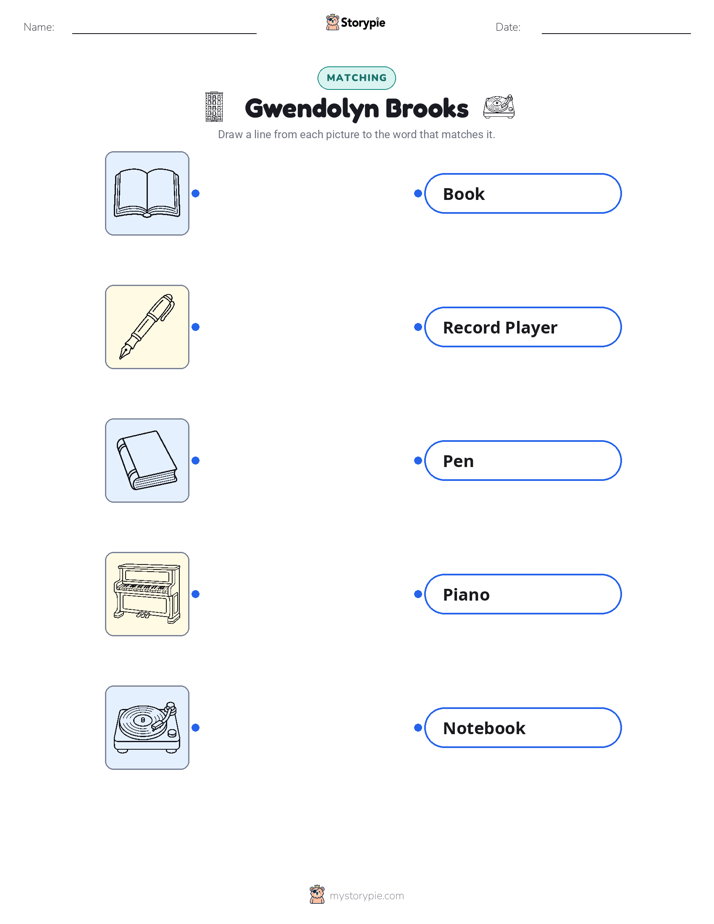
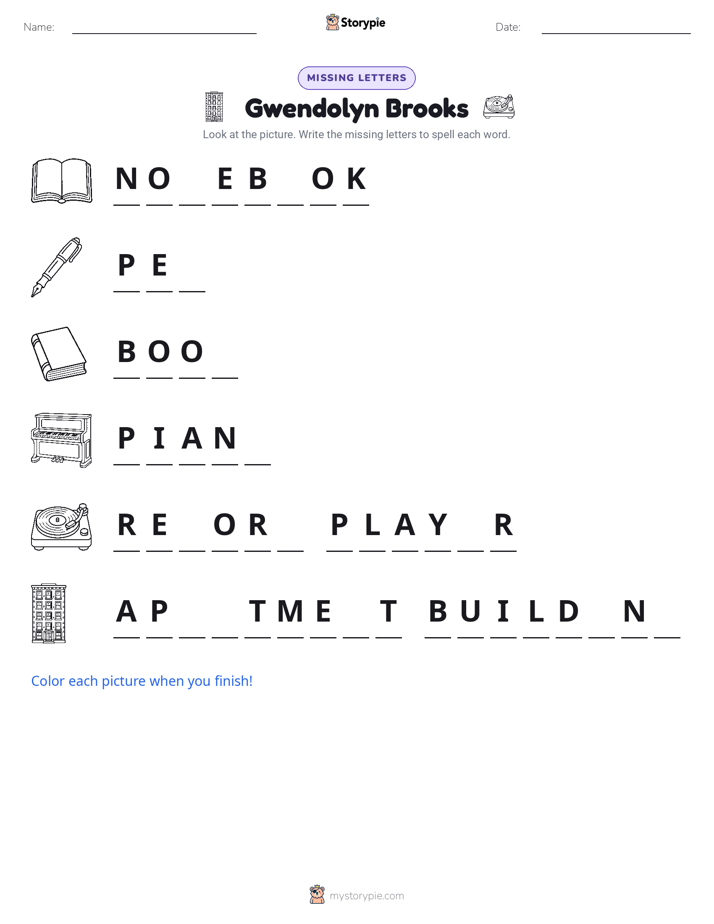
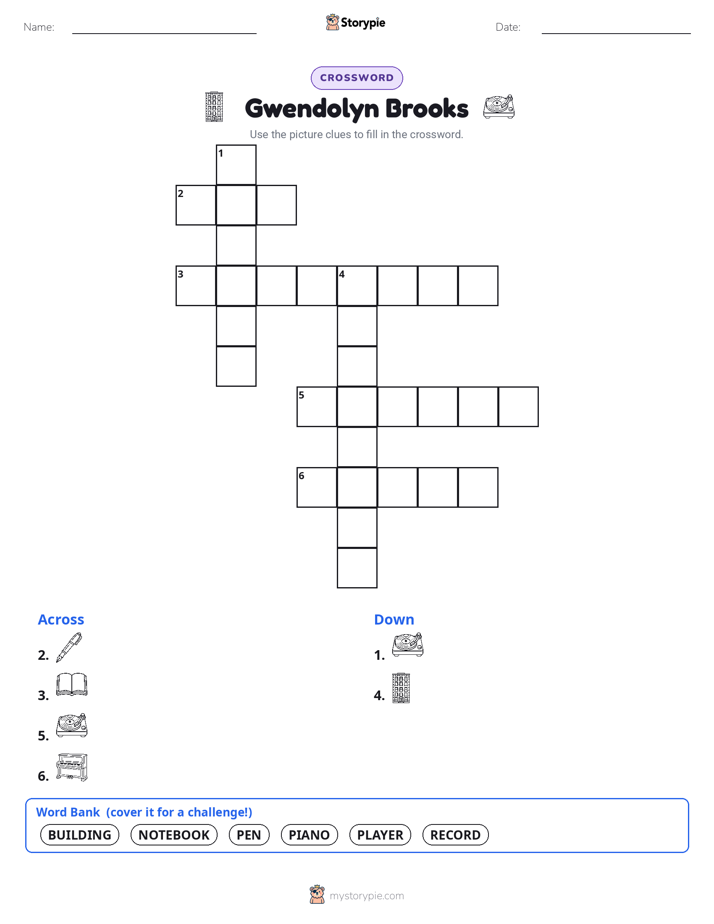
Print & create
Answer keys·No prep·Free with an account
28 worksheets · answer keys · full story · quiz · Ages 10-12 · CEFR B2
Plus adds 290,000+ more stories in 27 languages, audio for every one, and printables for all of them.
Just want Gwendolyn Brooks?
Hello, my name is Gwendolyn Brooks, and I want to tell you my story, which is a story about the power of words. I was born on June 7th, 1917, in Topeka, Kansas, but my family moved to the big city of Chicago when I was just a baby. Our home was filled with books and music. My father would sing, and my mother, who was a teacher, always encouraged my love for reading. I was a shy child, and I found that I could express my biggest feelings in the quiet pages of a notebook. I started writing poems when I was seven years old, scribbling down rhymes and observations about the world I saw from my window and on my walks through my neighborhood.
My mother was so proud of my writing that she often said, 'Gwendolyn, you are going to be the next Paul Laurence Dunbar!'. That was a huge compliment. By the time I was 13, in 1930, I had my very first poem, 'Eventide,' published in a magazine. What a thrill! A few years later, I gathered my best poems and my mother took me to meet the famous poets James Weldon Johnson and Langston Hughes. They read my work and were so encouraging. Mr. Hughes even wrote back to me after I sent him more poems, telling me I had real talent. Their belief in me was like a gust of wind beneath my wings. After I graduated from Wilson Junior College in 1936, I kept writing and joined a poetry workshop, learning more about my craft and sharing my work with other writers.
In 1939, I married a wonderful fellow writer named Henry Lowington Blakely, Jr., and we started our family. We lived in an apartment in a part of Chicago's South Side called Bronzeville. It was a vibrant, bustling community, and I found endless inspiration there. I didn't want to write about kings or queens in faraway lands; I wanted to write about the people I knew. I wrote about the mothers, the children playing in the street, the soldiers returning from war, and the dreamers hoping for a better life. I poured all these stories and observations into my first book of poetry, which I called 'A Street in Bronzeville.' When it was published in 1945, people were excited to read poems that sounded like their own lives and reflected their own world.
Gwendolyn Brooks
Hello, my name is Gwendolyn Brooks, and I want to tell you my story, which is a story about the power of words. I was born on June 7th, 1917, in Topeka, Kansas, but my family moved to the big city of Chicago when I was just a baby. Our home was filled with books and music. My father would sing, and my mother, who was a teacher, always encouraged my love for reading. I was a shy child, and I found that I could express my biggest feelings in the quiet pages of a notebook. I started writing poems when I was seven years old, scribbling down rhymes and observations about the world I saw from my window and on my walks through my neighborhood.
My mother was so proud of my writing that she often said, 'Gwendolyn, you are going to be the next Paul Laurence Dunbar!'. That was a huge compliment. By the time I was 13, in 1930, I had my very first poem, 'Eventide,' published in a magazine. What a thrill! A few years later, I gathered my best poems and my mother took me to meet the famous poets James Weldon Johnson and Langston Hughes. They read my work and were so encouraging. Mr. Hughes even wrote back to me after I sent him more poems, telling me I had real talent. Their belief in me was like a gust of wind beneath my wings. After I graduated from Wilson Junior College in 1936, I kept writing and joined a poetry workshop, learning more about my craft and sharing my work with other writers.
In 1939, I married a wonderful fellow writer named Henry Lowington Blakely, Jr., and we started our family. We lived in an apartment in a part of Chicago's South Side called Bronzeville. It was a vibrant, bustling community, and I found endless inspiration there. I didn't want to write about kings or queens in faraway lands; I wanted to write about the people I knew. I wrote about the mothers, the children playing in the street, the soldiers returning from war, and the dreamers hoping for a better life. I poured all these stories and observations into my first book of poetry, which I called 'A Street in Bronzeville.' When it was published in 1945, people were excited to read poems that sounded like their own lives and reflected their own world.
I continued to write, and my second book of poems was called 'Annie Allen.' It told the story of a young Black girl growing up in Chicago. I worked hard on every line, trying to make the language as beautiful and precise as possible. Then, on May 1st, 1950, something incredible happened. I received a phone call telling me that I had won the Pulitzer Prize for Poetry. I couldn't believe it! I was the very first African American person to ever receive a Pulitzer Prize. It was a tremendous honor, not just for me, but for my family, my community, and for all the writers who looked like me. This prize gave me a bigger platform and strengthened my belief that the stories of ordinary Black people were important and deserved to be told with artistry and care.
The world was changing in the 1960s, and I felt myself changing with it. Attending a writers' conference in 1967 opened my eyes and my poetry to new possibilities. I became more involved in the Black Arts Movement, and my writing became more direct, speaking out about social justice and celebrating Black culture and history. I also discovered a deep love for teaching. I wanted to help young people find their own voices, just as others had helped me. I held poetry workshops in my community, often using my own money to create prizes for student poets. In 1968, I was named the Poet Laureate of Illinois, a role I held for the rest of my life. And in 1985, I was appointed the Consultant in Poetry to the Library of Congress, which is now called the U.S. Poet Laureate.
I wrote poems for my entire life, always trying to capture the truth of what I saw. I lived to be 83 years old, and the world of words was my home until the very end. Today, my poems are read in classrooms and homes all over the world. I hope they show you that poetry isn't something distant or fancy; it can be found in the rhythm of a city street, in the quiet hopes of your own heart, and in the stories of the people all around you. My greatest wish is that my words inspire you to look closely at your world and to share your own unique and important story.
Wow facts
About
Gwendolyn Brooks was a celebrated American poet, author, and teacher who became the first African American to win the Pulitzer Prize in 1950. Her work often focused on the everyday lives of Black people in urban communities.
Take a Quiz
Question 1 of 5
What motivated Gwendolyn Brooks to write about the people in her neighborhood of Bronzeville?
Explore next






Want to do even more?
Go beyond exploring. Unlock tools that turn every story into real learning.
Storypie Plus for families
Full stories, quizzes, and printables. Nights and car rides, sorted.
- Unlimited audio stories
- Create Mode: your child stars in the story
- Offline downloads
- Printable worksheets & coloring pages

Why Storypie for Schools
Students engaged. Prep in seconds. Evenings back to you.
- Worksheets & Quizzes
- Classroom Management
- Formative Assessment
- Custom Curriculum & Lesson Plans
- 27 Languages

Why Storypie for Homeschool
Curriculum done. They'll ask for more. Hours back in your day.
- Worksheet Generator
- First-Person Audio Stories
- Built-in Comprehension Quizzes
- Custom Curriculum & Lesson Plans
- Print & Go Activities