English


Hans Lippershey
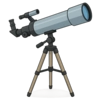
Hans Lippershey was a German-Dutch spectacle maker who is widely credited with the invention of the telescope.
Reads at Grades 6–8 Listens at Grades 4–8
Print & create
Answer keys·No prep·Free with an account
28 worksheets · answer keys · full story · quiz · Ages 10-12 · CEFR B2
Plus adds 164,000+ more stories in 27 languages, audio for every one, and printables for all of them.
Just want Hans Lippershey?
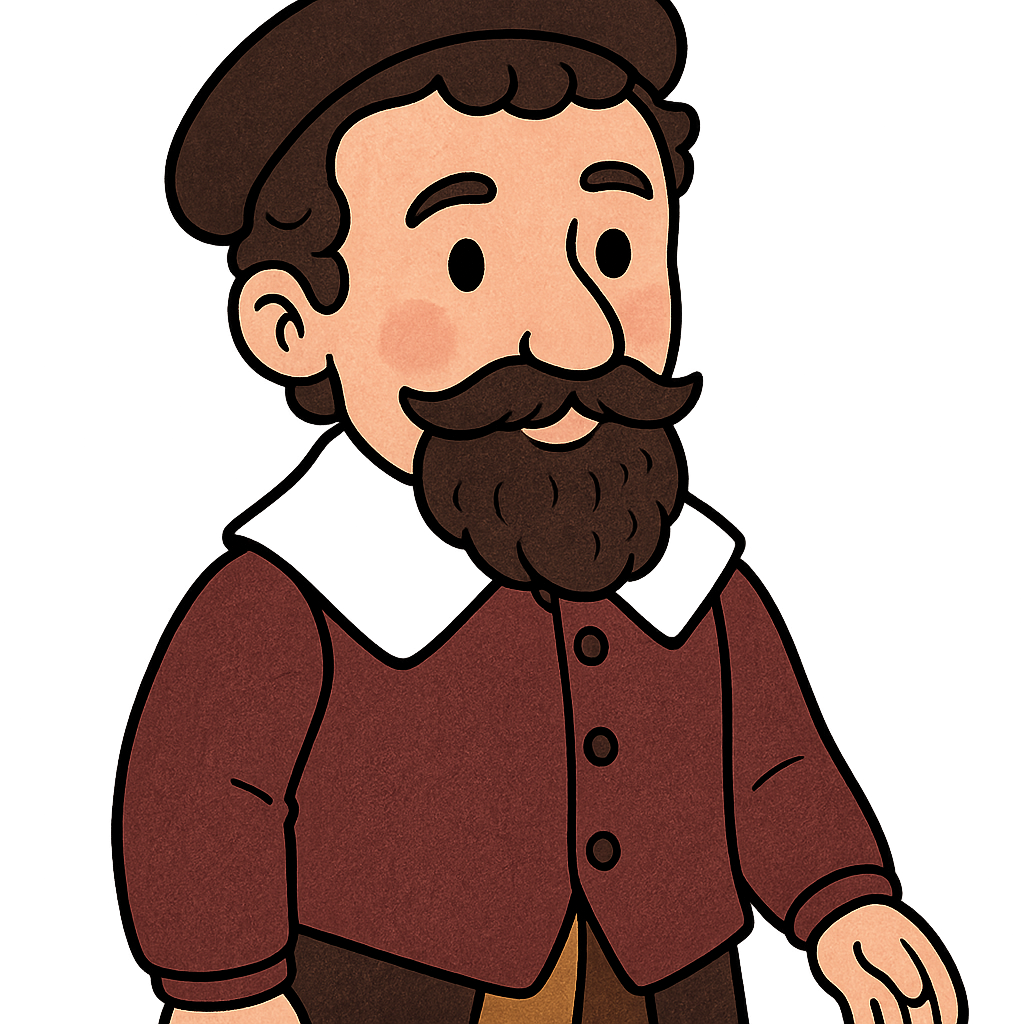
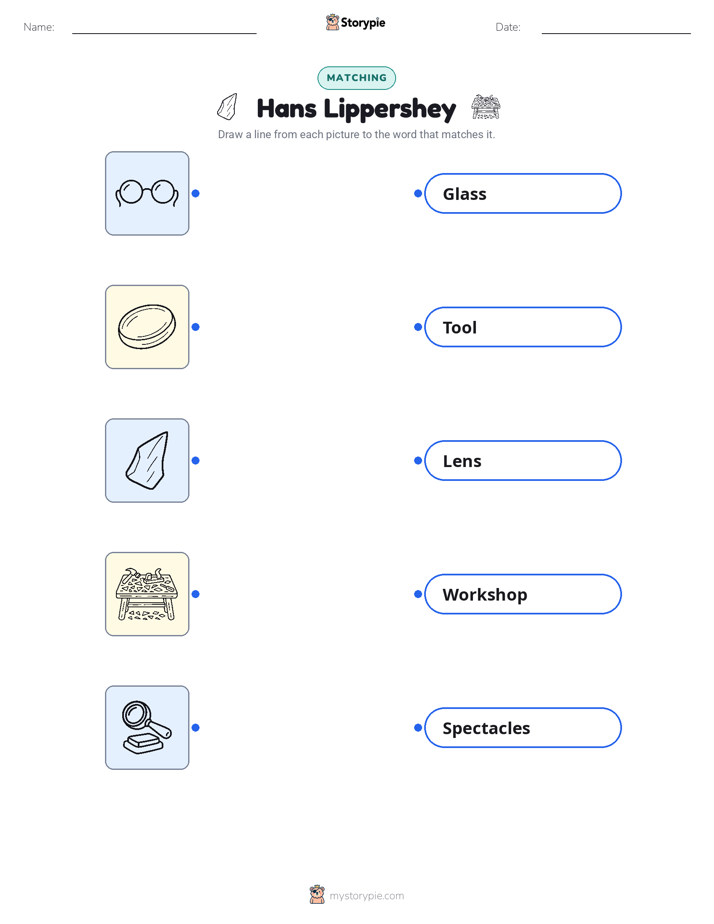
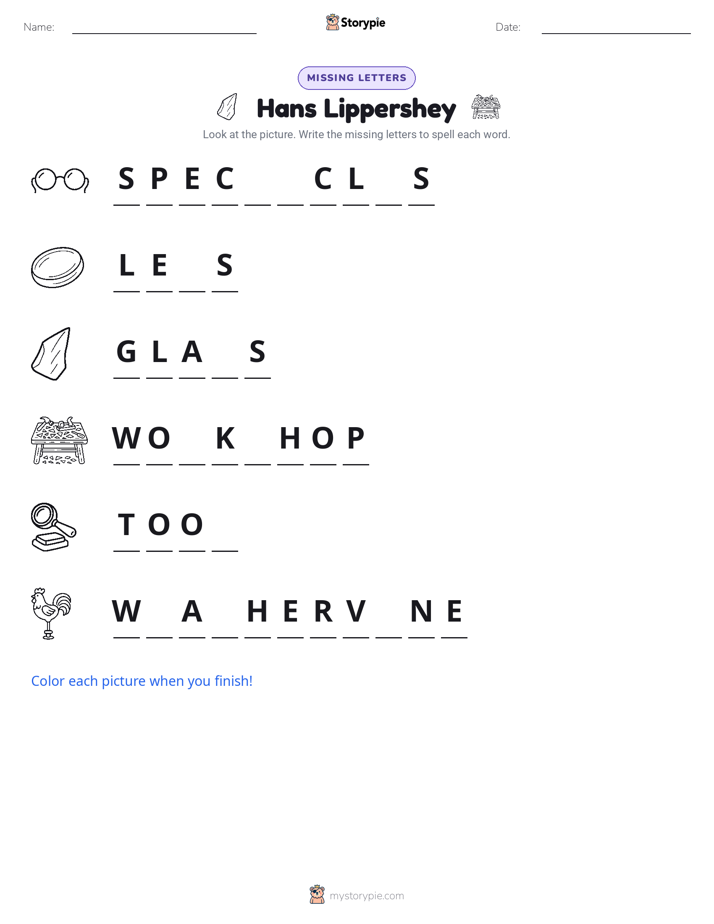
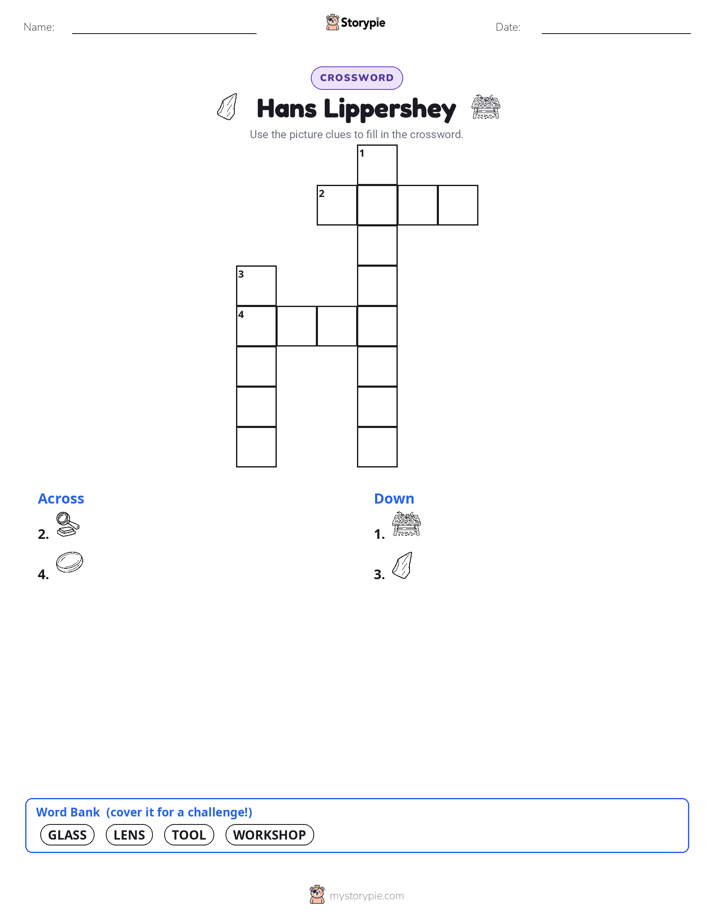
Hello, my name is Hans Lippershey, and I was a spectacle maker who lived long ago in the Netherlands. My story is about how a simple observation in my workshop helped give humanity a new way to see the world and the stars. I was born around the year 1570 in a town called Wesel, which is now part of Germany. As a young man, I moved to the busy, prosperous city of Middelburg in the Netherlands to build my life and career. My craft was a delicate and important one: I was a master lens grinder. I spent my days carefully grinding and polishing pieces of glass into lenses for eyeglasses, helping people with poor vision to see the world clearly again. It was a respected trade that required patience, precision, and a deep understanding of how light and glass worked together. In 1594, I married and started a family, and by 1602, I had officially become a citizen of Middelburg, my adopted home. My workshop was my world—a place filled with glass dust, polishing tools, and the constant quiet hum of scientific curiosity. It was there, among my lenses, that a surprising discovery would change everything.
One day, a moment of pure chance changed the course of my work forever. The most popular story, and the one I like to remember, involves two children playing in my workshop. Some versions of the tale say they were my own children. They were amusing themselves with my collection of lenses, which I kept for making spectacles. As they played, one of them held a lens up to their eye, and then placed another lens in front of it. Looking through the pair, they gasped in amazement. The weathervane on the steeple of a distant church suddenly appeared large and clear, as if it were just across the street. Their playful discovery immediately caught my attention. I was intrigued by what they had seen and wanted to understand the science behind it. I began my own experiments, taking their accidental arrangement and trying to perfect it. I discovered that by placing a convex lens—one that curves outward—at one end and a concave lens—one that curves inward—at the other, I could magnify distant objects. To make the device practical, I built a tube to hold the two lenses at just the right distance from each other. This was the first version of my new invention.
Hans Lippershey: A New Way of Seeing
Hello, my name is Hans Lippershey, and I was a spectacle maker who lived long ago in the Netherlands. My story is about how a simple observation in my workshop helped give humanity a new way to see the world and the stars. I was born around the year 1570 in a town called Wesel, which is now part of Germany. As a young man, I moved to the busy, prosperous city of Middelburg in the Netherlands to build my life and career. My craft was a delicate and important one: I was a master lens grinder. I spent my days carefully grinding and polishing pieces of glass into lenses for eyeglasses, helping people with poor vision to see the world clearly again. It was a respected trade that required patience, precision, and a deep understanding of how light and glass worked together. In 1594, I married and started a family, and by 1602, I had officially become a citizen of Middelburg, my adopted home. My workshop was my world—a place filled with glass dust, polishing tools, and the constant quiet hum of scientific curiosity. It was there, among my lenses, that a surprising discovery would change everything.
One day, a moment of pure chance changed the course of my work forever. The most popular story, and the one I like to remember, involves two children playing in my workshop. Some versions of the tale say they were my own children. They were amusing themselves with my collection of lenses, which I kept for making spectacles. As they played, one of them held a lens up to their eye, and then placed another lens in front of it. Looking through the pair, they gasped in amazement. The weathervane on the steeple of a distant church suddenly appeared large and clear, as if it were just across the street. Their playful discovery immediately caught my attention. I was intrigued by what they had seen and wanted to understand the science behind it. I began my own experiments, taking their accidental arrangement and trying to perfect it. I discovered that by placing a convex lens—one that curves outward—at one end and a concave lens—one that curves inward—at the other, I could magnify distant objects. To make the device practical, I built a tube to hold the two lenses at just the right distance from each other. This was the first version of my new invention.
I knew my invention was something special, and I wanted to protect it. I called it a 'kijker,' which means 'looker' in Dutch, and also referred to it as a 'Dutch perspective glass.' On October 2nd, 1608, I traveled to The Hague, the seat of the government, to demonstrate my creation. The officials were astounded. They took turns peering through the tube, exclaiming as they saw the towers and clocks of distant cities as if they were standing right next to them. Convinced of its value, especially for military purposes like spotting enemy ships from afar, I applied for a patent to have the exclusive right to produce and sell my looker. However, my path to securing the patent was not simple. Shortly after my application, another man from my city, Jacob Metius, also filed a claim, stating he had invented a similar device. The government officials debated the matter and ultimately concluded that the instrument was too easy to construct. They believed the secret of its design could not be kept, and therefore, they denied my patent. While I was disappointed, they were so impressed with my work that they paid me a generous sum to make several of my perspective glasses for them.
Even without a patent, news of my invention spread like wildfire across Europe. Letters and travelers carried the story of the Dutch perspective glass to every corner of the continent. While I had imagined my invention being used for earthly matters—for sailors, soldiers, and merchants—others saw a different, grander potential. In 1609, a brilliant Italian scientist and astronomer named Galileo Galilei heard descriptions of my device. He was fascinated and quickly began building his own, but he made them much more powerful than my original models. Then, Galileo did something truly revolutionary: he pointed his improved telescope toward the night sky. This single act opened up a new universe for humanity. For the first time, people could see that the surface of the Moon was not smooth but was covered in mountains and craters. They could see that Jupiter had its own moons orbiting it, a discovery that challenged old ideas about the Earth being the center of everything. My simple 'looker' had become the key that unlocked the secrets of the cosmos.
I continued my work as a spectacle and lens maker in Middelburg for the rest of my days. My life came to a peaceful close, and I was laid to rest in September of 1619. Although my patent was denied and other inventors like Jacob Metius were working on similar ideas at the same time, history has remembered my crucial role in the telescope's creation. My name is now forever linked with the invention that changed astronomy. My workshop discovery, sparked by the playfulness of children, helped launch a new era of science, allowing us to peer deeper into space than ever before. To honor my contribution, there is even a crater on the Moon named Lippershey. It serves as a permanent reminder that sometimes, a new way of seeing the world can lead to discovering new worlds altogether.
Wow facts
About
Hans Lippershey was a German-Dutch spectacle maker who is widely credited with the invention of the telescope.
Take a Quiz
Question 1 of 5
Why was Hans Lippershey's patent application for his 'looker' denied by the government?
Explore next





Want to do even more?
Go beyond exploring. Unlock tools that turn every story into real learning.

Storypie Plus for families
Full stories, quizzes, and printables. Nights and car rides, sorted.
- Unlimited audio stories
- Create Mode: your child stars in the story
- Offline downloads
- Printable worksheets & coloring pages

Why Storypie for Schools
Students engaged. Prep in seconds. Evenings back to you.
- Worksheets & Quizzes
- Classroom Management
- Formative Assessment
- Custom Curriculum & Lesson Plans
- 27 Languages

Why Storypie for Homeschool
Curriculum done. They'll ask for more. Hours back in your day.
- Worksheet Generator
- First-Person Audio Stories
- Built-in Comprehension Quizzes
- Custom Curriculum & Lesson Plans
- Print & Go Activities