English

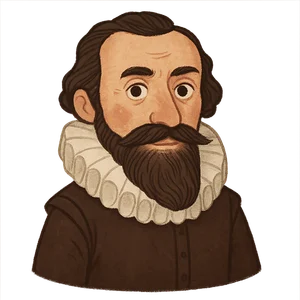
Johannes Kepler
Johannes Kepler was a German astronomer, mathematician…
Reads at Grades 3–5 Listens at Grades 1–5
Print & create
Answer keys·No prep·Free with an account
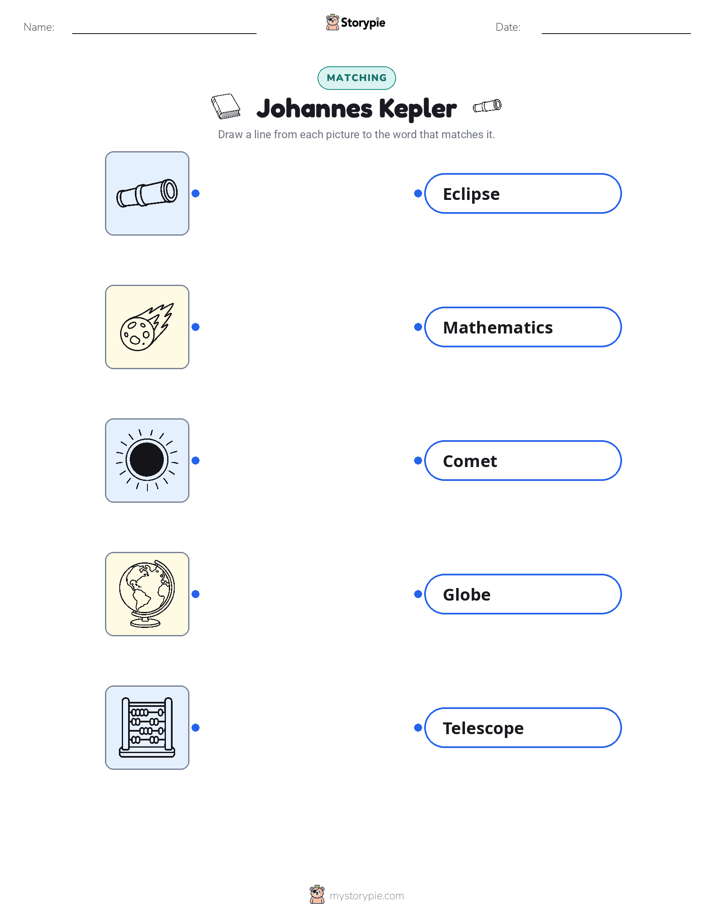
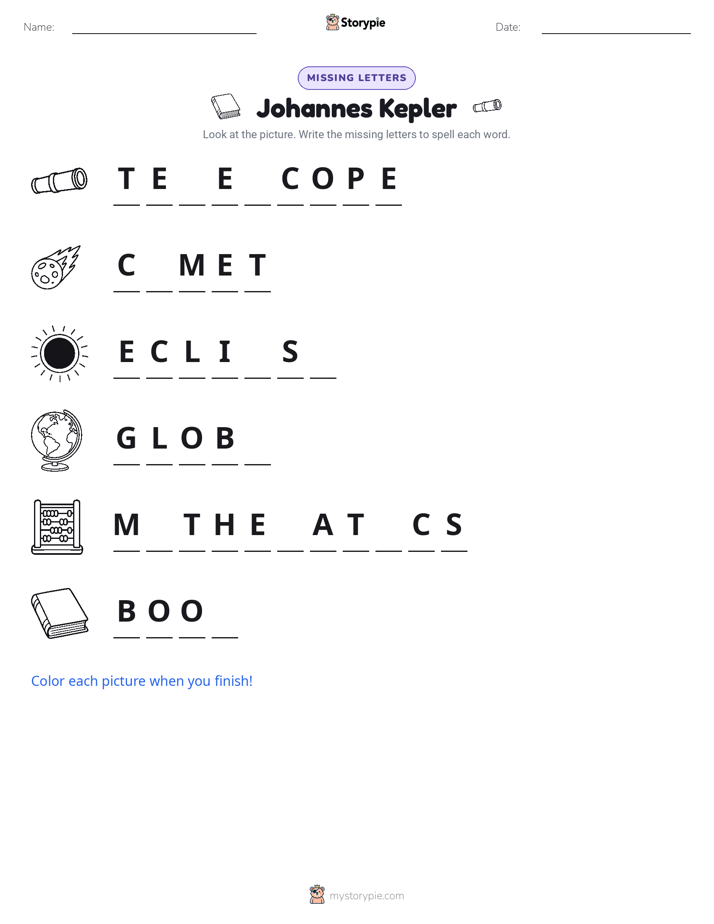
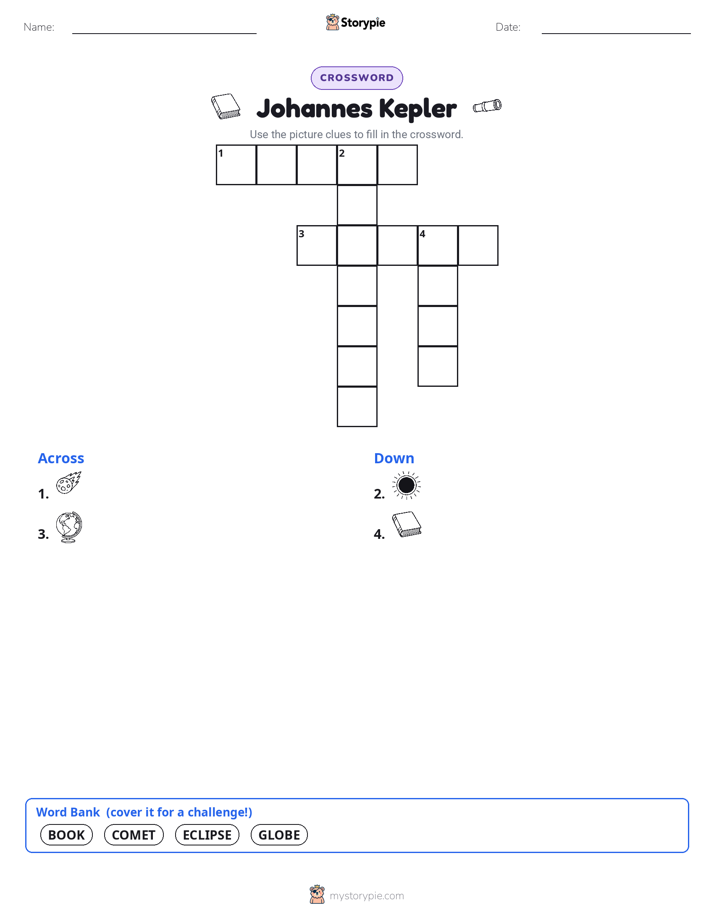
28 worksheets · answer keys · full story · quiz · Ages 8-10 · CEFR B1
Plus adds 102,000+ more stories in 27 languages, audio for every one, and printables for all of them.
Just want Johannes Kepler?
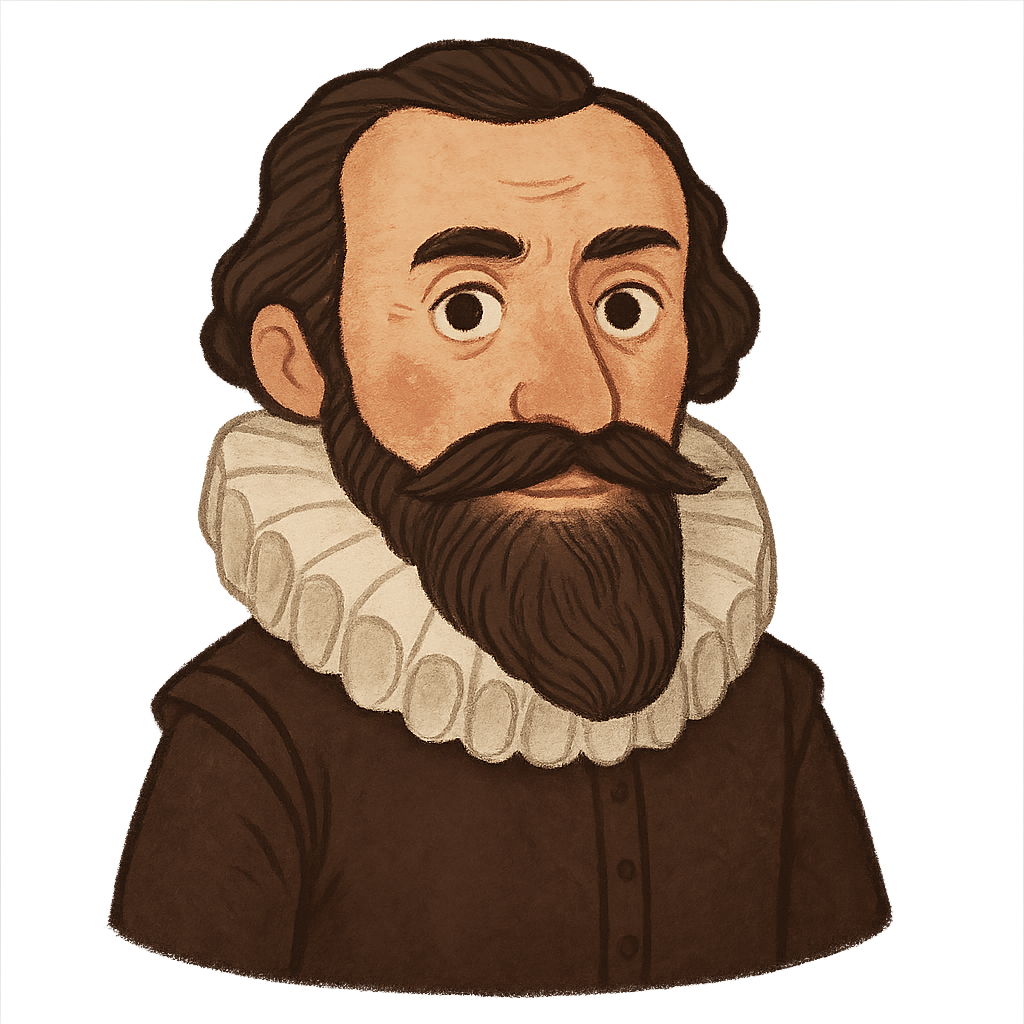
Hello! My name is Johannes Kepler. I was born on December 27th, 1571, in a small town in Germany called Weil der Stadt. When I was a boy, I was often sick, but my mind was always buzzing with curiosity. I loved looking up at the night sky. In 1577, my mother took me to see a great comet with a long, bright tail, and in 1580, my father showed me an eclipse that made the Moon turn red. These amazing sights made me fall in love with the mystery and beauty of the stars. It felt like the universe was showing me its secrets, and I wanted to understand them more than anything.
When I grew up, I went to a big school called the University of Tübingen. There, I learned about a bold idea from an astronomer named Nicolaus Copernicus. He believed that the Earth and all the other planets actually traveled around the Sun! Back then, almost everyone thought the Sun and planets circled around the Earth. I was fascinated by this idea and felt sure it was true. I wanted to prove it with numbers and observations. Around the year 1594, I became a teacher, and I loved sharing my ideas about the stars. In 1596, I wrote my very first book, called 'Mysterium Cosmographicum,' to explain why I thought the Sun was the center of our family of planets. I hoped my book would help others see the universe in this new way.
In the year 1600, I moved to the city of Prague to work with a famous astronomer named Tycho Brahe. This was a very exciting step for me. Tycho had spent his whole life carefully watching and measuring the positions of the stars and planets from his special observatory. He had the best and most accurate charts in the whole world. When Tycho passed away in 1601, I was trusted with all of his amazing work. It was a huge responsibility. He had left me a special puzzle to solve: the orbit of the planet Mars. I spent years trying to figure out its path, but it just wouldn't fit the perfect circle that everyone, including me, expected.
Johannes Kepler
Hello! My name is Johannes Kepler. I was born on December 27th, 1571, in a small town in Germany called Weil der Stadt. When I was a boy, I was often sick, but my mind was always buzzing with curiosity. I loved looking up at the night sky. In 1577, my mother took me to see a great comet with a long, bright tail, and in 1580, my father showed me an eclipse that made the Moon turn red. These amazing sights made me fall in love with the mystery and beauty of the stars. It felt like the universe was showing me its secrets, and I wanted to understand them more than anything.
When I grew up, I went to a big school called the University of Tübingen. There, I learned about a bold idea from an astronomer named Nicolaus Copernicus. He believed that the Earth and all the other planets actually traveled around the Sun! Back then, almost everyone thought the Sun and planets circled around the Earth. I was fascinated by this idea and felt sure it was true. I wanted to prove it with numbers and observations. Around the year 1594, I became a teacher, and I loved sharing my ideas about the stars. In 1596, I wrote my very first book, called 'Mysterium Cosmographicum,' to explain why I thought the Sun was the center of our family of planets. I hoped my book would help others see the universe in this new way.
In the year 1600, I moved to the city of Prague to work with a famous astronomer named Tycho Brahe. This was a very exciting step for me. Tycho had spent his whole life carefully watching and measuring the positions of the stars and planets from his special observatory. He had the best and most accurate charts in the whole world. When Tycho passed away in 1601, I was trusted with all of his amazing work. It was a huge responsibility. He had left me a special puzzle to solve: the orbit of the planet Mars. I spent years trying to figure out its path, but it just wouldn't fit the perfect circle that everyone, including me, expected.
After so much hard work and many failed attempts, I had a breakthrough! I realized the path of Mars wasn't a perfect circle at all. It was an ellipse, which is like a slightly squashed circle, or an oval. This changed everything. In 1609, I published my first two laws of planetary motion. The first law said that planets move in elliptical orbits around the Sun. The second explained that planets move faster when they get closer to the Sun and slower when they are farther away. My work wasn't finished. Ten years later, in 1619, I discovered a third law that connected how long it takes a planet to go around the Sun with how far away it is. I had found the rules for how the planets danced in the sky!
My discoveries helped other scientists, like Isaac Newton, understand big ideas like gravity. My work changed the way we see our universe, proving that it was a place of order and beautiful rules, not just random movements. I lived to be 58 years old. Today, people remember me for figuring out the laws that guide the planets on their journeys through space. These same laws help scientists today send rockets to the Moon, Mars, and beyond, following the paths I first described so long ago.
Wow facts
About
Johannes Kepler was a German astronomer, mathematician, and astrologer who was a key figure in the 17th-century Scientific Revolution. He is best known for his laws of planetary motion.
Take a Quiz
Question 1 of 5
What does the word 'orbit' mean in the story?
Explore next





Want to do even more?
Go beyond exploring. Unlock tools that turn every story into real learning.

Storypie Plus for families
Full stories, quizzes, and printables. Nights and car rides, sorted.
- Unlimited audio stories
- Create Mode: your child stars in the story
- Offline downloads
- Printable worksheets & coloring pages

Why Storypie for Schools
Students engaged. Prep in seconds. Evenings back to you.
- Worksheets & Quizzes
- Classroom Management
- Formative Assessment
- Custom Curriculum & Lesson Plans
- 27 Languages

Why Storypie for Homeschool
Curriculum done. They'll ask for more. Hours back in your day.
- Worksheet Generator
- First-Person Audio Stories
- Built-in Comprehension Quizzes
- Custom Curriculum & Lesson Plans
- Print & Go Activities