English

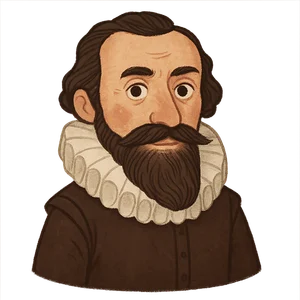
Johannes Kepler
Johannes Kepler was a German astronomer, mathematician…
Reads at Grades 6–8 Listens at Grades 4–8
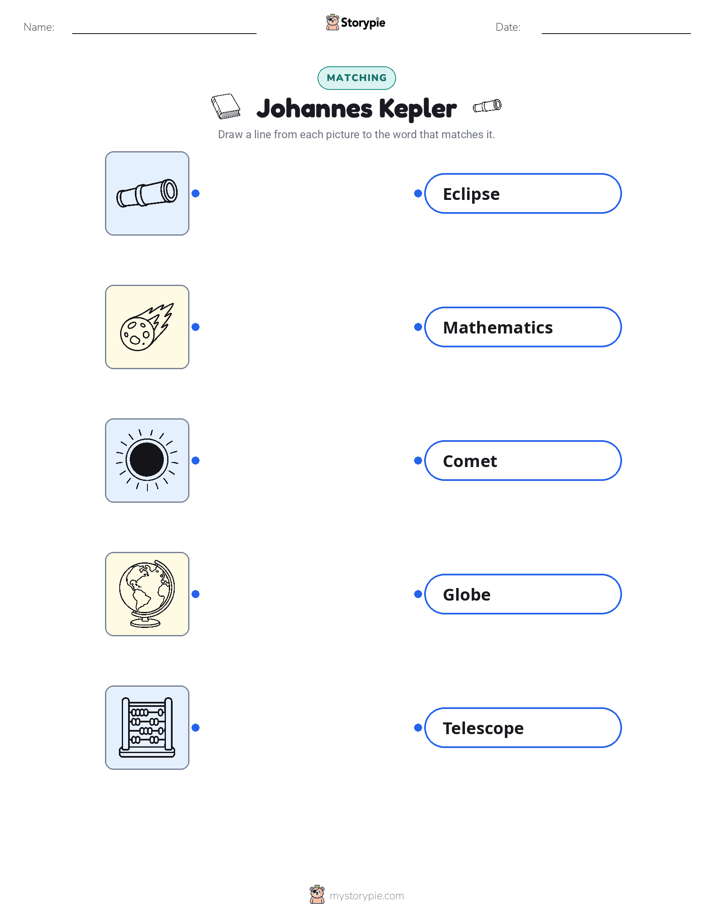
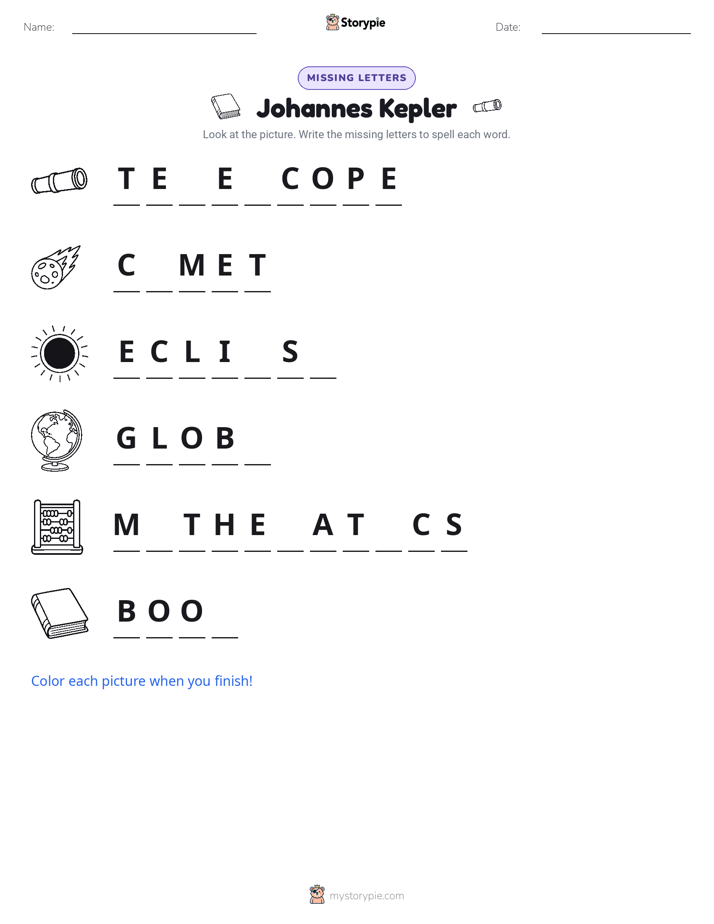
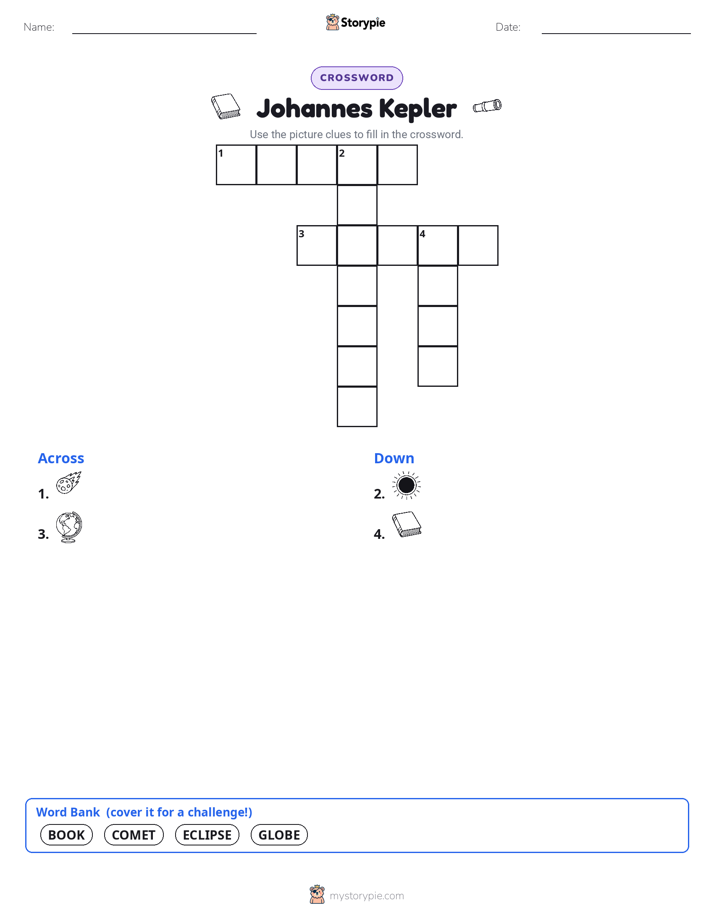
Print & create
Answer keys·No prep·Free with an account
28 worksheets · answer keys · full story · quiz · Ages 10-12 · CEFR B2
Plus adds 102,000+ more stories in 27 languages, audio for every one, and printables for all of them.
Just want Johannes Kepler?
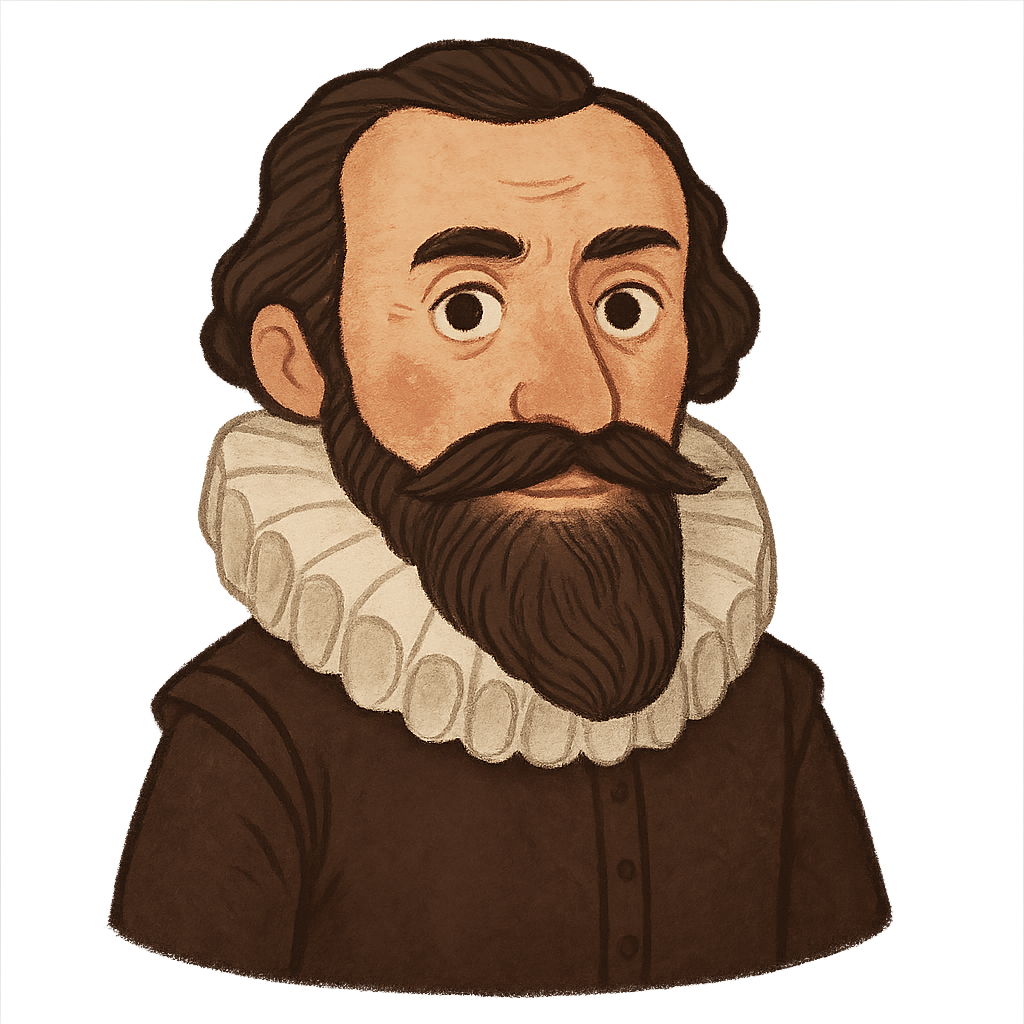
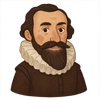
Hello! My name is Johannes Kepler, and I spent my life looking up at the stars, trying to understand their secrets. I was born on December 27th, 1571, in a town called Weil der Stadt in what is now Germany. As a child, I was often sick, but my mind was always curious. I remember my mother taking me out on a dark night in 1577 to see a spectacular sight—the Great Comet! A few years later, in 1580, my father showed me a lunar eclipse, where the Moon turned a beautiful, deep red. These moments sparked a fire in me; I knew I had to learn more about the heavens.
When I was old enough, in 1589, I went to the famous University of Tübingen. At first, I studied to become a church minister. But I also fell in love with mathematics and astronomy. My professor, Michael Maestlin, secretly taught me about the radical ideas of a man named Nicolaus Copernicus, who believed the Sun, not the Earth, was the center of the universe! This idea fascinated me. In 1594, instead of becoming a minister, I accepted a job as a teacher of mathematics and astronomy in Graz, Austria, so I could dedicate my life to studying the cosmos.
In Graz, I wrote my first major book, 'Mysterium Cosmographicum,' which was published in 1596. In it, I tried to explain the spacing of the planets using the five perfect geometric solids. My idea wasn't quite right, but it was a bold attempt to find a hidden mathematical order in the universe. More importantly, my book caught the attention of the greatest astronomer of the age, a Danish nobleman named Tycho Brahe.
Johannes Kepler
Hello! My name is Johannes Kepler, and I spent my life looking up at the stars, trying to understand their secrets. I was born on December 27th, 1571, in a town called Weil der Stadt in what is now Germany. As a child, I was often sick, but my mind was always curious. I remember my mother taking me out on a dark night in 1577 to see a spectacular sight—the Great Comet! A few years later, in 1580, my father showed me a lunar eclipse, where the Moon turned a beautiful, deep red. These moments sparked a fire in me; I knew I had to learn more about the heavens.
When I was old enough, in 1589, I went to the famous University of Tübingen. At first, I studied to become a church minister. But I also fell in love with mathematics and astronomy. My professor, Michael Maestlin, secretly taught me about the radical ideas of a man named Nicolaus Copernicus, who believed the Sun, not the Earth, was the center of the universe! This idea fascinated me. In 1594, instead of becoming a minister, I accepted a job as a teacher of mathematics and astronomy in Graz, Austria, so I could dedicate my life to studying the cosmos.
In Graz, I wrote my first major book, 'Mysterium Cosmographicum,' which was published in 1596. In it, I tried to explain the spacing of the planets using the five perfect geometric solids. My idea wasn't quite right, but it was a bold attempt to find a hidden mathematical order in the universe. More importantly, my book caught the attention of the greatest astronomer of the age, a Danish nobleman named Tycho Brahe.
In the year 1600, I moved to Prague to become an assistant to Tycho Brahe. He was the Imperial Mathematician to the Holy Roman Emperor and had spent decades making the most precise measurements of the stars and planets ever recorded. Our partnership was not always easy—he was a grand figure, and I was a young, eager mathematician. He guarded his precious data closely. But when Tycho passed away unexpectedly in 1601, I was appointed to his position. Suddenly, all his life's work, especially his detailed observations of the planet Mars, was in my hands.
I called my work on Mars's orbit my 'war with Mars' because it was a long and difficult battle. For years, I tried to make Tycho's data fit the old belief that planets moved in perfect circles. But the numbers wouldn't lie; the orbit was always slightly off. After countless calculations, I had a breakthrough. What if the orbit wasn't a circle at all? In my 1609 book, 'Astronomia nova,' I revealed my first two laws of planetary motion. First, planets travel in ellipses, which are like stretched-out circles. Second, a planet moves faster when it's closer to the Sun and slower when it's farther away. The ancient puzzle was finally beginning to make sense!
My life had many other challenges, including religious wars and having to spend years, from 1615 to 1621, defending my own mother after she was accused of being a witch. Through it all, I never stopped my work. In 1619, I published another book, 'Harmonices Mundi,' where I announced my third law. This law was like a beautiful piece of music; it was a mathematical equation that connected the time it takes a planet to orbit the Sun with its distance from the Sun. Finally, in 1627, I published the 'Rudolphine Tables,' a star catalog that used my laws to predict the positions of the planets with amazing accuracy for years to come.
I passed away in 1630 while on a journey. I lived to be 58 years old. My ideas were so new that not everyone accepted them right away. But over time, my three laws became the foundation of modern astronomy. A brilliant scientist who came after me, Isaac Newton, even used my laws to help him develop his own theory of universal gravitation. Today, when scientists send spacecraft to other planets, they use the very same mathematical laws I discovered four hundred years ago. I hope my story reminds you to always stay curious, to question everything, and to never stop looking for the beautiful patterns hidden in the world around you.
Wow facts
About
Johannes Kepler was a German astronomer, mathematician, and astrologer who was a key figure in the 17th-century Scientific Revolution. He is best known for his laws of planetary motion.
Take a Quiz
Question 1 of 5
Retell the key steps in Johannes Kepler's journey from university student to discovering the laws of planetary motion.
Explore next



Want to do even more?
Go beyond exploring. Unlock tools that turn every story into real learning.

Storypie Plus for families
Full stories, quizzes, and printables. Nights and car rides, sorted.
- Unlimited audio stories
- Create Mode: your child stars in the story
- Offline downloads
- Printable worksheets & coloring pages

Why Storypie for Schools
Students engaged. Prep in seconds. Evenings back to you.
- Worksheets & Quizzes
- Classroom Management
- Formative Assessment
- Custom Curriculum & Lesson Plans
- 27 Languages

Why Storypie for Homeschool
Curriculum done. They'll ask for more. Hours back in your day.
- Worksheet Generator
- First-Person Audio Stories
- Built-in Comprehension Quizzes
- Custom Curriculum & Lesson Plans
- Print & Go Activities