English

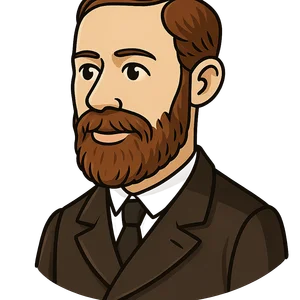
Heinrich Hertz
Heinrich Hertz was a German physicist who proved the existence of electromagnetic waves…
Reads at Grades 6–8 Listens at Grades 4–8
Print & create
Answer keys·No prep·Free with an account
28 worksheets · answer keys · full story · quiz · Ages 10-12 · CEFR B2
Plus adds 164,000+ more stories in 27 languages, audio for every one, and printables for all of them.
Just want Heinrich Hertz?
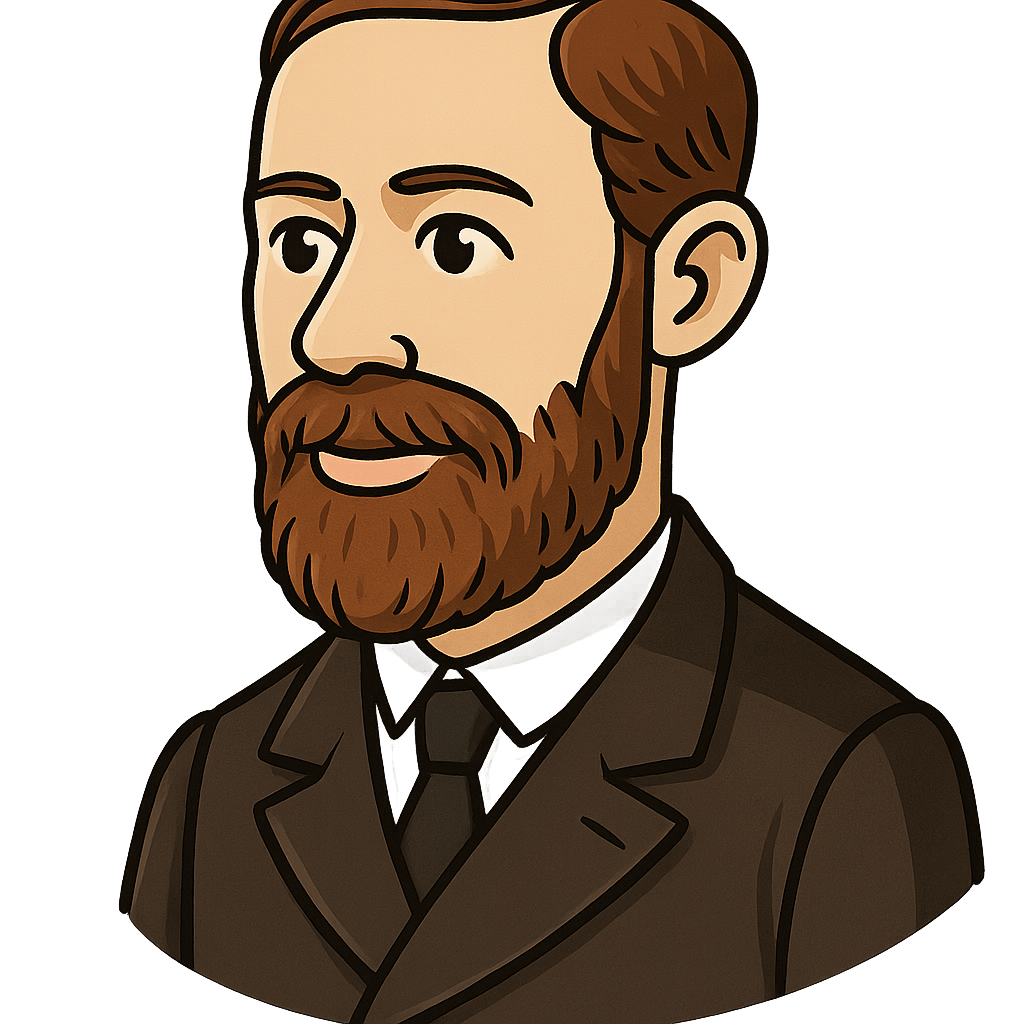
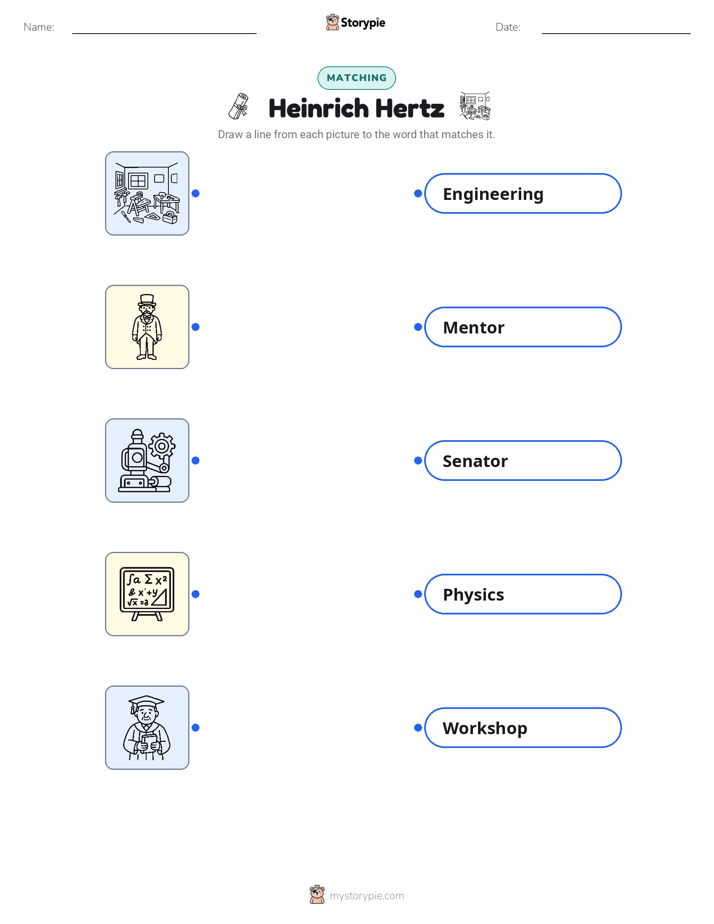
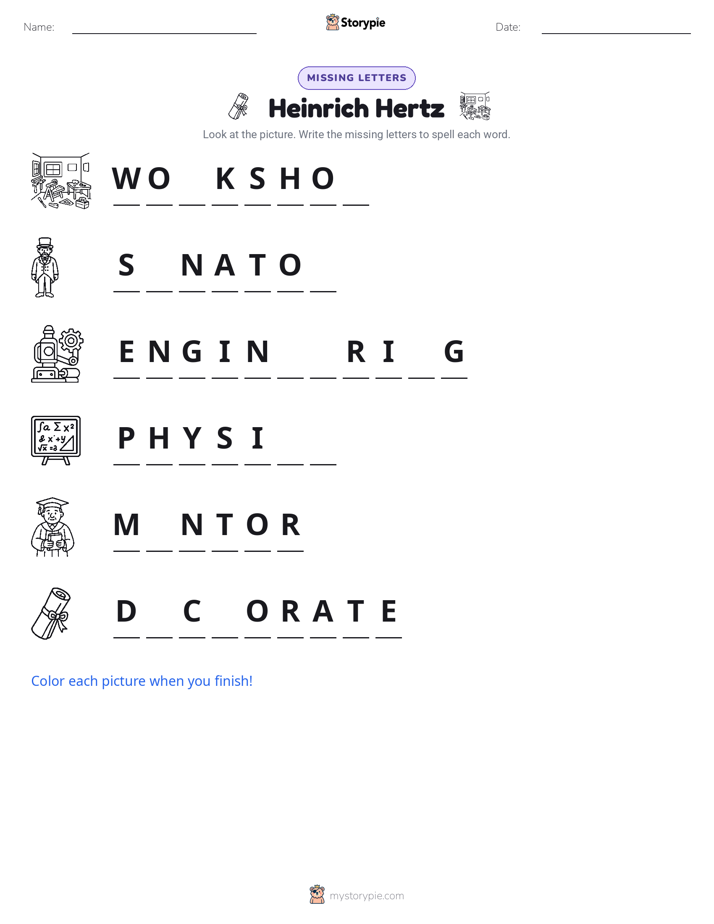
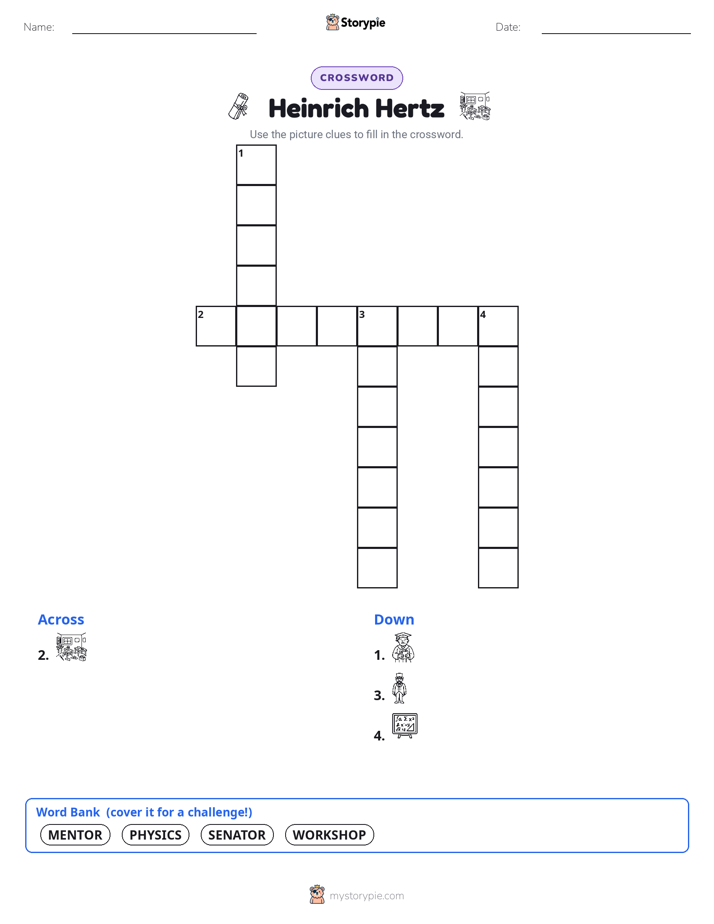
Hello, my name is Heinrich Hertz, and I am a physicist who discovered something that surrounds you every single moment, even though you cannot see it. I was born on February 22nd, 1857, in the lively port city of Hamburg, Germany. My family valued learning greatly; my father was a respected senator in the city government, and he encouraged my curious mind. From a young age, I was fascinated with how things worked. I even built a small workshop for myself where I would spend hours constructing different devices and instruments. While I loved science, my interests were broad. I also had a passion for languages and learned several. I believe that being curious about many different subjects helped me become a better thinker and prepared me for the challenges I would face in the world of science.
When it was time for university, I initially decided to study a practical field. In 1877, I began my studies in engineering, learning how to design and build things on a much larger scale than in my childhood workshop. However, I soon realized that while I enjoyed making things, I was even more fascinated by the deep questions behind how the universe works. I wanted to understand the fundamental laws of nature, not just apply them. This realization led me to change my path and pursue physics. I moved to Berlin, which was a center for scientific thought, to study under some of the most brilliant minds of my time, including the great physicist Hermann von Helmholtz. He became my mentor and guided my studies. My passion for the subject drove me, and in 1880, I earned my doctorate at the young age of 23. My academic career began shortly after, and in 1883, I accepted my first position as a professor at the University of Kiel.
Heinrich Hertz: The Man Who Revealed Invisible Waves
Hello, my name is Heinrich Hertz, and I am a physicist who discovered something that surrounds you every single moment, even though you cannot see it. I was born on February 22nd, 1857, in the lively port city of Hamburg, Germany. My family valued learning greatly; my father was a respected senator in the city government, and he encouraged my curious mind. From a young age, I was fascinated with how things worked. I even built a small workshop for myself where I would spend hours constructing different devices and instruments. While I loved science, my interests were broad. I also had a passion for languages and learned several. I believe that being curious about many different subjects helped me become a better thinker and prepared me for the challenges I would face in the world of science.
When it was time for university, I initially decided to study a practical field. In 1877, I began my studies in engineering, learning how to design and build things on a much larger scale than in my childhood workshop. However, I soon realized that while I enjoyed making things, I was even more fascinated by the deep questions behind how the universe works. I wanted to understand the fundamental laws of nature, not just apply them. This realization led me to change my path and pursue physics. I moved to Berlin, which was a center for scientific thought, to study under some of the most brilliant minds of my time, including the great physicist Hermann von Helmholtz. He became my mentor and guided my studies. My passion for the subject drove me, and in 1880, I earned my doctorate at the young age of 23. My academic career began shortly after, and in 1883, I accepted my first position as a professor at the University of Kiel.
My most important work began after I moved to the University of Karlsruhe in 1885. There, I had the resources and freedom to explore one of the biggest scientific mysteries of the era. A brilliant Scottish physicist named James Clerk Maxwell had, in the 1860s, developed a set of mathematical equations that predicted the existence of invisible energy waves that could travel through space. His theory was remarkable, but for years, it remained just that—a theory on paper. No one had ever been able to prove these waves actually existed. I was determined to be the one to solve this puzzle. I set up my laboratory and began building my own equipment from scratch. To create the waves, I designed what is now called a 'spark-gap transmitter,' which sent a powerful electrical spark jumping between two metal spheres. To detect them, I created a simple receiver: a loop of copper wire with a tiny gap in it. My idea was that if Maxwell's waves were real, they would travel from the transmitter, be picked up by the receiver, and create a tiny spark of their own in the gap.
Then, in 1886, the breakthrough moment arrived. As I operated my transmitter, I looked over at the receiver loop across the room and saw it—a faint but definite spark jumping across the tiny gap. There were no wires connecting the two devices. The energy had to have traveled through the air as an invisible wave, just as Maxwell had predicted. It was a thrilling discovery, but my work was not done. Between 1886 and 1889, I conducted a series of careful experiments to understand the nature of these waves. I showed that I could reflect them off a sheet of metal, just as light reflects from a mirror. I demonstrated that they could be bent, or refracted, as they passed through different materials. I also found they could be blocked by objects. In every test, they behaved exactly like light waves. This was the final piece of the puzzle, proving that light itself was just one form of these electromagnetic waves. During this intensely productive period, in 1887, I also made another important discovery known as the 'photoelectric effect,' which later became crucial to the development of quantum mechanics.
In 1889, I accepted a new position as a professor at the University of Bonn, where I continued my research. However, my time for discovery was sadly cut short by a serious illness. I lived to be only 36 years old, and my life came to an end on January 1st, 1894. Although I did not live long enough to see the incredible technologies that would grow from my work, I am proud of what I left behind. My discovery of electromagnetic waves laid the foundation for inventions that have changed the world, including the radio, television, radar, and the Wi-Fi that connects your devices today. To honor my contribution, scientists decided to name the standard unit of frequency—the measure of waves per second—the 'hertz.' So, every time you tune a radio or use a microwave, my name is a small part of it.
Wow facts
About
Heinrich Hertz was a German physicist who proved the existence of electromagnetic waves, which paved the way for radio, television, and other wireless technologies.
Take a Quiz
Question 1 of 5
In your own words, describe the key experiment Heinrich Hertz conducted in 1886.
Explore next






Want to do even more?
Go beyond exploring. Unlock tools that turn every story into real learning.

Storypie Plus for families
Full stories, quizzes, and printables. Nights and car rides, sorted.
- Unlimited audio stories
- Create Mode: your child stars in the story
- Offline downloads
- Printable worksheets & coloring pages

Why Storypie for Schools
Students engaged. Prep in seconds. Evenings back to you.
- Worksheets & Quizzes
- Classroom Management
- Formative Assessment
- Custom Curriculum & Lesson Plans
- 27 Languages

Why Storypie for Homeschool
Curriculum done. They'll ask for more. Hours back in your day.
- Worksheet Generator
- First-Person Audio Stories
- Built-in Comprehension Quizzes
- Custom Curriculum & Lesson Plans
- Print & Go Activities