English

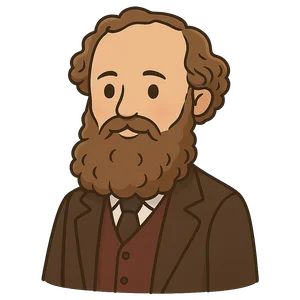
James Clerk Maxwell
James Clerk Maxwell was a Scottish physicist best known for his revolutionary work in classical…
Reads at Grades 3–5 Listens at Grades 1–5
James Clerk Maxwell: The Man Who Connected Our World
Hello! My name is James Clerk Maxwell, and I was a scientist who loved figuring out how the world works. I was born on June 13th, 1831, in Edinburgh, Scotland. Even as a little boy, I was full of questions, always asking my father, 'What's the go o' that?' which was my way of saying, 'How does that work?' My curiosity led me to explore all sorts of ideas. When I was only fourteen years old, in 1846, I wrote my very first scientific paper about a special way to draw oval shapes. It was a proud moment when my work was shared with the grown-up scientists at the Royal Society of Edinburgh.
I loved to learn, so I went to the University of Edinburgh and later to the University of Cambridge in England to continue my studies. One of the biggest puzzles in science at the time was Saturn's beautiful rings. Nobody knew what they were made of! In 1857, I started thinking about it, using mathematics as my guide. I calculated that the rings couldn't be a solid piece or a liquid. I proved they had to be made of countless small, separate particles, all orbiting the planet like tiny moons. For this discovery, I won a very important award called the Adams Prize in 1859, which made me feel very honored.
Besides planets, I was fascinated by light and color. I wondered if it was possible to take a photograph in full color. Back then, all photos were in black and white, so this was a big challenge. In 1861, I had an idea. I took three separate pictures of a colorful tartan ribbon. For each picture, I used a different colored filter: one red, one green, and one blue. When I projected the three images on top of each other, they combined to create the world's first-ever durable color photograph! It was a magical moment, and it proved that all the colors we see can be made by mixing red, green, and blue light.
My biggest adventure was exploring the invisible forces of electricity and magnetism. I studied the amazing experiments of scientists like Michael Faraday, but I wanted to describe their discoveries with the clear and powerful language of mathematics. Around 1865, I wrote four special equations that are now famously called 'Maxwell's Equations.' These equations showed something incredible: electricity and magnetism are not separate things but two parts of the same force, which we call electromagnetism. My math also predicted that this force traveled in waves. When I calculated their speed, I found they moved at the exact speed of light! This meant light itself was an electromagnetic wave, a discovery that connected light, electricity, and magnetism forever.
I spent the rest of my life teaching, exploring, and writing. I gathered many of my ideas into my famous book, 'A Treatise on Electricity and Magnetism,' which was published in 1873. I lived to be 48 years old. Though I didn't get to see them, my discoveries about electromagnetic waves paved the way for amazing inventions like the radio, television, cell phones, and Wi-Fi. A very famous scientist named Albert Einstein said my work was one of the most important in the history of physics. It makes me happy to know that my curiosity helped us understand the invisible waves that connect our world.
Wow facts
About
James Clerk Maxwell was a Scottish physicist best known for his revolutionary work in classical electromagnetic theory, which united electricity, magnetism, and light as different manifestations of the same phenomenon.
Take a Quiz
Question 1 of 5
In the story, I say my discoveries 'paved the way' for inventions like the radio. What does the phrase 'paved the way' mean here?
Explore next






Want to do even more?
Go beyond exploring. Unlock tools that turn every story into real learning.

Storypie Plus for families
Full stories, quizzes, and printables. Nights and car rides, sorted.
- Unlimited audio stories
- Create Mode: your child stars in the story
- Offline downloads
- Printable worksheets & coloring pages

Why Storypie for Schools
Students engaged. Prep in seconds. Evenings back to you.
- Worksheets & Quizzes
- Classroom Management
- Formative Assessment
- Custom Curriculum & Lesson Plans
- 27 Languages

Why Storypie for Homeschool
Curriculum done. They'll ask for more. Hours back in your day.
- Worksheet Generator
- First-Person Audio Stories
- Built-in Comprehension Quizzes
- Custom Curriculum & Lesson Plans
- Print & Go Activities