English

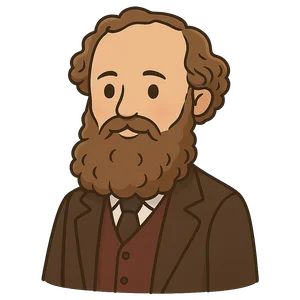
James Clerk Maxwell
James Clerk Maxwell was a Scottish physicist best known for his revolutionary work in classical…
Reads at Grades 6–8 Listens at Grades 4–8
James Clerk Maxwell: The Man Who Connected the World
Hello there. My name is James Clerk Maxwell, and I was a scientist who helped change the way we see the world. My story begins in the beautiful city of Edinburgh, Scotland, where I was born on June 13th, 1831. From my earliest days, I was filled with an endless curiosity about how everything worked. I would follow my father, John, around our estate, constantly pointing at things and asking, 'What's the go o' that?' I wanted to understand the purpose and mechanics of everything, from the way water flowed to how a spinning top stayed upright. My world changed when I was only eight years old, in 1839, when my dear mother, Katherine, passed away. Her loss brought my father and me even closer. He encouraged my scientific mind, and by the time I was 14, I wrote my very first scientific paper. In 1846, I presented my ideas on a special method for drawing perfect oval shapes, and I knew then that my life's path would be one of discovery.
My hunger for knowledge led me to university at a young age. In 1847, when I was just 16, I began my studies at the University of Edinburgh. Three years later, in 1850, I moved to England to attend the very prestigious Trinity College at the University of Cambridge. There, I was surrounded by some of the greatest minds in the world, which only pushed me to think about bigger and more complex problems. One of the greatest cosmic puzzles of my time was about the rings of Saturn. Astronomers wondered what they could possibly be made of. Were they solid like a giant hoop? Or were they made of liquid? I decided to tackle the problem using the tool I trusted most: mathematics. Through careful calculations, I was able to prove that the rings could not be solid or liquid. Instead, they had to be composed of countless small, separate particles, all orbiting the planet together. In 1859, I was honored to receive the Adams Prize for this important discovery.
After solving a puzzle in the heavens, I turned my attention to something we see every day: light and color. I developed a theory that our eyes see color because they have three different types of receivers, one sensitive to red light, one to green, and one to blue. To prove this idea, I set out to take the world's first permanent color photograph. In 1861, I captured an image of a colorful tartan ribbon, a small tribute to my Scottish heritage. It was a remarkable moment, proving that color could be captured and preserved using scientific principles. My curiosity didn't stop with light. I also became fascinated by the invisible world of gases. I wanted to understand the behavior of the tiny, fast-moving molecules that make up the air we breathe. I developed a new way of describing their speeds and energies, a set of ideas that became known as the kinetic theory of gases, helping other scientists understand the nature of heat and pressure.
Now, I want to tell you about my greatest discovery, the work for which I am most remembered. In my time, scientists like the great Michael Faraday had made incredible discoveries about electricity and magnetism, but everyone viewed them as two separate, distinct forces. I spent years studying their experiments and filling notebooks with mathematical calculations. I had a strong feeling they were connected, but I needed to prove it. In 1865, I published a paper called 'A Dynamical Theory of the Electromagnetic Field.' In it, I presented four famous equations that described exactly how electricity and magnetism worked together. They showed that these two forces were actually just different aspects of a single, unified force: electromagnetism. My equations led to an even more stunning conclusion. They predicted that waves of electromagnetism should travel through space at a very specific speed—the speed of light. This meant that light itself was an electromagnetic wave, and it also meant that other, invisible electromagnetic waves must exist all around us.
My discoveries brought me great recognition, and in 1871, I was given a new and exciting challenge. I was invited to become the first-ever Cavendish Professor of Physics at the University of Cambridge. My most important task wasn't just to teach, but to create a new home for science. I was asked to design and oversee the building of a world-class laboratory dedicated to experimental physics. I poured my energy into the project, carefully planning every detail of what would become the Cavendish Laboratory. I wanted it to be the perfect place for future generations of curious minds to test their ideas and uncover the secrets of the universe. It was a great joy for me to work there, teaching students and collaborating with other scientists who shared my passion for understanding the world.
My journey of discovery came to an end on November 5th, 1879, when I passed away from an illness. I lived to be 48 years old. Although my life was not as long as some, my ideas lived on. The invisible electromagnetic waves that my equations predicted were discovered years later, and they laid the foundation for incredible inventions I never got to see, like the radio, television, and even the Wi-Fi you use today. Great scientists who came after me, including Albert Einstein, said that my work was the essential stepping stone for their own discoveries about space, time, and gravity. I am remembered for showing the world that even the most mysterious forces of nature are connected by beautiful, elegant mathematical laws, just waiting to be discovered.
Wow facts
About
James Clerk Maxwell was a Scottish physicist best known for his revolutionary work in classical electromagnetic theory, which united electricity, magnetism, and light as different manifestations of the same phenomenon.
Take a Quiz
Question 1 of 5
What was James Clerk Maxwell's most important discovery, according to his story?
Explore next




Want to do even more?
Go beyond exploring. Unlock tools that turn every story into real learning.

Storypie Plus for families
Full stories, quizzes, and printables. Nights and car rides, sorted.
- Unlimited audio stories
- Create Mode: your child stars in the story
- Offline downloads
- Printable worksheets & coloring pages

Why Storypie for Schools
Students engaged. Prep in seconds. Evenings back to you.
- Worksheets & Quizzes
- Classroom Management
- Formative Assessment
- Custom Curriculum & Lesson Plans
- 27 Languages

Why Storypie for Homeschool
Curriculum done. They'll ask for more. Hours back in your day.
- Worksheet Generator
- First-Person Audio Stories
- Built-in Comprehension Quizzes
- Custom Curriculum & Lesson Plans
- Print & Go Activities