English


Jack Kilby
Jack Kilby was an American electrical engineer who co-invented the first integrated circuit (microchip) in…
Reads at Grades 3–5 Listens at Grades 1–5
Print & create
Answer keys·No prep·Free with an account
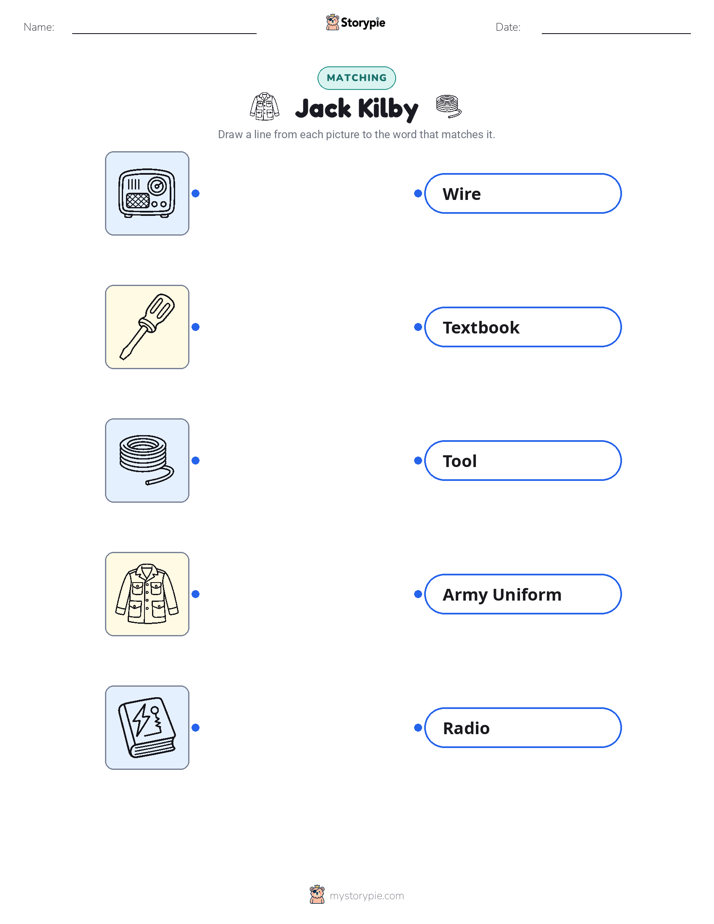
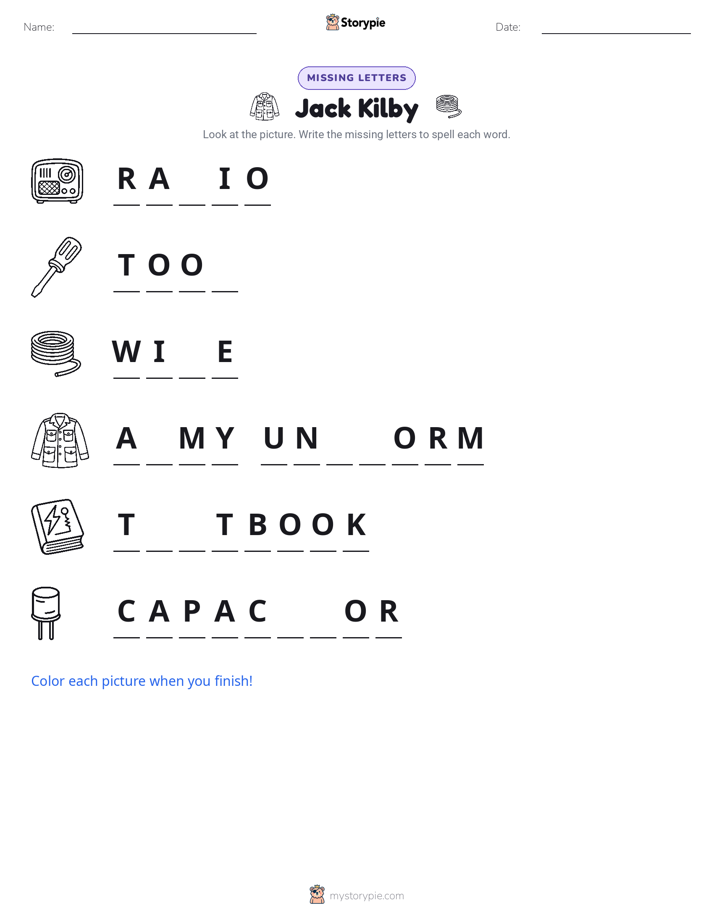
28 worksheets · answer keys · full story · quiz · Ages 8-10 · CEFR B1
Plus adds 244,000+ more stories in 27 languages, audio for every one, and printables for all of them.
Just want Jack Kilby?

Hello! My name is Jack Kilby, and I invented something so small it can fit on your fingertip, but so powerful it changed the world. I was born on November 8th, 1923, in Jefferson City, Missouri, but I grew up in Great Bend, Kansas. My dad ran an electric company, and our town was small, so when ice storms knocked out the power, my dad was the one who fixed it. I loved going with him and seeing how all the wires and parts worked together. I even became a ham radio operator, which let me talk to people far away using radio waves. All those gadgets and gizmos sparked my curiosity and made me want to solve electrical puzzles.
When it was time for college, I wanted to study electrical engineering. My education was paused when I served in the army during World War II. After the war, I finally earned my degree from the University of Illinois in 1947. I started working, but I never stopped learning. I even got my master's degree by going to school at night. I was always fascinated by electronics, but I saw a big problem. To make things like radios and computers more powerful, you needed more and more parts. The machines were becoming huge, expensive, and tangled with wires. People called this the 'tyranny of numbers,' and I wanted to find a way to escape it.
In 1958, I started a new job at a company called Texas Instruments in Dallas, Texas. Since I was new, I didn't get a summer vacation like everyone else. So, while the building was nearly empty, I had a lot of quiet time to think. I kept thinking about the 'tyranny of numbers.' What if, instead of connecting hundreds of separate parts with wires, you could build all the parts—the resistors, the capacitors, the transistors—out of the very same piece of material? It was a simple idea, but no one had ever done it before. I sketched my idea in my notebook and couldn't wait to show my bosses when they returned from their vacation.
Jack Kilby: The Man Who Invented the Microchip
Hello! My name is Jack Kilby, and I invented something so small it can fit on your fingertip, but so powerful it changed the world. I was born on November 8th, 1923, in Jefferson City, Missouri, but I grew up in Great Bend, Kansas. My dad ran an electric company, and our town was small, so when ice storms knocked out the power, my dad was the one who fixed it. I loved going with him and seeing how all the wires and parts worked together. I even became a ham radio operator, which let me talk to people far away using radio waves. All those gadgets and gizmos sparked my curiosity and made me want to solve electrical puzzles.
When it was time for college, I wanted to study electrical engineering. My education was paused when I served in the army during World War II. After the war, I finally earned my degree from the University of Illinois in 1947. I started working, but I never stopped learning. I even got my master's degree by going to school at night. I was always fascinated by electronics, but I saw a big problem. To make things like radios and computers more powerful, you needed more and more parts. The machines were becoming huge, expensive, and tangled with wires. People called this the 'tyranny of numbers,' and I wanted to find a way to escape it.
In 1958, I started a new job at a company called Texas Instruments in Dallas, Texas. Since I was new, I didn't get a summer vacation like everyone else. So, while the building was nearly empty, I had a lot of quiet time to think. I kept thinking about the 'tyranny of numbers.' What if, instead of connecting hundreds of separate parts with wires, you could build all the parts—the resistors, the capacitors, the transistors—out of the very same piece of material? It was a simple idea, but no one had ever done it before. I sketched my idea in my notebook and couldn't wait to show my bosses when they returned from their vacation.
My bosses liked my idea and gave me the green light to try and build it. I got to work in the lab. On September 12th, 1958, I was ready. I had a tiny slice of a material called germanium, and I had built a complete, working electronic circuit on it. It wasn't pretty—it was held together with wax and had a few wires sticking out—but when we tested it, it worked perfectly! I had created the world's first integrated circuit, which you might know today as a microchip. Around the same time, another smart engineer named Robert Noyce also invented an integrated circuit. Together, our work started a revolution.
My little invention made it possible to make electronics smaller, faster, and much cheaper. A few years later, in 1967, I used my invention to help create another cool gadget: the first handheld electronic calculator. Before then, calculators were as big as cash registers! The integrated circuit I helped create is now in almost every piece of technology you use, from your family's car to the computer at your school and the phone in your parent's hand. It all started with that one quiet summer and a big idea.
In the year 2000, I was honored to receive the Nobel Prize in Physics for my invention. It was an incredible moment. I lived to be 81 years old, and I was so happy to see how my work helped make the world a more connected place. People remember me as one of the inventors of the microchip, the tiny brain that powers our modern world. I hope my story shows you that sometimes the biggest changes can come from the smallest ideas, so never stop being curious and looking for new ways to solve problems.
Wow facts
About
Jack Kilby was an American electrical engineer who co-invented the first integrated circuit (microchip) in 1958 while working at Texas Instruments, an invention that earned him the Nobel Prize in Physics in 2000.
Take a Quiz
Question 1 of 5
Why did Jack Kilby have a lot of quiet time to think during the summer of 1958?
Explore next





Want to do even more?
Go beyond exploring. Unlock tools that turn every story into real learning.

Storypie Plus for families
Full stories, quizzes, and printables. Nights and car rides, sorted.
- Unlimited audio stories
- Create Mode: your child stars in the story
- Offline downloads
- Printable worksheets & coloring pages

Why Storypie for Schools
Students engaged. Prep in seconds. Evenings back to you.
- Worksheets & Quizzes
- Classroom Management
- Formative Assessment
- Custom Curriculum & Lesson Plans
- 27 Languages

Why Storypie for Homeschool
Curriculum done. They'll ask for more. Hours back in your day.
- Worksheet Generator
- First-Person Audio Stories
- Built-in Comprehension Quizzes
- Custom Curriculum & Lesson Plans
- Print & Go Activities