English

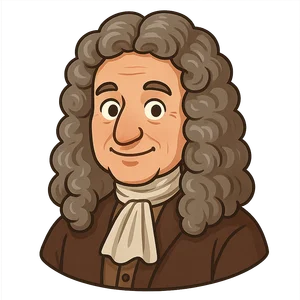
Jacob Bernoulli
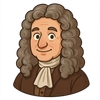
Jacob Bernoulli was a prominent Swiss mathematician and scientist…
Reads at Grades 6–8 Listens at Grades 4–8
Print & create
Answer keys·No prep·Free with an account
28 worksheets · answer keys · full story · quiz · Ages 10-12 · CEFR B2
Plus adds 244,000+ more stories in 27 languages, audio for every one, and printables for all of them.
Just want Jacob Bernoulli?
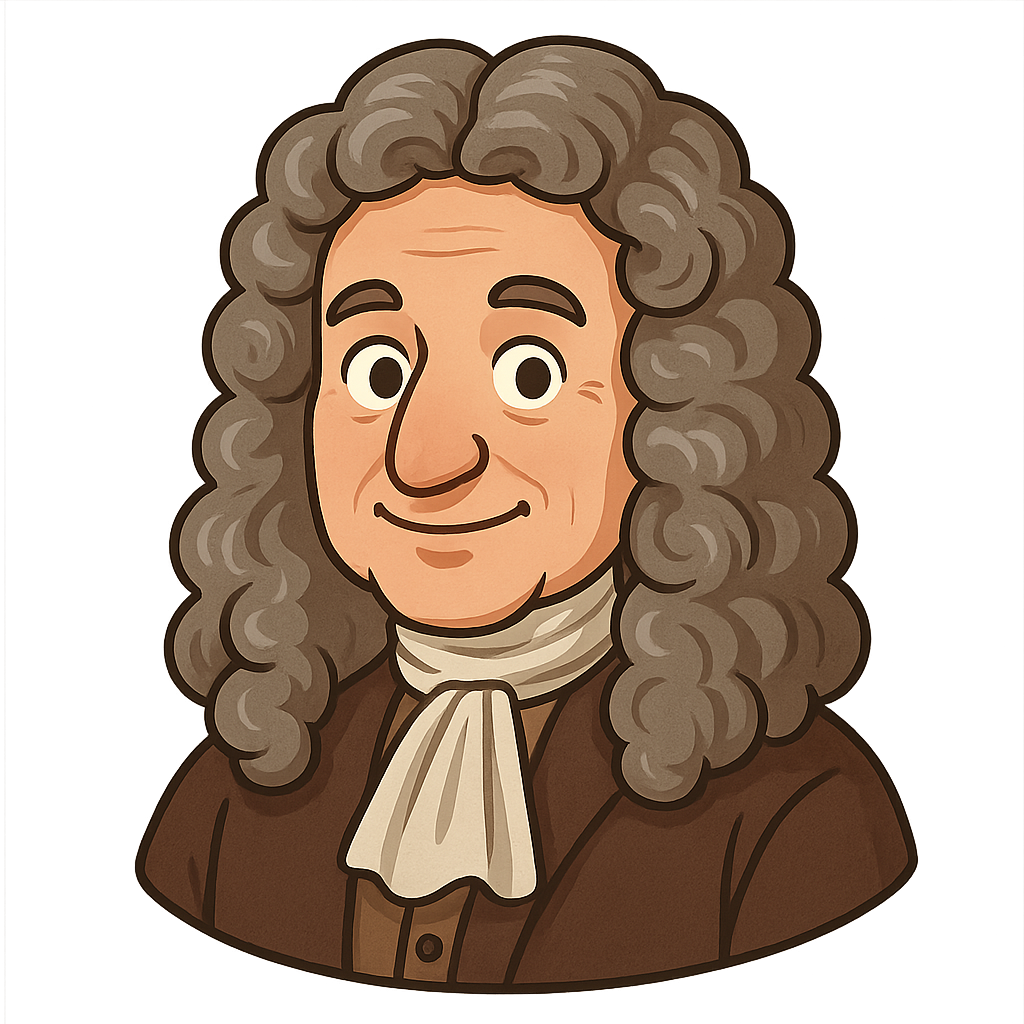
Hello, my name is Jacob Bernoulli, and I am a mathematician who found beauty in the patterns of numbers and the logic of chance. I was born in the city of Basel, Switzerland, on December 27th, 1654. In my time, the world was alive with new scientific ideas, but my family had a different path in mind for me. My father insisted that I study serious subjects like religion and philosophy. He believed these were the most honorable pursuits, and to please him, I did as he asked. I attended the University of Basel and earned a degree in philosophy in 1671, followed by a degree in theology in 1676. But even as I studied these subjects, my mind was always drifting to the stars and the elegant certainty of mathematics. I would study astronomy and mathematics in secret, filling my notebooks with equations and theories that truly captured my imagination. I knew, deep down, that my life's work would not be in a church, but in the world of numbers.
After completing my formal studies in 1676, I felt a strong pull to see more of the world and meet the great minds of my era. I set out on a grand tour of Europe that would last until 1682. My journey took me to France, where I was surrounded by new ideas in art and science. I traveled to the Netherlands and then to England, where I had the incredible opportunity to meet brilliant thinkers, including the famous scientist Robert Boyle. Speaking with these men and learning about their discoveries confirmed what I had always felt: my destiny was in science and mathematics. This trip was a turning point for me. When I returned to my hometown of Basel in 1683, I was filled with a new sense of purpose. I began teaching at the university, sharing my knowledge of mechanics and mathematics with students, finally able to dedicate my life to the subjects I loved.
Jacob Bernoulli: The Art of Chance
Hello, my name is Jacob Bernoulli, and I am a mathematician who found beauty in the patterns of numbers and the logic of chance. I was born in the city of Basel, Switzerland, on December 27th, 1654. In my time, the world was alive with new scientific ideas, but my family had a different path in mind for me. My father insisted that I study serious subjects like religion and philosophy. He believed these were the most honorable pursuits, and to please him, I did as he asked. I attended the University of Basel and earned a degree in philosophy in 1671, followed by a degree in theology in 1676. But even as I studied these subjects, my mind was always drifting to the stars and the elegant certainty of mathematics. I would study astronomy and mathematics in secret, filling my notebooks with equations and theories that truly captured my imagination. I knew, deep down, that my life's work would not be in a church, but in the world of numbers.
After completing my formal studies in 1676, I felt a strong pull to see more of the world and meet the great minds of my era. I set out on a grand tour of Europe that would last until 1682. My journey took me to France, where I was surrounded by new ideas in art and science. I traveled to the Netherlands and then to England, where I had the incredible opportunity to meet brilliant thinkers, including the famous scientist Robert Boyle. Speaking with these men and learning about their discoveries confirmed what I had always felt: my destiny was in science and mathematics. This trip was a turning point for me. When I returned to my hometown of Basel in 1683, I was filled with a new sense of purpose. I began teaching at the university, sharing my knowledge of mechanics and mathematics with students, finally able to dedicate my life to the subjects I loved.
My career took a significant step forward in 1687 when I was appointed the Professor of Mathematics at the University of Basel. This was a position of great respect, and it allowed me to dive even deeper into my research. It was during this time that my talented younger brother, Johann, also began to show his incredible skill in mathematics. Together, we became fascinated by a revolutionary new field of math called calculus, which had been developed by a genius named Gottfried Leibniz. Calculus was a powerful tool for understanding change and motion, and Johann and I were among the very first people to truly master its complexities. We worked closely, solving problems and pushing the boundaries of this new mathematics. However, our shared passion soon turned into a famous rivalry. We began to challenge each other publicly, sending difficult problems back and forth, each trying to prove he was the superior mathematician. It was a fierce competition, but it pushed both of us to achieve amazing things.
While the rivalry with my brother was well known, my most important work was a project I spent two decades developing. It was a book I called Ars Conjectandi, which is Latin for 'The Art of Conjecturing.' This book was not about calculus, but about something that affects everyone: probability, which is the mathematics of chance. I wanted to understand the logic behind things that seem random, like flipping a coin. In this book, I described one of my most important discoveries, which is now called the Law of Large Numbers. The idea is quite simple: the more times you repeat an experiment, like flipping a coin, the closer your results will get to the expected outcome. If you flip it ten times, you might get seven heads, but if you flip it a thousand times, your results will be much closer to half heads and half tails. I was also deeply fascinated by a shape called the logarithmic spiral, a perfect curve that grows but never changes its form. I worked on Ars Conjectandi for over twenty years, but sadly, it was not published until 1713, several years after my life had ended.
I lived to be 50 years old and passed away in my beloved hometown of Basel on August 16th, 1705. I remained so captivated by the logarithmic spiral that I requested it be carved on my tombstone, along with the Latin words 'Eadem mutata resurgo,' which means 'Though changed, I shall arise the same.' I felt this phrase captured the spiral's constant and beautiful nature. My work in Ars Conjectandi became a foundation for the modern field of statistics, which is used every day in science, medicine, and business to make sense of our world. My brother and I also began a remarkable family tradition. The Bernoulli name would become famous in the world of mathematics, as many of my relatives in the following generations became brilliant mathematicians themselves, carrying on the legacy we began.
Wow facts
About
Jacob Bernoulli was a prominent Swiss mathematician and scientist, one of the many notable members of the Bernoulli family. He made significant contributions to calculus and was a pioneer in the field of probability theory, formulating an early version of the Law of Large Numbers.
Take a Quiz
Question 1 of 5
In the story, the word 'conjecturing' is used. Based on the context of the book 'The Art of Conjecturing,' what does this word most likely mean?
Explore next





Want to do even more?
Go beyond exploring. Unlock tools that turn every story into real learning.

Storypie Plus for families
Full stories, quizzes, and printables. Nights and car rides, sorted.
- Unlimited audio stories
- Create Mode: your child stars in the story
- Offline downloads
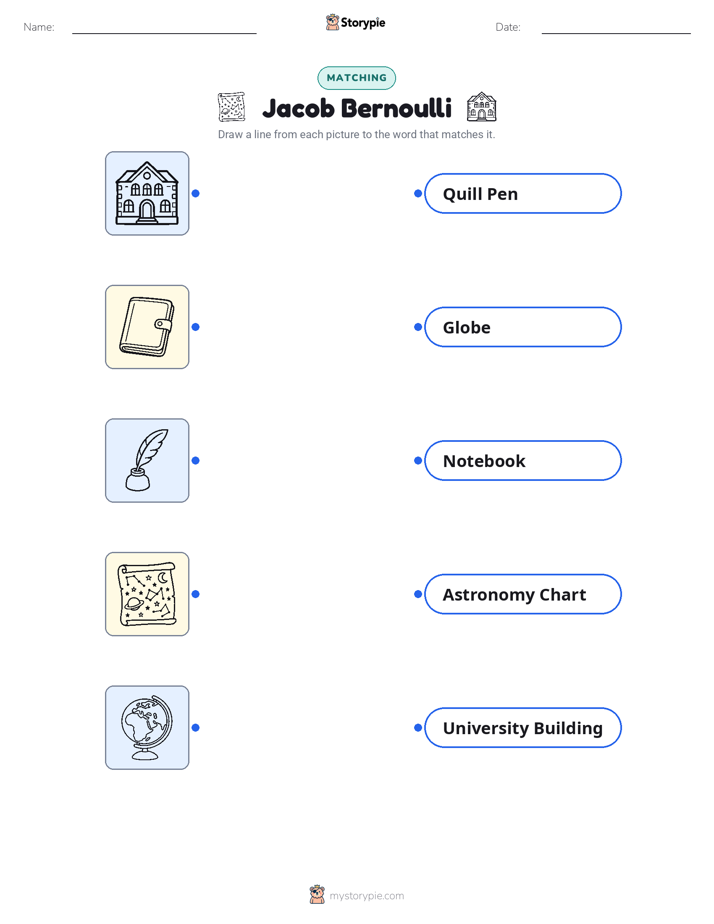
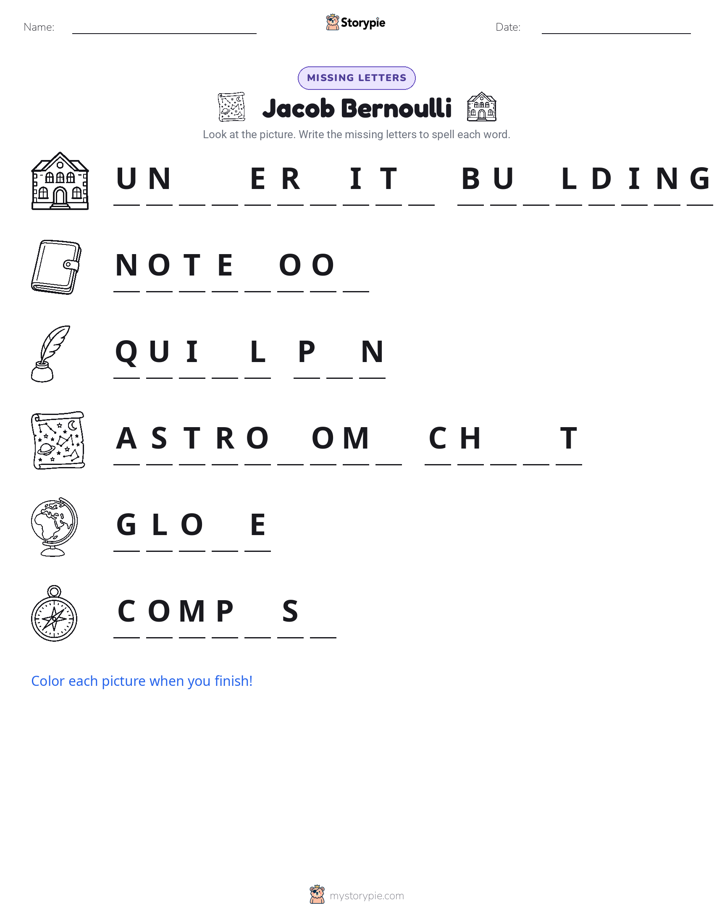
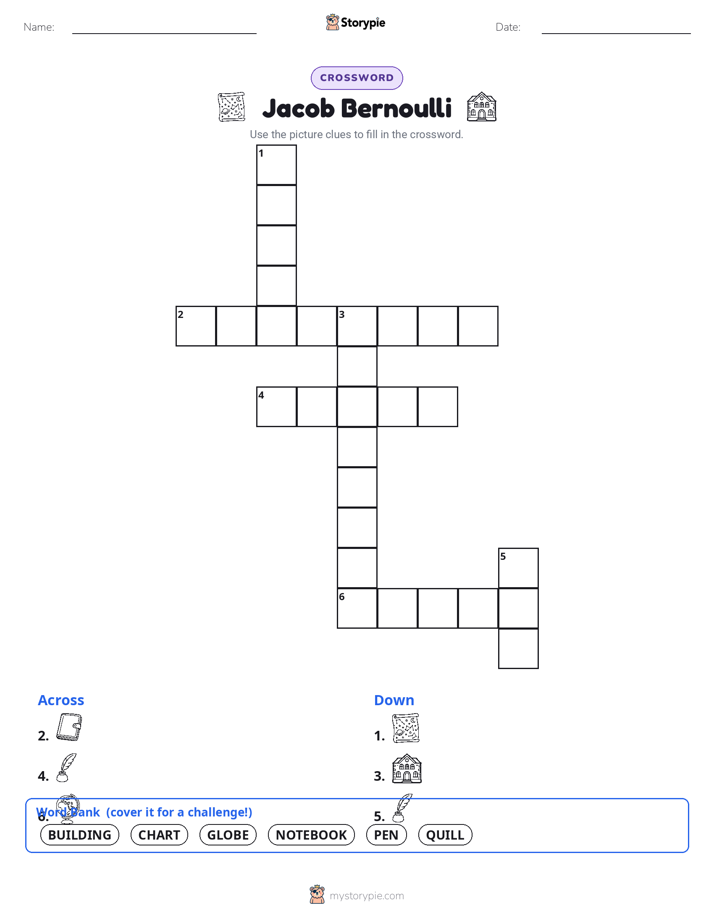
- Printable worksheets & coloring pages

Why Storypie for Schools
Students engaged. Prep in seconds. Evenings back to you.
- Worksheets & Quizzes
- Classroom Management
- Formative Assessment
- Custom Curriculum & Lesson Plans
- 27 Languages

Why Storypie for Homeschool
Curriculum done. They'll ask for more. Hours back in your day.
- Worksheet Generator
- First-Person Audio Stories
- Built-in Comprehension Quizzes
- Custom Curriculum & Lesson Plans
- Print & Go Activities