English

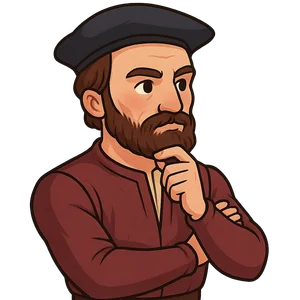
Jacques Cartier
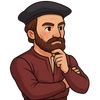
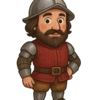
Jacques Cartier was a French-Breton maritime explorer for France.
Reads at Grades 6–8 Listens at Grades 4–8
Print & create
Answer keys·No prep·Free with an account
28 worksheets · answer keys · full story · quiz · Ages 10-12 · CEFR B2
Plus adds 102,000+ more stories in 27 languages, audio for every one, and printables for all of them.
Just want Jacques Cartier?
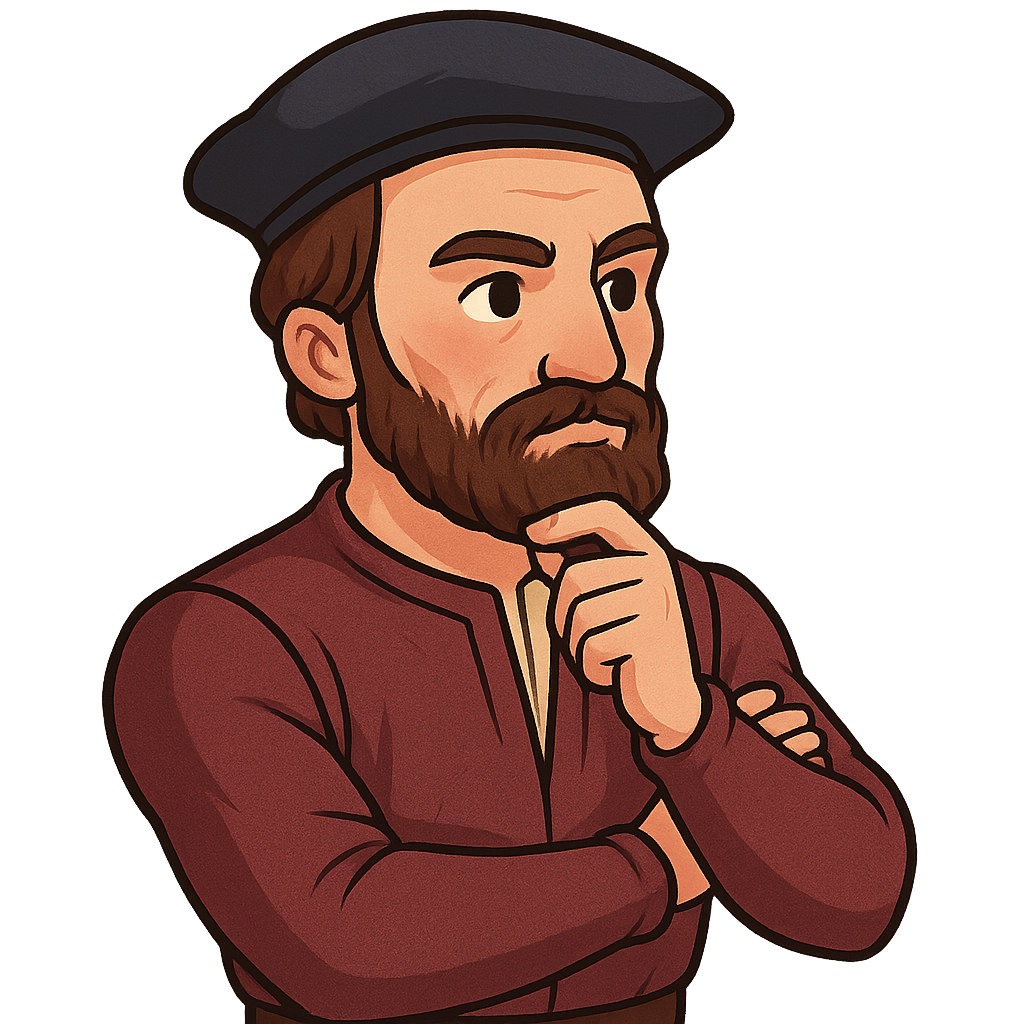
Hello, my name is Jacques Cartier, and I was an explorer who sailed for the king of France. My story begins in the year 1491, in the busy port town of Saint-Malo, France, where I was born. Growing up, I was surrounded by the sights and sounds of the sea. Tall ships with giant sails filled the harbor, and sailors from faraway lands walked the cobblestone streets, telling tales of their adventures. From a very young age, I knew I wanted to be one of them. The ocean called to me, promising discovery and new horizons. I worked hard to become a respected mariner, learning everything I could about navigation and sailing. In 1520, I married a woman named Mary Catherine des Granches. Her family was well-connected, and this marriage helped me gain the attention of important people who could help me achieve my dreams of exploration.
During my lifetime, Europe was buzzing with excitement in an era that historians now call the Age of Discovery. Explorers from Spain and Portugal were returning with incredible riches and stories from new lands across the Atlantic Ocean. My king, Francis I of France, watched this and grew determined that France should not be left behind. He wanted to find new trade routes to Asia and claim new territories and treasures for our country. In 1534, the king gave me a mission of great importance. He commanded me to sail west, across the vast ocean, to explore the northern parts of the New World. My primary goal was to find a sea route through this new continent to Asia, a passage that would later become known as the Northwest Passage.
Jacques Cartier: An Explorer's Story
Hello, my name is Jacques Cartier, and I was an explorer who sailed for the king of France. My story begins in the year 1491, in the busy port town of Saint-Malo, France, where I was born. Growing up, I was surrounded by the sights and sounds of the sea. Tall ships with giant sails filled the harbor, and sailors from faraway lands walked the cobblestone streets, telling tales of their adventures. From a very young age, I knew I wanted to be one of them. The ocean called to me, promising discovery and new horizons. I worked hard to become a respected mariner, learning everything I could about navigation and sailing. In 1520, I married a woman named Mary Catherine des Granches. Her family was well-connected, and this marriage helped me gain the attention of important people who could help me achieve my dreams of exploration.
During my lifetime, Europe was buzzing with excitement in an era that historians now call the Age of Discovery. Explorers from Spain and Portugal were returning with incredible riches and stories from new lands across the Atlantic Ocean. My king, Francis I of France, watched this and grew determined that France should not be left behind. He wanted to find new trade routes to Asia and claim new territories and treasures for our country. In 1534, the king gave me a mission of great importance. He commanded me to sail west, across the vast ocean, to explore the northern parts of the New World. My primary goal was to find a sea route through this new continent to Asia, a passage that would later become known as the Northwest Passage.
On April 20th, 1534, with two ships and a hopeful crew, I set sail from France. The journey across the Atlantic was swift, and after just 20 days, we sighted land. We had arrived in a world that was completely new to us. I spent that summer exploring the coastline, which I now know as the Gulf of St. Lawrence. It was here that I first met the Indigenous peoples of the land, including the Mi'kmaq, who were skilled fishers. Later, I encountered a group of Iroquoians from a village called Stadacona. On July 24th, on the Gaspé Peninsula, I ordered my men to raise a large wooden cross, a symbol to claim the territory for France. The Iroquoian chief, a man named Donnacona, was present and showed great concern, making it clear this was his people's land. Before returning to France, I made a difficult decision. I brought Donnacona's two sons with me, promising their father that they would learn our language and that I would bring them back on my next voyage.
My second voyage began the following year, in May of 1535. This time, I had three ships and Donnacona's sons to act as our guides. They showed me the way into a magnificent, wide river, which I named the St. Lawrence. We sailed up this great river to their home village of Stadacona, near modern-day Quebec City. The Iroquoians there were welcoming at first. I was curious to see what lay further upriver, so I continued to a much larger village called Hochelaga. Near this village stood a tall hill, which I climbed to get a view of the surrounding land. I named it Mount Royal, which is where the city of Montreal now stands. We decided to spend the winter near Stadacona, but we were unprepared for the harsh Canadian cold. A terrible illness called scurvy spread through my crew. Many of my men were dying until the Iroquoians showed us their remedy: a tea made from the bark and leaves of a white cedar tree. This medicine saved us. Despite their help, before I sailed back to France in 1536, I captured Chief Donnacona and several other Iroquoians to take with me, hoping they could tell the king about the riches of their land.
My third and final voyage took place in 1541. The king's goal this time was not just exploration, but to establish a permanent French colony. When I returned to the St. Lawrence, I found that the Iroquoians were no longer friendly. I had broken my promise to bring their people back, as Chief Donnacona and the others had passed away in France. The trust between us was gone. Near our settlement, my men and I found something that filled us with excitement. The ground glittered with what we believed were heaps of gold and diamonds. Convinced I had found a great fortune, I disobeyed my orders to wait for the colony's leader and secretly sailed back to France in 1542. My heart sank when I arrived. The royal experts examined my treasure and delivered the disappointing news: my 'gold' was just worthless iron pyrite, and the 'diamonds' were only quartz crystals. My great discovery was nothing more than 'fool's gold.'
After my final voyage, I returned to my home near Saint-Malo and settled down on my estate. My days of exploring the great seas were over. I lived to be 65 years old and passed away on September 1st, 1557. While I never found the Northwest Passage to Asia or the great riches I searched for, my journeys were not a failure. From the Iroquoian word 'kanata,' meaning 'village,' I gave a great country its name: Canada. I also created the first detailed maps of the St. Lawrence River. These maps became essential guides for the French explorers who followed me, paving the way for them to build a new nation in the lands I was the first European to chart.
Wow facts
About
Jacques Cartier was a French-Breton maritime explorer for France. He was among the first Europeans to describe and map the Gulf of Saint Lawrence and the shores of the Saint Lawrence River, which he named 'The Country of Canadas'.
Take a Quiz
Question 1 of 5
What was the main reason King Francis I sent Jacques Cartier on his first voyage in 1534?
Explore next



Want to do even more?
Go beyond exploring. Unlock tools that turn every story into real learning.

Storypie Plus for families
Full stories, quizzes, and printables. Nights and car rides, sorted.
- Unlimited audio stories
- Create Mode: your child stars in the story
- Offline downloads
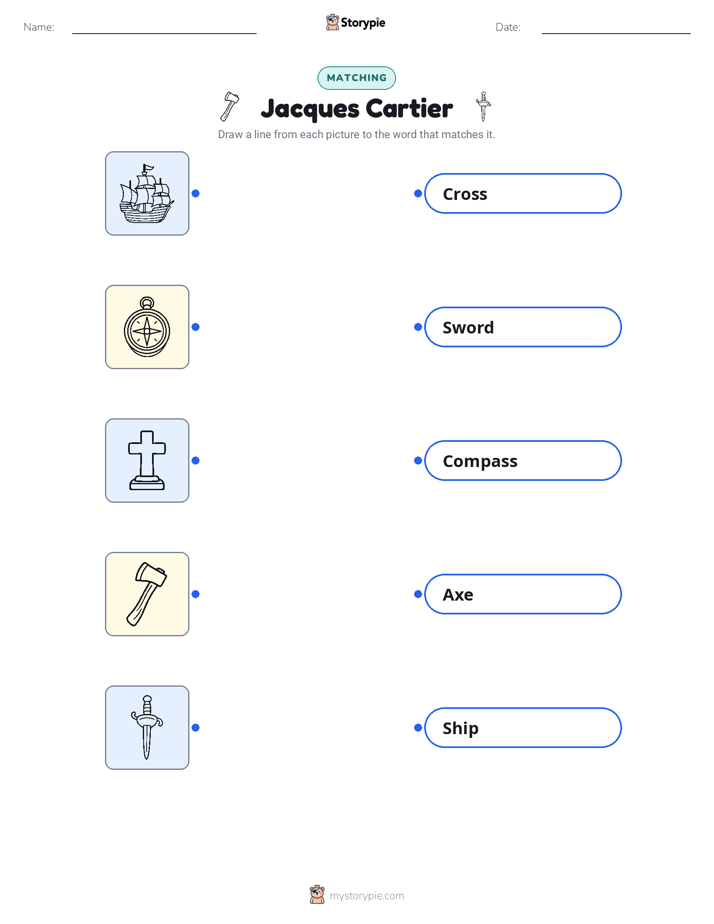
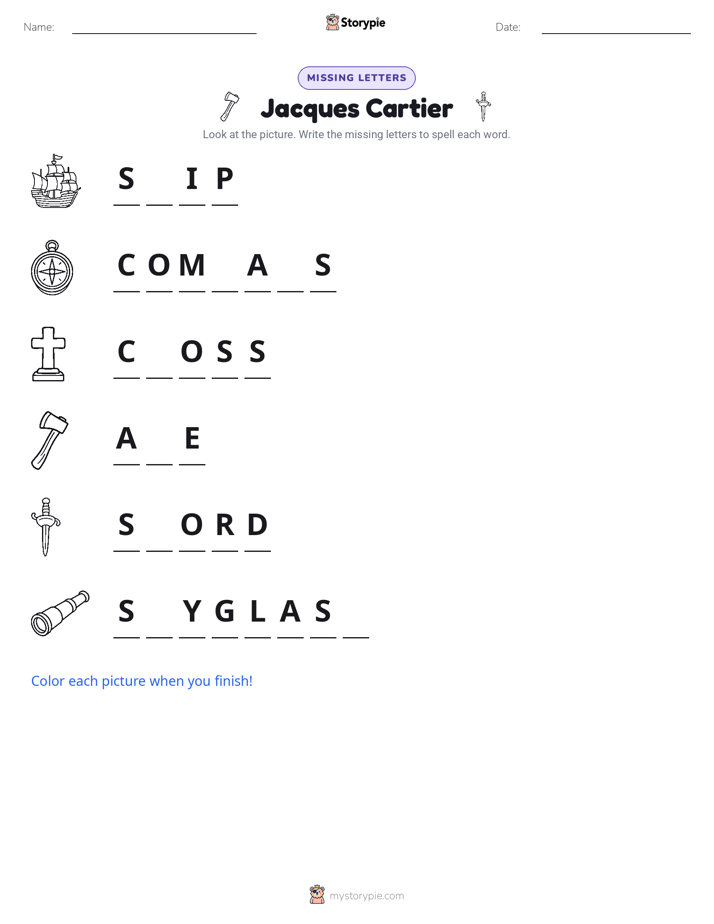
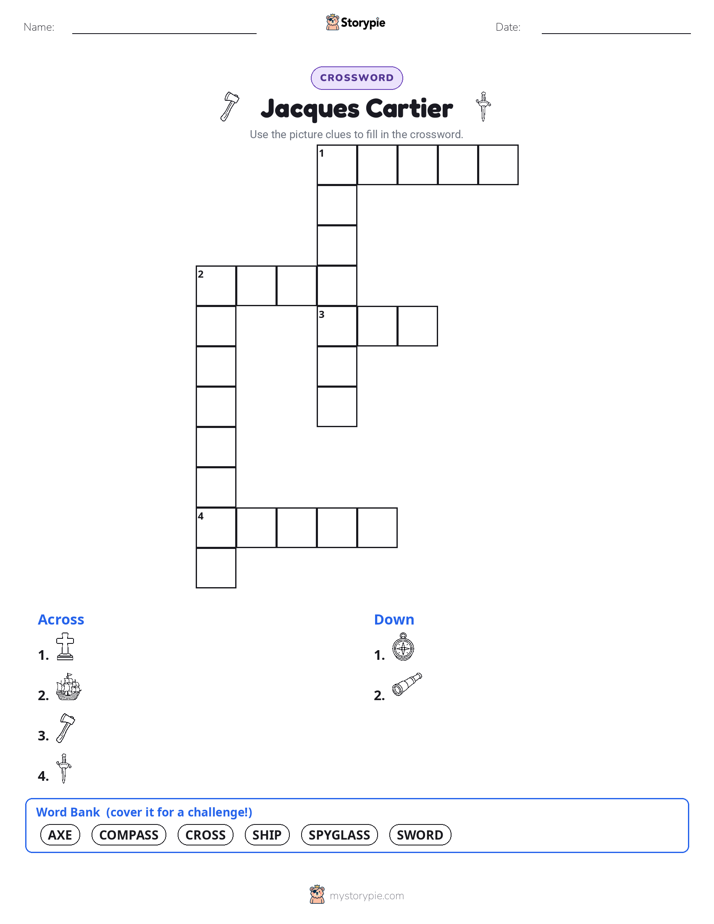
- Printable worksheets & coloring pages

Why Storypie for Schools
Students engaged. Prep in seconds. Evenings back to you.
- Worksheets & Quizzes
- Classroom Management
- Formative Assessment
- Custom Curriculum & Lesson Plans
- 27 Languages

Why Storypie for Homeschool
Curriculum done. They'll ask for more. Hours back in your day.
- Worksheet Generator
- First-Person Audio Stories
- Built-in Comprehension Quizzes
- Custom Curriculum & Lesson Plans
- Print & Go Activities