English

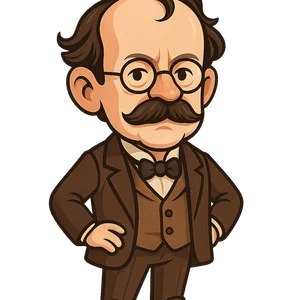
J. J. Thomson
J.
Reads at Grades 6–8 Listens at Grades 4–8
Print & create
Answer keys·No prep·Free with an account
28 worksheets · answer keys · full story · quiz · Ages 10-12 · CEFR B2
Plus adds 208,000+ more stories in 27 languages, audio for every one, and printables for all of them.
Just want J. J. Thomson?
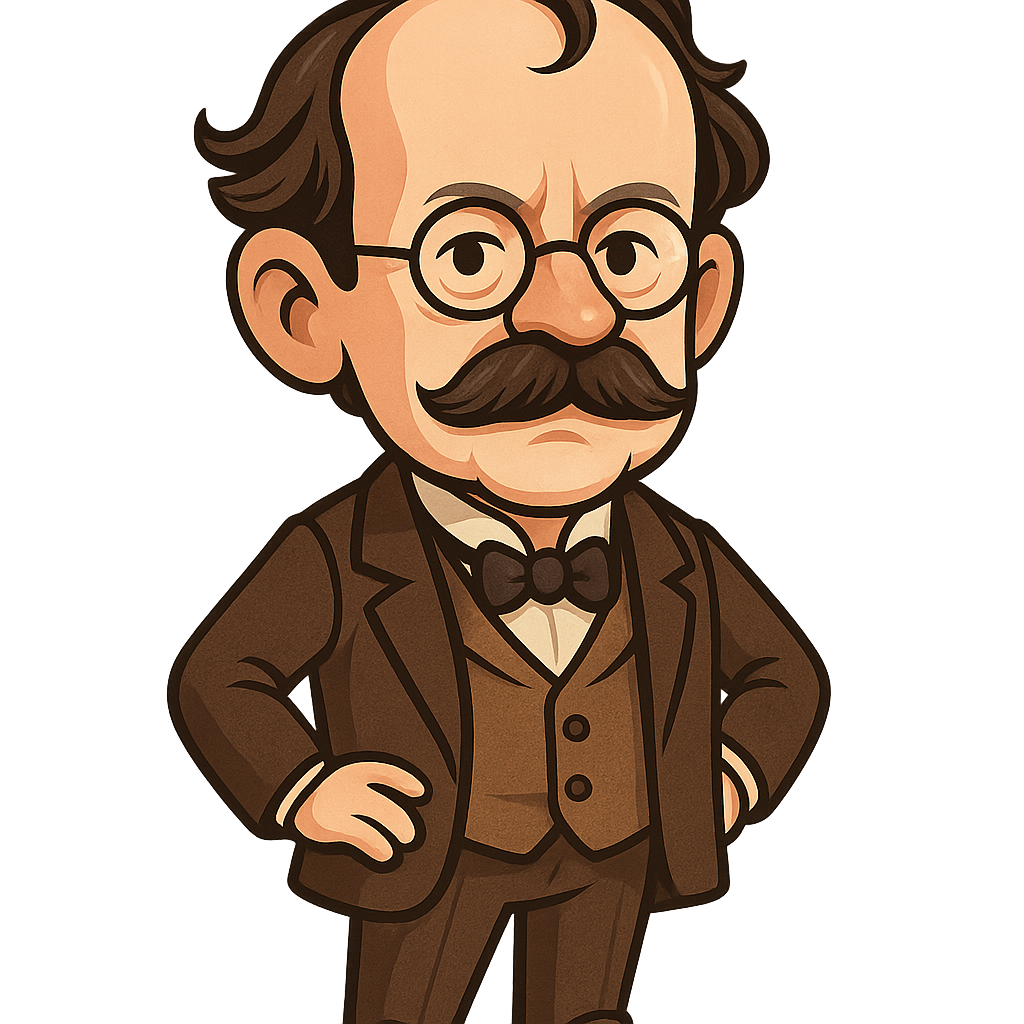
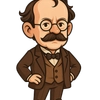
Hello. My name is Joseph John Thomson, but you can call me J. J., as most people did. My story begins on December 18th, 1856, in a bustling city called Manchester, England. The world back then was full of steam engines and new inventions, and I was born right in the middle of this exciting time. My father owned a bookshop, and it was my favorite place in the world. I spent countless hours surrounded by books on every imaginable subject, which sparked a deep curiosity in me about how things worked. My parents always encouraged my questions. They saw that I had a mind for figuring things out and wanted to give me the best education possible. Their plan was for me to become an engineer, a person who designs and builds amazing machines. To get started, they enrolled me at Owens College in 1870 when I was only 14 years old, which was quite young for a college student. I was excited to learn about engineering, but life has a way of changing your path. When my father passed away, our family's plans had to change, and my journey into engineering took a different turn, leading me toward the world of science and discovery.
After my time at Owens College, a new door opened for me. In 1876, I earned a special scholarship to study mathematics at Trinity College, which is part of Cambridge University. Cambridge was, and still is, one of the most respected and famous universities in the entire world. Imagine walking through ancient halls where some of history's greatest thinkers had studied. It was thrilling. While I was a student of mathematics, I became fascinated by how I could use numbers and equations to understand the physical world—the world of motion, energy, and matter. It was like learning a secret language that could explain the universe’s puzzles. I worked very hard, and my passion for science grew stronger every day. My dedication paid off in a way I never expected. In 1884, when I was only 28 years old, I was given an incredible opportunity. I was appointed the head of the famous Cavendish Laboratory at Cambridge, taking on the role of the Cavendish Professor of Experimental Physics. This was a place where groundbreaking scientific experiments were happening. It was a huge responsibility, especially for someone so young, but I was ready to lead the way and explore the deepest mysteries of nature.
J. J. Thomson: The Man Who Discovered the Electron
Hello. My name is Joseph John Thomson, but you can call me J. J., as most people did. My story begins on December 18th, 1856, in a bustling city called Manchester, England. The world back then was full of steam engines and new inventions, and I was born right in the middle of this exciting time. My father owned a bookshop, and it was my favorite place in the world. I spent countless hours surrounded by books on every imaginable subject, which sparked a deep curiosity in me about how things worked. My parents always encouraged my questions. They saw that I had a mind for figuring things out and wanted to give me the best education possible. Their plan was for me to become an engineer, a person who designs and builds amazing machines. To get started, they enrolled me at Owens College in 1870 when I was only 14 years old, which was quite young for a college student. I was excited to learn about engineering, but life has a way of changing your path. When my father passed away, our family's plans had to change, and my journey into engineering took a different turn, leading me toward the world of science and discovery.
After my time at Owens College, a new door opened for me. In 1876, I earned a special scholarship to study mathematics at Trinity College, which is part of Cambridge University. Cambridge was, and still is, one of the most respected and famous universities in the entire world. Imagine walking through ancient halls where some of history's greatest thinkers had studied. It was thrilling. While I was a student of mathematics, I became fascinated by how I could use numbers and equations to understand the physical world—the world of motion, energy, and matter. It was like learning a secret language that could explain the universe’s puzzles. I worked very hard, and my passion for science grew stronger every day. My dedication paid off in a way I never expected. In 1884, when I was only 28 years old, I was given an incredible opportunity. I was appointed the head of the famous Cavendish Laboratory at Cambridge, taking on the role of the Cavendish Professor of Experimental Physics. This was a place where groundbreaking scientific experiments were happening. It was a huge responsibility, especially for someone so young, but I was ready to lead the way and explore the deepest mysteries of nature.
At the Cavendish Laboratory, my team and I focused on one of the biggest scientific puzzles of the late 19th century: cathode rays. For years, scientists had been studying these mysterious rays that appeared inside glass tubes when most of the air was pumped out and an electric current was passed through them. No one knew what they were made of. Were they waves of energy, or were they streams of tiny particles? I decided to find out. In 1897, I designed a series of careful experiments. I used specially built glass tubes, powerful magnets, and electric fields to see how the cathode rays would behave. I watched as the glowing ray bent when I brought a magnet near it, and it also bent when it passed through an electric field. This was a crucial clue. It told me that the rays were not like light; they were made of something that had a negative electric charge. But the most astonishing part came when I measured how much they bent. Through my calculations, I discovered that the particles making up these rays were incredibly tiny—about 2,000 times lighter than the lightest known atom, hydrogen. It was a thrilling, breathtaking moment of discovery. These particles were something entirely new to science. On April 30th, 1897, I announced my findings. I called these tiny, negatively charged particles "corpuscles." My discovery proved that atoms were not the smallest things in the universe. There were even smaller pieces inside them. This realization completely changed how we understood matter and opened up a whole new field of science.
Discovering the "corpuscle," which we now call the electron, was just the beginning. It created a brand-new question: if atoms have these tiny negative particles inside them, what does an atom actually look like? Since I knew atoms were neutral overall, there had to be something positive to balance out the negative charge of the electrons. In 1904, I proposed a new idea, which became known as the "plum pudding model." I imagined that the atom was a sphere of positively charged material, like the dough of a pudding. Scattered throughout this positive sphere were the negatively charged electrons, like plums or raisins mixed into the pudding. This was the first major model to suggest that atoms had an internal structure. It wasn't perfect, and other scientists would later improve upon it, but it was a critical step forward in understanding the atom. My work on electricity and gases was recognized in 1906, when I was awarded the Nobel Prize in Physics, which is the highest honor a scientist can receive. A few years later, in 1912, I made another important discovery. While studying streams of charged atoms, I found that atoms of the same element could have different masses. We now call these different versions of an element "isotopes," and they are incredibly important in fields like medicine and energy.
I spent most of my life at the Cavendish Laboratory, and it was more than just a workplace; it was my home. I loved teaching and guiding the next generation of scientists. It was one of my greatest joys to see my students' curiosity ignite as they performed their own experiments. I was incredibly proud to have mentored brilliant young minds, including a man named Ernest Rutherford, who would go on to make his own incredible discoveries about the atom. My pride grew even more as many of my students, and even my own son, George, went on to win Nobel Prizes for their work. Seeing my legacy carried on through them was deeply rewarding. I lived a long and fulfilling life dedicated to uncovering the secrets of the universe. I lived to be 83 years old, and my journey came to a peaceful end on August 30th, 1940. While my life concluded, my work did not. The discovery of the electron unlocked the subatomic world, paving the way for countless technological wonders. It formed the foundation for modern electronics, leading to inventions like televisions and computers that have changed the way we all live. I hope my story shows you that a curious mind can uncover worlds hidden right before our eyes.
Wow facts
About
J. J. Thomson was a British physicist who is credited with the discovery of the electron in 1897, the first subatomic particle to be found. This discovery revolutionized the understanding of atomic structure.
Take a Quiz
Question 1 of 5
In your own words, describe the main events of J. J. Thomson's scientific career, from his appointment at the Cavendish Laboratory to his discovery of isotopes.
Explore next






Want to do even more?
Go beyond exploring. Unlock tools that turn every story into real learning.

Storypie Plus for families
Full stories, quizzes, and printables. Nights and car rides, sorted.
- Unlimited audio stories
- Create Mode: your child stars in the story
- Offline downloads
- Printable worksheets & coloring pages

Why Storypie for Schools
Students engaged. Prep in seconds. Evenings back to you.
- Worksheets & Quizzes
- Classroom Management
- Formative Assessment
- Custom Curriculum & Lesson Plans
- 27 Languages

Why Storypie for Homeschool
Curriculum done. They'll ask for more. Hours back in your day.
- Worksheet Generator
- First-Person Audio Stories
- Built-in Comprehension Quizzes
- Custom Curriculum & Lesson Plans
- Print & Go Activities