English

J. J. Thomson
J.
Reads at Grades 3–5 Listens at Grades 1–5
Print & create
Answer keys·No prep·Free with an account
28 worksheets · answer keys · full story · quiz · Ages 8-10 · CEFR B1
Plus adds 208,000+ more stories in 27 languages, audio for every one, and printables for all of them.
Just want J. J. Thomson?
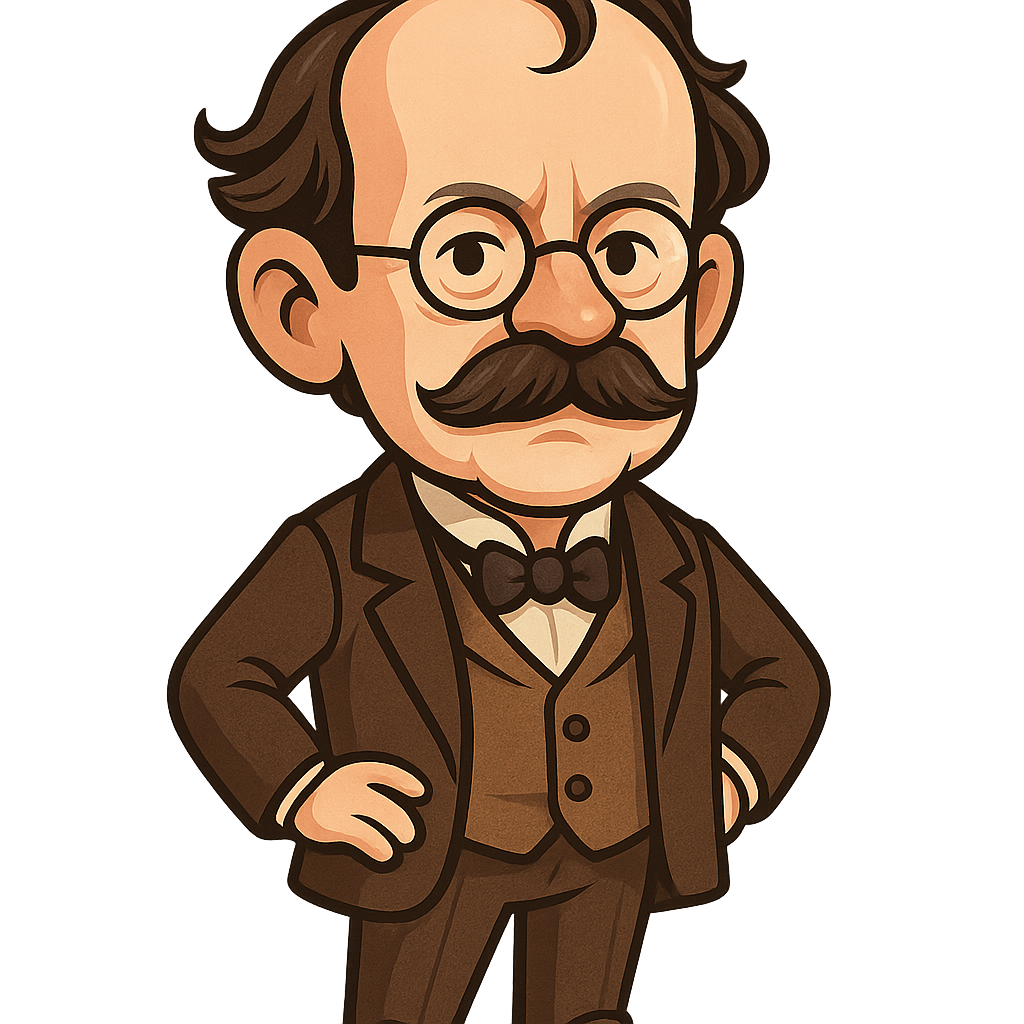
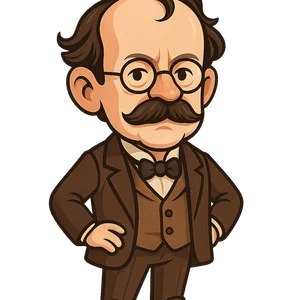
Hello there! My name is Joseph John Thomson, but my friends called me J. J. I was born on December 18th, 1856, in a suburb of Manchester, England. As a boy, I was fascinated by how things worked. My father wanted me to become an engineer, so he sent me to Owens College in 1870 when I was only 14 years old! I loved learning about science and mathematics there. It was the start of a great adventure into the world of things you can't even see.
After my studies at Owens College, I went to the famous University of Cambridge in 1876. I worked very hard, and in 1884, something amazing happened. I was chosen to be the head of the Cavendish Laboratory, the university's special place for physics experiments. I was only 28 years old! It was a huge responsibility, but I was excited. The laboratory was a place full of wires, glass tubes, and buzzing machines, and I couldn't wait to start exploring the mysteries of electricity.
At the time, scientists all over the world were puzzled by something called 'cathode rays.' When we passed electricity through a special glass tube with most of the air pumped out, a mysterious green glow would appear. What was this glow made of? Was it a wave? A strange kind of light? Or was it made of tiny bits of something? I was determined to solve this puzzle. I spent many hours in my laboratory, setting up experiments to trap and study these glowing beams.
In 1897, I finally found the answer! I used powerful magnets and electric plates to see if I could bend the cathode rays. And guess what? I could! The way they bent showed me two things. First, they were made of particles, not waves. Second, these particles had a negative electrical charge. But the most shocking part was how tiny they were. My calculations showed they were almost 2,000 times smaller than the smallest known atom, which is hydrogen. This was a huge discovery. Everyone had believed that atoms were the smallest things in the universe, but I had found something even smaller. I called my discovery 'corpuscles,' but today you know them as electrons.
J. J. Thomson: The Man Who Discovered the Electron
Hello there! My name is Joseph John Thomson, but my friends called me J. J. I was born on December 18th, 1856, in a suburb of Manchester, England. As a boy, I was fascinated by how things worked. My father wanted me to become an engineer, so he sent me to Owens College in 1870 when I was only 14 years old! I loved learning about science and mathematics there. It was the start of a great adventure into the world of things you can't even see.
After my studies at Owens College, I went to the famous University of Cambridge in 1876. I worked very hard, and in 1884, something amazing happened. I was chosen to be the head of the Cavendish Laboratory, the university's special place for physics experiments. I was only 28 years old! It was a huge responsibility, but I was excited. The laboratory was a place full of wires, glass tubes, and buzzing machines, and I couldn't wait to start exploring the mysteries of electricity.
At the time, scientists all over the world were puzzled by something called 'cathode rays.' When we passed electricity through a special glass tube with most of the air pumped out, a mysterious green glow would appear. What was this glow made of? Was it a wave? A strange kind of light? Or was it made of tiny bits of something? I was determined to solve this puzzle. I spent many hours in my laboratory, setting up experiments to trap and study these glowing beams.
In 1897, I finally found the answer! I used powerful magnets and electric plates to see if I could bend the cathode rays. And guess what? I could! The way they bent showed me two things. First, they were made of particles, not waves. Second, these particles had a negative electrical charge. But the most shocking part was how tiny they were. My calculations showed they were almost 2,000 times smaller than the smallest known atom, which is hydrogen. This was a huge discovery. Everyone had believed that atoms were the smallest things in the universe, but I had found something even smaller. I called my discovery 'corpuscles,' but today you know them as electrons.
Discovering the electron meant we had to change our ideas about what an atom looked like. In 1904, I suggested a new model. I imagined the atom was like a plum pudding—a popular dessert back then. I thought the atom was a ball of positive charge (the pudding) with all the tiny, negative electrons stuck inside it (the plums). My 'plum pudding model' wasn't quite right, as other scientists later discovered, but it was the very first model to include the electron. For my work, I was awarded the Nobel Prize in Physics in 1906, which was a tremendous honor.
I continued teaching and doing research at Cambridge for many years, and I was so proud that many of my students went on to make their own incredible discoveries. I lived to be 83 years old, passing away in 1940. People remember me for discovering the electron, which opened up a whole new world called particle physics. My work helped us understand that even the tiniest things are made of even tinier parts, a mystery scientists are still exploring today.
Wow facts
About
J. J. Thomson was a British physicist who is credited with the discovery of the electron in 1897, the first subatomic particle to be found. This discovery revolutionized the understanding of atomic structure.
Take a Quiz
Question 1 of 5
In the story, what does it mean that scientists were 'puzzled' by cathode rays?
Explore next






Want to do even more?
Go beyond exploring. Unlock tools that turn every story into real learning.

Storypie Plus for families
Full stories, quizzes, and printables. Nights and car rides, sorted.
- Unlimited audio stories
- Create Mode: your child stars in the story
- Offline downloads
- Printable worksheets & coloring pages

Why Storypie for Schools
Students engaged. Prep in seconds. Evenings back to you.
- Worksheets & Quizzes
- Classroom Management
- Formative Assessment
- Custom Curriculum & Lesson Plans
- 27 Languages

Why Storypie for Homeschool
Curriculum done. They'll ask for more. Hours back in your day.
- Worksheet Generator
- First-Person Audio Stories
- Built-in Comprehension Quizzes
- Custom Curriculum & Lesson Plans
- Print & Go Activities