English


Johannes Vermeer
Johannes Vermeer was a Dutch Baroque painter from the 17th century…
Reads at Grades 6–8 Listens at Grades 4–8
Johannes Vermeer: The Master of Light
Hello! My name is Johannes Vermeer, and I want to tell you the story of my life as a painter in the Netherlands during a very exciting time in history. I was born in a busy, beautiful city called Delft, where I was baptized on October 31st, 1632. My world was filled with art from the very beginning. My father worked as both an innkeeper and an art dealer, which meant our home was a lively place, often filled with travelers, artists, and of course, many wonderful paintings. Growing up in this environment, I couldn't help but fall in love with art. I was especially fascinated by light. I would spend hours watching the way sunlight streamed through a window, illuminating a room and making tiny dust particles dance in the air. I knew, even as a young boy, that I wanted to spend my life trying to capture that beautiful, ordinary light on canvas and share its magic with the world.
To become a professional artist, I had to dedicate myself to years of intense training and practice. It was a long journey, but my hard work paid off. On December 29th, 1653, I reached a significant moment in my career when I was officially accepted as a master painter into the Guild of Saint Luke. This was a very respected organization for artists in Delft, and becoming a member meant I was recognized as a true professional. That same year was also special for my personal life. In April of 1653, I married my dear wife, Catharina Bolnes. Together, we built a life and a very large family, eventually having many children. Supporting them was my greatest responsibility, so I worked not only as a painter but also continued my father's business as an art dealer. I was extremely meticulous with my own paintings. I worked very slowly and with great care, often producing only a few canvases each year because I was determined to make each one as perfect as I possibly could.
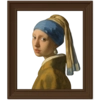
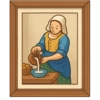
My studio was my sanctuary, the place where I could observe the world and bring it to life. I became fascinated with capturing quiet, intimate scenes of everyday life inside Dutch homes, a style that is now called genre painting. I found beauty in the simple, peaceful moments: a woman absorbed in reading a letter by a window, a kitchen maid carefully pouring milk from a jug, or a young lady practicing a melody on a musical instrument. I am most famous for the way I painted light. I spent countless hours studying how light fell across different surfaces and textures, from the soft glow on a string of pearls to the crusty surface of a loaf of bread. I wanted to make these objects seem so real that you could almost feel them. Around the year 1658, I completed 'The Milkmaid,' and about seven years later, around 1665, I created what is perhaps my most recognized painting, 'Girl with a Pearl Earring.' To achieve such realism, many historians believe I used a device called a camera obscura. This tool, which worked like a pinhole camera, helped me see details of light, shadow, and perspective with incredible clarity. Fortunately, a wealthy local patron named Pieter van Ruijven greatly admired my work. He purchased many of my paintings over the years, and his support was essential for me and my family.
For much of my life, my country experienced a period of great prosperity and cultural achievement that we call the Dutch Golden Age. Trade was booming, science was advancing, and there was a strong market for art. However, this peaceful time came to an abrupt end. In the year 1672, France invaded the Netherlands, leading to a war that devastated our nation. That year became known as the 'Rampjaar,' which translates to the 'Disaster Year.' The Dutch economy collapsed almost overnight. With the country in crisis, people no longer had money for luxury goods like paintings. The art market completely dried up, and it became nearly impossible for me to sell my work. This was an incredibly stressful and challenging period. The pressure of providing for my large family during a time of such widespread hardship weighed heavily on me and everyone around us.
I lived to be 43 years old, and my life came to an end in my hometown of Delft. I was buried on December 15th, 1675. After my time on Earth, my name and my art were largely forgotten by the wider world for nearly two hundred years. Only a small number of dedicated collectors and art lovers knew of my work. Then, in the 1800s, a French art critic named Théophile Thoré-Bürger rediscovered my paintings. He was captivated by their beauty and wrote about them with great passion, helping to reintroduce my art to the world. Today, although only about 34 of my paintings are known to have survived, they are considered priceless treasures. People travel from all over the globe to visit museums and see them in person. My work is remembered for its quiet, mysterious feeling and, above all, for the special and luminous way I painted with light.
Wow facts
About
Johannes Vermeer was a Dutch Baroque painter from the 17th century, celebrated for his mastery of light and his detailed, intimate scenes of domestic life. He is best known for paintings like 'Girl with a Pearl Earring' and 'The Milkmaid.'
Take a Quiz
Question 1 of 5
What is the main reason Johannes Vermeer is remembered as a great artist today?
Explore next




Want to do even more?
Go beyond exploring. Unlock tools that turn every story into real learning.

Storypie Plus for families
Full stories, quizzes, and printables. Nights and car rides, sorted.
- Unlimited audio stories
- Create Mode: your child stars in the story
- Offline downloads
- Printable worksheets & coloring pages

Why Storypie for Schools
Students engaged. Prep in seconds. Evenings back to you.
- Worksheets & Quizzes
- Classroom Management
- Formative Assessment
- Custom Curriculum & Lesson Plans
- 27 Languages

Why Storypie for Homeschool
Curriculum done. They'll ask for more. Hours back in your day.
- Worksheet Generator
- First-Person Audio Stories
- Built-in Comprehension Quizzes
- Custom Curriculum & Lesson Plans
- Print & Go Activities