English


John Logie Baird
John Logie Baird was a Scottish engineer and inventor…
Reads at Grades 3–5 Listens at Grades 1–5
Print & create
Answer keys·No prep·Free with an account
28 worksheets · answer keys · full story · quiz · Ages 8-10 · CEFR B1
Plus adds 291,000+ more stories in 27 languages, audio for every one, and printables for all of them.
Just want John Logie Baird?

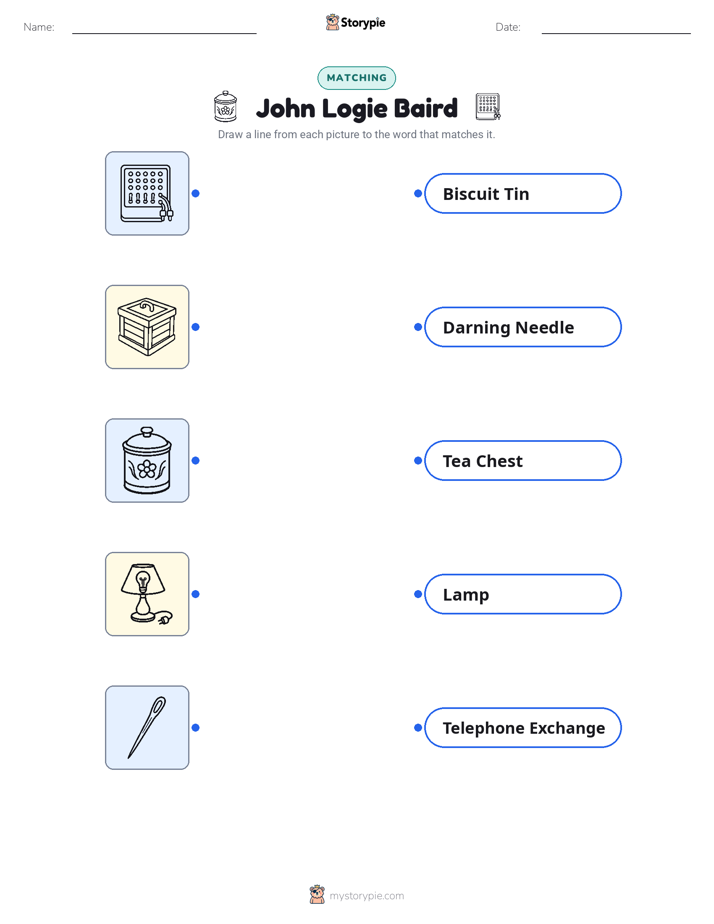
Hello, my name is John Logie Baird, and I am the person who demonstrated the world's first mechanical television system. I was born on August 13th, 1888, in a town called Helensburgh, right in the beautiful country of Scotland. Even as a young boy, I was filled with curiosity. My mind was always buzzing with new ideas, though my body was not always strong, as I was often unwell. I loved tinkering and building things. When I was just a boy, I set up my very own telephone exchange. I connected wires from my house to my friends' houses so we could talk to each other. This was an invention of my own, and it showed me how much I loved finding new ways for people to communicate.
As I grew up, my love for inventing only became stronger. I went to college in Glasgow to study engineering, where I learned how machines and electricity worked. I had so many dreams, but my poor health often made it difficult to pursue them. I tried starting a few businesses, but my heart was set on one giant idea: the dream of ‘seeing by wireless.’ Radios could already send sound through the air without any wires. I thought, why couldn't we do the same thing with pictures? In 1923, I moved to Hastings, England, to focus all my energy on this dream. I didn't have much money, so I built my first machine using objects I found. I used an old hatbox, lenses from bicycle lamps, sealing wax, and even darning needles. I called this strange-looking invention my ‘Televisor.’
I kept working day and night, later moving to London, trying to make my machine work. It was often frustrating, but I refused to give up. Then, on October 2nd, 1925, the magical moment finally happened. I was experimenting with a ventriloquist's dummy I named ‘Stooky Bill,’ and suddenly, a fuzzy, flickering image of its face appeared on my screen. It was blurry, but it was there. I had transmitted my first television picture with shades of gray. I was so filled with excitement that I ran down the stairs to find a real person. I found a young office worker and asked if he would help me with an experiment. He nervously agreed, and at that moment, he became the first person to be shown on television in a full range of tones. A few months later, in January 1926, I was ready to show my invention to the world. I showed members of the Royal Institution and a reporter my invention, and soon, newspapers were printing stories about the amazing invention called television.
John Logie Baird: The Boy Who Helped Create Television
Hello, my name is John Logie Baird, and I am the person who demonstrated the world's first mechanical television system. I was born on August 13th, 1888, in a town called Helensburgh, right in the beautiful country of Scotland. Even as a young boy, I was filled with curiosity. My mind was always buzzing with new ideas, though my body was not always strong, as I was often unwell. I loved tinkering and building things. When I was just a boy, I set up my very own telephone exchange. I connected wires from my house to my friends' houses so we could talk to each other. This was an invention of my own, and it showed me how much I loved finding new ways for people to communicate.
As I grew up, my love for inventing only became stronger. I went to college in Glasgow to study engineering, where I learned how machines and electricity worked. I had so many dreams, but my poor health often made it difficult to pursue them. I tried starting a few businesses, but my heart was set on one giant idea: the dream of ‘seeing by wireless.’ Radios could already send sound through the air without any wires. I thought, why couldn't we do the same thing with pictures? In 1923, I moved to Hastings, England, to focus all my energy on this dream. I didn't have much money, so I built my first machine using objects I found. I used an old hatbox, lenses from bicycle lamps, sealing wax, and even darning needles. I called this strange-looking invention my ‘Televisor.’
I kept working day and night, later moving to London, trying to make my machine work. It was often frustrating, but I refused to give up. Then, on October 2nd, 1925, the magical moment finally happened. I was experimenting with a ventriloquist's dummy I named ‘Stooky Bill,’ and suddenly, a fuzzy, flickering image of its face appeared on my screen. It was blurry, but it was there. I had transmitted my first television picture with shades of gray. I was so filled with excitement that I ran down the stairs to find a real person. I found a young office worker and asked if he would help me with an experiment. He nervously agreed, and at that moment, he became the first person to be shown on television in a full range of tones. A few months later, in January 1926, I was ready to show my invention to the world. I showed members of the Royal Institution and a reporter my invention, and soon, newspapers were printing stories about the amazing invention called television.
Seeing that first fuzzy image was just the beginning for me. I knew television could be even better. I immediately started working on my next big ideas. In 1928, I successfully demonstrated the world's first color television transmission. Can you imagine? Not just black and white pictures, but pictures with color, just like in real life. I also worked on Phonovision, a separate system for recording television pictures on discs. That same year, I achieved something that seemed impossible: I sent a television signal all the way across the Atlantic Ocean, from London, England, to New York in the United States. My mechanical television system was noticed, and the British Broadcasting Corporation, or BBC, began using it for its very first television broadcasts, which started in 1929. People could finally gather in their homes to watch a broadcast program.
Technology is always changing and growing, and that is a wonderful thing. Eventually, a different kind of electronic television was invented, and it became more popular than my mechanical one. But that’s how invention works—one idea leads to the next, with each person building on the work that came before. I lived to be 57 years old, and I was incredibly proud to have helped television take an important step forward. My childhood dream of ‘seeing by wireless’ had come true. My work helped create the amazing world of television that allows you to see news, stories, and sports from all around the globe today.
Wow facts
About
John Logie Baird was a Scottish engineer and inventor, renowned for demonstrating the world's first working mechanical television system and the first color television.
Take a Quiz
Question 1 of 5
A hatbox and bicycle lamp lenses were among the 'objects I found.' What kind of objects were these?
Explore next






Want to do even more?
Go beyond exploring. Unlock tools that turn every story into real learning.

Storypie Plus for families
Full stories, quizzes, and printables. Nights and car rides, sorted.
- Unlimited audio stories
- Create Mode: your child stars in the story
- Offline downloads
- Printable worksheets & coloring pages

Why Storypie for Schools
Students engaged. Prep in seconds. Evenings back to you.
- Worksheets & Quizzes
- Classroom Management
- Formative Assessment
- Custom Curriculum & Lesson Plans
- 27 Languages

Why Storypie for Homeschool
Curriculum done. They'll ask for more. Hours back in your day.
- Worksheet Generator
- First-Person Audio Stories
- Built-in Comprehension Quizzes
- Custom Curriculum & Lesson Plans
- Print & Go Activities