English

John Logie Baird
John Logie Baird was a Scottish engineer and inventor…
Reads at Grades 6–8 Listens at Grades 4–8
Print & create
Answer keys·No prep·Free with an account
28 worksheets · answer keys · full story · quiz · Ages 10-12 · CEFR B2
Plus adds 244,000+ more stories in 27 languages, audio for every one, and printables for all of them.
Just want John Logie Baird?
Hello, my name is John Logie Baird, and I am the inventor who first showed the world that moving pictures could travel through the air. My story begins on August 13th, 1888, in the town of Helensburgh, Scotland. From a very young age, I was completely fascinated by technology and how things worked. While other children might have been playing outside, I was often busy with my own projects. One of my earliest inventions was a telephone exchange I built myself. I wired it from my bedroom to the houses of my friends across the street so we could talk to each other. It was a marvel for our small neighborhood. Unfortunately, I was not a very healthy child. I was often sick, which meant I had to spend a great deal of time indoors. I didn't mind too much, though, because it gave me the chance to read countless books about science and engineering. These books filled my head with incredible ideas and dreams of creating my own inventions that could one day change the world. My quiet childhood, filled with experiments and scientific books, laid the foundation for the work that would define my entire life.
My passion for science led me to study electrical engineering at the Royal Technical College in Glasgow. I absorbed everything I could about electricity and signals, always thinking about new possibilities. My studies were interrupted when the First World War began in 1914. Like many young men, I tried to enlist in the army to serve my country, but I was turned away because of my lifelong poor health. After the war, I had to find a way to make a living, and I tried my hand at several different businesses. I sold specialty socks and even started a small business making jam. While these ventures were interesting, they weren't my true passion, and my health continued to be a challenge. In 1922, I decided to make a significant change. I moved to the quiet seaside town of Hastings, hoping the fresh sea air would do me good. It was there, away from the hustle and bustle, that I decided to stop pursuing other businesses and focus all my energy on an idea that had captivated me for years. I called it 'seeing by wireless', the incredible notion of sending moving pictures from one place to another without any cables.
John Logie Baird: The Man Who Made Pictures Fly
Hello, my name is John Logie Baird, and I am the inventor who first showed the world that moving pictures could travel through the air. My story begins on August 13th, 1888, in the town of Helensburgh, Scotland. From a very young age, I was completely fascinated by technology and how things worked. While other children might have been playing outside, I was often busy with my own projects. One of my earliest inventions was a telephone exchange I built myself. I wired it from my bedroom to the houses of my friends across the street so we could talk to each other. It was a marvel for our small neighborhood. Unfortunately, I was not a very healthy child. I was often sick, which meant I had to spend a great deal of time indoors. I didn't mind too much, though, because it gave me the chance to read countless books about science and engineering. These books filled my head with incredible ideas and dreams of creating my own inventions that could one day change the world. My quiet childhood, filled with experiments and scientific books, laid the foundation for the work that would define my entire life.
My passion for science led me to study electrical engineering at the Royal Technical College in Glasgow. I absorbed everything I could about electricity and signals, always thinking about new possibilities. My studies were interrupted when the First World War began in 1914. Like many young men, I tried to enlist in the army to serve my country, but I was turned away because of my lifelong poor health. After the war, I had to find a way to make a living, and I tried my hand at several different businesses. I sold specialty socks and even started a small business making jam. While these ventures were interesting, they weren't my true passion, and my health continued to be a challenge. In 1922, I decided to make a significant change. I moved to the quiet seaside town of Hastings, hoping the fresh sea air would do me good. It was there, away from the hustle and bustle, that I decided to stop pursuing other businesses and focus all my energy on an idea that had captivated me for years. I called it 'seeing by wireless', the incredible notion of sending moving pictures from one place to another without any cables.
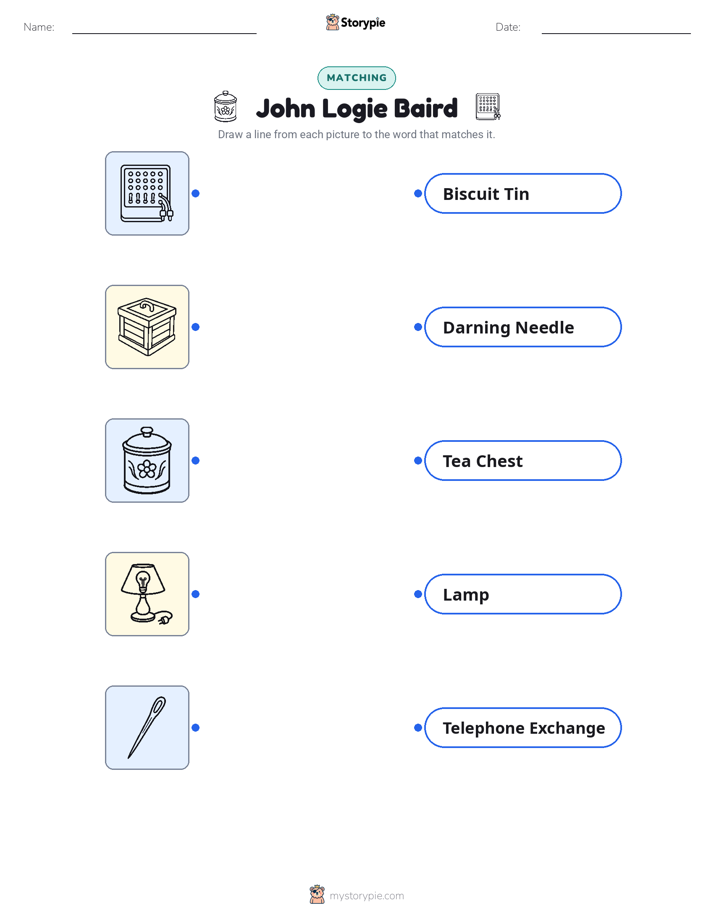
In my small lodgings in Hastings, I set up a makeshift laboratory. It was nothing grand; in fact, I built my equipment out of whatever I could find. I used an old tea chest for the base, biscuit tins to house the lamps, and even darning needles to hold parts together. The most important component of my invention was a device called a 'Nipkow disk'. This was a simple spinning disk with a spiral of holes in it. As the disk spun, the holes would scan an image line by line, converting light into an electrical signal. Another disk, spinning at the exact same speed, would then reassemble that signal back into a picture. After countless attempts and adjustments, a truly magical moment arrived in October of 1925. I placed my ventriloquist's dummy, whom I had named 'Stooky Bill', in front of the transmitter. On a small screen in another room, a blurry, flickering, but recognizable image of Stooky Bill's face appeared. It was the first-ever transmission of a moving grayscale image. This success gave me the confidence to show my invention to the world. On January 26th, 1926, I gave the first public demonstration of a true, moving television system to a group of scientists at the Royal Institution in London. They were astonished to see images come to life in a box.
After my public demonstration in 1926, the world began to take notice of television. The next few years were a whirlwind of progress and new milestones. I was determined to push the technology as far as it could go. On February 8th, 1928, I achieved what many thought was impossible: I transmitted the first television pictures across the vast Atlantic Ocean, sending them from London to New York. Later that same year, on July 3rd, 1928, I demonstrated another breakthrough: the world's first color television transmission. It was amazing to see images not just in black and white, but with vibrant reds and blues. My system caught the attention of the British Broadcasting Corporation, or BBC, which was the leading radio broadcaster at the time. In 1929, the BBC began using my mechanical television system to broadcast its first experimental television programs to the public. While this was happening, other inventors were working on a different kind of television—an all-electronic system. This new system, which used cathode-ray tubes, eventually produced a much clearer and more stable picture, and it became the standard for television for many decades. My mechanical system was phased out, but it had served its purpose as the essential first step that proved television was possible.
I never lost my passion for invention and continued working to improve television for the rest of my days. My mind was always buzzing with new ideas, and I went on to develop early systems for high-definition and even 3D television, concepts that were far ahead of their time. I lived to be 57 years old. Although the flat-screen televisions in homes today operate on different principles from my spinning disks and biscuit tins, my work was the spark that ignited the entire industry. I proved that sending moving pictures through the air was not just a fantasy, but a reality, opening the door for the incredible world of television we all share and enjoy now.
Wow facts
About
John Logie Baird was a Scottish engineer and inventor, renowned for demonstrating the world's first working mechanical television system and the first color television.
Take a Quiz
Question 1 of 5
In your own words, retell the main events of John Logie Baird's journey to invent television.
Explore next






Want to do even more?
Go beyond exploring. Unlock tools that turn every story into real learning.

Storypie Plus for families
Full stories, quizzes, and printables. Nights and car rides, sorted.
- Unlimited audio stories
- Create Mode: your child stars in the story
- Offline downloads
- Printable worksheets & coloring pages

Why Storypie for Schools
Students engaged. Prep in seconds. Evenings back to you.
- Worksheets & Quizzes
- Classroom Management
- Formative Assessment
- Custom Curriculum & Lesson Plans
- 27 Languages

Why Storypie for Homeschool
Curriculum done. They'll ask for more. Hours back in your day.
- Worksheet Generator
- First-Person Audio Stories
- Built-in Comprehension Quizzes
- Custom Curriculum & Lesson Plans
- Print & Go Activities