English

Animation (how animation works)
Animation is a method in which figures are manipulated to appear as moving images.
Reads at Grades 3–5 Listens at Grades 1–5
Print & create
Answer keys·No prep·Free with an account
28 worksheets · answer keys · full story · quiz · Ages 8-10 · CEFR B1
Plus adds 244,000+ more stories in 27 languages, audio for every one, and printables for all of them.
Just want Animation (how animation works)?
Have you ever watched a drawing on a piece of paper suddenly wink at you. Or maybe you’ve seen a little clay figure lift its hand and wave hello. You’ve surely seen superheroes leap and fly across a giant screen, soaring through cities that only exist in someone’s imagination. Have you ever wondered how still, quiet pictures learn to dance, run, and sing. It feels like magic, doesn’t it. Well, it is a special kind of magic, and I am the secret ingredient that makes it all happen. I am the spark that brings drawings to life. I am Animation.
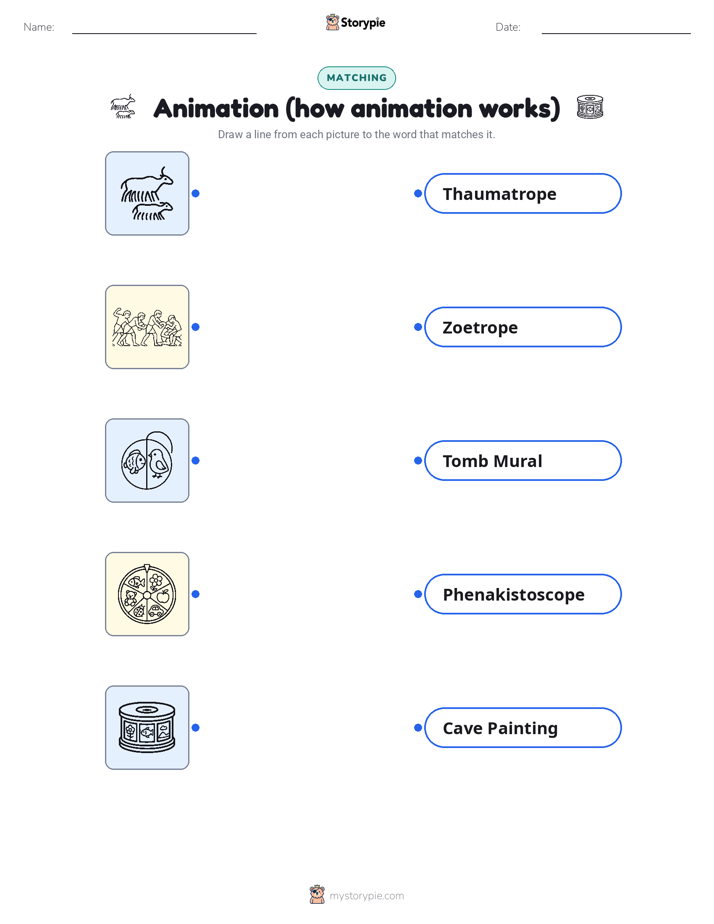
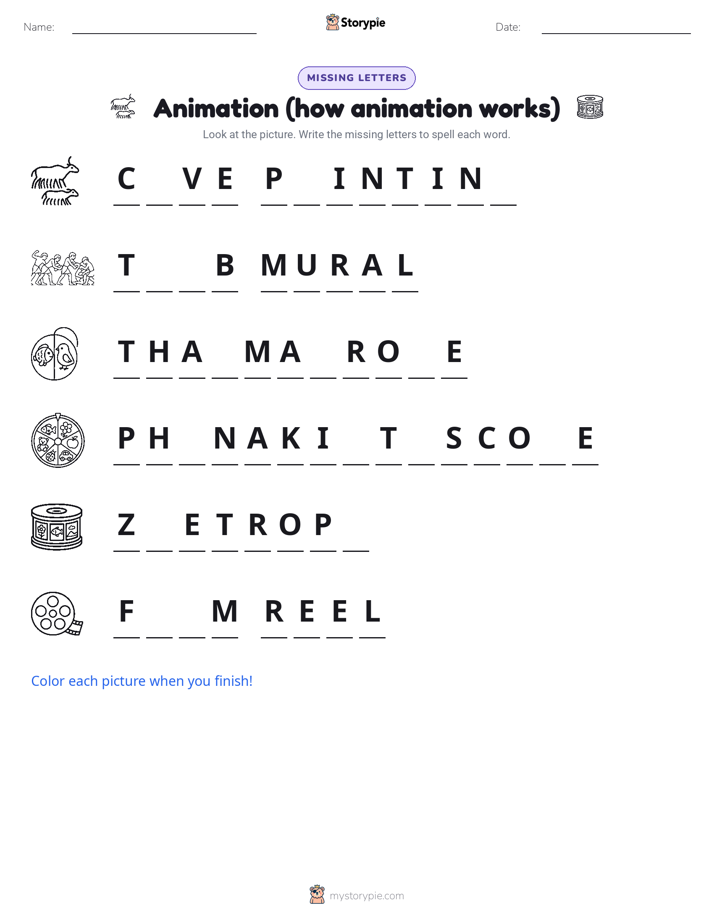
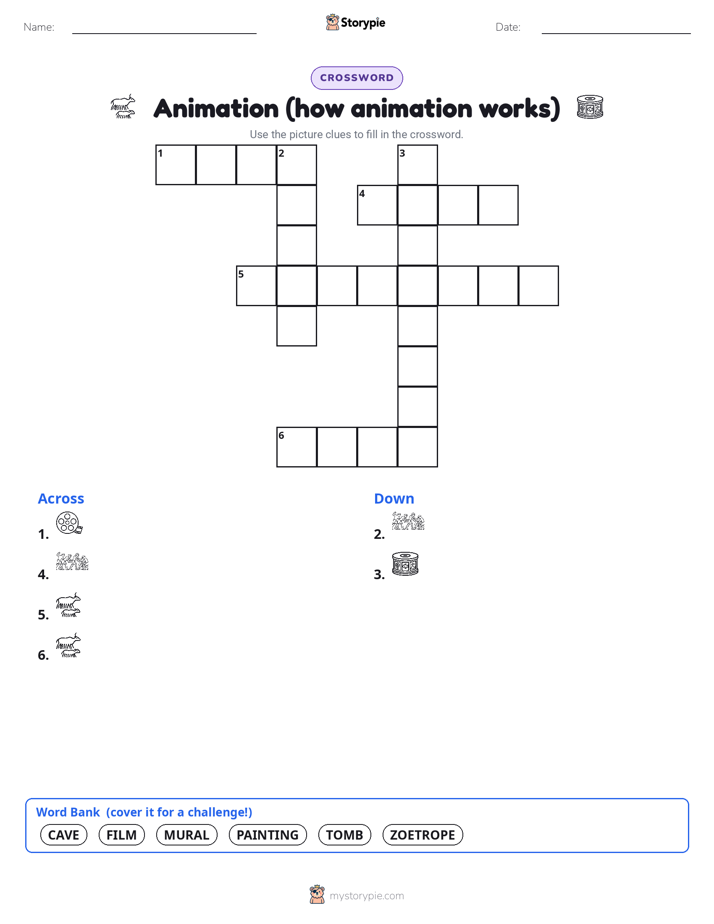
My first real steps into the world happened a long, long time ago, all thanks to a cool trick your brain can do. It’s called ‘persistence of vision’, which is a fancy way of saying that your eyes hold onto an image for a tiny split second after it’s gone. In the early 1800s, clever people realized they could use this trick to make pictures move. My first real appearances were in toys. Around 1827, a toy called the Thaumatrope showed up. It was just a simple paper disc on a string with a bird on one side and a cage on the other. When you spun it fast, your brain would put the two pictures together, and poof. The bird was in the cage. Then, in 1832, a man named Joseph Plateau invented the Phenakistoscope, a spinning wheel with drawings around the edge that you’d view through little slots. A year or two later, in 1834, William George Horner created the Zoetrope, a spinning drum that many people could peek into at once to see a horse gallop or a person dance. These were my first playful wiggles and hops.
The Magic of Movement
Have you ever watched a drawing on a piece of paper suddenly wink at you. Or maybe you’ve seen a little clay figure lift its hand and wave hello. You’ve surely seen superheroes leap and fly across a giant screen, soaring through cities that only exist in someone’s imagination. Have you ever wondered how still, quiet pictures learn to dance, run, and sing. It feels like magic, doesn’t it. Well, it is a special kind of magic, and I am the secret ingredient that makes it all happen. I am the spark that brings drawings to life. I am Animation.
My first real steps into the world happened a long, long time ago, all thanks to a cool trick your brain can do. It’s called ‘persistence of vision’, which is a fancy way of saying that your eyes hold onto an image for a tiny split second after it’s gone. In the early 1800s, clever people realized they could use this trick to make pictures move. My first real appearances were in toys. Around 1827, a toy called the Thaumatrope showed up. It was just a simple paper disc on a string with a bird on one side and a cage on the other. When you spun it fast, your brain would put the two pictures together, and poof. The bird was in the cage. Then, in 1832, a man named Joseph Plateau invented the Phenakistoscope, a spinning wheel with drawings around the edge that you’d view through little slots. A year or two later, in 1834, William George Horner created the Zoetrope, a spinning drum that many people could peek into at once to see a horse gallop or a person dance. These were my first playful wiggles and hops.
For a while, I was just a toy, something for people to enjoy in their homes. But I dreamed of being on a bigger stage. My big break came thanks to a brilliant man in France named Charles-Émile Reynaud. He created something amazing called the Théâtre Optique. On October 28th, 1892, he used it to project my hand-painted stories onto a big screen for a paying audience in Paris. People gasped as they watched my colorful characters move and act out little plays. I was a star. Soon, others helped me grow. An American filmmaker named J. Stuart Blackton made a short film in 1906 called ‘Humorous Phases of Funny Faces’, where chalk drawings moved all by themselves. But a huge moment for me was in 1914, when an artist named Winsor McCay introduced the world to ‘Gertie the Dinosaur’. She wasn’t just a moving drawing; she had a personality. She was shy, playful, and even a little clumsy. Then, a man named Walt Disney gave me a voice. On November 18th, 1928, ‘Steamboat Willie’ was released, and for the first time, I had sound. A little mouse whistled a tune, and the world was enchanted. In 1937, Disney proved I could tell big, emotional stories with the first-ever full-length animated movie, ‘Snow White and the Seven Dwarfs’.
After becoming a movie star, I found a new, cozy home right inside people's living rooms. In the 1950s and 1960s, television was the new big thing, and I became a weekend friend to children everywhere. Saturday morning cartoons brought laughter and adventure to families every week. I was still being made mostly with pencils, ink, and paint, with artists drawing thousands upon thousands of pictures to create just a few minutes of action. Can you imagine that. But my biggest change was just around the corner. I was about to learn a whole new language, the language of computers. Instead of paintbrushes, artists started using programs. Instead of paper, they used pixels. This was a huge transformation. It took a lot of work, but on November 22nd, 1995, a movie called ‘Toy Story’ was released. It was the first feature film made entirely on computers. Suddenly, I could create worlds with incredible detail, where toys could look shiny and plastic, and characters could have hair that moved in the wind.
Today, I am more than just cartoons on a screen. I am a powerful tool for telling any story you can imagine. You can find me in the exciting worlds of video games, where you control the action. I help doctors practice for surgeries by showing them what the inside of a person looks like, and I help architects show what a building will look like before it’s even built. I am a way to share ideas, to teach, and to dream. I am here for everyone, including you. If you have a story in your head or an idea in your heart, I am here to help you bring it to life, one picture, one frame at a time. As long as there are imaginations filled with wonder, I will be there to put them in motion.
Wow facts
About
Animation is a method in which figures are manipulated to appear as moving images. In traditional animation, images are drawn or painted by hand on transparent celluloid sheets to be photographed and exhibited on film.
Take a Quiz
Question 1 of 5
In the story, I say I learned to speak a language of 'pixels'. What does the word 'pixels' mean in this context?
Explore next






Want to do even more?
Go beyond exploring. Unlock tools that turn every story into real learning.

Storypie Plus for families
Full stories, quizzes, and printables. Nights and car rides, sorted.
- Unlimited audio stories
- Create Mode: your child stars in the story
- Offline downloads
- Printable worksheets & coloring pages

Why Storypie for Schools
Students engaged. Prep in seconds. Evenings back to you.
- Worksheets & Quizzes
- Classroom Management
- Formative Assessment
- Custom Curriculum & Lesson Plans
- 27 Languages

Why Storypie for Homeschool
Curriculum done. They'll ask for more. Hours back in your day.
- Worksheet Generator
- First-Person Audio Stories
- Built-in Comprehension Quizzes
- Custom Curriculum & Lesson Plans
- Print & Go Activities