English

Animation (how animation works)
Animation is a method in which figures are manipulated to appear as moving images.
Reads at Grades 6–8 Listens at Grades 4–8
Print & create
Answer keys·No prep·Free with an account
28 worksheets · answer keys · full story · quiz · Ages 10-12 · CEFR B2
Plus adds 244,000+ more stories in 27 languages, audio for every one, and printables for all of them.
Just want Animation (how animation works)?
Have you ever watched a simple drawing on a page suddenly leap into action on a screen, running and jumping and even talking? It feels like pure magic, a secret whispered from the artist’s hand to your eyes. But the secret isn’t just in the drawing; it’s inside you. It’s a wonderful trick played on your mind, a principle scientists call 'persistence of vision.' Your brain cleverly holds onto an image for a tiny fraction of a second after it has disappeared. So, when someone flashes a series of still pictures in front of you very, very quickly, they blur together. A drawing of a character with its arm down, followed by one with its arm slightly up, then a little higher, creates a seamless illusion of lifting. The empty space between the pictures vanishes, and in its place, life appears. This is how still, silent lines on a page are gifted with motion, personality, and a soul all their own. I am the magic that breathes life into lines. I am Animation.
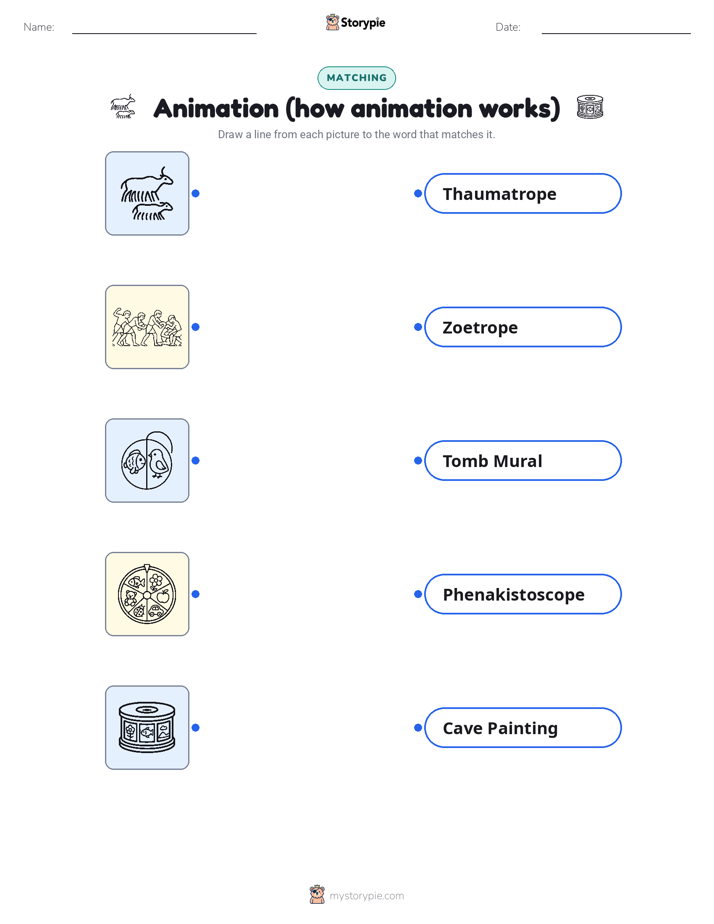
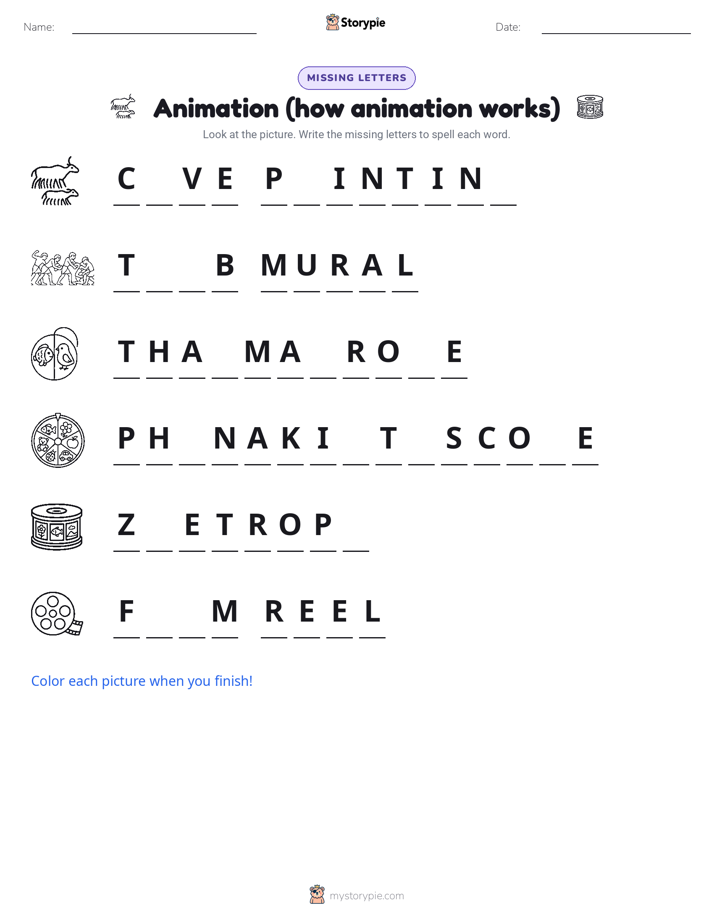
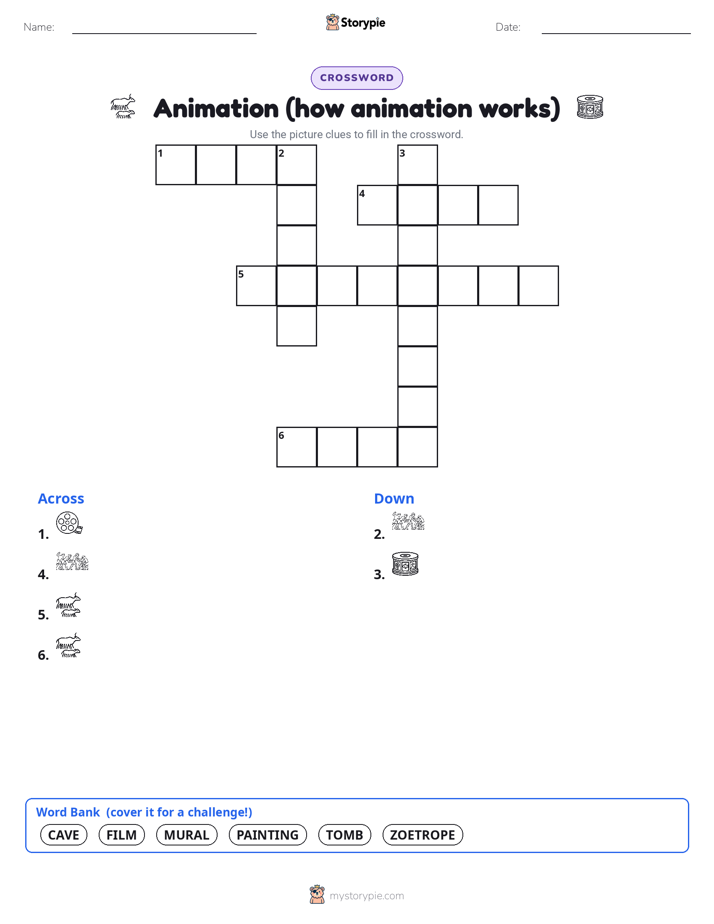
My story, however, began long before screens and projectors. It started with a simple human desire to capture the feeling of movement. As far back as 17,000 BCE, ancient artists painted animals with extra legs on cave walls, a clever attempt to show a beast in mid-gallop. In Egypt, around 2000 BCE, a tomb mural showed a sequence of wrestlers in different poses, like a comic strip frozen in time. For thousands of years, these were just dreams of motion locked in stone. But the 19th century, a time buzzing with invention, brought me into the light. People created marvelous optical toys to play with my secret. In 1827, the Thaumatrope appeared—a simple disk with a picture on each side, maybe a bird on one and a cage on the other. When spun on a string, the two images would merge, and suddenly the bird was inside the cage. Then came the Phenakistoscope in 1832, a spinning wheel with drawings arranged in a circle. When you spun it and looked through narrow slits, the drawings would perform a short, looping dance. But my most popular toy was the Zoetrope, invented in 1834. It was a spinning drum with a strip of pictures inside. Peeking through its slits, people could watch a horse gallop or an acrobat tumble, a tiny movie spinning right before their eyes.
I Am Animation
Have you ever watched a simple drawing on a page suddenly leap into action on a screen, running and jumping and even talking? It feels like pure magic, a secret whispered from the artist’s hand to your eyes. But the secret isn’t just in the drawing; it’s inside you. It’s a wonderful trick played on your mind, a principle scientists call 'persistence of vision.' Your brain cleverly holds onto an image for a tiny fraction of a second after it has disappeared. So, when someone flashes a series of still pictures in front of you very, very quickly, they blur together. A drawing of a character with its arm down, followed by one with its arm slightly up, then a little higher, creates a seamless illusion of lifting. The empty space between the pictures vanishes, and in its place, life appears. This is how still, silent lines on a page are gifted with motion, personality, and a soul all their own. I am the magic that breathes life into lines. I am Animation.
My story, however, began long before screens and projectors. It started with a simple human desire to capture the feeling of movement. As far back as 17,000 BCE, ancient artists painted animals with extra legs on cave walls, a clever attempt to show a beast in mid-gallop. In Egypt, around 2000 BCE, a tomb mural showed a sequence of wrestlers in different poses, like a comic strip frozen in time. For thousands of years, these were just dreams of motion locked in stone. But the 19th century, a time buzzing with invention, brought me into the light. People created marvelous optical toys to play with my secret. In 1827, the Thaumatrope appeared—a simple disk with a picture on each side, maybe a bird on one and a cage on the other. When spun on a string, the two images would merge, and suddenly the bird was inside the cage. Then came the Phenakistoscope in 1832, a spinning wheel with drawings arranged in a circle. When you spun it and looked through narrow slits, the drawings would perform a short, looping dance. But my most popular toy was the Zoetrope, invented in 1834. It was a spinning drum with a strip of pictures inside. Peeking through its slits, people could watch a horse gallop or an acrobat tumble, a tiny movie spinning right before their eyes.
Those toys were wonderful, but I longed for a bigger stage. The invention of the movie camera finally gave me my chance to reach audiences everywhere. A few brilliant pioneers saw my potential and transformed me from a parlor trick into true entertainment. One of the first was J. Stuart Blackton. On April 6th, 1906, he released 'Humorous Phases of Funny Faces,' a short film where he appeared to draw funny faces on a chalkboard that then came to life, winking and smiling all on their own. He filmed it frame by frame, a painstaking process of drawing, filming, erasing, and drawing again. A French artist named Émile Cohl took this idea even further in 1908 with his film 'Fantasmagorie,' a dreamlike world of stick figures transforming into a wild collection of objects. But it was an American artist, Winsor McCay, who gave me a personality. In 1914, he introduced the world to 'Gertie the Dinosaur.' Gertie wasn't just a moving drawing; she was a character. McCay would stand on stage during the film, and it looked as if he were giving commands to the animated dinosaur on screen, who would bow and even eat a pumpkin. Audiences were completely amazed. Then, a man named Walt Disney helped me find my voice—literally. On November 18th, 1928, 'Steamboat Willie' premiered, and the world heard a cartoon character, Mickey Mouse, whistling in perfect time with the music. It was the first cartoon with fully synchronized sound, and it was a sensation. A few years later, on December 21st, 1937, Disney proved I could do even more. He released 'Snow White and the Seven Dwarfs,' the first feature-length animated film. It made people laugh and cry, proving that I could tell stories as deep, emotional, and captivating as any movie with human actors.
After conquering the movie theater, I found a new home in people's living rooms. In the 1960s, I became a television star with shows like 'The Flintstones,' which brought cartoon families to audiences every week. But my biggest transformation was yet to come, and it arrived with the computer. Artists and scientists realized they could use computers as a new kind of paintbrush, camera, and drawing board all rolled into one. At first, computer-generated imagery, or CGI, was used for small effects, but creative minds at studios like Pixar dreamed bigger. They worked for years to figure out how to build entire worlds and characters inside a computer. Their incredible breakthrough was shared with the world on November 22nd, 1995, with the release of 'Toy Story.' It was the first feature film made entirely with computers, and it opened up a universe of possibilities. Suddenly, toys could have heartfelt conversations, monsters could be lovable, and superheroes could fly in ways that looked completely real. From the spinning disk of a Thaumatrope to the powerful render farms of a digital studio, my journey has been incredible. But whether I am brought to life with a simple flip book, a clay model for stop-motion, or a powerful computer, I am still powered by the same, timeless force: human imagination. I give everyone, from kids with a pencil to huge teams of artists, the power to bring their dreams to life, one frame at a time, and share their stories with the world.
Wow facts
About
Animation is a method in which figures are manipulated to appear as moving images. In traditional animation, images are drawn or painted by hand on transparent celluloid sheets to be photographed and exhibited on film.
Take a Quiz
Question 1 of 5
According to the story, why was Winsor McCay's 'Gertie the Dinosaur' a significant milestone for animation?
Explore next






Want to do even more?
Go beyond exploring. Unlock tools that turn every story into real learning.

Storypie Plus for families
Full stories, quizzes, and printables. Nights and car rides, sorted.
- Unlimited audio stories
- Create Mode: your child stars in the story
- Offline downloads
- Printable worksheets & coloring pages

Why Storypie for Schools
Students engaged. Prep in seconds. Evenings back to you.
- Worksheets & Quizzes
- Classroom Management
- Formative Assessment
- Custom Curriculum & Lesson Plans
- 27 Languages

Why Storypie for Homeschool
Curriculum done. They'll ask for more. Hours back in your day.
- Worksheet Generator
- First-Person Audio Stories
- Built-in Comprehension Quizzes
- Custom Curriculum & Lesson Plans
- Print & Go Activities