English

Leucippus
Leucippus was an ancient Greek philosopher from the 5th century BCE who is credited as the originator of…
Reads at Grades 6–8 Listens at Grades 4–8
Print & create
Answer keys·No prep·Free with an account
28 worksheets · answer keys · full story · quiz · Ages 10-12 · CEFR B2
Plus adds 244,000+ more stories in 27 languages, audio for every one, and printables for all of them.
Just want Leucippus?
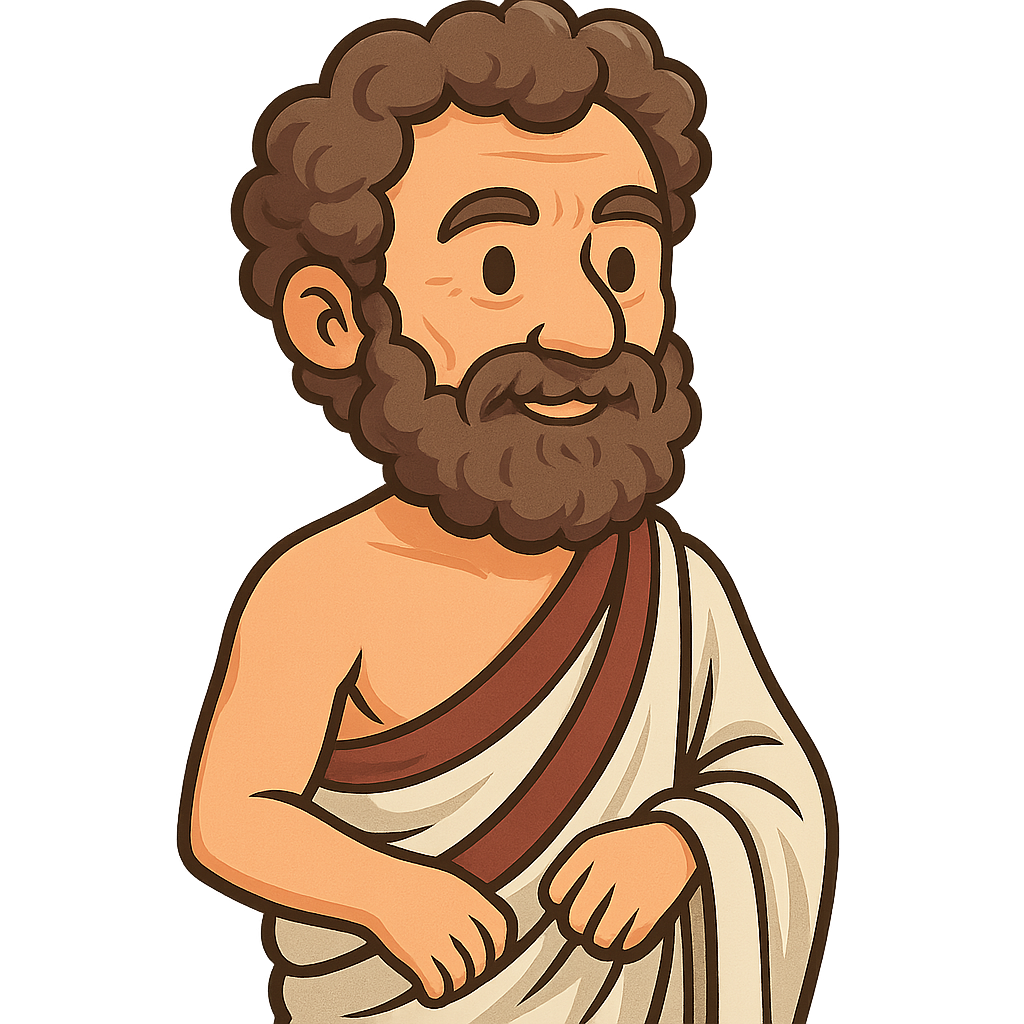
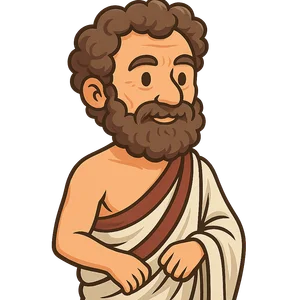
Hello, my name is Leucippus. I lived a very long time ago, in the 5th century BCE in ancient Greece. It was an exciting time when people were asking big questions about the world. No one is quite sure where I was born—perhaps Miletus or Abdera—but what mattered most to me was not where I was from, but what I could figure out. While others looked to the gods for answers, I looked at the world around me. I was a philosopher, which is a fancy word for someone who loves wisdom and seeks to understand life's biggest mysteries. My favorite question was a simple one, but it was one of the biggest of all: What is everything made of?
Imagine you have a piece of cheese. You can cut it in half. You can cut that smaller piece in half again, and again, and again. Most thinkers in my time, around 440 BCE, believed you could just keep cutting forever. But that didn't seem right to me. I thought, 'There must be a point where you get to a piece so tiny, so fundamental, that it simply cannot be cut anymore.' I decided to give these tiny, uncuttable building blocks a name. I called them 'atomos,' which in my Greek language means 'uncuttable.' Today, you call them atoms. But I realized these 'atomos' couldn't be the only thing. If the whole universe was packed solid with them, nothing could ever move or change. So, there had to be something else: empty space. I called this 'the void.' My big idea was that everything—everything in the entire cosmos—was made of just two things: tiny, solid atoms and the complete emptiness of the void for them to move in.
Leucippus: The Thinker Who Imagined Atoms
Hello, my name is Leucippus. I lived a very long time ago, in the 5th century BCE in ancient Greece. It was an exciting time when people were asking big questions about the world. No one is quite sure where I was born—perhaps Miletus or Abdera—but what mattered most to me was not where I was from, but what I could figure out. While others looked to the gods for answers, I looked at the world around me. I was a philosopher, which is a fancy word for someone who loves wisdom and seeks to understand life's biggest mysteries. My favorite question was a simple one, but it was one of the biggest of all: What is everything made of?
Imagine you have a piece of cheese. You can cut it in half. You can cut that smaller piece in half again, and again, and again. Most thinkers in my time, around 440 BCE, believed you could just keep cutting forever. But that didn't seem right to me. I thought, 'There must be a point where you get to a piece so tiny, so fundamental, that it simply cannot be cut anymore.' I decided to give these tiny, uncuttable building blocks a name. I called them 'atomos,' which in my Greek language means 'uncuttable.' Today, you call them atoms. But I realized these 'atomos' couldn't be the only thing. If the whole universe was packed solid with them, nothing could ever move or change. So, there had to be something else: empty space. I called this 'the void.' My big idea was that everything—everything in the entire cosmos—was made of just two things: tiny, solid atoms and the complete emptiness of the void for them to move in.
This idea of atoms and the void was the beginning of a grand theory. I imagined that there were countless atoms, always moving, bouncing, and tumbling through the void. They weren't all the same, either. I proposed that they came in many different shapes and sizes. Some might be round and smooth, while others could be jagged and pointy. When these atoms hooked together, they formed the objects we see and touch. The reason a rock is hard and solid is because its atoms are jagged and packed tightly together. The reason water can flow is because its atoms are smooth and can roll past one another. It was a simple but powerful way to explain the entire world without needing magic or myths. I was lucky to have a brilliant student named Democritus. He was fascinated by my ideas, and together we explored and expanded this atomic theory. He wrote many books explaining our work, which helped our ideas spread throughout Greece.
Not everyone was convinced. Our theory was radical for its time. Many other famous philosophers, like the great Aristotle who came after me, disagreed with the idea of atoms. They argued that you couldn't see them, so how could you prove they existed? And they were right; in the 5th century BCE, we had no tools to see something so small. It was purely an idea, a conclusion reached by thinking logically about the world. I wrote about my theories in books, including one called 'The Great World System.' Unfortunately, through the long passage of time, all of my original writings have been lost. The only reason we know about my ideas today is because other writers, including those who argued against me like Aristotle, wrote about them in their own books.
I lived a full life in the 5th century BCE, dedicated to thinking and questioning. Though my ideas were debated for centuries, they never completely disappeared. It took more than two thousand years for scientists with powerful instruments to finally prove that atoms are real. My early philosophical idea laid the groundwork for what is now a fundamental principle of modern science. Today, atomic theory is the foundation of chemistry, physics, and our understanding of the universe. It all began with a simple thought experiment about cutting a piece of cheese, and the question that followed: 'What are the unbreakable, fundamental building blocks of everything?'
Wow facts
About
Leucippus was an ancient Greek philosopher from the 5th century BCE who is credited as the originator of atomism, the theory that all matter is composed of tiny, indivisible particles called atoms.
Take a Quiz
Question 1 of 5
What is the main problem Leucippus and his theory faced during the 5th century BCE?
Explore next




Want to do even more?
Go beyond exploring. Unlock tools that turn every story into real learning.

Storypie Plus for families
Full stories, quizzes, and printables. Nights and car rides, sorted.
- Unlimited audio stories
- Create Mode: your child stars in the story
- Offline downloads
- Printable worksheets & coloring pages

Why Storypie for Schools
Students engaged. Prep in seconds. Evenings back to you.
- Worksheets & Quizzes
- Classroom Management
- Formative Assessment
- Custom Curriculum & Lesson Plans
- 27 Languages

Why Storypie for Homeschool
Curriculum done. They'll ask for more. Hours back in your day.
- Worksheet Generator
- First-Person Audio Stories
- Built-in Comprehension Quizzes
- Custom Curriculum & Lesson Plans
- Print & Go Activities