English

Lucretia Mott
Lucretia Mott was a 19th-century American Quaker minister, abolitionist, social reformer…
Reads at Grades 6–8 Listens at Grades 4–8
Print & create
Answer keys·No prep·Free with an account
28 worksheets · answer keys · full story · quiz · Ages 10-12 · CEFR B2
Plus adds 290,000+ more stories in 27 languages, audio for every one, and printables for all of them.
Just want Lucretia Mott?
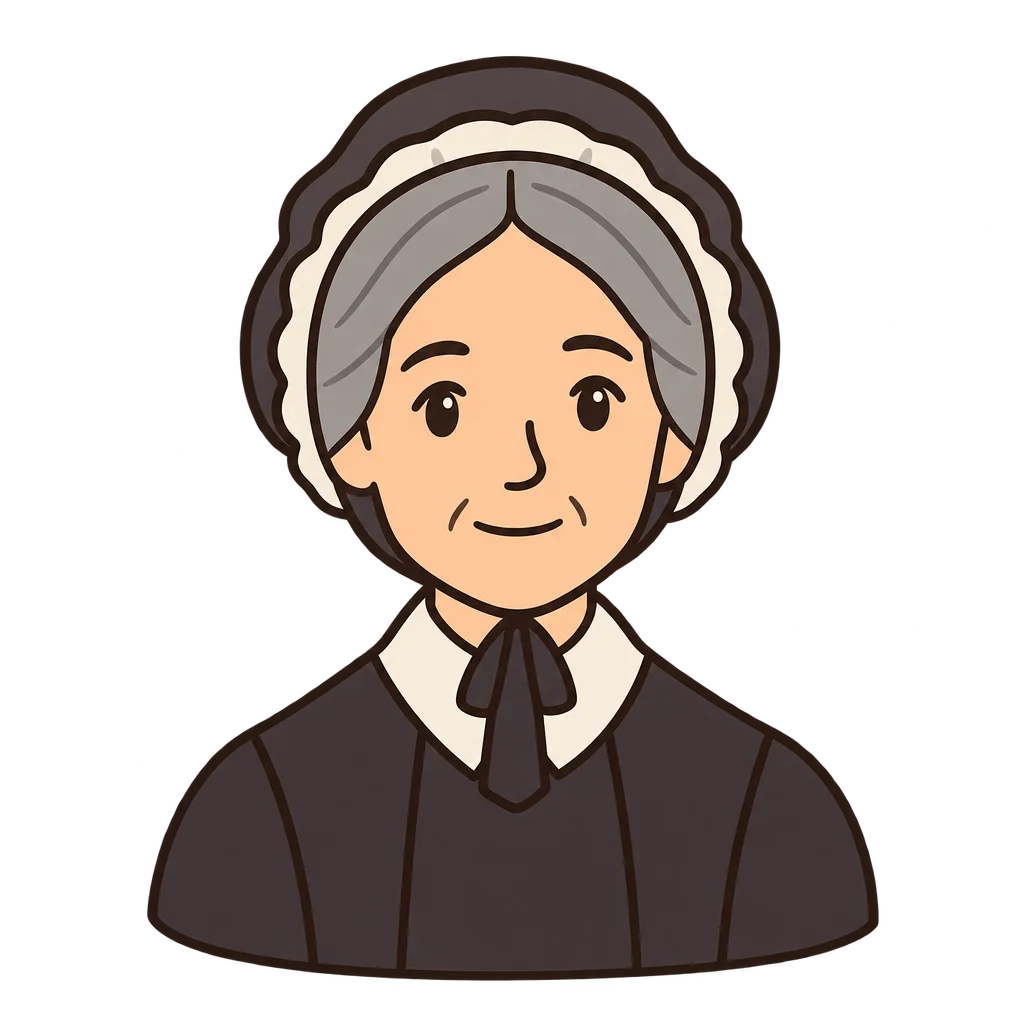
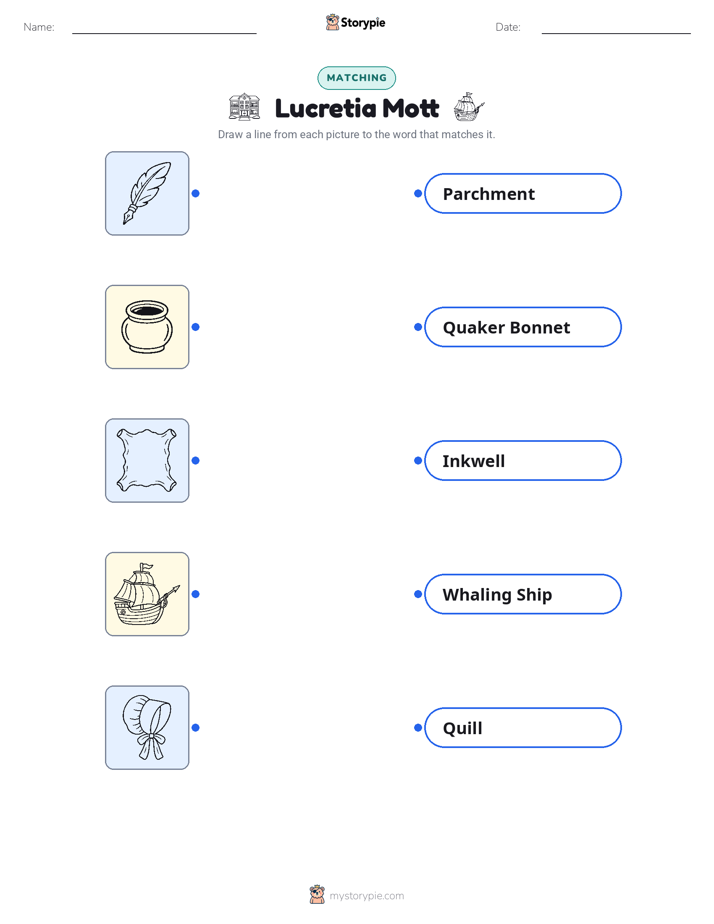
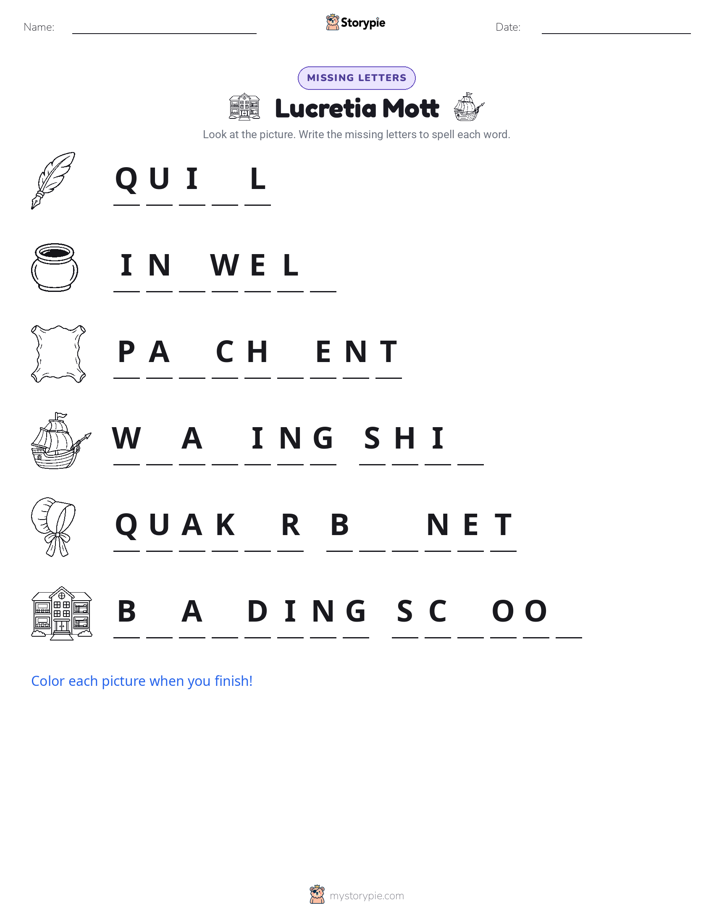
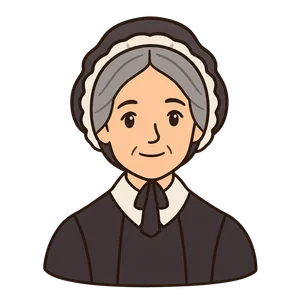
Hello. My name is Lucretia Mott, and I spent my life fighting for the simple but powerful idea that every single person is equal. My story begins on a small island called Nantucket, Massachusetts, where I was born on January 3rd, 1793. I was raised in the Quaker faith, which taught a belief that has guided my entire life: that every person has an 'Inner Light' from God. This meant that everyone, regardless of their race or whether they were a man or a woman, was equal in the eyes of God. This single idea became the foundation for everything I would fight for. My parents, Thomas Coffin Jr. and Anna Folger, raised me in a community where women were remarkably strong and independent. The men of Nantucket were often away at sea on whaling ships for years at a time. While they were gone, the women managed the businesses, cared for the homes, and ran the island. Seeing these capable women all around me showed me from a very young age just how much women could achieve when given the chance.
My formal education began in 1806 when I was sent to the Nine Partners School, a Quaker boarding school. I loved to learn and absorbed everything I could. I did so well, in fact, that I was eventually asked to stay and become a teacher there myself. But it was during my time as a teacher that I learned a hard and unfair lesson about the world. I discovered that the male teachers at the school were being paid twice as much as the female teachers, even though we were doing the exact same work. This injustice felt deeply wrong to me. It opened my eyes to the many ways that society treated women as less important than men. This personal experience lit a fire in me to work for change. It was also at this school that I met a fellow teacher named James Mott. He shared my Quaker beliefs and my passion for justice and equality. We fell in love, and on April 10th, 1811, we were married, beginning a partnership that would support our shared work for the rest of our lives.
A Voice for Equality: The Story of Lucretia Mott
Hello. My name is Lucretia Mott, and I spent my life fighting for the simple but powerful idea that every single person is equal. My story begins on a small island called Nantucket, Massachusetts, where I was born on January 3rd, 1793. I was raised in the Quaker faith, which taught a belief that has guided my entire life: that every person has an 'Inner Light' from God. This meant that everyone, regardless of their race or whether they were a man or a woman, was equal in the eyes of God. This single idea became the foundation for everything I would fight for. My parents, Thomas Coffin Jr. and Anna Folger, raised me in a community where women were remarkably strong and independent. The men of Nantucket were often away at sea on whaling ships for years at a time. While they were gone, the women managed the businesses, cared for the homes, and ran the island. Seeing these capable women all around me showed me from a very young age just how much women could achieve when given the chance.
My formal education began in 1806 when I was sent to the Nine Partners School, a Quaker boarding school. I loved to learn and absorbed everything I could. I did so well, in fact, that I was eventually asked to stay and become a teacher there myself. But it was during my time as a teacher that I learned a hard and unfair lesson about the world. I discovered that the male teachers at the school were being paid twice as much as the female teachers, even though we were doing the exact same work. This injustice felt deeply wrong to me. It opened my eyes to the many ways that society treated women as less important than men. This personal experience lit a fire in me to work for change. It was also at this school that I met a fellow teacher named James Mott. He shared my Quaker beliefs and my passion for justice and equality. We fell in love, and on April 10th, 1811, we were married, beginning a partnership that would support our shared work for the rest of our lives.
After our marriage, James and I moved to Philadelphia, a city that was a center for many reform movements. My commitment to justice only grew stronger there. In 1821, I was officially recognized as a Quaker minister. In our faith, this meant that the community recognized my gift for public speaking and spiritual leadership. This was an important step, as it gave me a platform to speak to large groups of people. I used my voice to preach about one of the greatest injustices of our time: the horror of slavery. I argued that it was a sin to own another human being. At the time, women were usually not allowed to join the men's anti-slavery groups or speak at their meetings. Refusing to be silenced, I worked with other women to establish the Philadelphia Female Anti-Slavery Society in 1833. We were determined to do our part. We wrote pamphlets to educate the public, organized boycotts of products like cotton and sugar that were made by enslaved people, and stood firm even when faced with angry mobs who hated our message and threatened us with violence.
My work as an abolitionist took me across the ocean in 1840. I was chosen as an official delegate to attend the World Anti-Slavery Convention in London, England. I was excited to meet with fellow activists from around the globe and contribute to the cause. However, when I and the other American female delegates arrived, we were met with a closed door. The male organizers of the convention voted that women would not be allowed to be seated as delegates or to speak. We had traveled thousands of miles only to be told to sit in a separate section, hidden from view behind a curtain, and remain silent. The frustration and humiliation were immense. It was there, in that segregated section, that I began a deep conversation with a bright and passionate young woman named Elizabeth Cady Stanton. She was just as outraged as I was. We realized that we could not effectively fight for the rights of others if our own rights as women were not recognized. That day, we made a promise to each other: we would return to the United States and hold a convention to fight for the rights of women.
It took eight years, but we never forgot our promise. On July 19th and 20th, 1848, Elizabeth Cady Stanton, myself, and a few other determined women organized the very first women's rights convention in Seneca Falls, New York. It was a revolutionary moment. We knew we needed a powerful statement to declare our purpose, so we drafted a document we called the Declaration of Sentiments. We modeled it after the American Declaration of Independence, but we made a crucial change. Where the original said, 'all men are created equal,' our document boldly stated, 'all men and women are created equal.' Our declaration listed the many injustices women faced and laid out a series of demands. We called for women to have the right to an education, the right to own property, and the right to control their own wages. We also included the most radical idea of all at the time: the right for women to vote.
I dedicated my entire life to the pursuit of justice. I continued to travel and speak out against slavery, for the equal rights of women, and for peace among all people. In 1864, I helped found Swarthmore College, a place of higher learning that was created to educate both men and women. I lived to be 87 years old. Although I did not live long enough to see women win the right to vote or for all my dreams of equality to be realized, I am remembered as one of the mothers of the women's rights movement in America. My hope is that my story inspires you to find your own 'Inner Light' and use your voice to speak up for what is right, working toward a world where every single person is treated with dignity and respect.
Wow facts
About
Lucretia Mott was a 19th-century American Quaker minister, abolitionist, social reformer, and a leading figure in the women's rights movement.
Take a Quiz
Question 1 of 5
Based on the story, what was the main goal of Lucretia Mott's life's work?
Explore next





Want to do even more?
Go beyond exploring. Unlock tools that turn every story into real learning.

Storypie Plus for families
Full stories, quizzes, and printables. Nights and car rides, sorted.
- Unlimited audio stories
- Create Mode: your child stars in the story
- Offline downloads
- Printable worksheets & coloring pages

Why Storypie for Schools
Students engaged. Prep in seconds. Evenings back to you.
- Worksheets & Quizzes
- Classroom Management
- Formative Assessment
- Custom Curriculum & Lesson Plans
- 27 Languages

Why Storypie for Homeschool
Curriculum done. They'll ask for more. Hours back in your day.
- Worksheet Generator
- First-Person Audio Stories
- Built-in Comprehension Quizzes
- Custom Curriculum & Lesson Plans
- Print & Go Activities