English


Luigi Galvani
An Italian physician, physicist…
Reads at Grades 6–8 Listens at Grades 4–8
Print & create
Answer keys·No prep·Free with an account
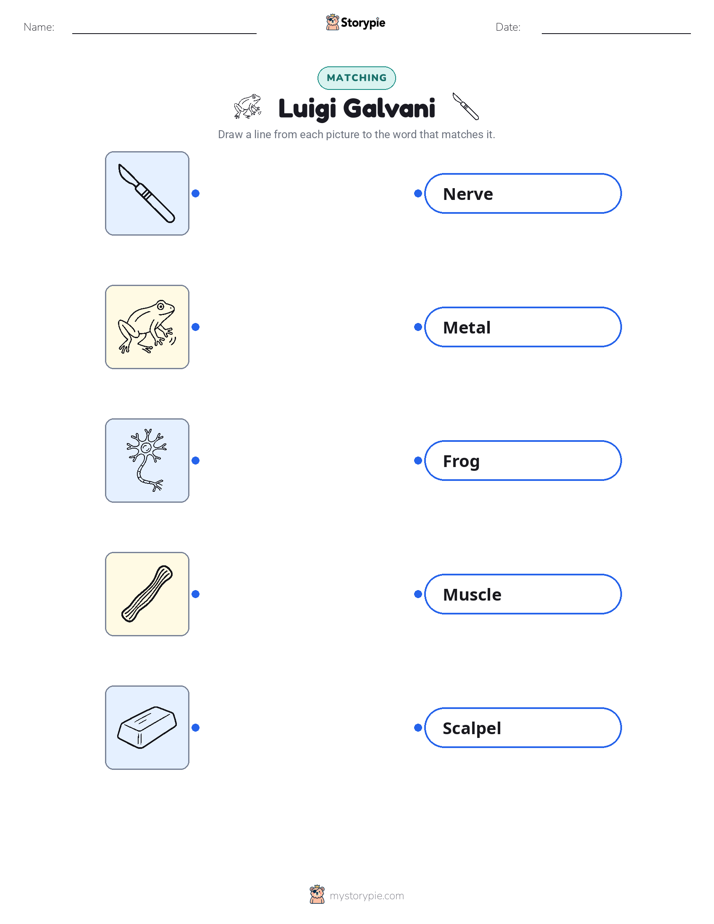
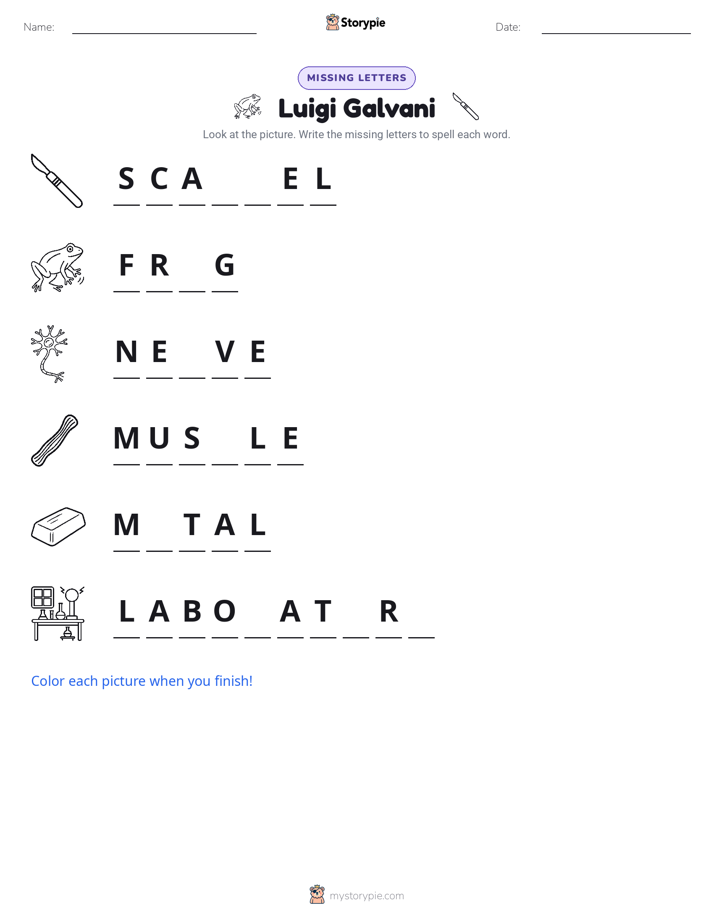
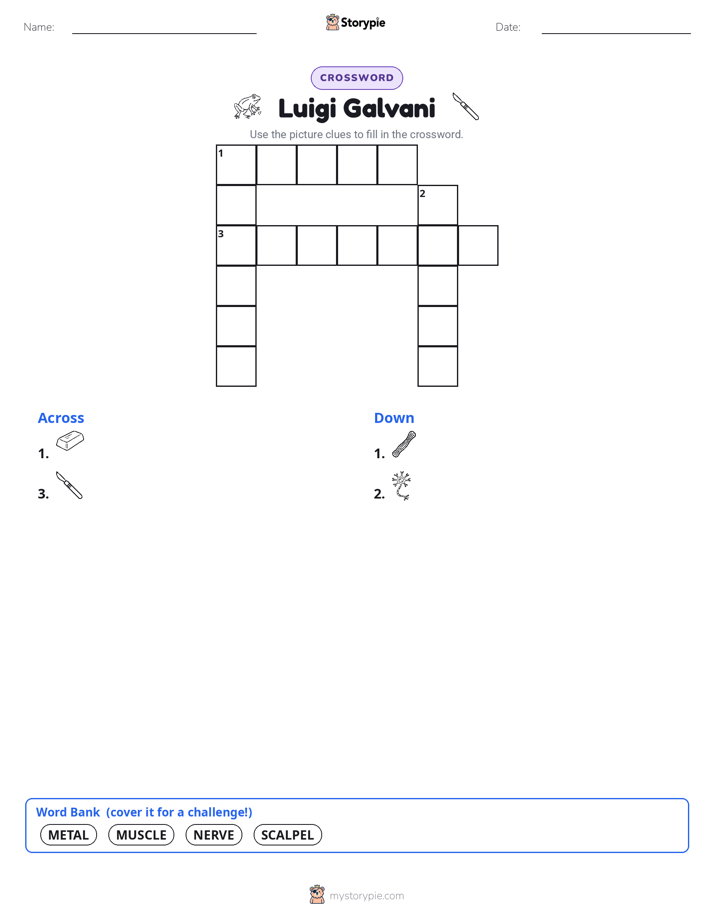
28 worksheets · answer keys · full story · quiz · Ages 10-12 · CEFR B2
Plus adds 244,000+ more stories in 27 languages, audio for every one, and printables for all of them.
Just want Luigi Galvani?
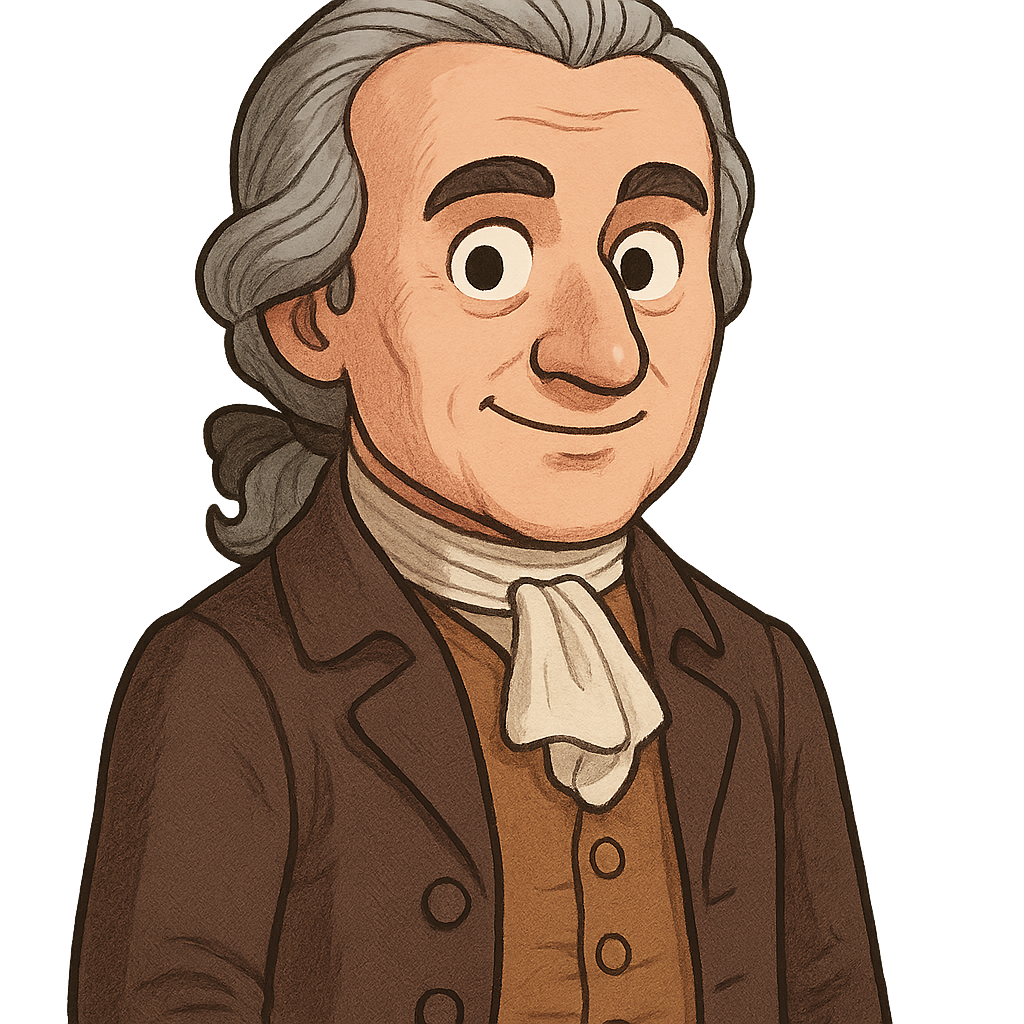
Hello! My name is Luigi Galvani, and I want to tell you about a discovery that sent a jolt through the scientific world. I was born on September 9th, 1737, in a beautiful city in Italy called Bologna. Growing up, our home was filled with books and curiosity. At first, I thought I would dedicate my life to the church, but I soon realized my true passion was understanding the marvelous workings of the human body. So, I enrolled at the famous University of Bologna, one of the oldest universities in the world. I studied medicine and philosophy, eager to learn everything I could about anatomy—the science of how living things are put together. I spent countless hours reading, attending lectures, and preparing for my future as a doctor, never guessing that a simple frog would one day make me famous.
After I graduated with my medical degree in 1759, my life began to take shape. In 1762, I married the love of my life, Lucia Galeazzi. Her father, Gusmano Galeazzi, was one of my favorite professors, and he became a wonderful mentor to me. That same year, I was given the great honor of becoming a professor of anatomy at my beloved University of Bologna. I was also appointed to teach surgery. My days were very busy! I would spend my mornings teaching students about bones, muscles, and nerves, and my afternoons and evenings working as a surgeon, helping the people of Bologna. I loved my work, but a part of me was always asking questions. I was particularly fascinated by the work of scientists like Benjamin Franklin and their experiments with electricity. I began to wonder: could this mysterious force of electricity have something to do with how our bodies move?
A Biography of Luigi Galvani
Hello! My name is Luigi Galvani, and I want to tell you about a discovery that sent a jolt through the scientific world. I was born on September 9th, 1737, in a beautiful city in Italy called Bologna. Growing up, our home was filled with books and curiosity. At first, I thought I would dedicate my life to the church, but I soon realized my true passion was understanding the marvelous workings of the human body. So, I enrolled at the famous University of Bologna, one of the oldest universities in the world. I studied medicine and philosophy, eager to learn everything I could about anatomy—the science of how living things are put together. I spent countless hours reading, attending lectures, and preparing for my future as a doctor, never guessing that a simple frog would one day make me famous.
After I graduated with my medical degree in 1759, my life began to take shape. In 1762, I married the love of my life, Lucia Galeazzi. Her father, Gusmano Galeazzi, was one of my favorite professors, and he became a wonderful mentor to me. That same year, I was given the great honor of becoming a professor of anatomy at my beloved University of Bologna. I was also appointed to teach surgery. My days were very busy! I would spend my mornings teaching students about bones, muscles, and nerves, and my afternoons and evenings working as a surgeon, helping the people of Bologna. I loved my work, but a part of me was always asking questions. I was particularly fascinated by the work of scientists like Benjamin Franklin and their experiments with electricity. I began to wonder: could this mysterious force of electricity have something to do with how our bodies move?
My biggest discovery happened quite by accident in the 1780s. One evening, I was in my laboratory preparing a frog for dissection. On the same table, one of my assistants was working with a machine that generated static electricity. My assistant happened to touch an exposed nerve in the frog's leg with a metal scalpel. Instantly, the frog’s leg kicked, as if it were still alive! We were all astonished. What had just happened? This single, shocking moment sparked an obsession in me. I had to understand the connection between electricity and life. I began a series of experiments. I took frog legs outside during thunderstorms in 1786, attaching them to a long metal wire to attract lightning. When the lightning flashed, the legs twitched violently! Then, I found I could make the legs twitch even without a storm, simply by touching the nerves and muscles with two different types of metal, like brass and iron. It was clear that some kind of electricity was at play.
After years of careful experiments, I came to a groundbreaking conclusion. I believed that animals produced their very own special kind of electricity inside their bodies. I called it 'animal electricity.' I imagined it was a fluid that flowed from the brain, through the nerves, and into the muscles, causing them to contract and move. To me, this was the secret spark of life itself! In 1791, I published all my findings in a book for other scientists to read. The news of my discovery spread like wildfire across Europe. Scientists everywhere were fascinated and began trying to repeat my experiments with the twitching frog legs. It was an exciting time, and my work opened up a brand-new field of science dedicated to studying electricity in living things.
Not everyone agreed with my theory of 'animal electricity.' A brilliant fellow Italian scientist named Alessandro Volta was very interested in my work, but he had a different idea. He believed the electricity wasn't coming from the frog itself, but was instead generated by the two different metals I was using. We wrote letters back and forth, each defending our ideas. This friendly but serious disagreement pushed both of us to conduct even more experiments. While I continued to prove that animal tissue could create a current, Volta's research into 'metallic electricity' led him to invent something incredible: the world's first electric battery. My final years were also difficult because of political changes. In 1797, I refused to swear an oath to a new government I did not support, and because of my principles, I lost my job at the university.
I returned home to Bologna, where I passed away on December 4th, 1798. I lived to be 61 years old. Though my debate with Volta was famous, history has shown that we were both right in our own ways. His work gave the world the battery, but my discovery revealed the fundamental electrical nature of our own bodies. My research on 'animal electricity' created a whole new scientific field called electrophysiology, the study of how electricity works in the body. Today, doctors use this science to understand our hearts and brains. It all started with a curious observation about a frog's leg, proving that sometimes the smallest twitch can lead to the biggest leaps in human knowledge.
Wow facts
About
An Italian physician, physicist, and biologist who discovered that electricity could cause the muscles of dead frogs' legs to twitch, a foundational discovery in the field of bioelectricity.
Take a Quiz
Question 1 of 5
What was the main conflict or problem that Luigi Galvani and Alessandro Volta had?
Explore next




Want to do even more?
Go beyond exploring. Unlock tools that turn every story into real learning.

Storypie Plus for families
Full stories, quizzes, and printables. Nights and car rides, sorted.
- Unlimited audio stories
- Create Mode: your child stars in the story
- Offline downloads
- Printable worksheets & coloring pages

Why Storypie for Schools
Students engaged. Prep in seconds. Evenings back to you.
- Worksheets & Quizzes
- Classroom Management
- Formative Assessment
- Custom Curriculum & Lesson Plans
- 27 Languages

Why Storypie for Homeschool
Curriculum done. They'll ask for more. Hours back in your day.
- Worksheet Generator
- First-Person Audio Stories
- Built-in Comprehension Quizzes
- Custom Curriculum & Lesson Plans
- Print & Go Activities