English


Piet Mondrian
Piet Mondrian was a Dutch painter and a pioneer of 20th-century abstract art.
Reads at Grades 6–8 Listens at Grades 4–8
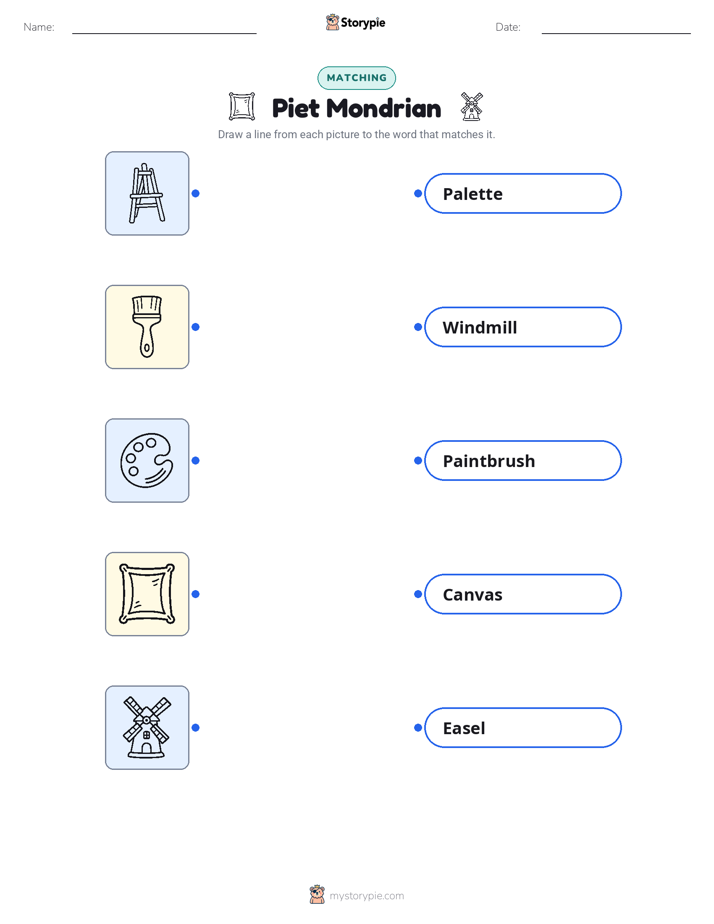
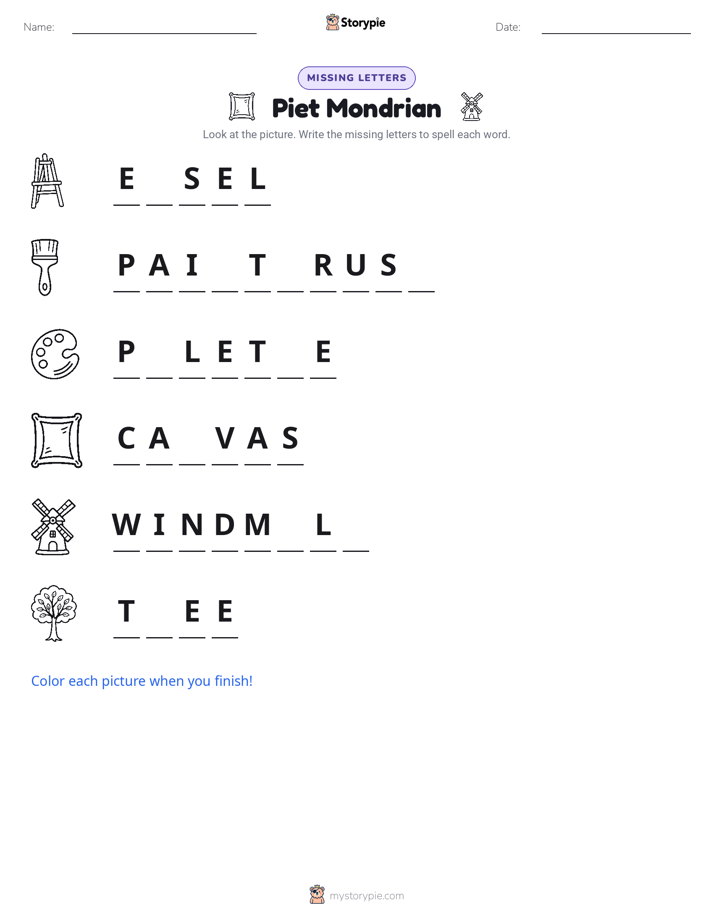
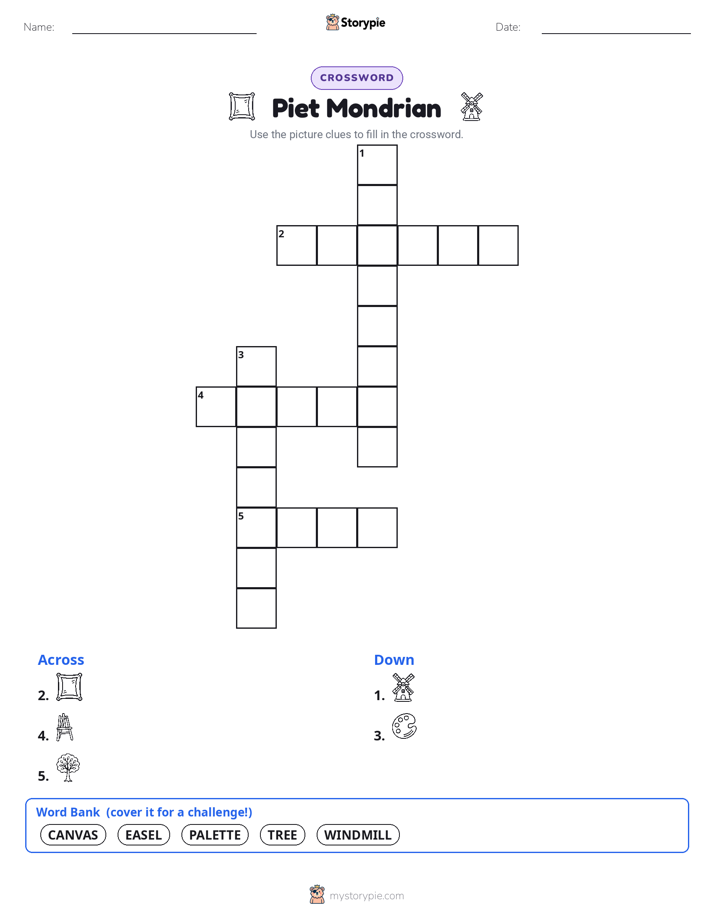
Print & create
Answer keys·No prep·Free with an account
28 worksheets · answer keys · full story · quiz · Ages 10-12 · CEFR B2
Plus adds 164,000+ more stories in 27 languages, audio for every one, and printables for all of them.
Just want Piet Mondrian?

Hello. My name is Piet Mondrian, and I am known for creating paintings with straight black lines, primary colors, and perfect balance. But my artistic journey did not begin there. I was born in the Netherlands on March 7th, 1872. Growing up, art was all around me. My father was a drawing teacher, and my uncle was a professional painter. They taught me the fundamentals of art, showing me how to sketch and paint the world I saw. My early works were very traditional for that time. I painted the landscapes of my home country: the flat fields stretching to the horizon, the slow-turning windmills, and the quiet rivers reflecting the sky. I loved capturing the world exactly as my eyes saw it. To deepen my skills, I enrolled at the Royal Academy of Visual Arts in Amsterdam in 1892. For years, I dedicated myself to mastering realistic painting, believing that art’s main purpose was to create a perfect copy of nature.
In 1911, I made a decision that would change my art, and my life, forever. I moved to Paris, France, which was the vibrant center of the art world at the time. It was there that I first saw a radical new style of painting called Cubism, created by artists like the famous Pablo Picasso. Cubist paintings broke down objects into geometric shapes and showed them from multiple angles at once. This was a revelation to me. I began to understand that a painting didn't have to be a simple window onto the world. It could express the underlying structure and essential feeling of things. My own work began to transform. I painted trees over and over, but each time they became less realistic. The leaves and branches slowly dissolved into a complex web of intersecting lines and flat planes. To mark this profound shift in my thinking, in 1912 I changed the spelling of my last name from the Dutch 'Mondriaan' to the more French-sounding 'Mondrian.' I was becoming a new artist for a new century.
Piet Mondrian: A Life in Lines and Color
Hello. My name is Piet Mondrian, and I am known for creating paintings with straight black lines, primary colors, and perfect balance. But my artistic journey did not begin there. I was born in the Netherlands on March 7th, 1872. Growing up, art was all around me. My father was a drawing teacher, and my uncle was a professional painter. They taught me the fundamentals of art, showing me how to sketch and paint the world I saw. My early works were very traditional for that time. I painted the landscapes of my home country: the flat fields stretching to the horizon, the slow-turning windmills, and the quiet rivers reflecting the sky. I loved capturing the world exactly as my eyes saw it. To deepen my skills, I enrolled at the Royal Academy of Visual Arts in Amsterdam in 1892. For years, I dedicated myself to mastering realistic painting, believing that art’s main purpose was to create a perfect copy of nature.
In 1911, I made a decision that would change my art, and my life, forever. I moved to Paris, France, which was the vibrant center of the art world at the time. It was there that I first saw a radical new style of painting called Cubism, created by artists like the famous Pablo Picasso. Cubist paintings broke down objects into geometric shapes and showed them from multiple angles at once. This was a revelation to me. I began to understand that a painting didn't have to be a simple window onto the world. It could express the underlying structure and essential feeling of things. My own work began to transform. I painted trees over and over, but each time they became less realistic. The leaves and branches slowly dissolved into a complex web of intersecting lines and flat planes. To mark this profound shift in my thinking, in 1912 I changed the spelling of my last name from the Dutch 'Mondriaan' to the more French-sounding 'Mondrian.' I was becoming a new artist for a new century.
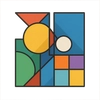
My artistic evolution was interrupted in 1914 when World War I began, forcing me to return to the Netherlands. While I was there, I met another Dutch artist named Theo van Doesburg. We discovered that we shared many of the same beliefs about the future of art. We both felt that art needed to move beyond personal feelings and individual objects to express something more universal. In 1917, we founded an art movement and a magazine to spread our ideas, which we called De Stijl, a Dutch phrase that means 'The Style.' It was during this period that I developed the philosophy I called Neoplasticism. I believed that by using the most basic elements, I could create a feeling of perfect, universal harmony. I set strict rules for myself. My paintings would use only straight vertical and horizontal lines. My color palette would be limited to the three primary colors—red, yellow, and blue—along with the non-colors of white, black, and gray. My goal was not to paint a tree or a building, but to create a perfect, logical balance on the canvas that would feel stable and pure to anyone who saw it.
The world was thrown into turmoil again with the rise of World War II. Seeking safety, I moved first to London in 1938 and then, in 1940, I crossed the Atlantic Ocean to New York City. I was nearly 70 years old, but the city filled me with a new and powerful energy. I was absolutely fascinated by its structure and its rhythm. The grid of the city streets, the towering skyscrapers reaching for the sky, and the lively beat of American jazz and boogie-woogie music all made a deep impression on me. This new environment made my art more dynamic and joyful than ever before. I began to break up my solid black lines into small, pulsing blocks of bright color. The straight lines were still there, but now they felt like they were dancing, capturing the fast-paced, energetic rhythm of the city. It was during this incredibly creative time that I painted one of my most famous works, 'Broadway Boogie Woogie,' a vibrant tribute to the music and life of New York.
My journey was a long search for truth and harmony through art. When I fell ill with pneumonia, my final painting, 'Victory Boogie Woogie,' was still in my studio, filled with small pieces of colored tape as I worked out its final, complex rhythm. My life came to an end on February 1st, 1944. I lived to be 71 years old. Though my paintings were where my ideas took shape, my search for simplicity and balance did not end with me. The principles of De Stijl and Neoplasticism went on to influence architects who designed clean, modern buildings, furniture designers who created simple and functional pieces, and even fashion designers. I hope that when people look at my grids of color and line, they see more than just shapes. I hope they see a story of how looking at the world in a new, simpler way can create something beautiful, balanced, and full of life.
Wow facts
About
Piet Mondrian was a Dutch painter and a pioneer of 20th-century abstract art. He is best known for his grid-based paintings with primary colors, which he developed as part of the De Stijl art movement.
Take a Quiz
Question 1 of 5
What is the main idea of Piet Mondrian's story as an artist?
Explore next





Want to do even more?
Go beyond exploring. Unlock tools that turn every story into real learning.

Storypie Plus for families
Full stories, quizzes, and printables. Nights and car rides, sorted.
- Unlimited audio stories
- Create Mode: your child stars in the story
- Offline downloads
- Printable worksheets & coloring pages

Why Storypie for Schools
Students engaged. Prep in seconds. Evenings back to you.
- Worksheets & Quizzes
- Classroom Management
- Formative Assessment
- Custom Curriculum & Lesson Plans
- 27 Languages

Why Storypie for Homeschool
Curriculum done. They'll ask for more. Hours back in your day.
- Worksheet Generator
- First-Person Audio Stories
- Built-in Comprehension Quizzes
- Custom Curriculum & Lesson Plans
- Print & Go Activities