English

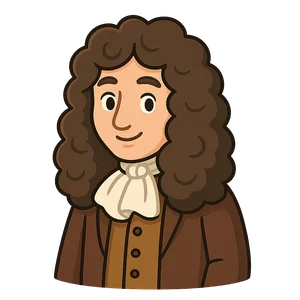
Robert Boyle
Robert Boyle was an influential 17th-century scientist and natural philosopher…
Reads at Grades 6–8 Listens at Grades 4–8
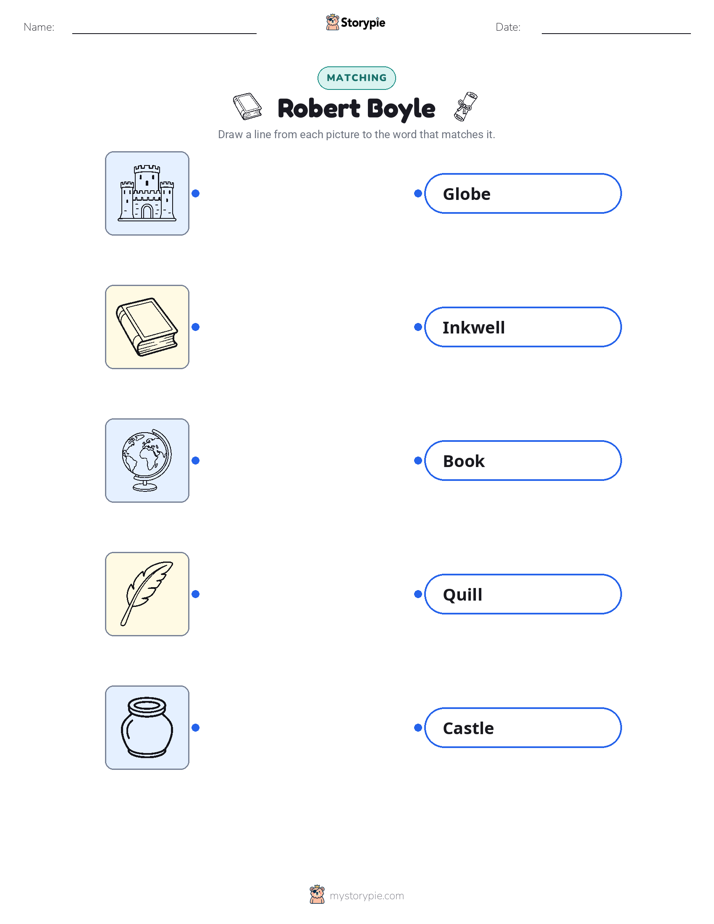
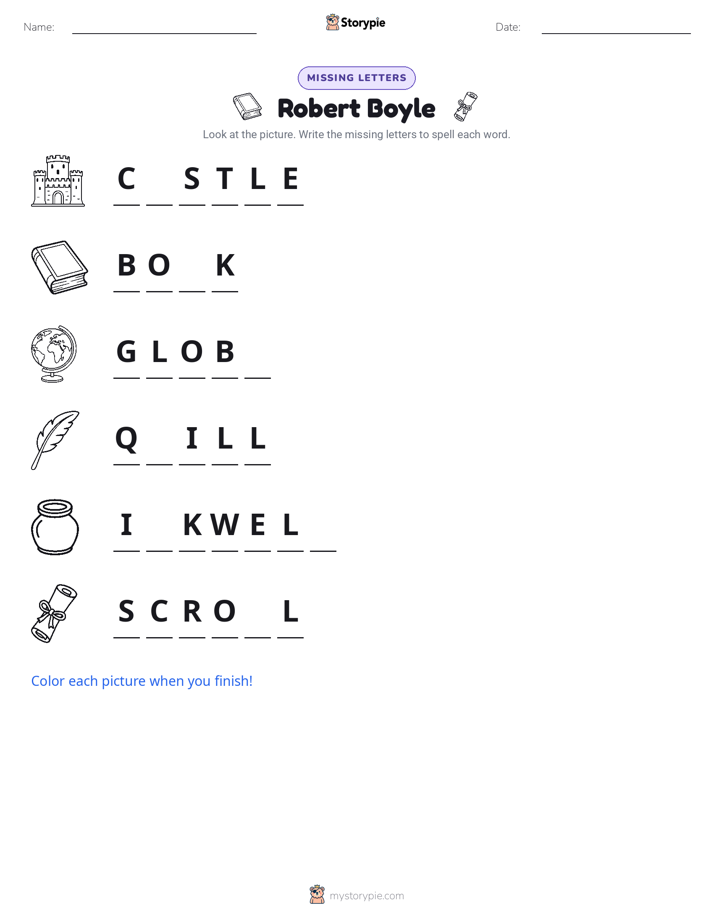
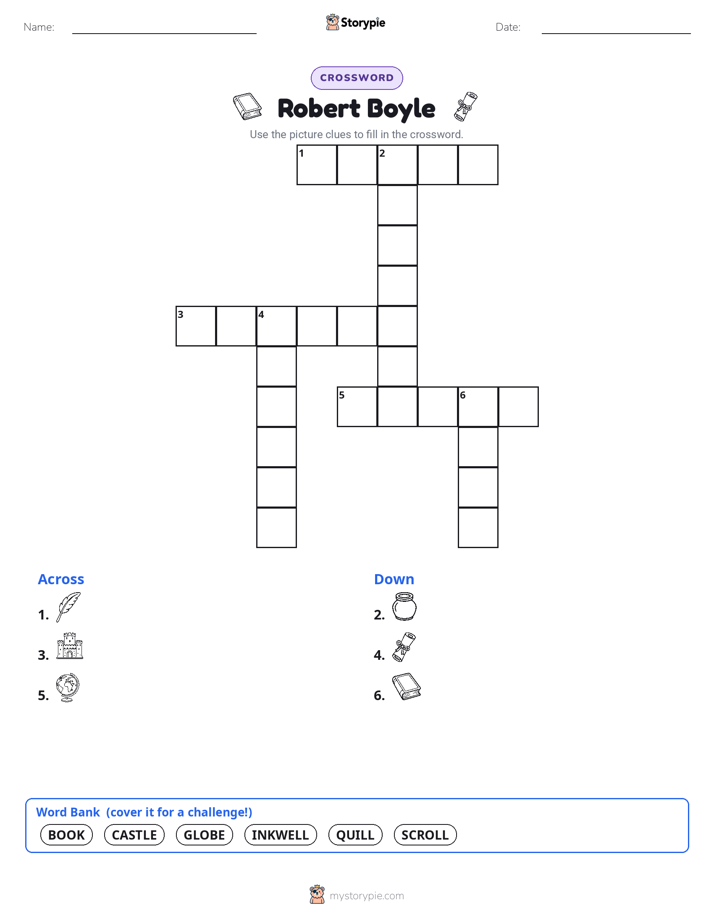
Print & create
Answer keys·No prep·Free with an account
28 worksheets · answer keys · full story · quiz · Ages 10-12 · CEFR B2
Plus adds 208,000+ more stories in 27 languages, audio for every one, and printables for all of them.
Just want Robert Boyle?
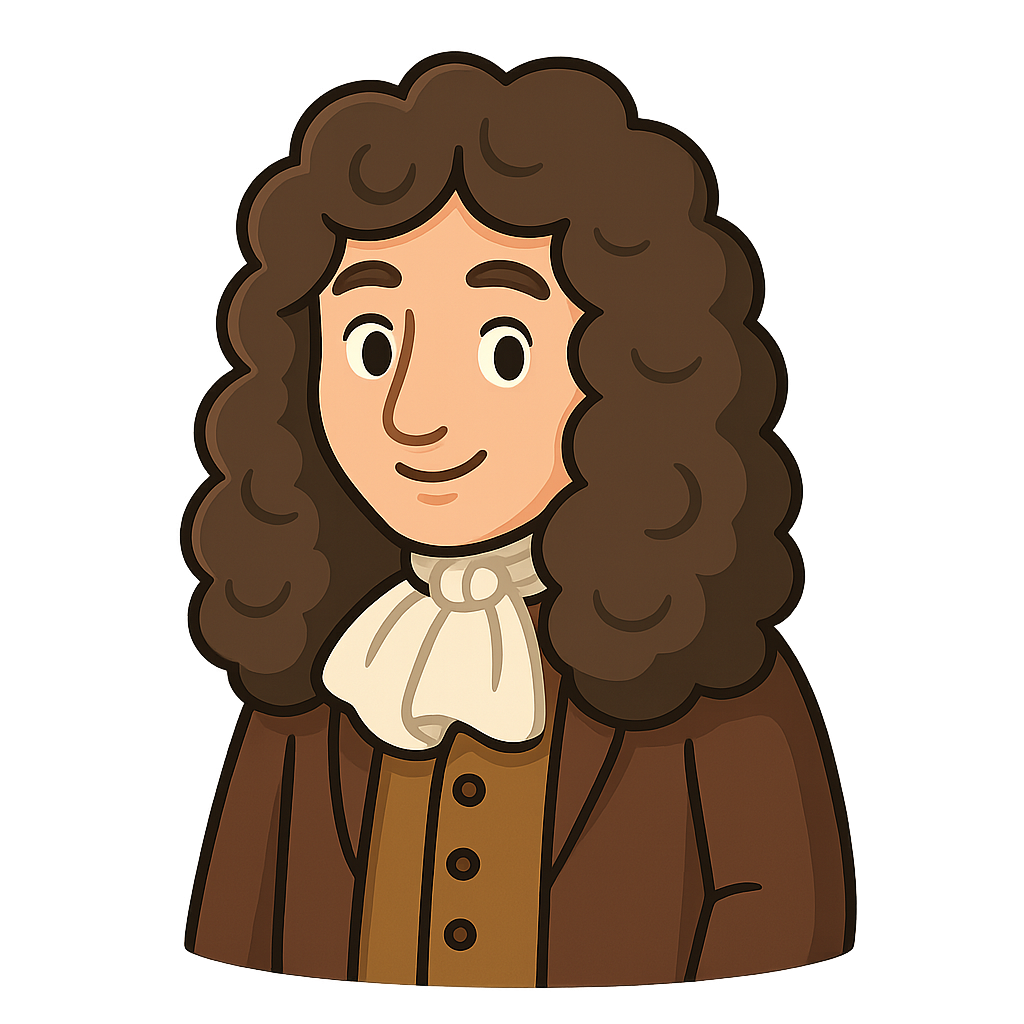
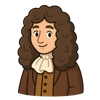
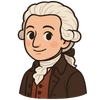
Hello! My name is Robert Boyle, and I’d like to share my story with you. I was born on January 25th, 1627, in a grand Irish home called Lismore Castle. As the fourteenth child of the Earl of Cork, I grew up in a busy household with many siblings! From a very young age, I was fascinated by the world around me and developed a great love for reading and learning new languages. When I was just eight years old, in 1635, my father sent me to study at the famous Eton College in England. A few years after that, I embarked on a grand tour across Europe with my tutor. This journey was incredibly important because it opened my eyes to many new ideas and cultures, sparking a lifelong passion for what was then called 'natural philosophy'—what you now know as science.
I returned to England in 1644, right in the middle of a period of great unrest known as the English Civil War. Despite the turmoil happening around me, I was determined to dedicate my life to scientific pursuits. I connected with a group of like-minded thinkers who would meet to discuss experiments and share new discoveries. We called ourselves the 'Invisible College' because our meetings were often held in secret to avoid the political chaos of the time. Our group shared a core belief: the best way to understand the natural world was not simply by reading old books, but by conducting careful experiments and meticulously observing the results. This was a revolutionary way of thinking, and it helped establish the foundation for the modern scientific method.
Robert Boyle: The Father of Modern Chemistry
Hello! My name is Robert Boyle, and I’d like to share my story with you. I was born on January 25th, 1627, in a grand Irish home called Lismore Castle. As the fourteenth child of the Earl of Cork, I grew up in a busy household with many siblings! From a very young age, I was fascinated by the world around me and developed a great love for reading and learning new languages. When I was just eight years old, in 1635, my father sent me to study at the famous Eton College in England. A few years after that, I embarked on a grand tour across Europe with my tutor. This journey was incredibly important because it opened my eyes to many new ideas and cultures, sparking a lifelong passion for what was then called 'natural philosophy'—what you now know as science.
I returned to England in 1644, right in the middle of a period of great unrest known as the English Civil War. Despite the turmoil happening around me, I was determined to dedicate my life to scientific pursuits. I connected with a group of like-minded thinkers who would meet to discuss experiments and share new discoveries. We called ourselves the 'Invisible College' because our meetings were often held in secret to avoid the political chaos of the time. Our group shared a core belief: the best way to understand the natural world was not simply by reading old books, but by conducting careful experiments and meticulously observing the results. This was a revolutionary way of thinking, and it helped establish the foundation for the modern scientific method.
In 1656, I moved to Oxford and set up what was, for the time, a state-of-the-art laboratory. My workshop became a hub of curiosity and discovery. I was fortunate to have a brilliant assistant named Robert Hooke, who was a gifted inventor and scientist in his own right. Together, around the year 1659, we designed and built one of our most important inventions: an improved air pump, which we called our 'pneumatical engine.' This remarkable machine allowed us to pump nearly all the air out of a sealed glass container, creating what is known as a vacuum. For the very first time in history, we had a way to study what happened to different things in a space where there was almost no air. This invention unlocked a whole new world of experiments that no one had ever been able to perform before.
With our powerful new air pump, we conducted a wide range of fascinating experiments. We proved that sound needs air to travel by placing a bell inside the vacuum chamber; when we rang it, we could hear nothing. We also demonstrated that in the absence of air resistance, a light feather and a heavy coin fell at exactly the same speed. But my most famous discovery came in 1662. Through a series of very careful measurements, I uncovered a fundamental relationship between the pressure and the volume of a gas. I found that if you keep the temperature constant, squeezing a gas into half its original space will cause its pressure to double. I called this predictable property the 'spring of the air,' and today, it is known all over the world as Boyle's Law.
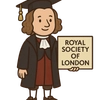
I was passionate about sharing my new, experiment-based approach to science with the world. In 1661, I published an influential book titled The Sceptical Chymist. In this work, I argued that the study of chemistry should be treated as a true science, grounded in experiments and evidence, rather than relying on the mystical traditions of alchemy. I put forward the idea that all matter was composed of simple, fundamental substances—what we might now call 'elements'—which are the basic building blocks of everything. This was a groundbreaking concept that helped transform chemistry into the modern science we know today. To further promote this new way of thinking, I helped found a new organization in 1660, which soon became the prestigious Royal Society of London, a place where scientists could gather to share and debate their findings.
I continued my experiments and writing for the remainder of my life. I lived to be 64 years old, passing away in London at the end of 1691. My greatest contribution to the world was helping to establish the critical importance of the experimental method—the principle that scientific truth must be built on evidence and proof. Because my work helped separate the field from old superstitions and turn it into a rigorous science, I am often called the 'Father of Modern Chemistry.' Today, Boyle's Law is a fundamental principle taught in science classes everywhere, and my insistence on experimentation continues to guide scientists as they explore the great mysteries of the universe.
Wow facts
About
Robert Boyle was an influential 17th-century scientist and natural philosopher, considered one of the founders of modern chemistry. He is best known for Boyle's Law, which describes the relationship between the pressure and volume of a gas.
Take a Quiz
Question 1 of 5
What was the main argument Robert Boyle made in his 1661 book, *The Sceptical Chymist*?
Explore next


Want to do even more?
Go beyond exploring. Unlock tools that turn every story into real learning.

Storypie Plus for families
Full stories, quizzes, and printables. Nights and car rides, sorted.
- Unlimited audio stories
- Create Mode: your child stars in the story
- Offline downloads
- Printable worksheets & coloring pages

Why Storypie for Schools
Students engaged. Prep in seconds. Evenings back to you.
- Worksheets & Quizzes
- Classroom Management
- Formative Assessment
- Custom Curriculum & Lesson Plans
- 27 Languages

Why Storypie for Homeschool
Curriculum done. They'll ask for more. Hours back in your day.
- Worksheet Generator
- First-Person Audio Stories
- Built-in Comprehension Quizzes
- Custom Curriculum & Lesson Plans
- Print & Go Activities