English

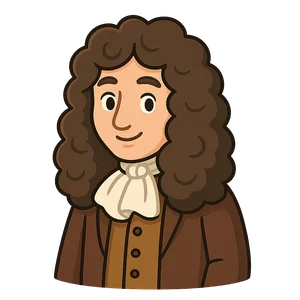
Robert Boyle
Robert Boyle was an influential 17th-century scientist and natural philosopher…
Reads at Grades 3–5 Listens at Grades 1–5
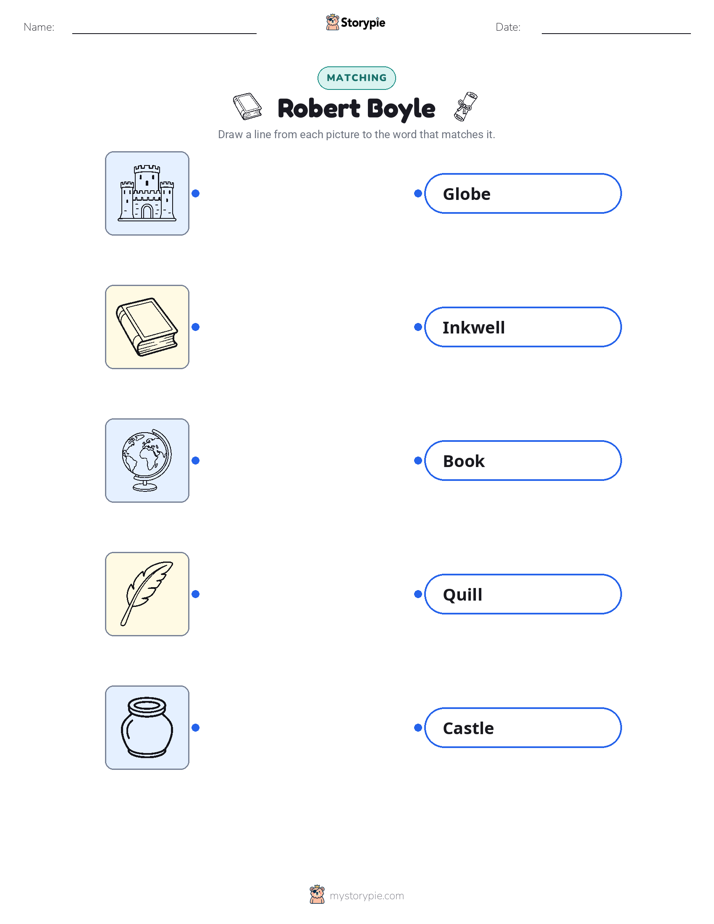
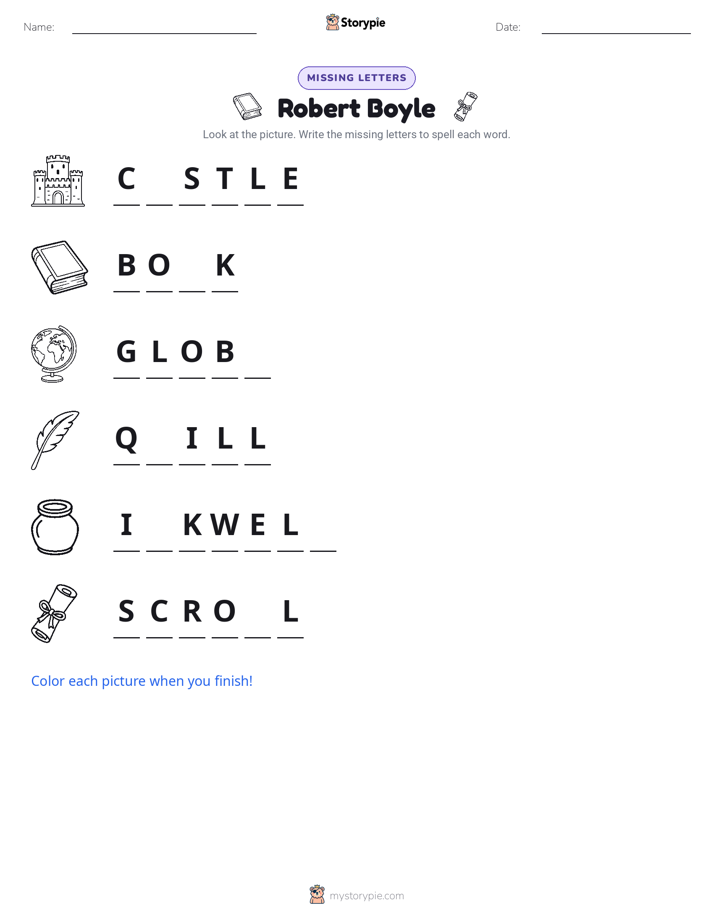
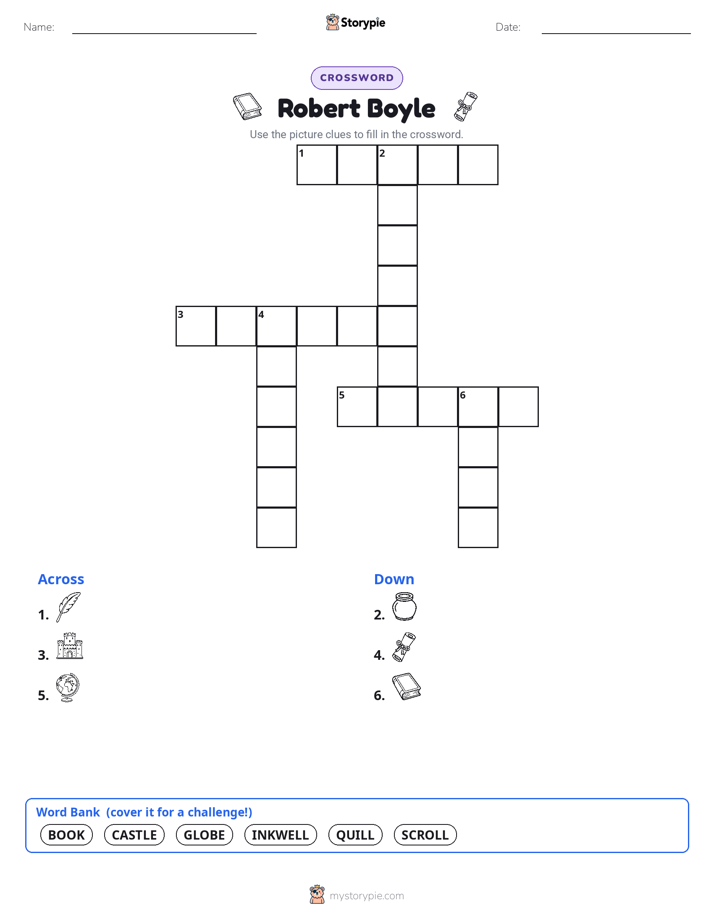
Print & create
Answer keys·No prep·Free with an account
28 worksheets · answer keys · full story · quiz · Ages 8-10 · CEFR B1
Plus adds 208,000+ more stories in 27 languages, audio for every one, and printables for all of them.
Just want Robert Boyle?
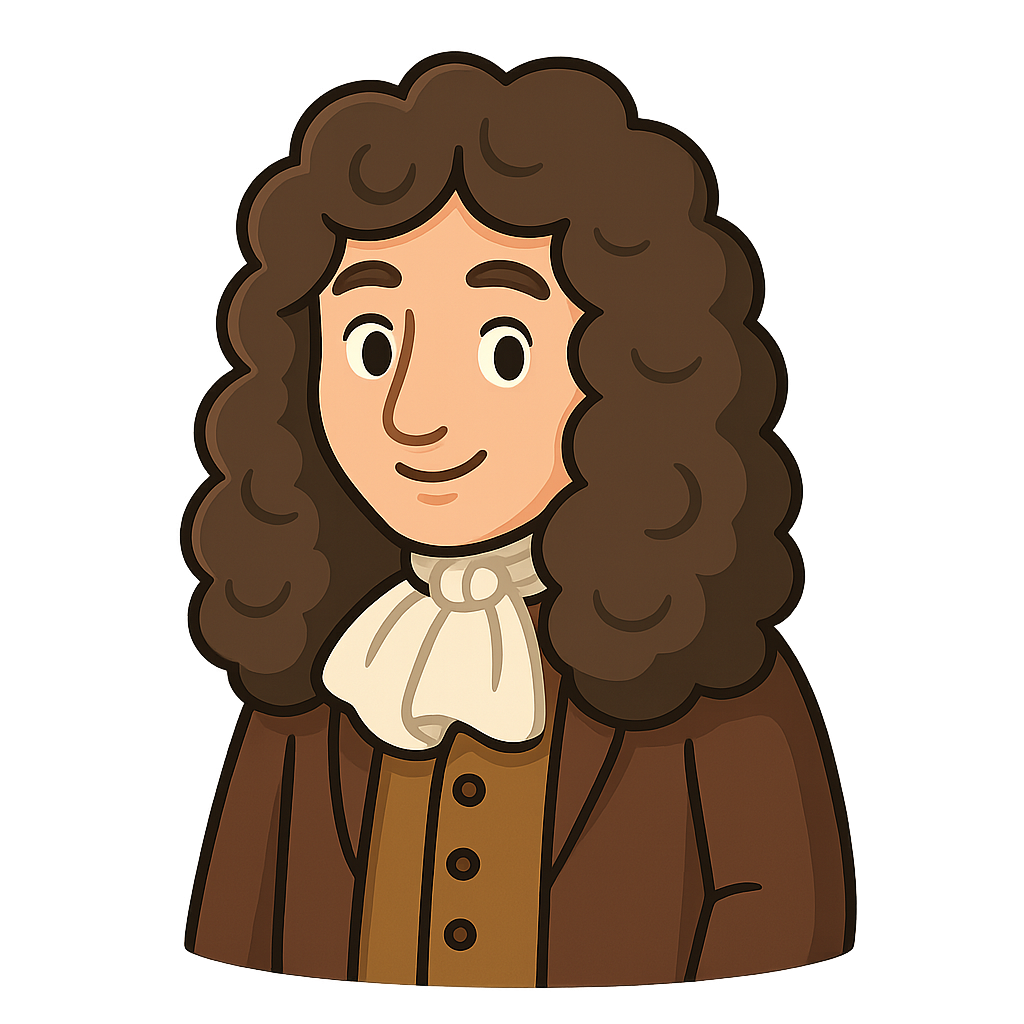
Hello! My name is Robert Boyle, and I was a scientist who loved asking questions. I was born on January 25th, 1627, at a big castle in Ireland. My family was very large—I was the fourteenth child! We were lucky to have enough money for a good education. From a young age, I loved to read, learn new languages, and travel. Seeing the world made me even more curious about how everything worked, from the tiniest bug to the biggest stars in the sky.
When I grew up and moved to England, I found friends who were just as curious as I was. Around 1645, we formed a special group we called the 'Invisible College.' We weren't in a real school building; instead, we met in each other's homes to talk about science and share our ideas. We believed that the best way to learn about the world was not just by reading old books, but by doing experiments. We wanted to see things for ourselves and test our ideas to see if they were true. This little group of mine would later become very famous. In 1660, it was officially named the Royal Society, and it grew to become one of the most important science organizations in the world.
To do my experiments, I needed special tools. My clever assistant, Robert Hooke, and I built a fantastic machine around 1659 called an air pump. It looked like a giant glass globe with a pump attached, which let us suck all the air out of the globe. This allowed us to study what air is and what it does. Through our experiments, we discovered that sound cannot travel without air and that a candle flame goes out when there is no air. My most famous discovery came in 1662. I found that if you squeeze a gas into a smaller space, its pressure goes up. If you give the gas more room, its pressure goes down. This simple but important rule became known as Boyle's Law, and it's something scientists still use today to understand how gases behave.
Robert Boyle: The Curious Chemist
Hello! My name is Robert Boyle, and I was a scientist who loved asking questions. I was born on January 25th, 1627, at a big castle in Ireland. My family was very large—I was the fourteenth child! We were lucky to have enough money for a good education. From a young age, I loved to read, learn new languages, and travel. Seeing the world made me even more curious about how everything worked, from the tiniest bug to the biggest stars in the sky.
When I grew up and moved to England, I found friends who were just as curious as I was. Around 1645, we formed a special group we called the 'Invisible College.' We weren't in a real school building; instead, we met in each other's homes to talk about science and share our ideas. We believed that the best way to learn about the world was not just by reading old books, but by doing experiments. We wanted to see things for ourselves and test our ideas to see if they were true. This little group of mine would later become very famous. In 1660, it was officially named the Royal Society, and it grew to become one of the most important science organizations in the world.
To do my experiments, I needed special tools. My clever assistant, Robert Hooke, and I built a fantastic machine around 1659 called an air pump. It looked like a giant glass globe with a pump attached, which let us suck all the air out of the globe. This allowed us to study what air is and what it does. Through our experiments, we discovered that sound cannot travel without air and that a candle flame goes out when there is no air. My most famous discovery came in 1662. I found that if you squeeze a gas into a smaller space, its pressure goes up. If you give the gas more room, its pressure goes down. This simple but important rule became known as Boyle's Law, and it's something scientists still use today to understand how gases behave.
I loved turning old ideas into new science. In my time, many people practiced something called 'alchemy,' which was a mix of science, magic, and philosophy. Alchemists often tried to turn ordinary metals into gold. I thought we could learn about materials in a better, more careful way. In 1661, I wrote a book called The Sceptical Chymist. In it, I argued that we should study materials using careful experiments and precise measurements. I also suggested the idea that all things were made of tiny particles that combine in different ways to form everything we see. This idea helped turn alchemy into the modern science of chemistry. That is why some people call me the 'Father of Modern Chemistry.'
I spent my whole life exploring, experimenting, and writing about my discoveries. I lived to be 64 years old and had a very full life asking questions about the world. Today, I am remembered for helping to start the science of chemistry and for my strong belief in the power of experiments. My discovery, Boyle's Law, is taught in science classes all around the world, helping students understand the amazing, invisible world of gases all around us. I hope my story inspires you to stay curious and always ask 'why?'
Wow facts
About
Robert Boyle was an influential 17th-century scientist and natural philosopher, considered one of the founders of modern chemistry. He is best known for Boyle's Law, which describes the relationship between the pressure and volume of a gas.
Take a Quiz
Question 1 of 5
What was the 'Invisible College,' and what did its members believe was the best way to learn?
Explore next




Want to do even more?
Go beyond exploring. Unlock tools that turn every story into real learning.

Storypie Plus for families
Full stories, quizzes, and printables. Nights and car rides, sorted.
- Unlimited audio stories
- Create Mode: your child stars in the story
- Offline downloads
- Printable worksheets & coloring pages

Why Storypie for Schools
Students engaged. Prep in seconds. Evenings back to you.
- Worksheets & Quizzes
- Classroom Management
- Formative Assessment
- Custom Curriculum & Lesson Plans
- 27 Languages

Why Storypie for Homeschool
Curriculum done. They'll ask for more. Hours back in your day.
- Worksheet Generator
- First-Person Audio Stories
- Built-in Comprehension Quizzes
- Custom Curriculum & Lesson Plans
- Print & Go Activities