English

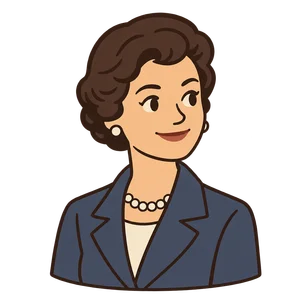
Ruth Handler
Ruth Handler was an American businesswoman and inventor…
Reads at Grades 6–8 Listens at Grades 4–8
Print & create
Answer keys·No prep·Free with an account
28 worksheets · answer keys · full story · quiz · Ages 10-12 · CEFR B2
Plus adds 290,000+ more stories in 27 languages, audio for every one, and printables for all of them.
Just want Ruth Handler?
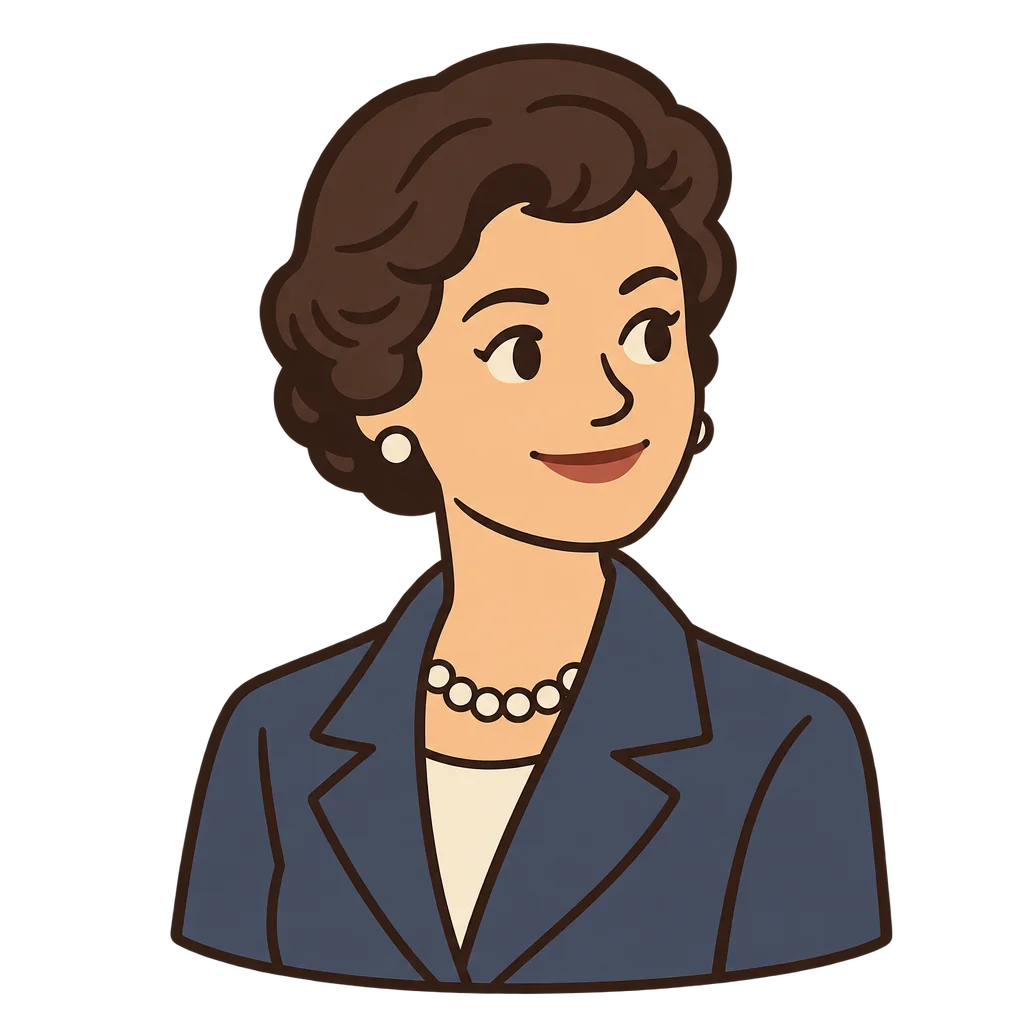
Hello, my name is Ruth Handler. I want to tell you the story of how I helped create one of the most famous toys in the world. I was born on November 4th, 1916, in Denver, Colorado. My parents were Polish immigrants, and as the youngest of ten children, our house was always a busy place! From a young age, I was ambitious and had a love for business. I met my high school sweetheart, Elliot Handler, and we married in 1938. Soon after, we moved to the sunshine of Los Angeles to chase our dreams and start our lives together.
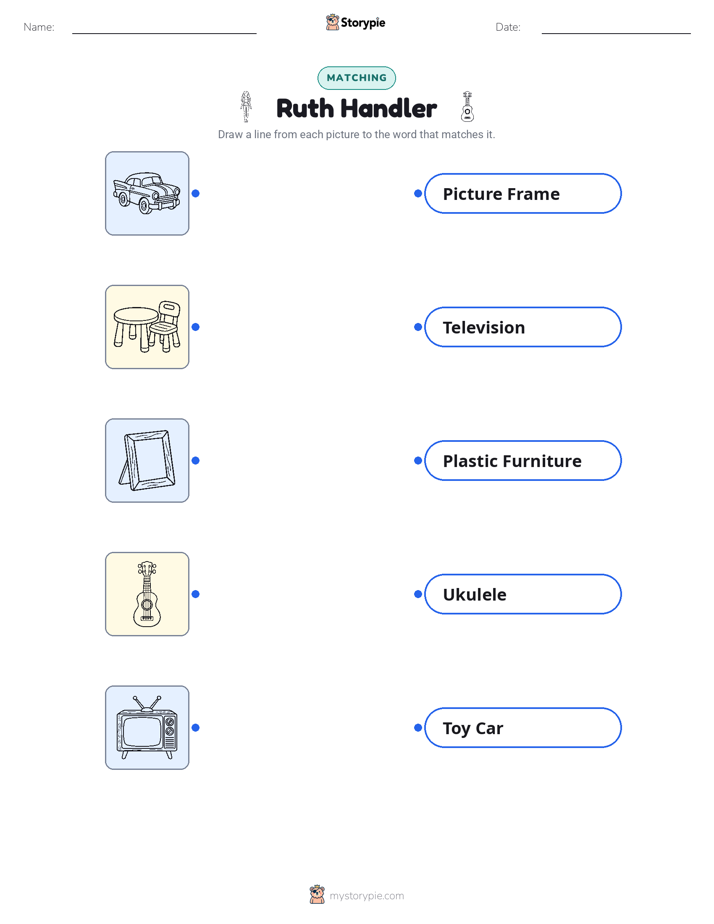
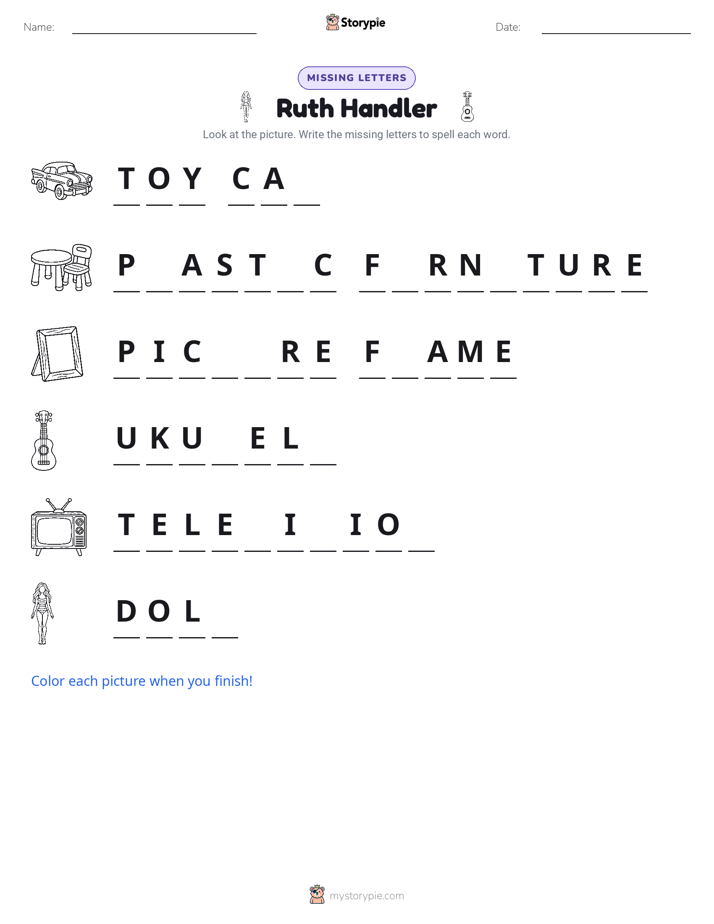
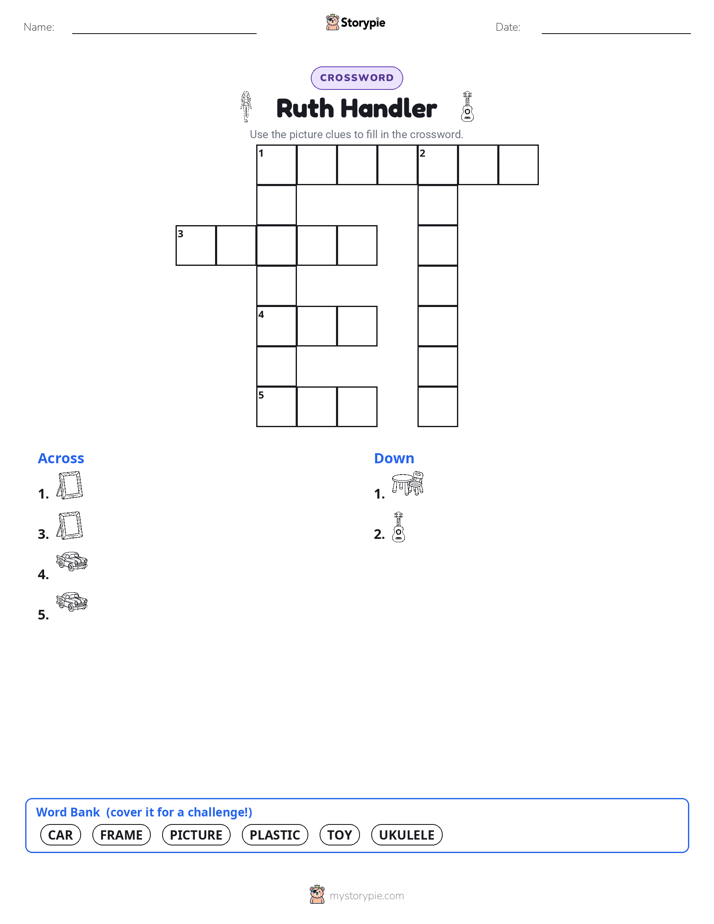
Elliot was a talented designer, and I had a natural skill for business. We started our first company right out of our garage, making plastic furniture. In 1945, we joined forces with our friend Harold 'Matt' Matson to form a new company. We wanted a catchy name, so we combined 'Matt' and 'Elliot' to create 'Mattel.' Our first products were picture frames, but we soon noticed that the leftover wood scraps could be used to make dollhouse furniture. This furniture became so popular that we decided to switch our focus entirely to making toys! One of our first big successes was a toy ukulele called the 'Uke-A-Doodle.' Then, in 1955, we made a very bold business decision. We sponsored a new television show called the 'Mickey Mouse Club.' At the time, it was revolutionary for a toy company to advertise directly to children on TV, and that single move completely changed the entire toy business.
I was a mother to two wonderful children, a daughter named Barbara and a son named Kenneth. I often watched them play, and I noticed something interesting. My son, Ken, had toys that let him imagine being a firefighter, an astronaut, or a doctor. But my daughter Barbara's dolls were almost all babies, which limited her play to being a mother or caregiver. I saw her and her friends playing for hours with paper dolls, giving them adult roles and imagining their futures as college students, career women, and leaders. It became clear to me that there was a huge gap in the toy market. Girls wanted and needed a doll that would let them dream about who they could become. My big idea found its inspiration during a family trip to Europe in 1956. There, I saw a German doll named Bild Lilli. She was a fashion doll with an adult body, but she was intended for grown-ups. I immediately saw her potential. This was the kind of three-dimensional doll girls could use to act out their dreams. When I brought the idea back to the all-male executives at Mattel, they were not convinced. They thought no mother would buy her daughter a doll with a grown-up figure. But I knew I was right, and I refused to give up on my idea.
Ruth Handler: The Creator of Barbie
Hello, my name is Ruth Handler. I want to tell you the story of how I helped create one of the most famous toys in the world. I was born on November 4th, 1916, in Denver, Colorado. My parents were Polish immigrants, and as the youngest of ten children, our house was always a busy place! From a young age, I was ambitious and had a love for business. I met my high school sweetheart, Elliot Handler, and we married in 1938. Soon after, we moved to the sunshine of Los Angeles to chase our dreams and start our lives together.
Elliot was a talented designer, and I had a natural skill for business. We started our first company right out of our garage, making plastic furniture. In 1945, we joined forces with our friend Harold 'Matt' Matson to form a new company. We wanted a catchy name, so we combined 'Matt' and 'Elliot' to create 'Mattel.' Our first products were picture frames, but we soon noticed that the leftover wood scraps could be used to make dollhouse furniture. This furniture became so popular that we decided to switch our focus entirely to making toys! One of our first big successes was a toy ukulele called the 'Uke-A-Doodle.' Then, in 1955, we made a very bold business decision. We sponsored a new television show called the 'Mickey Mouse Club.' At the time, it was revolutionary for a toy company to advertise directly to children on TV, and that single move completely changed the entire toy business.
I was a mother to two wonderful children, a daughter named Barbara and a son named Kenneth. I often watched them play, and I noticed something interesting. My son, Ken, had toys that let him imagine being a firefighter, an astronaut, or a doctor. But my daughter Barbara's dolls were almost all babies, which limited her play to being a mother or caregiver. I saw her and her friends playing for hours with paper dolls, giving them adult roles and imagining their futures as college students, career women, and leaders. It became clear to me that there was a huge gap in the toy market. Girls wanted and needed a doll that would let them dream about who they could become. My big idea found its inspiration during a family trip to Europe in 1956. There, I saw a German doll named Bild Lilli. She was a fashion doll with an adult body, but she was intended for grown-ups. I immediately saw her potential. This was the kind of three-dimensional doll girls could use to act out their dreams. When I brought the idea back to the all-male executives at Mattel, they were not convinced. They thought no mother would buy her daughter a doll with a grown-up figure. But I knew I was right, and I refused to give up on my idea.
I spent the next few years working hard to develop my idea. In honor of my daughter, I named the doll 'Barbie.' She made her grand debut at the American International Toy Fair in New York on March 9th, 1959. She was dressed in a stylish black-and-white striped swimsuit, ready to take on the world. At first, the toy buyers were just as skeptical as my own executives had been. But everything changed once our television commercials began to air. Suddenly, girls everywhere wanted a Barbie doll. She became a sensation! Barbie was more than just a toy; she was a tool for imagination. She showed girls that they could be anything they wanted to be—a doctor, an astronaut, a business executive, and so much more. Two years later, in 1961, we introduced a boyfriend for her, whom we named Ken, after my son. As the president of Mattel, I was filled with pride to see how our creation was inspiring millions of children around the world.
I led Mattel for many years, but my time there came to an end in 1975 after I faced some difficult business challenges. During that same period, I was fighting a serious personal battle. I was diagnosed with breast cancer in 1970. After undergoing surgery, I struggled to find a prosthetic that looked and felt natural, which deeply affected my confidence. Just as I had once seen a need for a new kind of doll for girls, I now saw a need for a better product for women who had gone through the same experience as me. This led me to a new purpose. In 1976, I started a new company called Ruthton Corp. with the mission to create realistic and comfortable prosthetic breasts for women. My invention, which I called 'Nearly Me,' helped thousands of women regain their confidence and feel whole again after their surgeries.
I lived to be 85 years old, passing away in 2002. I look back on my life with immense pride, especially at its two major chapters. With Barbie, I hope I gave girls a new way to dream and to believe that they could be anything they wanted to be. With my second company, I was able to use my own difficult experience to help other women feel whole and confident again. I always believed that if you see a problem or a need in the world, you have the power within you to create a solution.
Wow facts
About
Ruth Handler was an American businesswoman and inventor, best known as the co-founder of the toy company Mattel and the creator of the iconic Barbie doll.
Take a Quiz
Question 1 of 5
In your own words, what was the main reason Ruth Handler created the Barbie doll?
Explore next






Want to do even more?
Go beyond exploring. Unlock tools that turn every story into real learning.

Storypie Plus for families
Full stories, quizzes, and printables. Nights and car rides, sorted.
- Unlimited audio stories
- Create Mode: your child stars in the story
- Offline downloads
- Printable worksheets & coloring pages

Why Storypie for Schools
Students engaged. Prep in seconds. Evenings back to you.
- Worksheets & Quizzes
- Classroom Management
- Formative Assessment
- Custom Curriculum & Lesson Plans
- 27 Languages

Why Storypie for Homeschool
Curriculum done. They'll ask for more. Hours back in your day.
- Worksheet Generator
- First-Person Audio Stories
- Built-in Comprehension Quizzes
- Custom Curriculum & Lesson Plans
- Print & Go Activities