English


Sergei Korolev
Sergei Korolev was the lead Soviet rocket engineer and spacecraft designer during the Space Race in the 1950s…
Reads at Grades 6–8 Listens at Grades 4–8
Print & create
Answer keys·No prep·Free with an account
28 worksheets · answer keys · full story · quiz · Ages 10-12 · CEFR B2
Plus adds 164,000+ more stories in 27 languages, audio for every one, and printables for all of them.
Just want Sergei Korolev?

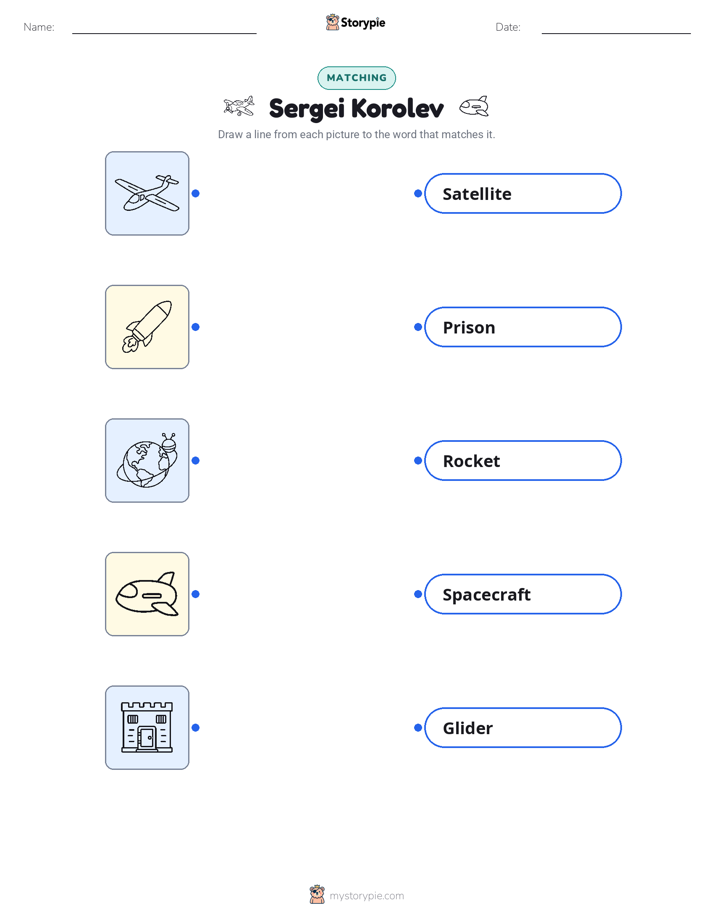
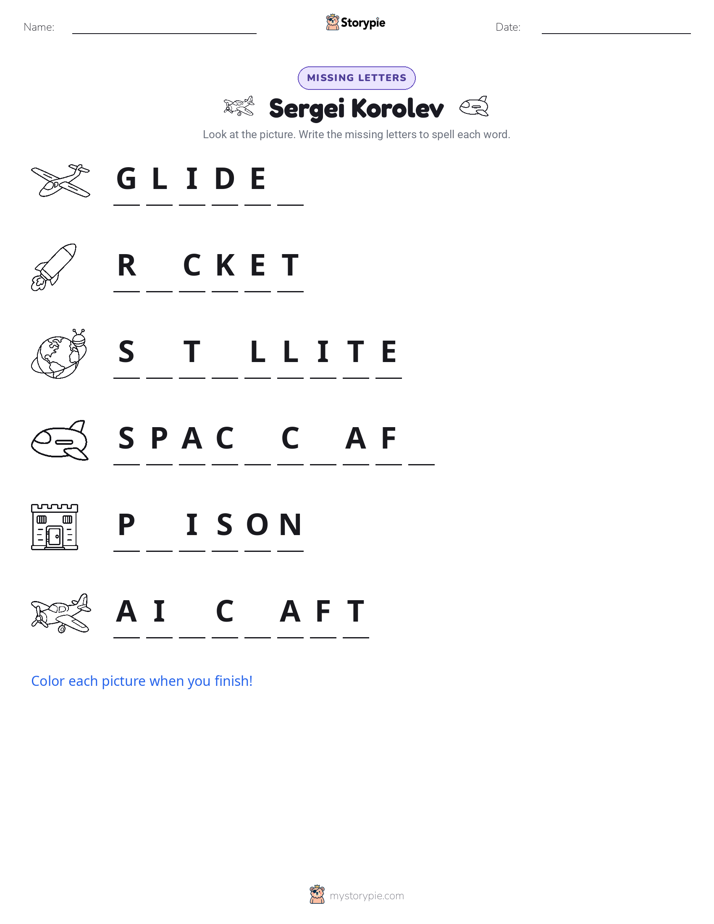
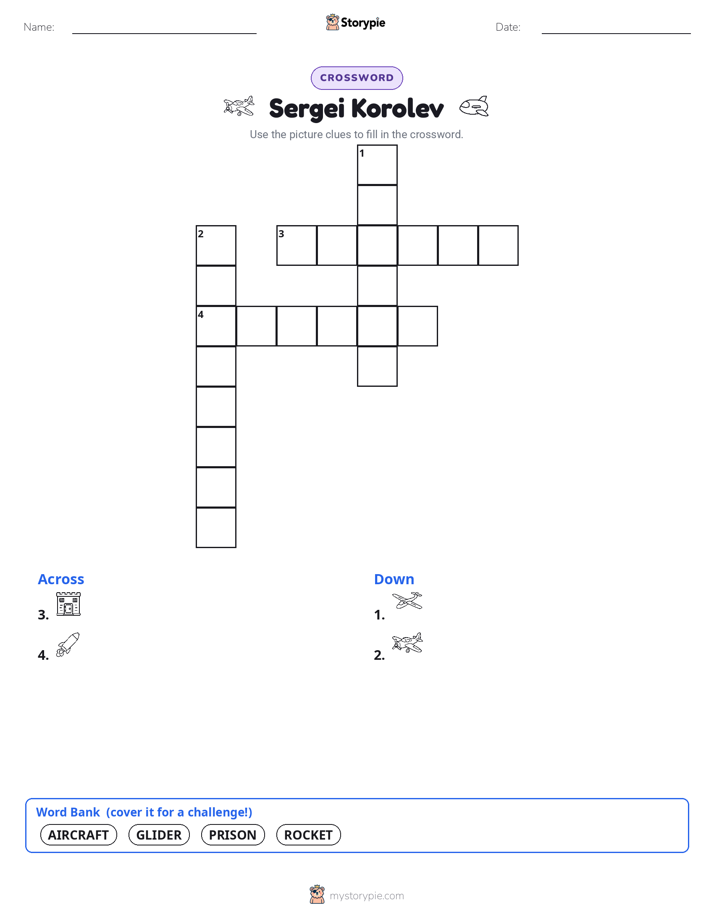
Hello, my name is Sergei Korolev, and I am known as the father of the Soviet space program. My story is one of dreaming about the stars and working tirelessly to reach them. I was born on January 12th, 1907, in a part of the Russian Empire that is now Ukraine. From a very young age, I was completely fascinated with the sky and the idea of flying. I read everything I could about aviation and taught myself how to be a pilot. My passion was so strong that in 1924, while I was still a teenager, I designed and built my very first glider. I knew my future was in the air, so I went on to study aeronautical engineering. In 1931, I co-founded a group of enthusiasts like myself called the Group for the Study of Reactive Motion, or GIRD. Together, my friends and I began building and testing the first liquid-fueled rockets in the Soviet Union. We were pioneers, filled with the incredible dream that one day, our rockets would travel beyond Earth's atmosphere and reach into space.
My dreams and my work were suddenly and terribly interrupted in 1938. It was a very difficult and fearful time in my country's history, and I was wrongly accused of a crime I did not commit. I was arrested and sent to a harsh prison camp in a remote, frozen part of the country. Life there was incredibly hard, and for a time, I thought my dreams of space were over. However, even in that terrible place, my skills as an engineer were too valuable to ignore. In 1942, during World War II, I was transferred from the camp to a special design bureau that was also a prison, known as a 'sharashka.' There, I was put to work with other scientists and engineers, designing new aircraft and rocket engines for the war effort. This period was one of the most challenging of my life, but it proved that my knowledge was still needed and allowed me to continue my work, even under the most difficult circumstances.
Sergei Korolev: The Chief Designer of the Space Age
Hello, my name is Sergei Korolev, and I am known as the father of the Soviet space program. My story is one of dreaming about the stars and working tirelessly to reach them. I was born on January 12th, 1907, in a part of the Russian Empire that is now Ukraine. From a very young age, I was completely fascinated with the sky and the idea of flying. I read everything I could about aviation and taught myself how to be a pilot. My passion was so strong that in 1924, while I was still a teenager, I designed and built my very first glider. I knew my future was in the air, so I went on to study aeronautical engineering. In 1931, I co-founded a group of enthusiasts like myself called the Group for the Study of Reactive Motion, or GIRD. Together, my friends and I began building and testing the first liquid-fueled rockets in the Soviet Union. We were pioneers, filled with the incredible dream that one day, our rockets would travel beyond Earth's atmosphere and reach into space.
My dreams and my work were suddenly and terribly interrupted in 1938. It was a very difficult and fearful time in my country's history, and I was wrongly accused of a crime I did not commit. I was arrested and sent to a harsh prison camp in a remote, frozen part of the country. Life there was incredibly hard, and for a time, I thought my dreams of space were over. However, even in that terrible place, my skills as an engineer were too valuable to ignore. In 1942, during World War II, I was transferred from the camp to a special design bureau that was also a prison, known as a 'sharashka.' There, I was put to work with other scientists and engineers, designing new aircraft and rocket engines for the war effort. This period was one of the most challenging of my life, but it proved that my knowledge was still needed and allowed me to continue my work, even under the most difficult circumstances.
After World War II ended in 1945, my name was cleared, and I was released. My country's leaders recognized my talent and put me in charge of a top-secret program to develop powerful rockets. My work was considered so important that my identity was hidden from the public to protect me and the program. To the outside world, and even to many people I worked with, I was known only by the title 'The Chief Designer.' Our greatest challenge was creating the R-7, the world's first intercontinental ballistic missile. It was an enormous and complex machine, and after many attempts, we achieved a successful launch in August 1957. This powerful rocket was designed for defense, but I knew it was also our key to the cosmos. Just a few months later, on October 4th, 1957, we used an R-7 rocket to launch Sputnik 1, a small metal sphere that became the world's first artificial satellite. As its simple 'beep-beep' signal was broadcast from orbit and heard by people all around the globe, a new chapter in history began: the Space Race.
With the success of Sputnik, the world was captivated by the possibility of space travel, and we were ready for the next giant leap. My team and I worked relentlessly, aiming for a target that had fascinated humanity for centuries: the Moon. In 1959, our Luna missions achieved incredible firsts, including becoming the first man-made objects to reach the Moon and later, the first to photograph its hidden far side, a part of the Moon no one had ever seen before. But our ultimate goal was even bigger. I believe the proudest moment of my entire life came on April 12th, 1961. On that day, our Vostok 1 spacecraft, perched atop another of our powerful rockets, carried cosmonaut Yuri Gagarin into orbit. He became the very first human being to travel in space and see our planet from above. I remember the immense tension during the launch and the overwhelming joy and relief when he returned safely to Earth. After that historic day, we continued to break new ground, sending the first woman into space and, in March 1965, conducting the first-ever spacewalk, where cosmonaut Alexei Leonov floated outside his capsule.
Years of working without rest, combined with the severe hardships I had endured in the prison camps, eventually took a toll on my health. I lived to be 59 years old. After I passed away in 1966, my identity was finally revealed to the world. For the first time, people learned the name of the 'Chief Designer' who had opened the door to the cosmos. I am remembered today as the architect of the Soviet space program, whose vision and determination guided humanity's first steps into space. My work proved that with courage and perseverance, even the most ambitious dreams, like reaching for the stars, are not just possible, but achievable.
Wow facts
About
Sergei Korolev was the lead Soviet rocket engineer and spacecraft designer during the Space Race in the 1950s and 1960s. Often called 'The Chief Designer,' his work was responsible for Sputnik, the first satellite, and for sending the first human, Yuri Gagarin, into space.
Take a Quiz
Question 1 of 5
Why was Sergei Korolev's identity kept a secret, with him being called only 'The Chief Designer'?
Explore next





Want to do even more?
Go beyond exploring. Unlock tools that turn every story into real learning.

Storypie Plus for families
Full stories, quizzes, and printables. Nights and car rides, sorted.
- Unlimited audio stories
- Create Mode: your child stars in the story
- Offline downloads
- Printable worksheets & coloring pages

Why Storypie for Schools
Students engaged. Prep in seconds. Evenings back to you.
- Worksheets & Quizzes
- Classroom Management
- Formative Assessment
- Custom Curriculum & Lesson Plans
- 27 Languages

Why Storypie for Homeschool
Curriculum done. They'll ask for more. Hours back in your day.
- Worksheet Generator
- First-Person Audio Stories
- Built-in Comprehension Quizzes
- Custom Curriculum & Lesson Plans
- Print & Go Activities