English

Terry Fox
Terry Fox was a Canadian athlete and cancer research activist who embarked on the Marathon of Hope…
Reads at Grades 6–8 Listens at Grades 4–8
Print & create
Answer keys·No prep·Free with an account
28 worksheets · answer keys · full story · quiz · Ages 10-12 · CEFR B2
Plus adds 164,000+ more stories in 27 languages, audio for every one, and printables for all of them.
Just want Terry Fox?
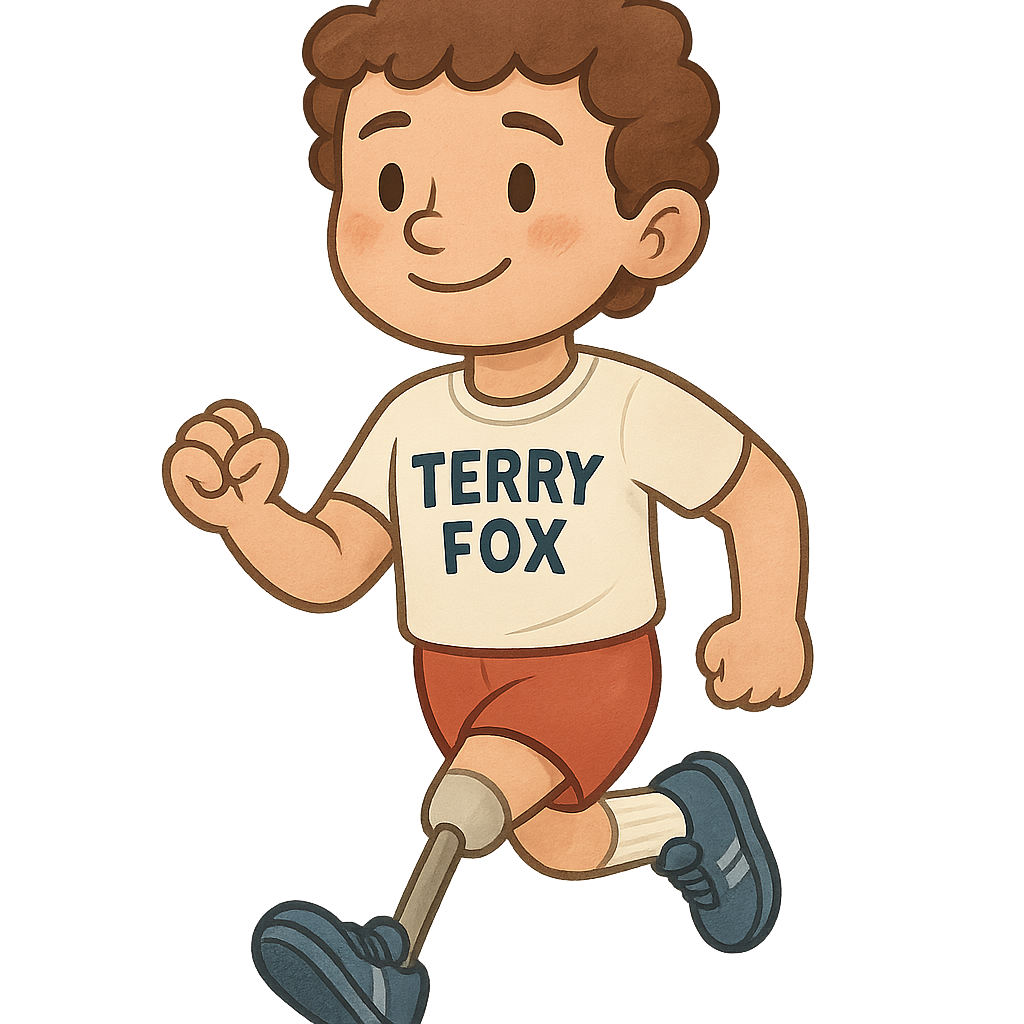
Hello, my name is Terry Fox. My story begins on July 28th, 1958, when I was born in Winnipeg, Manitoba. Though I was born on the prairies, I spent most of my childhood growing up in Port Coquitlam, British Columbia. From a very young age, my world revolved around sports. I loved the feeling of pushing myself to the limit, whether on the basketball court or out on a long run. I wasn't what you would call a natural athlete; I was often smaller than the other kids and not always the most skilled player on the team. But I had something else: a powerful sense of determination. If I wanted to achieve something, I would work tirelessly until I did. This drive served me well, especially in basketball and cross-country running. I learned early on that hard work could take you further than talent alone, and I poured all my energy into becoming the best athlete I could be.
My life took a sudden and unexpected turn in 1977. I was 18 years old and a student at university, still chasing my athletic dreams, when I started feeling a sharp pain in my right knee. After a series of tests, doctors gave me news that would change everything. I was diagnosed with osteosarcoma, a form of bone cancer. The doctors explained that to stop the cancer from spreading and save my life, my right leg would have to be amputated above the knee. The news was devastating, but I knew I had to fight. During my time in the hospital, I saw things that affected me deeply. I met other cancer patients, many of whom were young children facing the same scary battle I was. Seeing their bravery and their struggle filled me with a profound sense of purpose. I couldn't just accept my situation; I felt a powerful need to do something to help find a cure for this terrible disease, not just for me, but for all of them.
Terry Fox: A Marathon of Hope
Hello, my name is Terry Fox. My story begins on July 28th, 1958, when I was born in Winnipeg, Manitoba. Though I was born on the prairies, I spent most of my childhood growing up in Port Coquitlam, British Columbia. From a very young age, my world revolved around sports. I loved the feeling of pushing myself to the limit, whether on the basketball court or out on a long run. I wasn't what you would call a natural athlete; I was often smaller than the other kids and not always the most skilled player on the team. But I had something else: a powerful sense of determination. If I wanted to achieve something, I would work tirelessly until I did. This drive served me well, especially in basketball and cross-country running. I learned early on that hard work could take you further than talent alone, and I poured all my energy into becoming the best athlete I could be.
My life took a sudden and unexpected turn in 1977. I was 18 years old and a student at university, still chasing my athletic dreams, when I started feeling a sharp pain in my right knee. After a series of tests, doctors gave me news that would change everything. I was diagnosed with osteosarcoma, a form of bone cancer. The doctors explained that to stop the cancer from spreading and save my life, my right leg would have to be amputated above the knee. The news was devastating, but I knew I had to fight. During my time in the hospital, I saw things that affected me deeply. I met other cancer patients, many of whom were young children facing the same scary battle I was. Seeing their bravery and their struggle filled me with a profound sense of purpose. I couldn't just accept my situation; I felt a powerful need to do something to help find a cure for this terrible disease, not just for me, but for all of them.
Lying in my hospital bed, an idea began to form in my mind—a big, ambitious idea. I decided I was going to run across Canada. This wasn't just going to be a personal challenge; it had a much larger goal. I wanted to raise money for cancer research, and I set a specific target: to raise one dollar for every single person living in Canada at the time. I called my journey the Marathon of Hope. After months of training on my new artificial leg, the day finally came. On April 12th, 1980, I stood on the shore of the Atlantic Ocean in St. John's, Newfoundland. I dipped my prosthetic leg into the cold, salty water, marking the official start of my cross-country run. From that day forward, my life fell into a grueling routine. I would wake up before dawn and run the equivalent of a full marathon—about 42 kilometers—every single day. My good friend, Doug Alward, was with me every step of the way, driving our support van and helping me manage the logistics of such a massive undertaking.
When I first started my run, not many people knew what I was doing. For weeks, I ran through small towns in relative quiet. But as I made my way through the Maritime provinces and into Quebec during the summer of 1980, something incredible began to happen. Word of the Marathon of Hope started to spread. Soon, small crowds of people began to appear on the side of the highways, waiting to cheer me on. The small crowds grew into large gatherings, and people started donating to the cause. By the time I reached Ontario, the support was overwhelming. People lined the streets for miles, holding up signs, clapping, and offering words of encouragement. Seeing their faces and feeling their energy gave me strength on the days when the pain was almost too much to bear. Watching the donations for cancer research climb higher and higher was an incredible feeling. I knew that my dream was no longer just my own; it had become the dream of an entire nation.
For 143 days, I pushed my body to its absolute limit, running through sun, rain, and wind. I had run 5,373 kilometers and had made it more than halfway across the country. But on September 1st, 1980, my journey came to a sudden and heartbreaking stop. Just outside of Thunder Bay, Ontario, I began to cough uncontrollably and felt a terrible pain in my chest. I had to ask Doug to drive me to a hospital. The doctors there gave me the news I had been dreading: the cancer had returned and had spread to my lungs. It was physically impossible for me to continue running. Announcing to the country that I had to end my run was one of the hardest things I've ever had to do. I felt like I was letting everyone down, but I promised that I would continue my fight. I still held onto my dream of a world without cancer, even if I couldn't finish the run myself.
Even though I couldn't finish my Marathon of Hope, Canadians refused to let my dream die. Just a few weeks after I returned home, a nationwide telethon was organized in my honor. In a single day, the country came together and we reached my original fundraising goal, raising over $24 million for cancer research. I lived to be 22 years old, and my life came to an end on June 28th, 1981. But my story didn't end there. Today, my journey continues through the annual Terry Fox Run. Every year, millions of people in Canada and in countries all over the world participate in runs to raise money for cancer research, keeping my hope alive. My run may have ended, but the hope it started continues to move forward, one step at a time.
Wow facts
About
Terry Fox was a Canadian athlete and cancer research activist who embarked on the Marathon of Hope, a cross-Canada run to raise money and awareness for cancer research after losing his leg to the disease.
Take a Quiz
Question 1 of 5
What was the main reason I started the Marathon of Hope?
Explore next






Want to do even more?
Go beyond exploring. Unlock tools that turn every story into real learning.

Storypie Plus for families
Full stories, quizzes, and printables. Nights and car rides, sorted.
- Unlimited audio stories
- Create Mode: your child stars in the story
- Offline downloads
- Printable worksheets & coloring pages

Why Storypie for Schools
Students engaged. Prep in seconds. Evenings back to you.
- Worksheets & Quizzes
- Classroom Management
- Formative Assessment
- Custom Curriculum & Lesson Plans
- 27 Languages

Why Storypie for Homeschool
Curriculum done. They'll ask for more. Hours back in your day.
- Worksheet Generator
- First-Person Audio Stories
- Built-in Comprehension Quizzes
- Custom Curriculum & Lesson Plans
- Print & Go Activities