English

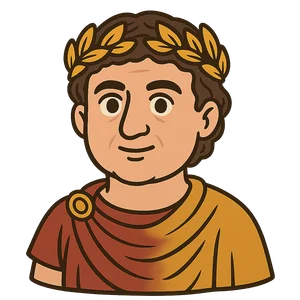
Theodosius I
Theodosius I was the last Roman emperor to rule over both the eastern and western halves of the Roman Empire.
Reads at Grades 6–8 Listens at Grades 4–8
Print & create
Answer keys·No prep·Free with an account
28 worksheets · answer keys · full story · quiz · Ages 10-12 · CEFR B2
Plus adds 244,000+ more stories in 27 languages, audio for every one, and printables for all of them.
Just want Theodosius I?
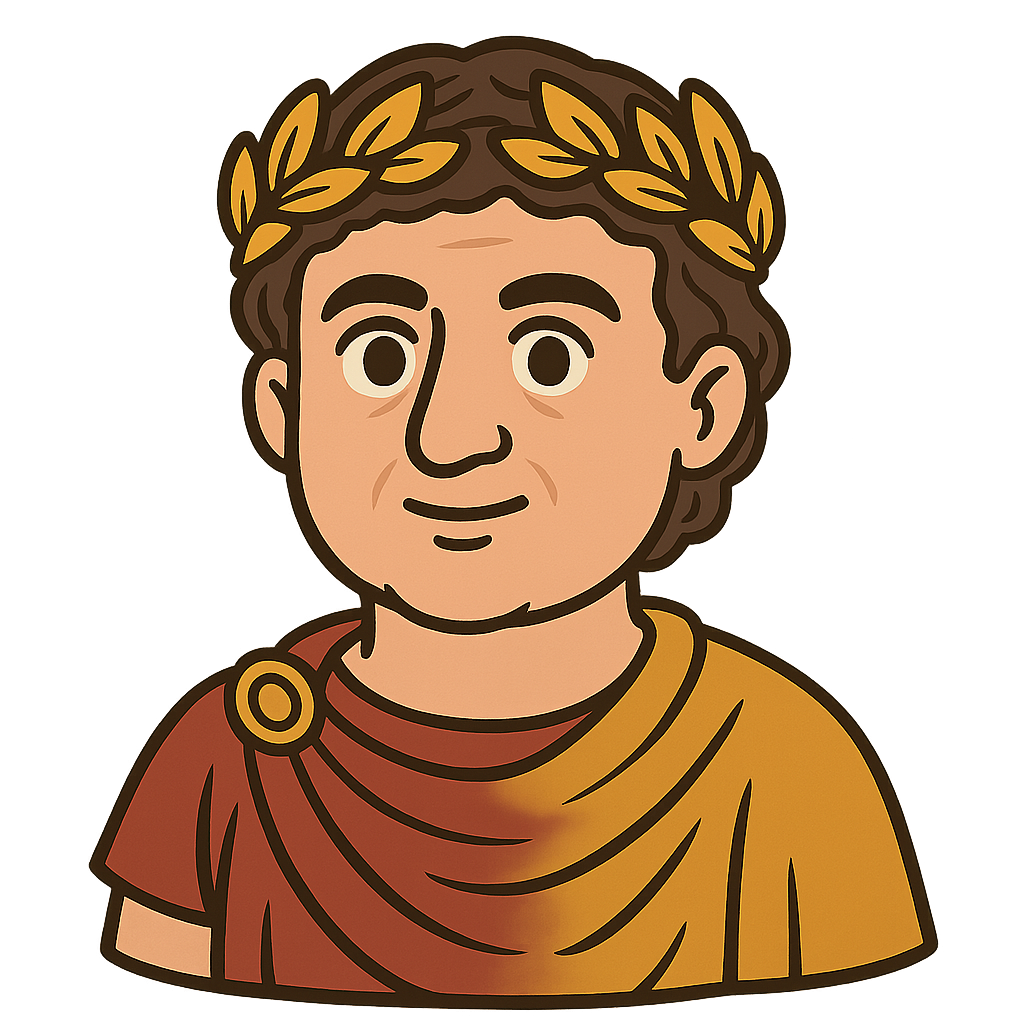
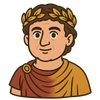
Hello, my name is Flavius Theodosius, but history would come to know me as Theodosius the Great. I was the last emperor to rule over the entire, undivided Roman Empire. My story begins in a Roman province called Hispania, in a town named Cauca, which is now part of the country of Spain. I was born there on January 11th, 347 CE. The world I grew up in was one of military might and political power, and my family was at the heart of it. My father, who was also named Theodosius, was a highly respected general in the Roman army. From my earliest days, I watched him, admiring his strength and his skill as a leader. I listened to stories of his campaigns and studied the maps of the vast empire he helped protect. It was clear to me, even as a boy, that I wanted to follow in his footsteps. I dedicated myself to learning everything I could about military strategy and how to command, preparing for a life in service to Rome.
Following my father's path, I began my career as a soldier. It was not an easy life, but it was the one I had prepared for. I had the unique opportunity to join my father on his military campaigns, which was the best education a future commander could receive. I wasn't just reading about battles in books; I was experiencing them firsthand, learning how to lead soldiers and make difficult decisions under pressure. My training and dedication paid off, and around the year 374 CE, I was given a significant responsibility of my own. I was appointed the military governor, or 'Dux Moesiae,' for the province of Moesia. This territory was located along the critical Danube River border, a frequent point of conflict for the empire. My primary duty was to defend our lands from groups like the Goths and Sarmatians who often tested Rome's defenses. The work was demanding and dangerous, but my successes in securing the border earned me a reputation as a capable and reliable military leader. This challenging command was the perfect training ground, shaping me for the immense responsibilities that awaited me.
Theodosius the Great: The Last Emperor of a United Rome
Hello, my name is Flavius Theodosius, but history would come to know me as Theodosius the Great. I was the last emperor to rule over the entire, undivided Roman Empire. My story begins in a Roman province called Hispania, in a town named Cauca, which is now part of the country of Spain. I was born there on January 11th, 347 CE. The world I grew up in was one of military might and political power, and my family was at the heart of it. My father, who was also named Theodosius, was a highly respected general in the Roman army. From my earliest days, I watched him, admiring his strength and his skill as a leader. I listened to stories of his campaigns and studied the maps of the vast empire he helped protect. It was clear to me, even as a boy, that I wanted to follow in his footsteps. I dedicated myself to learning everything I could about military strategy and how to command, preparing for a life in service to Rome.
Following my father's path, I began my career as a soldier. It was not an easy life, but it was the one I had prepared for. I had the unique opportunity to join my father on his military campaigns, which was the best education a future commander could receive. I wasn't just reading about battles in books; I was experiencing them firsthand, learning how to lead soldiers and make difficult decisions under pressure. My training and dedication paid off, and around the year 374 CE, I was given a significant responsibility of my own. I was appointed the military governor, or 'Dux Moesiae,' for the province of Moesia. This territory was located along the critical Danube River border, a frequent point of conflict for the empire. My primary duty was to defend our lands from groups like the Goths and Sarmatians who often tested Rome's defenses. The work was demanding and dangerous, but my successes in securing the border earned me a reputation as a capable and reliable military leader. This challenging command was the perfect training ground, shaping me for the immense responsibilities that awaited me.
My life took a dramatic and unexpected turn because of a great crisis that shook the Roman Empire to its core. In the year 378 CE, a catastrophic event occurred at the Battle of Adrianople. The Roman army in the east suffered a devastating defeat at the hands of the Goths. In that battle, the Eastern Roman Emperor, a man named Valens, was killed. His death left the entire eastern half of the empire in a state of chaos and vulnerability. The Goths were moving through the land, and there was no strong leader to stop them. The Western Roman Emperor, Gratian, was a young ruler and understood that he could not face this threat alone. The empire was too large, and the danger was too great. He needed someone with military experience and a steady hand to restore order. He needed a co-emperor he could trust. On January 19th, 379 CE, Emperor Gratian made a monumental decision. He officially summoned me and bestowed upon me the title of Augustus, making me his co-emperor. He gave me the enormous and difficult task of ruling the Eastern Roman Empire and dealing with the Gothic crisis.
As emperor, I faced the challenge of governing a vast and diverse population. The people of the Roman Empire held many different beliefs and worshipped many different gods. I felt that this diversity of faith sometimes led to disunity, and I believed the empire needed a single, unifying force to hold it together. I was a devout follower of Nicene Christianity, a specific form of the Christian faith. I believed that this faith could provide the moral and spiritual foundation the empire needed to be strong. Therefore, on February 27th, 380 CE, I, along with my co-emperors Gratian and Valentinian II, issued a decree that would change history. It was called the Edict of Thessalonica. This edict made Nicene Christianity the one and only official state religion of the Roman Empire. This was a profound change. For centuries, Rome had been known for its pantheon of gods and its general tolerance of different religions. My decision meant that traditional Roman religious practices were no longer supported by the government, and over time, they began to fade. This act cemented Christianity's place in the Western world and shaped the future of Europe for centuries to come.
My reign was filled with challenges, including political rivalries and civil wars. Other ambitious men tried to seize power for themselves, and I had to fight to keep the empire stable and secure. After many years of these internal struggles, I finally achieved a victory that brought a brief, final moment of unity to the Roman world. In the year 394 CE, I defeated my last major rival in battle. For the first time in many years, and for the last time in history, one man ruled over both the Eastern and Western halves of the Roman Empire. That man was me. For a few short but significant months, I was the sole ruler of a territory that stretched from the misty shores of Britain all the way to the sun-baked lands of Mesopotamia. It was an immense responsibility to govern such a vast and complex empire, and I worked to maintain peace and order across all its provinces. This period marked the end of an era, as the Roman Empire would never again be a single, united entity under one emperor.
My time as the sole ruler of the united Roman Empire was brief. My life came to an end in Milan on January 17th, 395 CE. I lived to be 48 years old. Before my death, I made a final, fateful decision about the future of the empire. I formally divided it between my two sons, giving the Eastern Empire to my son Arcadius and the Western Empire to my son Honorius. While emperors had divided responsibilities before, this division became permanent. The two parts of the Roman Empire drifted apart and were never truly united again. Today, people remember me as Theodosius the Great for two major reasons: for establishing Nicene Christianity as the foundation of the late Roman state and for being the last emperor to rule a single, united Roman Empire. My legacy is a reminder of a pivotal time when the ancient world was transforming into the world we know today.
Wow facts
About
Theodosius I was the last Roman emperor to rule over both the eastern and western halves of the Roman Empire. He is most famous for making Nicene Christianity the official state religion in 380 CE.
Take a Quiz
Question 1 of 5
What detail from my early life shows that I was ambitious and determined to follow my father's path?
Explore next



Want to do even more?
Go beyond exploring. Unlock tools that turn every story into real learning.

Storypie Plus for families
Full stories, quizzes, and printables. Nights and car rides, sorted.
- Unlimited audio stories
- Create Mode: your child stars in the story
- Offline downloads
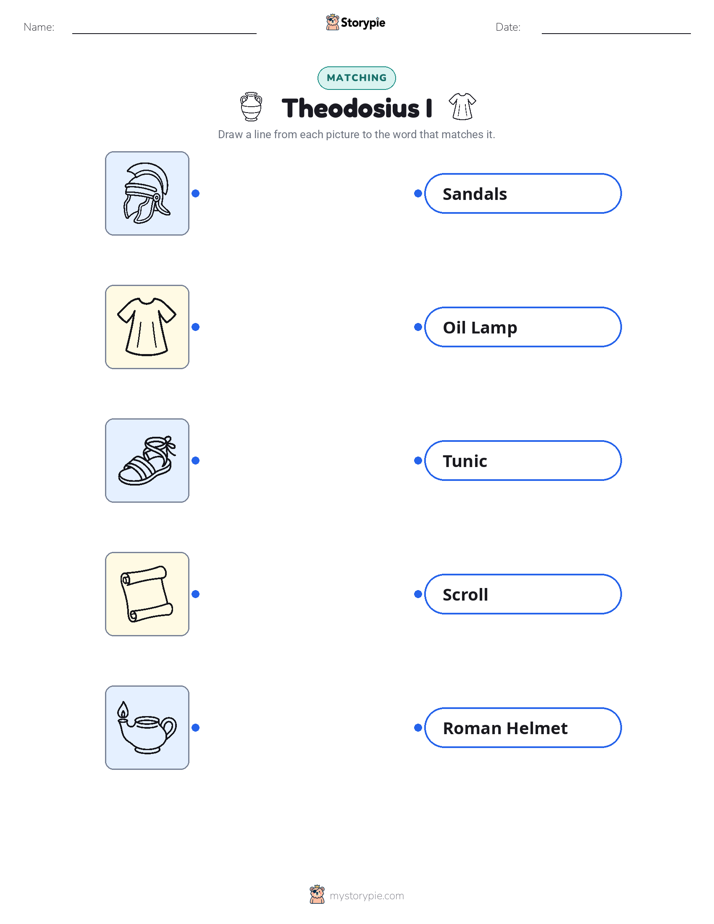
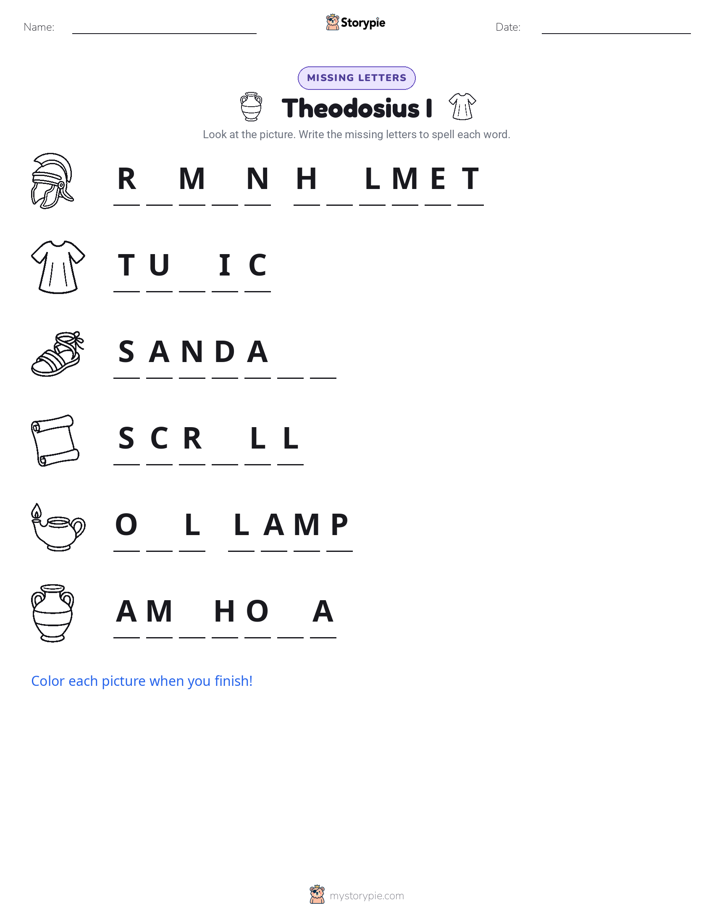
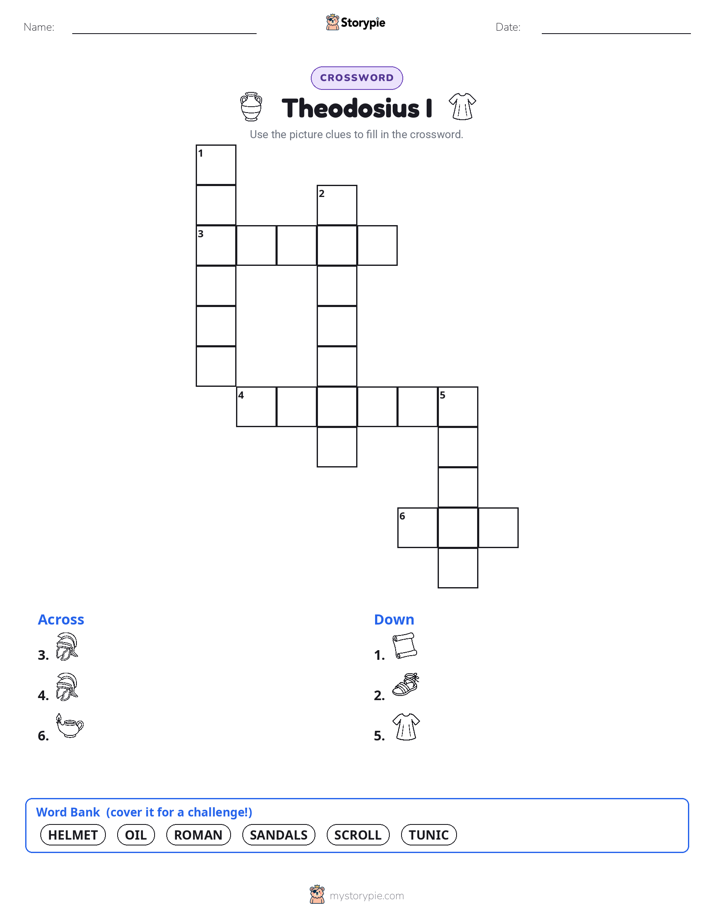
- Printable worksheets & coloring pages

Why Storypie for Schools
Students engaged. Prep in seconds. Evenings back to you.
- Worksheets & Quizzes
- Classroom Management
- Formative Assessment
- Custom Curriculum & Lesson Plans
- 27 Languages

Why Storypie for Homeschool
Curriculum done. They'll ask for more. Hours back in your day.
- Worksheet Generator
- First-Person Audio Stories
- Built-in Comprehension Quizzes
- Custom Curriculum & Lesson Plans
- Print & Go Activities