English


Tim Berners-Lee
A British computer scientist credited with inventing the World Wide Web…
Reads at Grades 6–8 Listens at Grades 4–8
Print & create
Answer keys·No prep·Free with an account
28 worksheets · answer keys · full story · quiz · Ages 10-12 · CEFR B2
Plus adds 164,000+ more stories in 27 languages, audio for every one, and printables for all of them.
Just want Tim Berners-Lee?

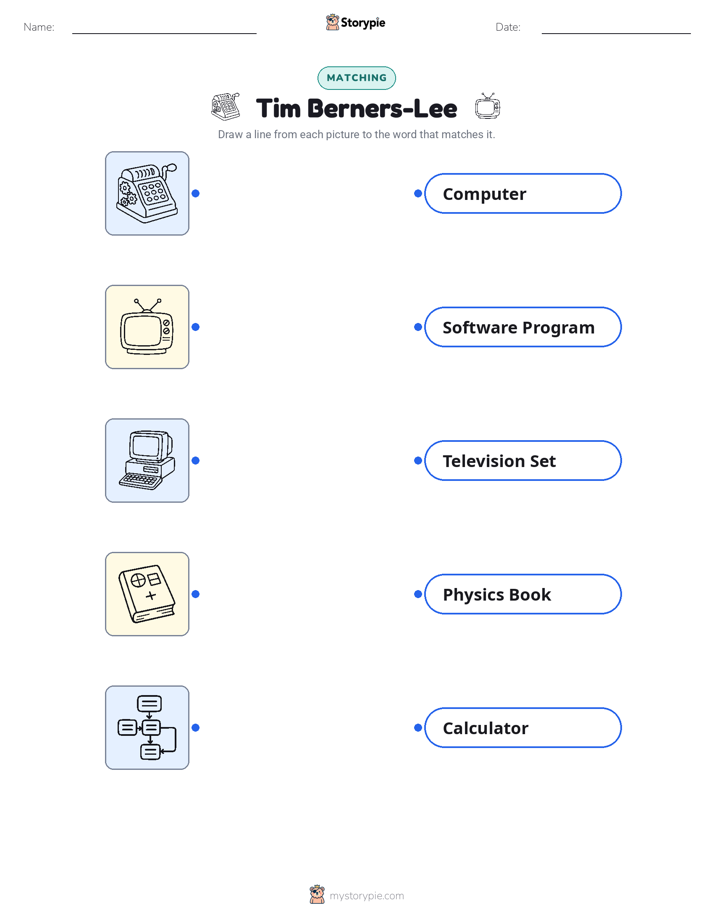
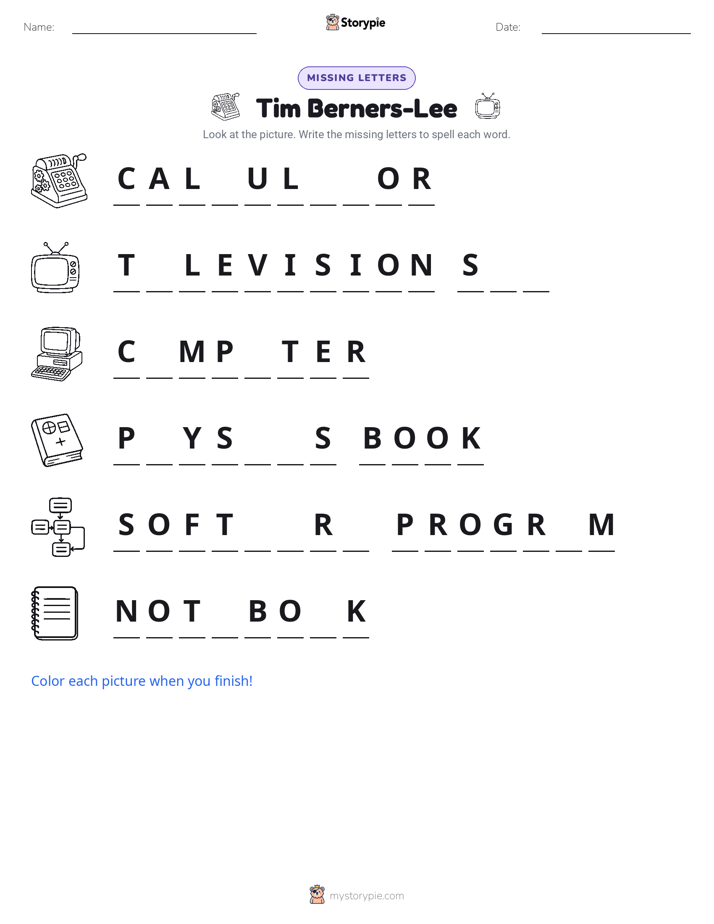
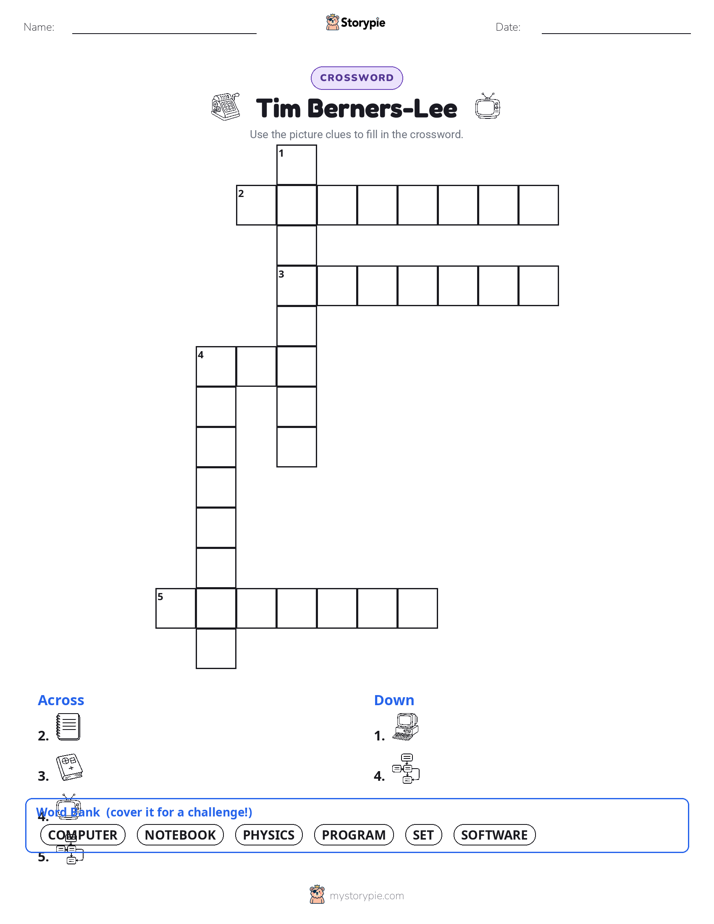
Hello. My name is Tim Berners-Lee, and I'd like to share the story of how I invented something you probably use every day: the World Wide Web. My journey started in London, England, where I was born on June 8th, 1955. My parents, Conway Berners-Lee and Mary Lee Woods, were both mathematicians and computer scientists. They were part of the team that worked on one of the very first computers built for commercial use, called the Ferranti Mark 1. With parents like mine, our home was always buzzing with talk about mathematics and machines. From a young age, I was fascinated by electronics. I loved taking things apart to see how they worked and putting them back together. I even built my own simple computer using a processor from an old calculator and a spare television set. This early passion for understanding how different parts could connect and share information was the first step toward a very big idea I would have years later.
After my school years, I went to study physics at The Queen's College, part of Oxford University, and I graduated in 1976. I worked for a couple of different companies before taking on a role as a software engineering consultant at CERN in 1980. CERN is a massive particle physics laboratory in Switzerland where thousands of scientists from all over the globe come to conduct research. I quickly noticed a huge problem. All of these brilliant researchers had their data, notes, and projects stored on different computers that couldn't communicate with each other. It was incredibly difficult to keep track of who was working on what. To solve this for myself, I wrote a small software program I named ENQUIRE. It acted like a personal digital notebook, allowing me to create links between different pages of information. At the time, I just saw it as a useful tool, but I didn't realize it was the foundation for my greatest invention.
Tim Berners-Lee: Inventor of the World Wide Web
Hello. My name is Tim Berners-Lee, and I'd like to share the story of how I invented something you probably use every day: the World Wide Web. My journey started in London, England, where I was born on June 8th, 1955. My parents, Conway Berners-Lee and Mary Lee Woods, were both mathematicians and computer scientists. They were part of the team that worked on one of the very first computers built for commercial use, called the Ferranti Mark 1. With parents like mine, our home was always buzzing with talk about mathematics and machines. From a young age, I was fascinated by electronics. I loved taking things apart to see how they worked and putting them back together. I even built my own simple computer using a processor from an old calculator and a spare television set. This early passion for understanding how different parts could connect and share information was the first step toward a very big idea I would have years later.
After my school years, I went to study physics at The Queen's College, part of Oxford University, and I graduated in 1976. I worked for a couple of different companies before taking on a role as a software engineering consultant at CERN in 1980. CERN is a massive particle physics laboratory in Switzerland where thousands of scientists from all over the globe come to conduct research. I quickly noticed a huge problem. All of these brilliant researchers had their data, notes, and projects stored on different computers that couldn't communicate with each other. It was incredibly difficult to keep track of who was working on what. To solve this for myself, I wrote a small software program I named ENQUIRE. It acted like a personal digital notebook, allowing me to create links between different pages of information. At the time, I just saw it as a useful tool, but I didn't realize it was the foundation for my greatest invention.
I left CERN for a time but returned in 1984. The information-sharing problem I had noticed before hadn't gone away; in fact, it had only gotten worse as more researchers and projects arrived. I couldn't stop thinking that there had to be a better system. I began to imagine a universal, connected information space where anyone, anywhere, could access and share knowledge with ease. In March of 1989, I formalized this vision in a document called 'Information Management: A Proposal.' I submitted it to my boss, Mike Sendall. He read it and wrote a now-famous note on the cover: 'Vague but exciting...'. Thankfully, his excitement outweighed the vagueness, and he gave me the encouragement and permission I needed to start working on the project during my spare time at CERN. That proposal was the official birth of the idea that would become the World Wide Web.
With my boss's approval, I spent the next year building the fundamental tools to bring my vision to life. Since nothing like it existed, I had to invent everything from scratch. I started by creating what I called HyperText Markup Language, or HTML, which is the standard language used to create web pages. Then, I developed the Uniform Resource Locator, or URL, which is the unique address for every single page on the web, just like a mailing address for a house. Finally, I designed the Hypertext Transfer Protocol, or HTTP, which is the set of rules that allows web browsers to request and retrieve information from web servers. By the end of 1990, I had also built the world’s first web browser, which I named 'WorldWideWeb,' and the first web server software. On December 20th, 1990, I published the very first website at CERN. It was a simple page that explained the World Wide Web project, but it marked the beginning of a global revolution in communication.
As the Web began to grow within CERN and at other research institutions, I knew it faced a critical moment. For my invention to truly change the world, it couldn't belong to just one person or company. Some people suggested that we should sell the technology and charge people to use it. However, I felt strongly that its power lay in being open and free for everyone. I argued that this was the only way it could reach its full potential. In 1993, CERN officially agreed and announced to the world that the underlying technology of the World Wide Web would be available on a royalty-free basis, for anyone to use, forever. This decision was perhaps the most important in the Web's history. It allowed innovation to flourish, as anyone could build a website, start an online business, or share their ideas without needing permission or paying a fee. This is the reason the Web expanded so rapidly across the globe.
My work didn't stop there. I continue to work to protect the Web and ensure it remains an open, accessible, and positive force in the world. In 1994, I founded the World Wide Web Consortium, also known as the W3C. This organization helps develop common standards and guidelines to ensure that the Web works for everyone, no matter what device they use or where they live. I also started the World Wide Web Foundation, an organization that fights to make sure the Web is a tool that benefits all of humanity. I invented the Web to be a creative and collaborative space that brings people together. My greatest hope is that you and future generations will use it to learn, to create, and to help build a better, more connected world for everyone.
Wow facts
About
A British computer scientist credited with inventing the World Wide Web, which transformed how information is shared and accessed globally.
Take a Quiz
Question 1 of 5
What was the main problem Tim Berners-Lee was trying to solve when he first created the World Wide Web at CERN?
Explore next




Want to do even more?
Go beyond exploring. Unlock tools that turn every story into real learning.

Storypie Plus for families
Full stories, quizzes, and printables. Nights and car rides, sorted.
- Unlimited audio stories
- Create Mode: your child stars in the story
- Offline downloads
- Printable worksheets & coloring pages

Why Storypie for Schools
Students engaged. Prep in seconds. Evenings back to you.
- Worksheets & Quizzes
- Classroom Management
- Formative Assessment
- Custom Curriculum & Lesson Plans
- 27 Languages

Why Storypie for Homeschool
Curriculum done. They'll ask for more. Hours back in your day.
- Worksheet Generator
- First-Person Audio Stories
- Built-in Comprehension Quizzes
- Custom Curriculum & Lesson Plans
- Print & Go Activities