English


Tim Berners-Lee
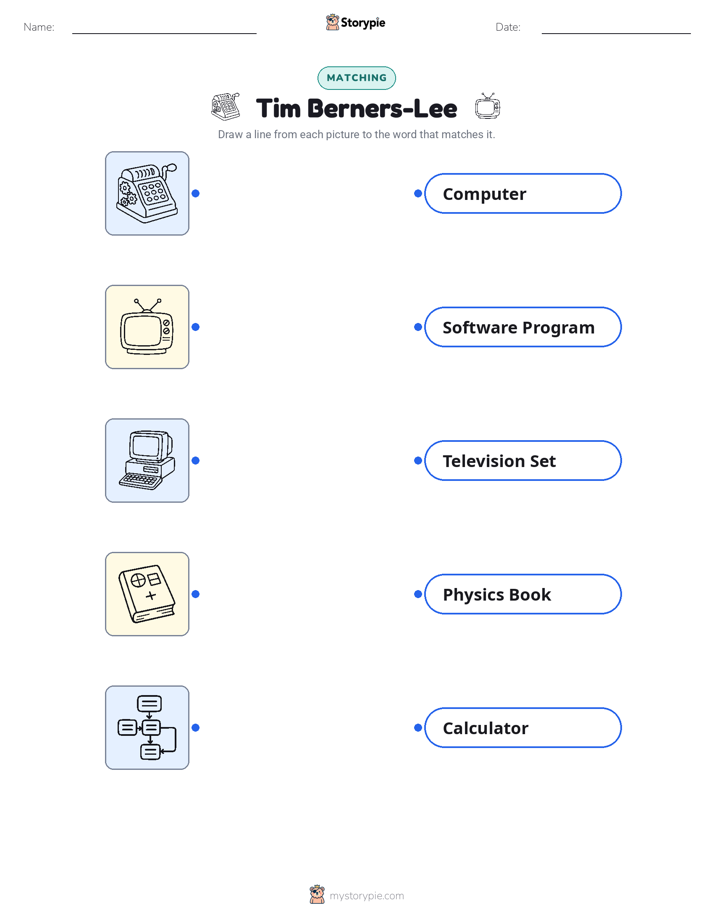
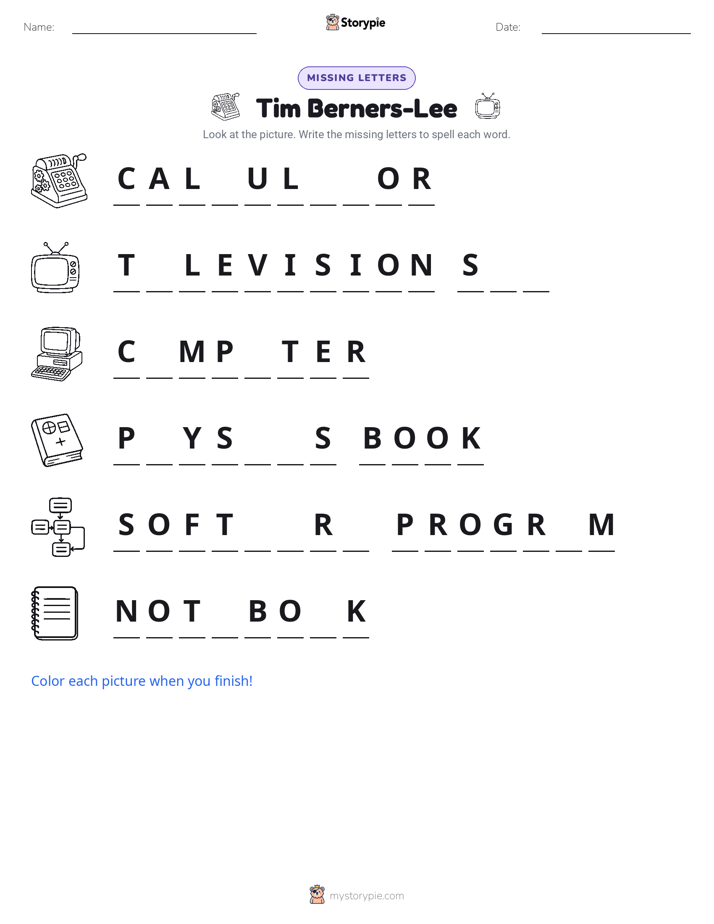
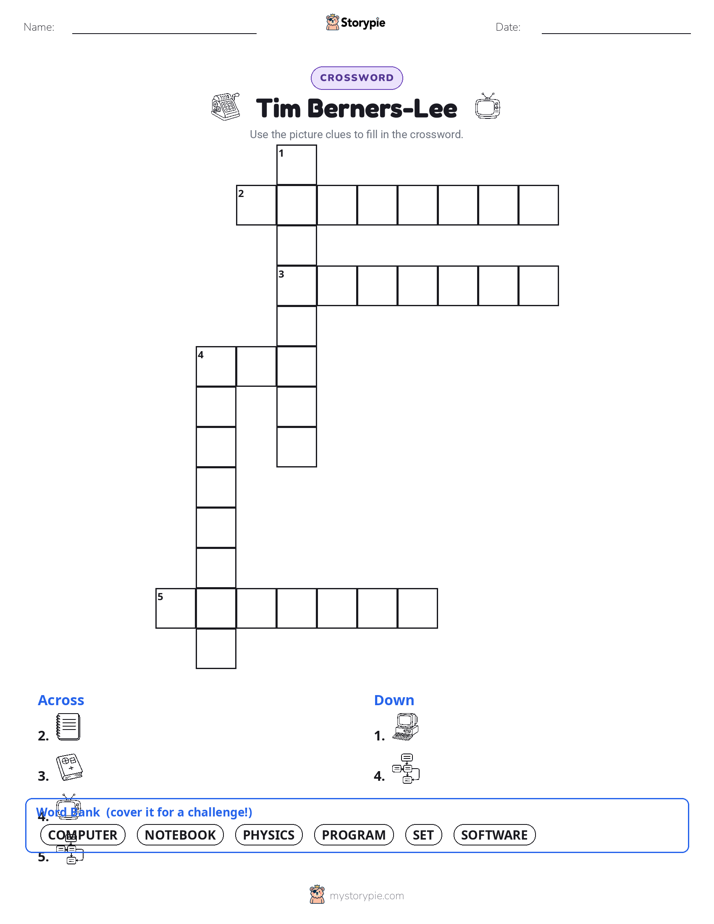
A British computer scientist credited with inventing the World Wide Web…
Reads at Grades 3–5 Listens at Grades 1–5
Print & create
Answer keys·No prep·Free with an account
28 worksheets · answer keys · full story · quiz · Ages 8-10 · CEFR B1
Plus adds 164,000+ more stories in 27 languages, audio for every one, and printables for all of them.
Just want Tim Berners-Lee?

Hello! My name is Tim Berners-Lee, and I invented something you probably use every day: the World Wide Web. I was born in London, England, on June 8th, 1955. My parents, Mary Lee Woods and Conway Berners-Lee, were mathematicians, which means they were experts with numbers. They worked on one of the very first computers ever built, called the Ferranti Mark 1. Because of their work, our house was always filled with interesting conversations about numbers, machines, and how things worked. I was a very curious child. I loved taking things apart, like radios and clocks, just to see the pieces inside and figure out how they fit together to make something happen. Then, I would carefully try to put them all back together again. This love for puzzles stayed with me. When I went to college at Oxford University, my fascination with computers grew even stronger. I decided to build my very own computer, but I didn't have a lot of money. So, I used an old television for the screen and other spare parts I could find. It was a wonderful challenge! I graduated in 1976, feeling very excited to go out into the world and use my skills to solve new puzzles in the world of computers.
In the 1980s, I began a new job at a famous science laboratory in Switzerland called CERN. CERN was an amazing place where thousands of scientists from all over the world came to work on big experiments. But they had a huge problem that was slowing down their progress. All of these brilliant scientists had important information and research stored on their computers, but the computers couldn't easily talk to each other. It was like they all had a library full of amazing books, but every book was written in a different language with no dictionary to help translate. A scientist in one country couldn't easily look at the research of another scientist in a different country. This was very frustrating and inefficient. I kept thinking to myself, 'There must be a better way!' I started to dream of a new system. I imagined a way to connect all of this information together, so you could click on a link in one document and instantly be taken to another related document, no matter where in the world it was stored. I pictured it as a giant, imaginary web, linking everything together.
Tim Berners-Lee: The Man Who Created the Web
Hello! My name is Tim Berners-Lee, and I invented something you probably use every day: the World Wide Web. I was born in London, England, on June 8th, 1955. My parents, Mary Lee Woods and Conway Berners-Lee, were mathematicians, which means they were experts with numbers. They worked on one of the very first computers ever built, called the Ferranti Mark 1. Because of their work, our house was always filled with interesting conversations about numbers, machines, and how things worked. I was a very curious child. I loved taking things apart, like radios and clocks, just to see the pieces inside and figure out how they fit together to make something happen. Then, I would carefully try to put them all back together again. This love for puzzles stayed with me. When I went to college at Oxford University, my fascination with computers grew even stronger. I decided to build my very own computer, but I didn't have a lot of money. So, I used an old television for the screen and other spare parts I could find. It was a wonderful challenge! I graduated in 1976, feeling very excited to go out into the world and use my skills to solve new puzzles in the world of computers.
In the 1980s, I began a new job at a famous science laboratory in Switzerland called CERN. CERN was an amazing place where thousands of scientists from all over the world came to work on big experiments. But they had a huge problem that was slowing down their progress. All of these brilliant scientists had important information and research stored on their computers, but the computers couldn't easily talk to each other. It was like they all had a library full of amazing books, but every book was written in a different language with no dictionary to help translate. A scientist in one country couldn't easily look at the research of another scientist in a different country. This was very frustrating and inefficient. I kept thinking to myself, 'There must be a better way!' I started to dream of a new system. I imagined a way to connect all of this information together, so you could click on a link in one document and instantly be taken to another related document, no matter where in the world it was stored. I pictured it as a giant, imaginary web, linking everything together.
In 1989, I finally wrote down my idea for this global information-sharing system and showed it to my boss at CERN. He read my proposal and told me it was 'vague, but exciting,' which was encouraging enough for me! He gave me permission to spend time working on it. I knew that to make this dream a reality, I needed to create a few key tools. First, I created a special language called HTML, which stands for HyperText Markup Language. You can think of HTML as the set of building blocks for making a webpage, like bricks for a house. Next, I came up with the idea of URLs, or Uniform Resource Locators. A URL is like a unique street address for every single page or piece of information on the web, so computers know exactly where to find it. Finally, I invented a set of rules called HTTP, or Hypertext Transfer Protocol. HTTP is like the postal service for the web, allowing computers to request and send web pages to each other. By the year 1990, I had used these tools to build the world's very first web browser and web server. Then, on August 6th, 1991, a very exciting moment happened: the very first website went online for the world to see. It was a simple page that explained what the World Wide Web was and how other people could start using it.
After creating the web, we had to make a very important decision. We could have tried to sell the idea and make a lot of money, but we believed it was too important for that. So, in 1993, CERN announced that the technology for the World Wide Web would be given to the world for free. Anyone, anywhere, could use it without having to pay any fees. This was the key that allowed the web to grow incredibly fast all over the globe. To help guide this growth and make sure the web stayed open and fair for everyone, I founded an organization called the World Wide Web Consortium, or W3C, in 1994. The W3C helps create standards so that the web works the same for everybody. In 2004, I received a great honor when I was knighted by Queen Elizabeth II for my work. Today, I am still working hard to make sure the web is a safe, creative, and positive place for all. I see it as a powerful tool for you to learn, to create, and to connect with others, and I truly hope you use it to build amazing things.
Wow facts
About
A British computer scientist credited with inventing the World Wide Web, which transformed how information is shared and accessed globally.
Take a Quiz
Question 1 of 5
What big problem did the scientists at CERN have in the 1980s?
Explore next


Want to do even more?
Go beyond exploring. Unlock tools that turn every story into real learning.

Storypie Plus for families
Full stories, quizzes, and printables. Nights and car rides, sorted.
- Unlimited audio stories
- Create Mode: your child stars in the story
- Offline downloads
- Printable worksheets & coloring pages

Why Storypie for Schools
Students engaged. Prep in seconds. Evenings back to you.
- Worksheets & Quizzes
- Classroom Management
- Formative Assessment
- Custom Curriculum & Lesson Plans
- 27 Languages

Why Storypie for Homeschool
Curriculum done. They'll ask for more. Hours back in your day.
- Worksheet Generator
- First-Person Audio Stories
- Built-in Comprehension Quizzes
- Custom Curriculum & Lesson Plans
- Print & Go Activities