English

Virginia Apgar
Virginia Apgar was an American physician, anesthesiologist…
Reads at Grades 6–8 Listens at Grades 4–8
Print & create
Answer keys·No prep·Free with an account
28 worksheets · answer keys · full story · quiz · Ages 10-12 · CEFR B2
Plus adds 290,000+ more stories in 27 languages, audio for every one, and printables for all of them.
Just want Virginia Apgar?
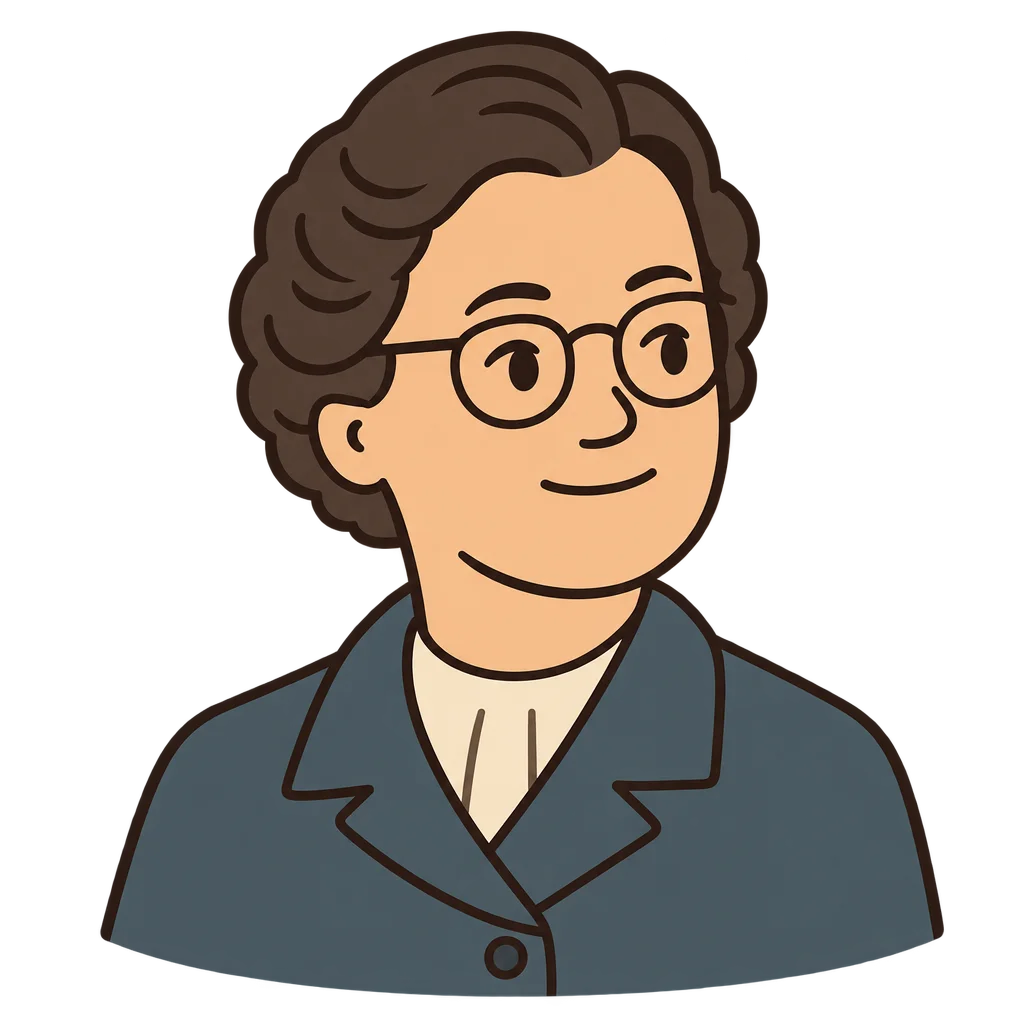
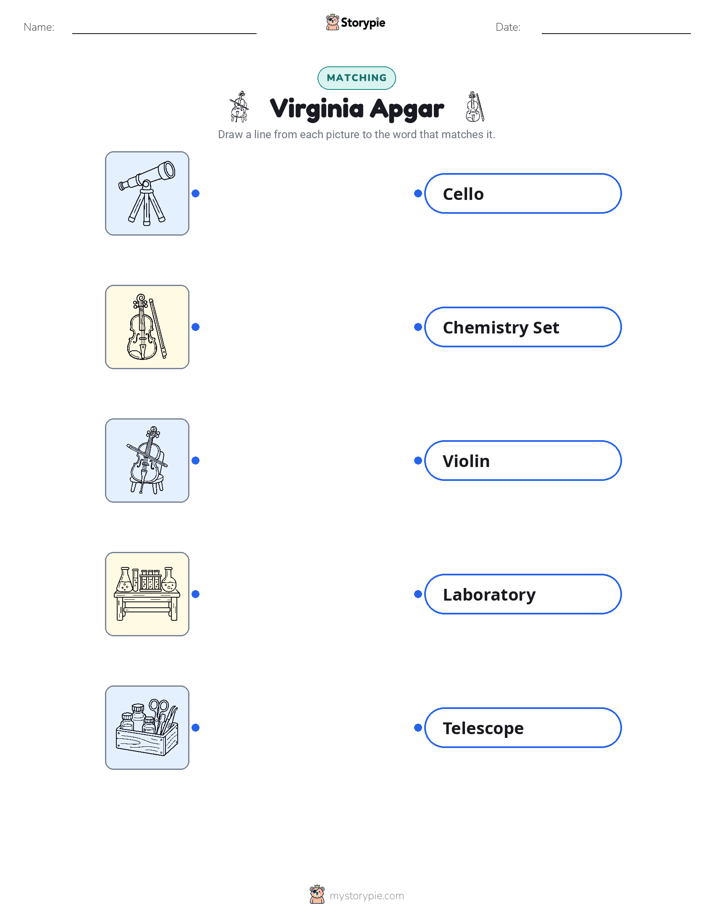
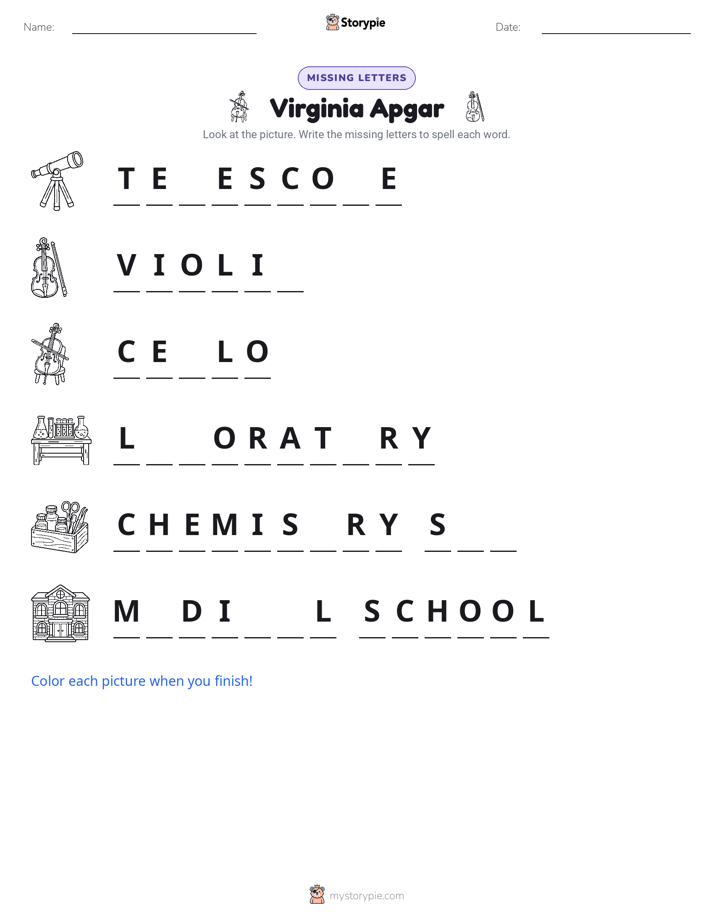
Hello! My name is Virginia Apgar, and I want to tell you my story. I was born on June 7th, 1909, in Westfield, New Jersey. My childhood home was a place of constant discovery, filled with both music and science. My father, an amateur inventor and astronomer, built a telescope in our backyard and turned our basement into a laboratory for his scientific experiments. My older brothers shared this passion for science, so our house was always buzzing with new ideas and questions about how the world worked. Alongside these scientific pursuits, I developed a deep love for music and became a talented violinist and cellist. This unique blend of artistic creativity and methodical scientific thinking was the foundation for who I would become: a doctor who approached problems with a fresh and innovative perspective.
From a very young age, I knew my calling was to become a doctor. I pursued this goal with determination, first attending Mount Holyoke College where I studied zoology and chemistry. I graduated in 1929 and was accepted into the Columbia University College of Physicians and Surgeons. In my class, I was one of only nine women, which was unusual at the time. I dedicated myself to my studies and graduated with my medical degree in 1933. My dream was to become a surgeon, and I spent the next two years in rigorous surgical training. However, a wise mentor, Dr. Allen Whipple, gave me some difficult but practical advice. He explained that, in that era, it would be nearly impossible for a woman to build a successful career as a surgeon. He saw my potential and energy, so he suggested I channel my talents into a new and growing field: anesthesiology, the science of keeping patients safe and without pain during surgery.
Virginia Apgar: A Score for Life
Hello! My name is Virginia Apgar, and I want to tell you my story. I was born on June 7th, 1909, in Westfield, New Jersey. My childhood home was a place of constant discovery, filled with both music and science. My father, an amateur inventor and astronomer, built a telescope in our backyard and turned our basement into a laboratory for his scientific experiments. My older brothers shared this passion for science, so our house was always buzzing with new ideas and questions about how the world worked. Alongside these scientific pursuits, I developed a deep love for music and became a talented violinist and cellist. This unique blend of artistic creativity and methodical scientific thinking was the foundation for who I would become: a doctor who approached problems with a fresh and innovative perspective.
From a very young age, I knew my calling was to become a doctor. I pursued this goal with determination, first attending Mount Holyoke College where I studied zoology and chemistry. I graduated in 1929 and was accepted into the Columbia University College of Physicians and Surgeons. In my class, I was one of only nine women, which was unusual at the time. I dedicated myself to my studies and graduated with my medical degree in 1933. My dream was to become a surgeon, and I spent the next two years in rigorous surgical training. However, a wise mentor, Dr. Allen Whipple, gave me some difficult but practical advice. He explained that, in that era, it would be nearly impossible for a woman to build a successful career as a surgeon. He saw my potential and energy, so he suggested I channel my talents into a new and growing field: anesthesiology, the science of keeping patients safe and without pain during surgery.
I followed Dr. Whipple's guidance and immersed myself in the world of anesthesiology. The field was so new that there were no professors or established training programs; I had to help build it from the very beginning. My hard work paid off, and in 1938, I was appointed the director of the new division of anesthesia at Columbia. In this role, I was responsible for recruiting and teaching other doctors, helping to establish anesthesiology as a respected medical specialty. A significant part of my work took place in the delivery room, where babies are born. While assisting mothers, I began to notice something that deeply worried me. After a birth, the medical team's focus was almost entirely on the mother, and the newborn was often set aside without a formal checkup. There was no standard, quick method to determine if a baby was healthy or in urgent need of help.
The more time I spent in the delivery room, the more a single, crucial question took shape in my mind. By 1949, I had achieved a significant milestone, becoming the first woman to be named a full professor at my medical school, and I felt a profound responsibility to use my position to solve important problems. I observed that some newborns who looked perfectly fine at first would later struggle to breathe, while others who appeared pale and weak were actually healthy. I thought to myself, 'There has to be a simple, fast, and reliable way to check a baby's health right after birth.' Finding an answer to this question became my mission. I was determined to create a straightforward tool that any doctor or nurse could use to decide, in less than a minute, if a newborn required immediate medical attention.
In 1952, I finally developed a solution. I created a simple scoring system based on five key signs that I could observe quickly and easily in a newborn. The five categories were: Appearance, which looked at skin color; Pulse, for heart rate; Grimace, which tested reflexes; Activity, for muscle tone; and Respiration, to check breathing. Each of these five categories was given a score of 0, 1, or 2. By adding the scores together, a doctor or nurse could get a total score out of 10. This assessment was done at one minute and again at five minutes after birth. A high score indicated the baby was healthy, but a low score was a clear signal to the medical team that the baby needed help right away. A clever medical student once pointed out that the first letters of each category—A, P, G, A, R—spelled my last name! It was a perfect coincidence, and from then on, my system was known as the Apgar Score.
The Apgar Score proved to be a remarkable success and was quickly adopted by hospitals everywhere. It provided a common language for medical staff to communicate a newborn's condition. After many years dedicated to teaching and research in anesthesiology, I felt ready for a new challenge. In 1959, I went back to school and earned a Master's degree in Public Health from Johns Hopkins University. Soon after, I began working for a wonderful organization called the March of Dimes. My new role was to travel all over the United States and around the world, educating doctors and the public about preventing birth defects and highlighting the importance of good health for both mothers and their babies. I loved this work because it allowed me to expand my mission and help countless more families.
I lived a full and exciting life, always balancing my love for science with my passion for music and my drive to help others. I even took on new adventures later in life, like learning to fly airplanes in my fifties! I lived to be 65 years old. Today, my simple Apgar Score is still used for nearly every baby born in hospitals worldwide, a testament to its effectiveness. It serves as a powerful reminder that sometimes the most impactful solutions come from asking a simple question and observing the world around you with great care and curiosity. I am so proud that my work continues to give millions of newborns a healthy start to life.
Wow facts
About
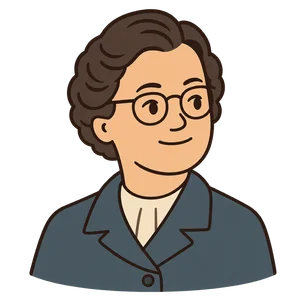
Virginia Apgar was an American physician, anesthesiologist, and medical researcher who created the Apgar Score, a simple and effective method to assess the health of newborn babies immediately after birth.
Take a Quiz
Question 1 of 5
In your own words, summarize the main problem Virginia Apgar noticed in the delivery room that led her to create the Apgar Score.
Explore next






Want to do even more?
Go beyond exploring. Unlock tools that turn every story into real learning.

Storypie Plus for families
Full stories, quizzes, and printables. Nights and car rides, sorted.
- Unlimited audio stories
- Create Mode: your child stars in the story
- Offline downloads
- Printable worksheets & coloring pages

Why Storypie for Schools
Students engaged. Prep in seconds. Evenings back to you.
- Worksheets & Quizzes
- Classroom Management
- Formative Assessment
- Custom Curriculum & Lesson Plans
- 27 Languages

Why Storypie for Homeschool
Curriculum done. They'll ask for more. Hours back in your day.
- Worksheet Generator
- First-Person Audio Stories
- Built-in Comprehension Quizzes
- Custom Curriculum & Lesson Plans
- Print & Go Activities