English

Wilhelm Röntgen
Wilhelm Röntgen was a German physicist who, in 1895…
Reads at Grades 3–5 Listens at Grades 1–5
Print & create
Answer keys·No prep·Free with an account
28 worksheets · answer keys · full story · quiz · Ages 8-10 · CEFR B1
Plus adds 164,000+ more stories in 27 languages, audio for every one, and printables for all of them.
Just want Wilhelm Röntgen?
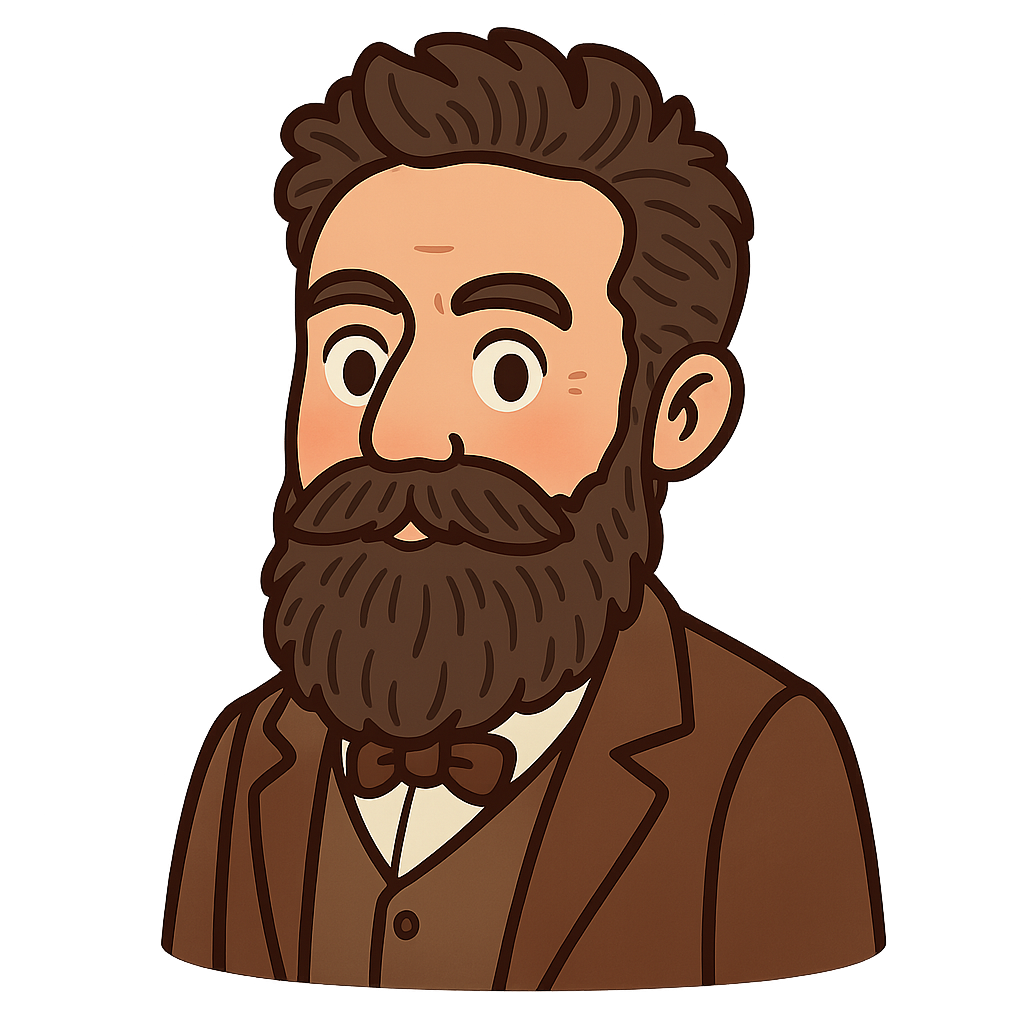
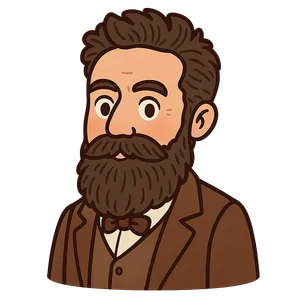
Hello! My name is Wilhelm Röntgen, and I want to tell you about a discovery that let us see inside things in a way no one ever had before. I was born a long time ago, on March 27th, 1845, in a town called Lennep in Germany. As a boy, I wasn't always the best student in the traditional sense, but I was always building things and exploring the outdoors. I loved nature and was fascinated by how the world worked, which sparked my lifelong love of science and mechanics.
My school years had some bumps. I was even expelled from one school! But I never gave up on my dream of studying science. I eventually went to university in Switzerland and, in 1869, I earned my Ph.D. in physics. I loved being in a laboratory, surrounded by equipment and ideas. I became a professor and spent my days teaching students and conducting my own experiments, always trying to understand the invisible forces of our universe, like electricity and light.
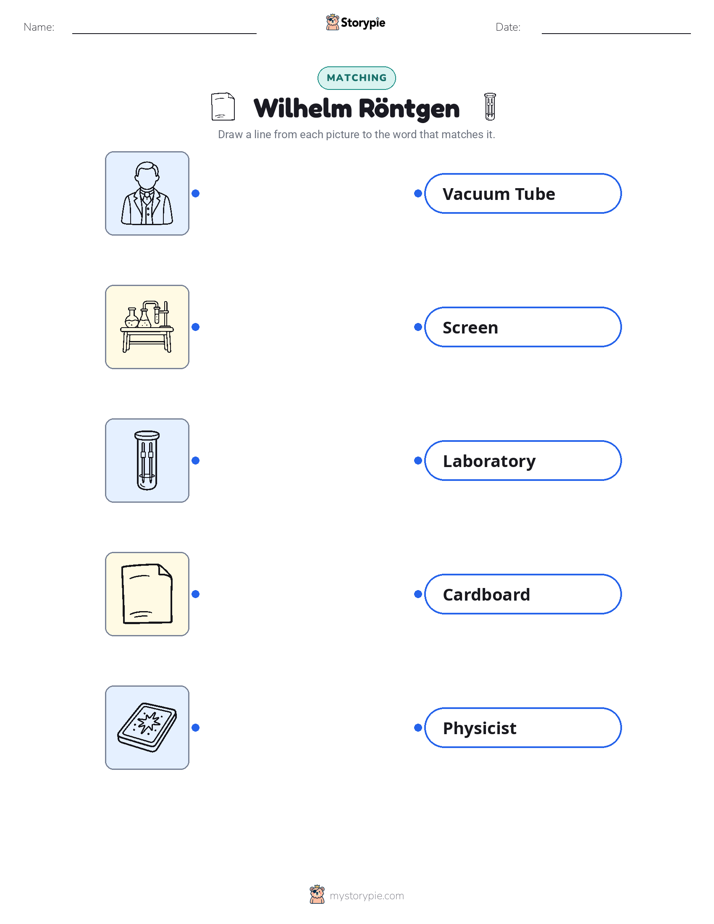
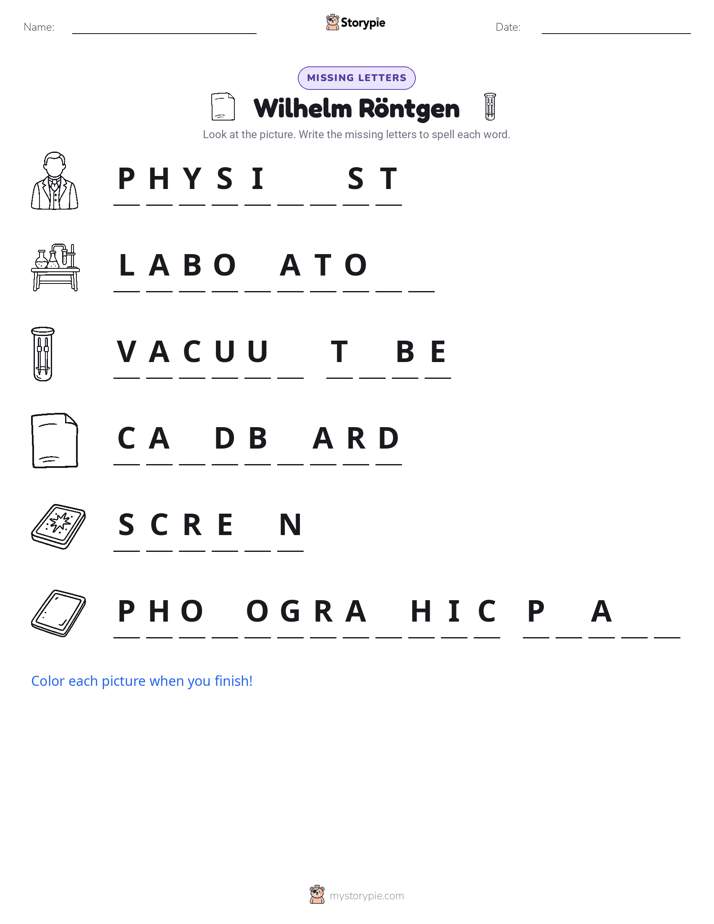
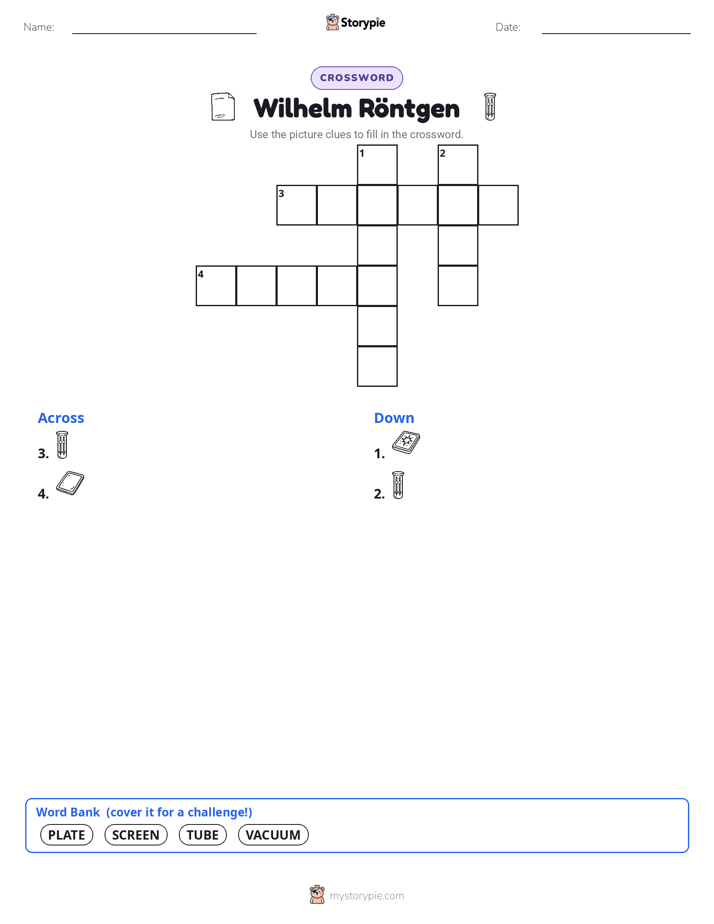
Everything changed on the evening of November 8th, 1895. I was working late in my laboratory at the University of Würzburg, experimenting with a special glass tube called a cathode-ray tube. I had covered the tube in black cardboard to block out all the light. But when I turned it on in my dark lab, I noticed something strange. A screen coated with a chemical called barium platinocyanide, which was sitting on a nearby bench, had started to glow with a faint, green light! I was puzzled. How could it be glowing when the tube was completely covered? I realized some new, invisible kind of ray must be coming from the tube, passing through the cardboard, and hitting the screen. I called them 'X-rays,' with 'X' standing for 'unknown'.
Wilhelm Röntgen: A Story of Seeing the Invisible
Hello! My name is Wilhelm Röntgen, and I want to tell you about a discovery that let us see inside things in a way no one ever had before. I was born a long time ago, on March 27th, 1845, in a town called Lennep in Germany. As a boy, I wasn't always the best student in the traditional sense, but I was always building things and exploring the outdoors. I loved nature and was fascinated by how the world worked, which sparked my lifelong love of science and mechanics.
My school years had some bumps. I was even expelled from one school! But I never gave up on my dream of studying science. I eventually went to university in Switzerland and, in 1869, I earned my Ph.D. in physics. I loved being in a laboratory, surrounded by equipment and ideas. I became a professor and spent my days teaching students and conducting my own experiments, always trying to understand the invisible forces of our universe, like electricity and light.
Everything changed on the evening of November 8th, 1895. I was working late in my laboratory at the University of Würzburg, experimenting with a special glass tube called a cathode-ray tube. I had covered the tube in black cardboard to block out all the light. But when I turned it on in my dark lab, I noticed something strange. A screen coated with a chemical called barium platinocyanide, which was sitting on a nearby bench, had started to glow with a faint, green light! I was puzzled. How could it be glowing when the tube was completely covered? I realized some new, invisible kind of ray must be coming from the tube, passing through the cardboard, and hitting the screen. I called them 'X-rays,' with 'X' standing for 'unknown'.
I was so excited that I spent the next few weeks studying these mysterious rays. I discovered they could pass through paper, wood, and even thin metals. But they were stopped by thicker things, like bone. I had an idea. I asked my wife, Anna Bertha, to help me. On December 22nd, 1895, I had her place her hand on a photographic plate, and I aimed the X-rays at it for a few minutes. When we developed the plate, we were amazed. We could see the bones inside her hand, and even the ring on her finger! It was the world's very first X-ray image of a person. We could see inside the human body without a single cut.
I knew this discovery was too important to keep to myself. I published my findings on December 28th, 1895, in a paper called 'On a New Kind of Rays.' The news spread across the world like wildfire! Doctors immediately saw how useful X-rays could be for finding broken bones or locating objects inside the body. In 1901, I was honored to receive the very first Nobel Prize in Physics for my work. I never put a patent on my discovery, because I wanted it to be freely available to help all of humankind.
My discovery opened up a whole new window into the world and created the field of medical imaging. I lived to be 77 years old, and I was so proud to see how my work was helping people. Today, every time someone gets an X-ray at a hospital or a dentist's office, they are using the same basic principle I discovered in my dark laboratory all those years ago. It just goes to show what you can find when you stay curious.
Wow facts
About
Wilhelm Röntgen was a German physicist who, in 1895, produced and detected electromagnetic radiation in a wavelength range known as X-rays. This achievement earned him the first-ever Nobel Prize in Physics in 1901.
Take a Quiz
Question 1 of 5
What did I name the mysterious rays I discovered, and why did I choose that name?
Explore next






Want to do even more?
Go beyond exploring. Unlock tools that turn every story into real learning.

Storypie Plus for families
Full stories, quizzes, and printables. Nights and car rides, sorted.
- Unlimited audio stories
- Create Mode: your child stars in the story
- Offline downloads
- Printable worksheets & coloring pages

Why Storypie for Schools
Students engaged. Prep in seconds. Evenings back to you.
- Worksheets & Quizzes
- Classroom Management
- Formative Assessment
- Custom Curriculum & Lesson Plans
- 27 Languages

Why Storypie for Homeschool
Curriculum done. They'll ask for more. Hours back in your day.
- Worksheet Generator
- First-Person Audio Stories
- Built-in Comprehension Quizzes
- Custom Curriculum & Lesson Plans
- Print & Go Activities