English

Algonquian Peoples
A large group of culturally and linguistically related Indigenous peoples of North America who traditionally…
Reads at Grades 6–8 Listens at Grades 4–8
Print & create
Answer keys·No prep·Free with an account
28 worksheets · answer keys · full story · quiz · Ages 10-12 · CEFR B2
Plus adds 244,000+ more stories in 27 languages, audio for every one, and printables for all of them.
Just want Algonquian Peoples?
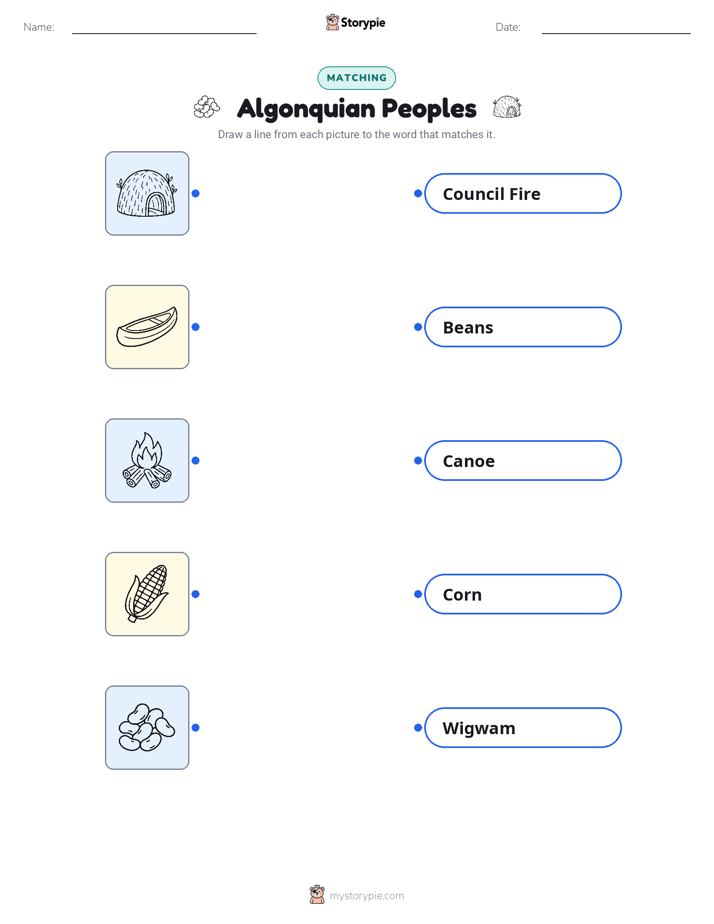
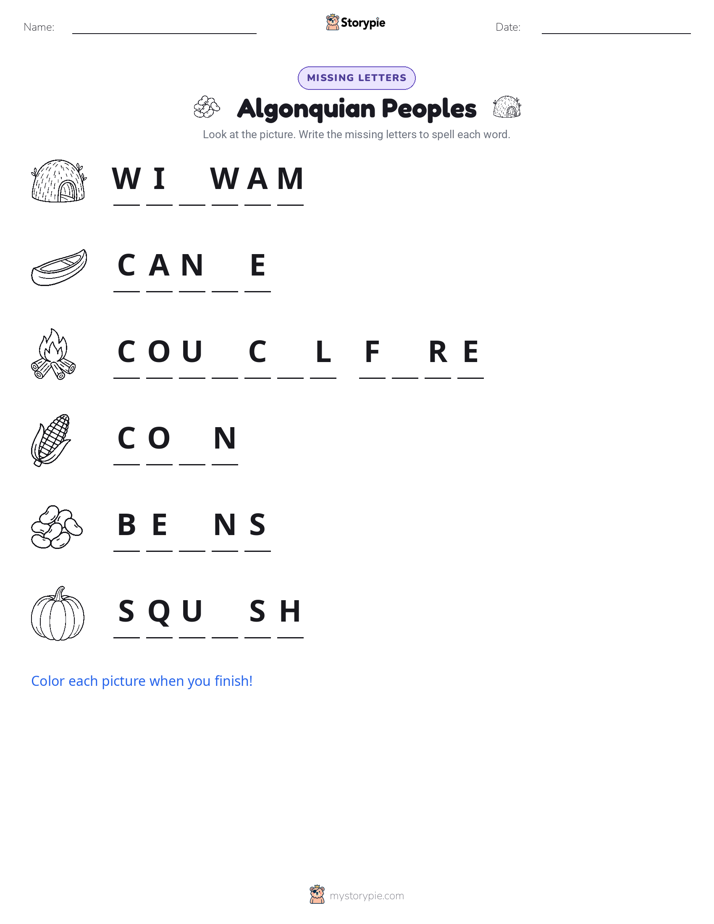
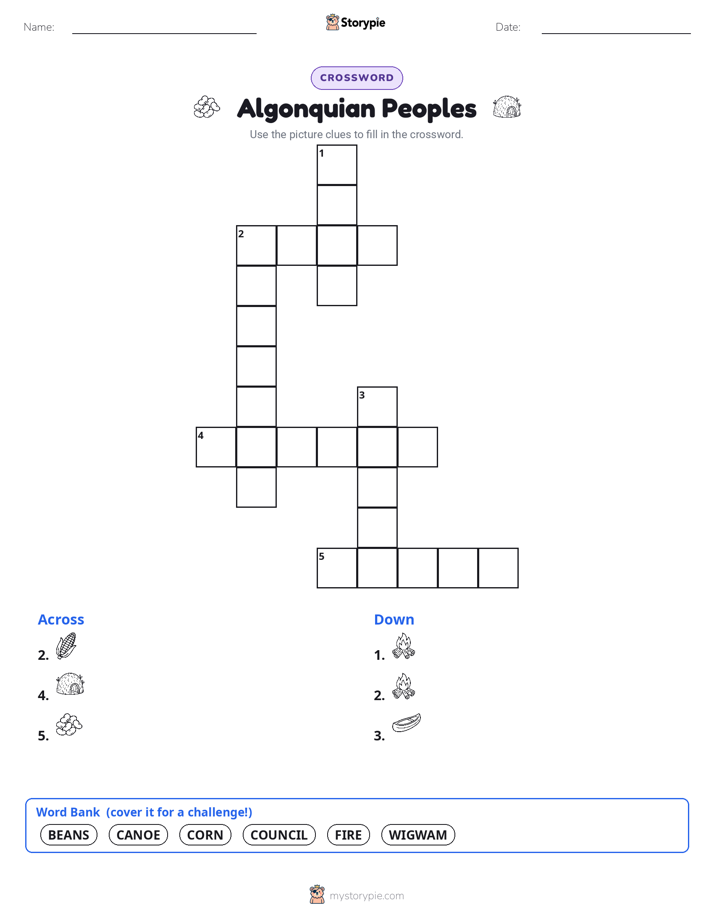
Before the maps were drawn with sharp lines and bold names, my voice was a whisper carried on the wind across a vast continent. You could hear me in the rustle of birch leaves in the great northern forests and in the gentle lapping of waves against the Atlantic shore. You could feel my presence in the steady current of the rivers that served as my highways and in the warmth of a council fire where elders shared wisdom. I was not one person, but many. I was a family of hundreds of communities, a network of peoples connected by the words we spoke and the lands we called home. My people lived in dome-shaped homes called wigwams, framed with saplings and covered in sheets of bark. They paddled sleek, silent canoes carved from single trees or crafted with birchbark stretched over a wooden frame, perfect for navigating the thousands of lakes and streams that crisscrossed our world. For countless generations, this was my existence: a deep, breathing connection between the people and the world they inhabited, from the salty air of the coast to the freshwater seas of the Great Lakes. My story is written on the land itself, in the ancient trails through the woods and the names of the rivers that still flow today. I am the Algonquian peoples, a family of nations woven into the story of this land for thousands of years.
My life was one of order, community, and balance. My many nations, from the Lenape in the mid-Atlantic to the Ojibwe in the north and the Powhatan in the south, lived in well-organized societies. We were skilled farmers, hunters, and diplomats. Our lives were sustained by the earth's generosity, especially the sacred 'Three Sisters'—corn, beans, and squash—which we grew together in a perfect partnership, just as our communities worked in partnership with one another. The corn provided a stalk for the beans to climb, the beans returned nutrients to the soil, and the broad leaves of the squash shaded the ground, keeping it moist and free of weeds. We hunted deer in the forests and fished for shad and sturgeon in the rivers, always giving thanks and ensuring we never took more than we needed. For millennia, our history, our laws, and our understanding of the universe were passed down not in books, but through the spoken word, in stories and ceremonies that connected each new generation to the ones who came before. But then, a profound change began. In the 16th and 17th centuries, great wooden ships with tall masts and white sails began to appear on the horizon. These newcomers arrived with strange tools, different languages, and unfamiliar ideas about the land. At first, there was curiosity and trade. We shared our knowledge of this world, and they offered goods of metal and cloth. But there were also deep misunderstandings. A powerful leader among my people, Chief Wahunsenacawh of the Powhatan Confederacy, met the English settlers who established Jamestown in 1607. His own daughter, Pocahontas, became a vital link between our two worlds, a diplomat who navigated the growing tensions with courage. A few years later, in 1621, my Wampanoag people, led by their sachem Massasoit, shared a harvest feast with the English Pilgrims, an event that was less about friendship and more about a strategic alliance in a time of great uncertainty and change for us all.
A Voice on the Wind
Before the maps were drawn with sharp lines and bold names, my voice was a whisper carried on the wind across a vast continent. You could hear me in the rustle of birch leaves in the great northern forests and in the gentle lapping of waves against the Atlantic shore. You could feel my presence in the steady current of the rivers that served as my highways and in the warmth of a council fire where elders shared wisdom. I was not one person, but many. I was a family of hundreds of communities, a network of peoples connected by the words we spoke and the lands we called home. My people lived in dome-shaped homes called wigwams, framed with saplings and covered in sheets of bark. They paddled sleek, silent canoes carved from single trees or crafted with birchbark stretched over a wooden frame, perfect for navigating the thousands of lakes and streams that crisscrossed our world. For countless generations, this was my existence: a deep, breathing connection between the people and the world they inhabited, from the salty air of the coast to the freshwater seas of the Great Lakes. My story is written on the land itself, in the ancient trails through the woods and the names of the rivers that still flow today. I am the Algonquian peoples, a family of nations woven into the story of this land for thousands of years.
My life was one of order, community, and balance. My many nations, from the Lenape in the mid-Atlantic to the Ojibwe in the north and the Powhatan in the south, lived in well-organized societies. We were skilled farmers, hunters, and diplomats. Our lives were sustained by the earth's generosity, especially the sacred 'Three Sisters'—corn, beans, and squash—which we grew together in a perfect partnership, just as our communities worked in partnership with one another. The corn provided a stalk for the beans to climb, the beans returned nutrients to the soil, and the broad leaves of the squash shaded the ground, keeping it moist and free of weeds. We hunted deer in the forests and fished for shad and sturgeon in the rivers, always giving thanks and ensuring we never took more than we needed. For millennia, our history, our laws, and our understanding of the universe were passed down not in books, but through the spoken word, in stories and ceremonies that connected each new generation to the ones who came before. But then, a profound change began. In the 16th and 17th centuries, great wooden ships with tall masts and white sails began to appear on the horizon. These newcomers arrived with strange tools, different languages, and unfamiliar ideas about the land. At first, there was curiosity and trade. We shared our knowledge of this world, and they offered goods of metal and cloth. But there were also deep misunderstandings. A powerful leader among my people, Chief Wahunsenacawh of the Powhatan Confederacy, met the English settlers who established Jamestown in 1607. His own daughter, Pocahontas, became a vital link between our two worlds, a diplomat who navigated the growing tensions with courage. A few years later, in 1621, my Wampanoag people, led by their sachem Massasoit, shared a harvest feast with the English Pilgrims, an event that was less about friendship and more about a strategic alliance in a time of great uncertainty and change for us all.
My journey through the centuries that followed was filled with immense challenges. My people faced devastating diseases brought from across the ocean, the loss of our ancestral lands, and relentless pressure to abandon our traditions and languages. It was a time of sorrow and struggle, a storm that threatened to extinguish my flame forever. But my spirit is resilient. It is rooted too deeply in this land to be erased. I am not a forgotten chapter in a history book. I am alive today, and my voice is growing stronger. You can hear it in the classrooms where young people are working to revitalize the languages of their ancestors, breathing new life into words that have been silent for too long. You can feel my heartbeat in the powerful rhythm of the drum at powwows, where my nations—the Ojibwe, the Cree, the Mi'kmaq, the Lenape, and so many others—gather to dance, to sing, and to celebrate our shared heritage. My story is told in the brilliant colors of modern beadwork, in the powerful words of our poets and writers, and in the wisdom of our leaders who advocate for our rights and for the protection of the earth. My ancient knowledge, which teaches that we are all connected and must care for the planet as a sacred trust, is more important now than ever. The story of the Algonquian peoples is not over. It is a living legacy, carried forward by new generations who hold the wisdom of the past and the hope of the future in their hands.
Wow facts
About
A large group of culturally and linguistically related Indigenous peoples of North America who traditionally lived along the Atlantic coast and into the interior along the St. Lawrence River and around the Great Lakes.
Take a Quiz
Question 1 of 5
Summarize the main idea of the section 'A Voice on the Wind and Water' in one or two sentences.
Explore next

Want to do even more?
Go beyond exploring. Unlock tools that turn every story into real learning.

Storypie Plus for families
Full stories, quizzes, and printables. Nights and car rides, sorted.
- Unlimited audio stories
- Create Mode: your child stars in the story
- Offline downloads
- Printable worksheets & coloring pages

Why Storypie for Schools
Students engaged. Prep in seconds. Evenings back to you.
- Worksheets & Quizzes
- Classroom Management
- Formative Assessment
- Custom Curriculum & Lesson Plans
- 27 Languages

Why Storypie for Homeschool
Curriculum done. They'll ask for more. Hours back in your day.
- Worksheet Generator
- First-Person Audio Stories
- Built-in Comprehension Quizzes
- Custom Curriculum & Lesson Plans
- Print & Go Activities