English

Algorithms (Step-by-Step Instructions)
An algorithm is a finite sequence of well-defined instructions…
Reads at Grades 6–8 Listens at Grades 4–8
Print & create
Answer keys·No prep·Free with an account
28 worksheets · answer keys · full story · quiz · Ages 10-12 · CEFR B2
Plus adds 244,000+ more stories in 27 languages, audio for every one, and printables for all of them.
Just want Algorithms (Step-by-Step Instructions)?
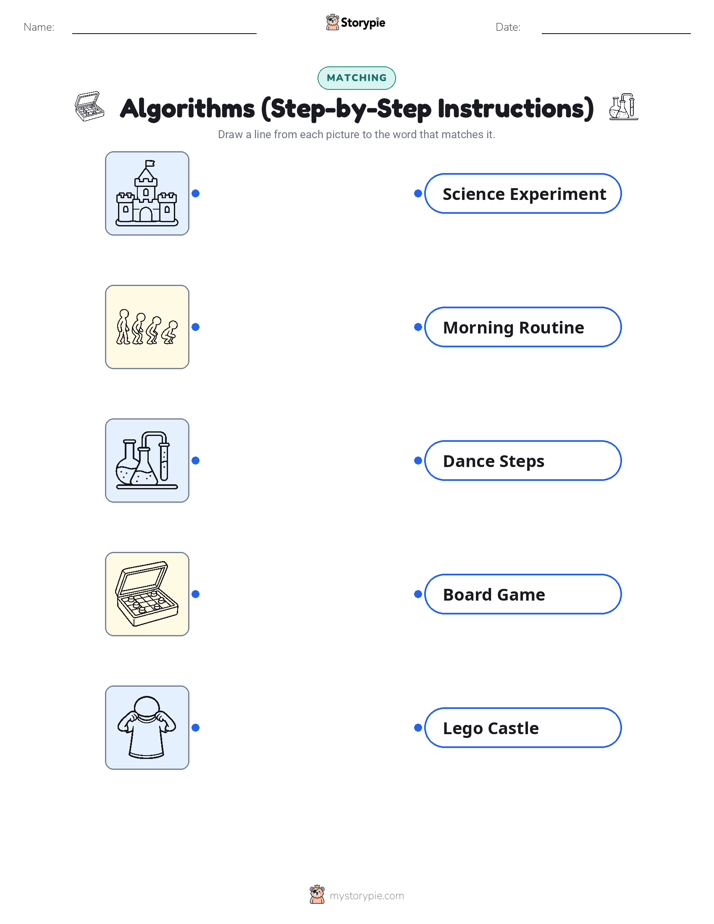
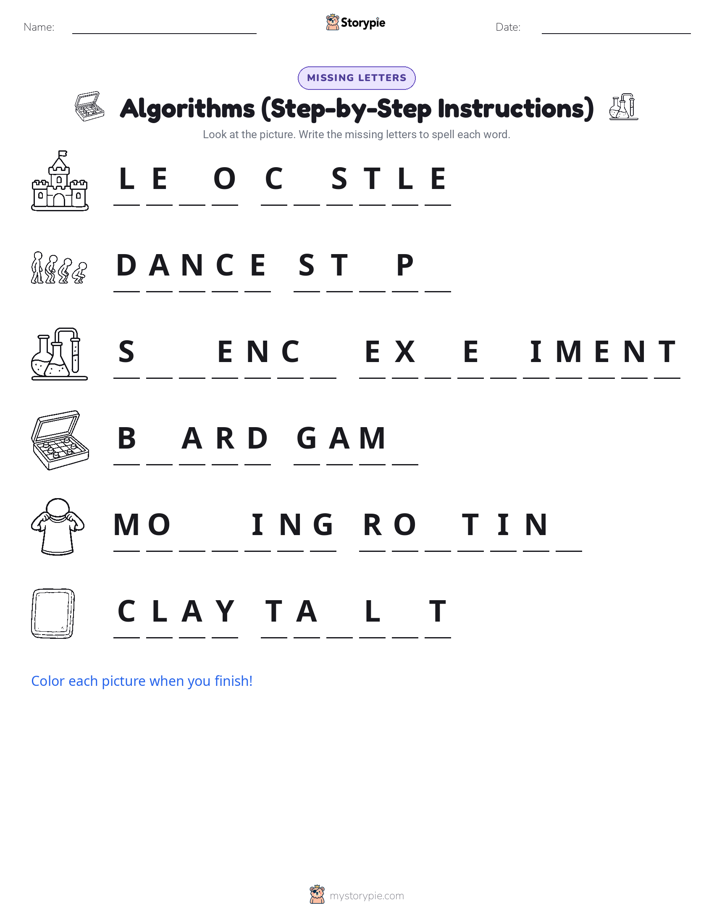
Have you ever followed a recipe to bake cookies, built a detailed LEGO castle, or learned the precise steps to a new dance? If you have, then you already know me. I am the secret path that leads from a question to an answer, from a problem to its solution. Think of me as a treasure map for your brain, where each instruction is a step that brings you closer to your goal. I exist in the list of steps for a science experiment, the official rules of your favorite board game, and even in the quiet routine you follow to get ready for school each morning. For thousands of years, long before you had a name for me, you knew me simply as a plan, a method, or a smart way to get things done. My purpose is to turn chaos into order and to break down enormous challenges into small, manageable pieces that anyone can follow. I am the logic that makes sense of the world, one step at a time. I am an Algorithm.
My story is much older than computers or even electricity. I began thousands of years ago, in the minds of the world's earliest thinkers and problem-solvers. Around 1800 BCE, clever people in ancient Babylonia etched my steps onto wet clay tablets to solve complicated problems about farming, trade, and the stars. They used me to figure out how much grain to store for the winter or how to divide land fairly among families. A bit later, around 1550 BCE, scribes in ancient Egypt used me to perform the calculations needed to build their magnificent pyramids, figuring out the perfect angles and the exact volume of stone required. One of my most famous and elegant early forms came from a brilliant Greek mathematician named Euclid around 300 BCE. He created a beautiful, simple algorithm to find the greatest common divisor of two numbers. It was a set of steps so perfect and efficient that mathematicians and computer scientists still admire and use it today. In those ancient days, I lived on scrolls, on tablets, and in people's minds, a powerful and essential tool for organizing thoughts and solving the puzzles of the world.
I Am an Algorithm: A Secret Set of Instructions
Have you ever followed a recipe to bake cookies, built a detailed LEGO castle, or learned the precise steps to a new dance? If you have, then you already know me. I am the secret path that leads from a question to an answer, from a problem to its solution. Think of me as a treasure map for your brain, where each instruction is a step that brings you closer to your goal. I exist in the list of steps for a science experiment, the official rules of your favorite board game, and even in the quiet routine you follow to get ready for school each morning. For thousands of years, long before you had a name for me, you knew me simply as a plan, a method, or a smart way to get things done. My purpose is to turn chaos into order and to break down enormous challenges into small, manageable pieces that anyone can follow. I am the logic that makes sense of the world, one step at a time. I am an Algorithm.
My story is much older than computers or even electricity. I began thousands of years ago, in the minds of the world's earliest thinkers and problem-solvers. Around 1800 BCE, clever people in ancient Babylonia etched my steps onto wet clay tablets to solve complicated problems about farming, trade, and the stars. They used me to figure out how much grain to store for the winter or how to divide land fairly among families. A bit later, around 1550 BCE, scribes in ancient Egypt used me to perform the calculations needed to build their magnificent pyramids, figuring out the perfect angles and the exact volume of stone required. One of my most famous and elegant early forms came from a brilliant Greek mathematician named Euclid around 300 BCE. He created a beautiful, simple algorithm to find the greatest common divisor of two numbers. It was a set of steps so perfect and efficient that mathematicians and computer scientists still admire and use it today. In those ancient days, I lived on scrolls, on tablets, and in people's minds, a powerful and essential tool for organizing thoughts and solving the puzzles of the world.
For many centuries, I was a nameless helper, a silent partner in human progress. That all changed in the 9th century CE, in the bustling and vibrant city of Baghdad, which was a center of learning and discovery. A brilliant Persian scholar and mathematician named Muhammad ibn Musa al-Khwārizmī was writing groundbreaking books on mathematics and astronomy. Around 820 CE, he wrote a revolutionary text that introduced Hindu-Arabic numerals to the Western world and detailed systematic, step-by-step methods for solving complex algebraic equations. His work was incredibly clear, logical, and useful. When his books were translated into Latin centuries later, European scholars were so impressed by his methods that they began calling any logical, step-by-step process an 'algorismus,' in honor of his Latinized name, 'Algoritmi.' Over many more years, that word slowly evolved into my modern name: Algorithm. Al-Khwārizmī didn't invent me, as I had been around for ages, but he described me so masterfully that he gave me the name I carry proudly to this day.
For most of my long life, I worked at the speed of human thought, limited by how fast a person could write or calculate. But in the 19th century, visionaries began to dream of machines that could think and calculate with my help. An English inventor named Charles Babbage designed an incredible, complex machine he called the Analytical Engine, a mechanical computer powered by steam. It was his friend, the insightful mathematician Ada Lovelace, who saw my true potential beyond simple number crunching. In a set of notes she published on August 14th, 1843, she wrote a detailed method for the Analytical Engine to calculate a complex sequence of numbers called Bernoulli numbers. This was me, an algorithm, written down not for a human, but for a machine to execute. Because of this incredible leap of imagination, she is now celebrated as the world's first computer programmer. My journey continued, and a century later, in 1936, a genius named Alan Turing formally defined me with his powerful concept of the 'Turing machine.' He established the theoretical foundation for what I could and could not compute, creating the essential blueprint for all modern digital computers that would follow.
Now, look around you. Thanks to the foundations laid by pioneers like al-Khwārizmī, Lovelace, and Turing, I am an essential and invisible part of your everyday world. I am the intelligence inside your family's car that helps it navigate with GPS, guiding you turn by turn. I am the logic that powers streaming services, recommending your next favorite book, show, or movie based on what you already love. I am the lightning-fast process that allows you to search the entire internet for information in a fraction of a second. I help scientists map the human genome, doctors diagnose illnesses more accurately, and artists create breathtaking digital worlds in video games and films. I am not magic; I am a tool, created and refined by human ingenuity to solve problems and express creativity. I am the reliable bridge between a brilliant idea and its final creation. From the simplest recipe for pancakes to the most complex mission to Mars, I am the set of steps that helps you achieve your goals. What amazing things will you and I build together next?
Wow facts
About
An algorithm is a finite sequence of well-defined instructions, typically used to solve a class of specific problems or to perform a computation.
Take a Quiz
Question 1 of 5
What is the main idea of this story?
Explore next






Want to do even more?
Go beyond exploring. Unlock tools that turn every story into real learning.

Storypie Plus for families
Full stories, quizzes, and printables. Nights and car rides, sorted.
- Unlimited audio stories
- Create Mode: your child stars in the story
- Offline downloads
- Printable worksheets & coloring pages

Why Storypie for Schools
Students engaged. Prep in seconds. Evenings back to you.
- Worksheets & Quizzes
- Classroom Management
- Formative Assessment
- Custom Curriculum & Lesson Plans
- 27 Languages

Why Storypie for Homeschool
Curriculum done. They'll ask for more. Hours back in your day.
- Worksheet Generator
- First-Person Audio Stories
- Built-in Comprehension Quizzes
- Custom Curriculum & Lesson Plans
- Print & Go Activities