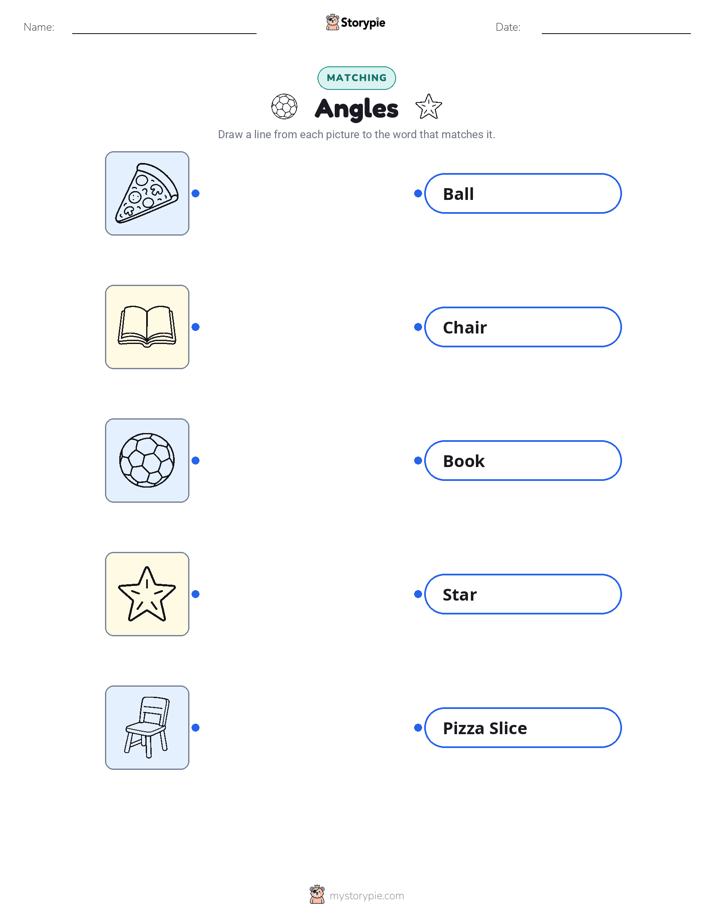
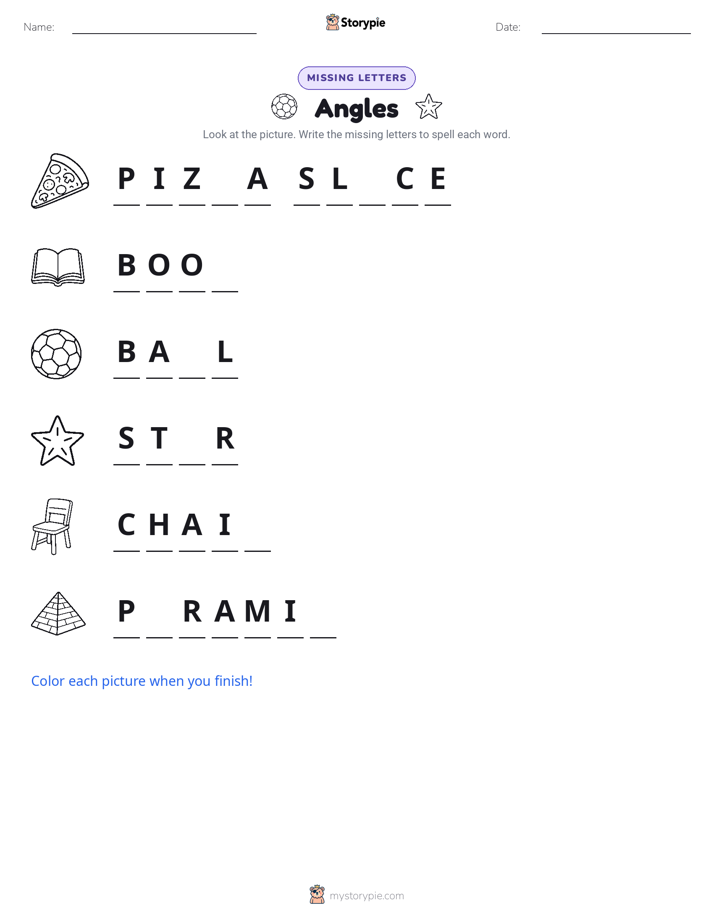
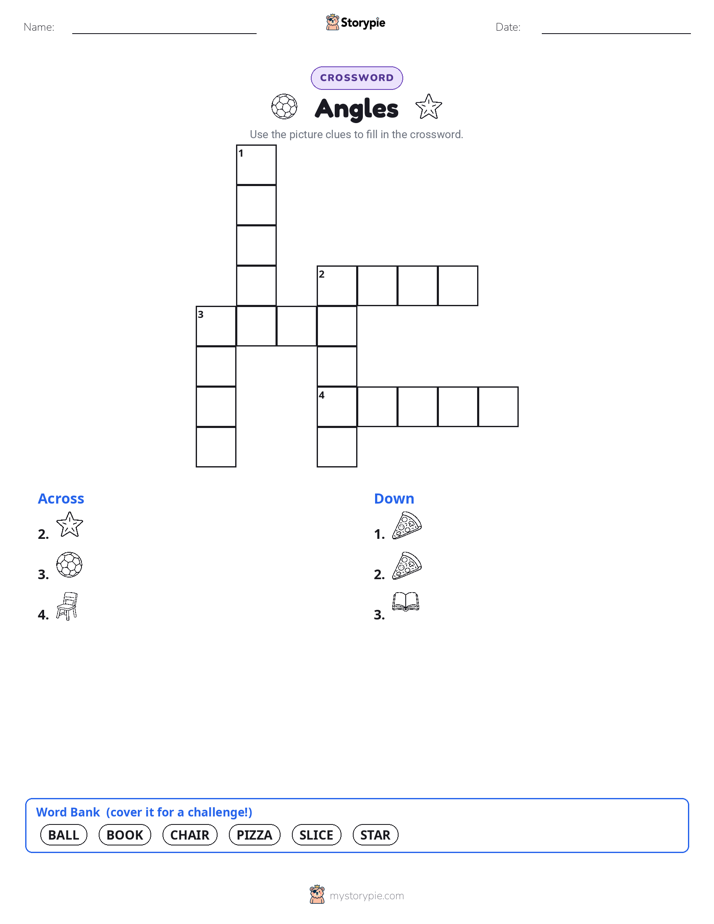
English


Angles
An angle is a geometric figure formed by two rays meeting at a common endpoint, called the vertex.
Reads at Grades 6–8 Listens at Grades 4–8
Print & create
Answer keys·No prep·Free with an account
28 worksheets · answer keys · full story · quiz · Ages 10-12 · CEFR B2
Plus adds 291,000+ more stories in 27 languages, audio for every one, and printables for all of them.
Just want Angles?

I am in the sharp corner of a book, the gentle curve of a smile, and the perfect slice of a pizza. Before you had a name for me, you saw me everywhere. I am what makes a house stand strong and what describes the path a ball takes when it is thrown. I exist wherever lines meet or cross, creating shapes and giving structure to the world you see. Think about the bend in your elbow, the way a door swings open on its hinges, or the precise cut of a diamond. I am there, quietly shaping everything, giving form to the formless and order to the chaotic. I am the relationship between two lines that begin at the same point. You might not always notice me, but without me, your world would be a wobbly, unpredictable place. I am in the slant of a roof that sheds rain and the V-shape of geese flying south for the winter. I have been a mystery, a tool, and a source of inspiration for thousands of years. I am the Angle.
My story really began to take shape in the minds of clever humans long ago. The ancient Egyptians were some of the first to truly master my use. To build their colossal monuments with breathtaking precision, like the Great Pyramid for Pharaoh Khufu in the 26th century BCE, they needed me. They used simple but effective tools to make sure their corners were perfect right angles, ensuring the massive stones fit together flawlessly. Far away, in ancient Babylonia, mathematicians were developing a number system based on 60, which is why even today, you measure me in a circle that has 360 degrees. But it was in ancient Greece that people truly began to wonder about my very nature. Was I a quality, like the color red. Was I a quantity you could measure. Or was I a relationship between lines. A brilliant mathematician named Euclid, who lived around 300 BCE, finally gave me a clear definition in his famous book, 'Elements,' describing me as the inclination to one another of two lines in a plane which meet one another and do not lie in a straight line. Even with his work, philosophers kept debating what I was. Centuries earlier, a wise man named Thales of Miletus, in the 6th century BCE, supposedly used me to perform a bit of magic. He measured the height of a great pyramid by simply measuring the length of its shadow at the exact moment his own shadow was the same length as his height, using me to create similar triangles. Around the same time, the followers of Pythagoras famously proved that the three of me inside any flat triangle must always add up to 180 degrees, a rule that students still learn today.
The Story of the Angle
I am in the sharp corner of a book, the gentle curve of a smile, and the perfect slice of a pizza. Before you had a name for me, you saw me everywhere. I am what makes a house stand strong and what describes the path a ball takes when it is thrown. I exist wherever lines meet or cross, creating shapes and giving structure to the world you see. Think about the bend in your elbow, the way a door swings open on its hinges, or the precise cut of a diamond. I am there, quietly shaping everything, giving form to the formless and order to the chaotic. I am the relationship between two lines that begin at the same point. You might not always notice me, but without me, your world would be a wobbly, unpredictable place. I am in the slant of a roof that sheds rain and the V-shape of geese flying south for the winter. I have been a mystery, a tool, and a source of inspiration for thousands of years. I am the Angle.
My story really began to take shape in the minds of clever humans long ago. The ancient Egyptians were some of the first to truly master my use. To build their colossal monuments with breathtaking precision, like the Great Pyramid for Pharaoh Khufu in the 26th century BCE, they needed me. They used simple but effective tools to make sure their corners were perfect right angles, ensuring the massive stones fit together flawlessly. Far away, in ancient Babylonia, mathematicians were developing a number system based on 60, which is why even today, you measure me in a circle that has 360 degrees. But it was in ancient Greece that people truly began to wonder about my very nature. Was I a quality, like the color red. Was I a quantity you could measure. Or was I a relationship between lines. A brilliant mathematician named Euclid, who lived around 300 BCE, finally gave me a clear definition in his famous book, 'Elements,' describing me as the inclination to one another of two lines in a plane which meet one another and do not lie in a straight line. Even with his work, philosophers kept debating what I was. Centuries earlier, a wise man named Thales of Miletus, in the 6th century BCE, supposedly used me to perform a bit of magic. He measured the height of a great pyramid by simply measuring the length of its shadow at the exact moment his own shadow was the same length as his height, using me to create similar triangles. Around the same time, the followers of Pythagoras famously proved that the three of me inside any flat triangle must always add up to 180 degrees, a rule that students still learn today.
As civilizations grew, I became a guide for the bold and a tool for the creative. During the Age of Exploration, from the 15th to the 17th centuries, the entire world seemed to open up, and I was the key. Sailors venturing into the vast, empty oceans had no roads or landmarks to follow. They had only the sun, the stars, and me. Using instruments like the mariner's astrolabe and the cross-staff, they would carefully measure my size between the horizon and the North Star or the sun at its highest point. This measurement gave them their latitude, telling them how far north or south of the equator they were. I was their invisible map, a constant and reliable guide that helped them navigate from one side of the world to the other and back again. Then, during the incredible artistic boom of the Renaissance, I took center stage. Artists wanted to make their paintings look as real as the world outside their windows. The architect Filippo Brunelleschi, in the early 15th century, was the first to figure out the mathematical rules for creating this illusion, which was called linear perspective. Another brilliant man, Leon Battista Alberti, wrote down these rules so that other artists could learn them. By using me to make lines appear to converge at a distant point, artists like the great Leonardo da Vinci could create a stunning illusion of depth on a flat canvas. Suddenly, painted rooms looked like you could walk right into them, and landscapes stretched for miles. I gave art a new dimension.
My journey didn't end in the Renaissance. Today, my life is more exciting and varied than ever. I am essential for the architects and engineers who design your schools, soaring skyscrapers, and massive bridges, ensuring every connection is strong and stable. I am at the heart of the computer programs that create the stunning 3D graphics in your favorite video games and animated movies, defining the shape and movement of every character and object. When a soccer player plans the perfect shot to score a goal or a basketball player aims for the hoop, they are using me, whether they realize it or not. I come in different forms, like different personalities. I can be small and sharp, which you call acute. I can be wide and open, which you call obtuse. I can be perfectly square, a right angle, which is the cornerstone of so much construction. Or I can be a straight line, flat and simple. I am so much more than a concept in a math book. I am a fundamental tool for understanding, building, and appreciating the world. By learning about me, you unlock a secret code that reveals the structure and beauty hidden in everything, from the tiniest crystal to the vastness of a swirling galaxy. I am a way of seeing.
Wow facts
About
An angle is a geometric figure formed by two rays meeting at a common endpoint, called the vertex. It is a fundamental concept in geometry, used to measure rotation and describe the shape of corners.
Take a Quiz
Question 1 of 5
What is the main idea of this story?
Explore next



Want to do even more?
Go beyond exploring. Unlock tools that turn every story into real learning.

Storypie Plus for families
Full stories, quizzes, and printables. Nights and car rides, sorted.
- Unlimited audio stories
- Create Mode: your child stars in the story
- Offline downloads
- Printable worksheets & coloring pages

Why Storypie for Schools
Students engaged. Prep in seconds. Evenings back to you.
- Worksheets & Quizzes
- Classroom Management
- Formative Assessment
- Custom Curriculum & Lesson Plans
- 27 Languages

Why Storypie for Homeschool
Curriculum done. They'll ask for more. Hours back in your day.
- Worksheet Generator
- First-Person Audio Stories
- Built-in Comprehension Quizzes
- Custom Curriculum & Lesson Plans
- Print & Go Activities