English

Animal Courtship and Nesting
Animal courtship and nesting are the sets of behaviors animals use to attract mates and build homes to raise…
Reads at Grades 6–8 Listens at Grades 4–8
Print & create
Answer keys·No prep·Free with an account
28 worksheets · answer keys · full story · quiz · Ages 10-12 · CEFR B2
Plus adds 244,000+ more stories in 27 languages, audio for every one, and printables for all of them.
Just want Animal Courtship and Nesting?
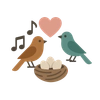
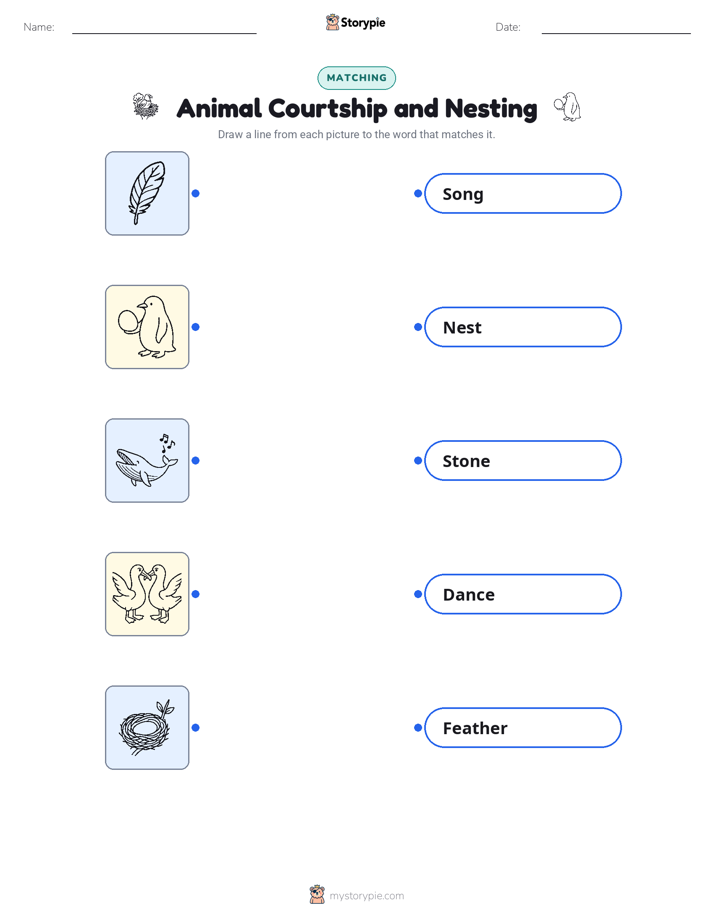
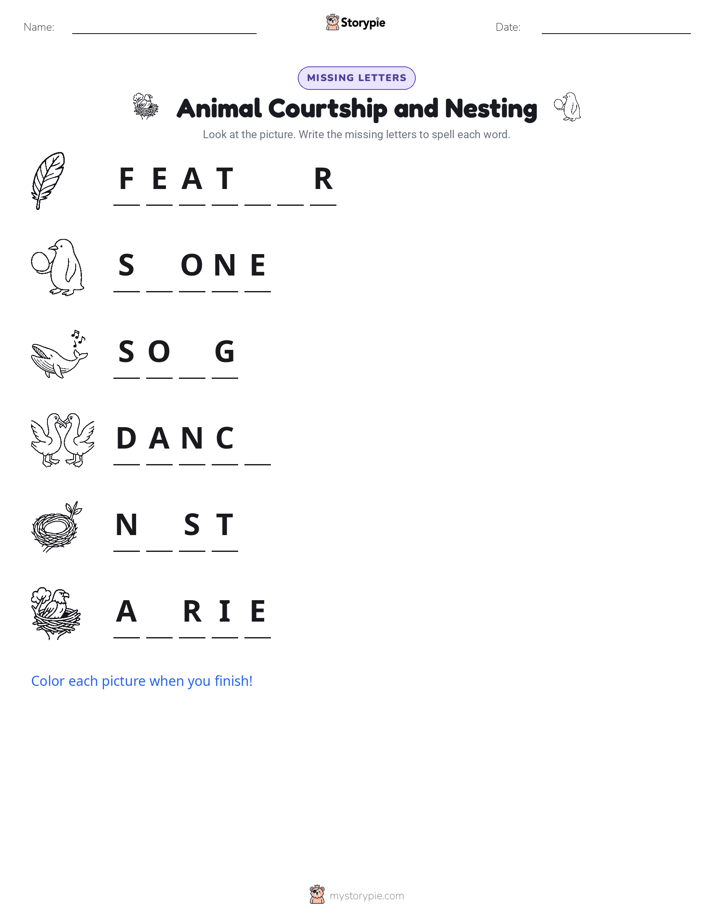
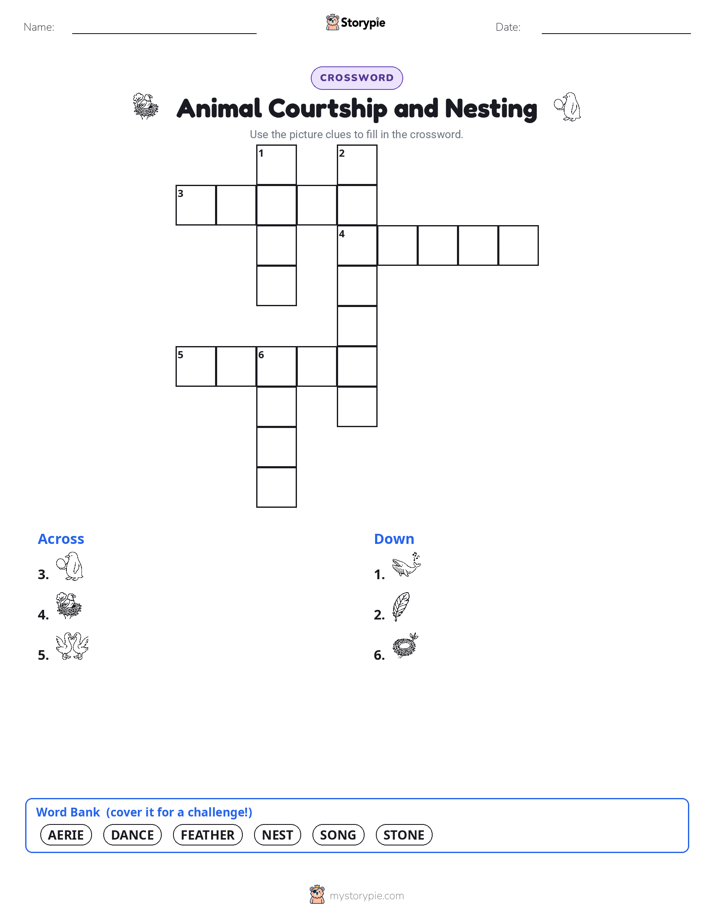
I begin as a secret signal. I am the brilliant blue feather a bowerbird seeks, the perfect stone a penguin presents to its partner. I am the deep, rumbling song a humpback whale sings across miles of ocean, and the perfectly synchronized dance of two albatrosses greeting each other. Before there were words written on a page or stories told around a fire, there was my rhythm, a powerful and ancient pulse beating in the heart of nearly every creature. I am also the instinct to build, to protect, to prepare a safe harbor for the future. You can see me in the delicate cup of a hummingbird's nest, woven with spider silk so it can stretch as the babies grow, or the mighty fortress of an eagle's aerie, built stick by stick high in a treetop, strong enough to hold the weight of a person. I am the drive to create a safe place for a new family. I am the ancient, unspoken promise of new life. I am Animal Courtship and Nesting.
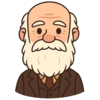
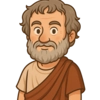
For thousands of years, humans have watched me, even before they knew my name or understood my rules. Early people, painting in the flickering torchlight of caves around 17,000 BCE, captured the life that surrounded them. They must have seen me in the powerful strut of a great stag and the graceful flight of a crane. Much later, a thoughtful and observant man in ancient Greece named Aristotle, around the 4th century BCE, did more than just watch. He wrote down his observations in a book called 'History of Animals.' He was one of the first to study me with scientific curiosity, describing how different birds built their nests with specific materials and how some fish guarded their eggs with fierce dedication. He was starting to piece together my puzzle. But the biggest leap in understanding me came much, much later. In 1871, a brilliant naturalist named Charles Darwin explained a powerful idea he called 'sexual selection.' He argued that my colorful displays and elaborate songs weren't just for show. He saw that the peacock with the most dazzling tail or the frog with the loudest croak was often the one chosen as a mate. These traits, he reasoned, were honest signals of strength and health, a promise of healthy offspring. Suddenly, my dances and decorations had a profound purpose. In the 20th century, scientists finally gave the study of animal behavior its own name: ethology. Researchers like Jane Goodall, beginning her work in the 1960s, lived among chimpanzees and showed the world their complex family lives, full of gestures, bonds, and conflicts that felt so familiar. Then, on October 11th, 1973, three scientists—Konrad Lorenz, Niko Tinbergen, and Karl von Frisch—won a Nobel Prize for their work in decoding my language, from how ducklings instinctively follow their mother to how bees perform a special 'waggle dance' to tell each other where to find the best flowers.
The World's Oldest Story
I begin as a secret signal. I am the brilliant blue feather a bowerbird seeks, the perfect stone a penguin presents to its partner. I am the deep, rumbling song a humpback whale sings across miles of ocean, and the perfectly synchronized dance of two albatrosses greeting each other. Before there were words written on a page or stories told around a fire, there was my rhythm, a powerful and ancient pulse beating in the heart of nearly every creature. I am also the instinct to build, to protect, to prepare a safe harbor for the future. You can see me in the delicate cup of a hummingbird's nest, woven with spider silk so it can stretch as the babies grow, or the mighty fortress of an eagle's aerie, built stick by stick high in a treetop, strong enough to hold the weight of a person. I am the drive to create a safe place for a new family. I am the ancient, unspoken promise of new life. I am Animal Courtship and Nesting.
For thousands of years, humans have watched me, even before they knew my name or understood my rules. Early people, painting in the flickering torchlight of caves around 17,000 BCE, captured the life that surrounded them. They must have seen me in the powerful strut of a great stag and the graceful flight of a crane. Much later, a thoughtful and observant man in ancient Greece named Aristotle, around the 4th century BCE, did more than just watch. He wrote down his observations in a book called 'History of Animals.' He was one of the first to study me with scientific curiosity, describing how different birds built their nests with specific materials and how some fish guarded their eggs with fierce dedication. He was starting to piece together my puzzle. But the biggest leap in understanding me came much, much later. In 1871, a brilliant naturalist named Charles Darwin explained a powerful idea he called 'sexual selection.' He argued that my colorful displays and elaborate songs weren't just for show. He saw that the peacock with the most dazzling tail or the frog with the loudest croak was often the one chosen as a mate. These traits, he reasoned, were honest signals of strength and health, a promise of healthy offspring. Suddenly, my dances and decorations had a profound purpose. In the 20th century, scientists finally gave the study of animal behavior its own name: ethology. Researchers like Jane Goodall, beginning her work in the 1960s, lived among chimpanzees and showed the world their complex family lives, full of gestures, bonds, and conflicts that felt so familiar. Then, on October 11th, 1973, three scientists—Konrad Lorenz, Niko Tinbergen, and Karl von Frisch—won a Nobel Prize for their work in decoding my language, from how ducklings instinctively follow their mother to how bees perform a special 'waggle dance' to tell each other where to find the best flowers.
Today, understanding me is more important than ever. My patterns are a roadmap for conservation. When scientists know that a sea turtle must return to the exact beach where she was born to lay her eggs, they know that we must protect that specific beach from harm. When they learn that certain birds need the mud from a particular riverbank or the branches of an old-growth tree for their nests, they can work to conserve those essential forests and wetlands. I show humans how to protect the homes and families of countless species, ensuring their survival for generations to come. But I am also a source of endless wonder and inspiration. I inspire artists with the iridescent colors of a hummingbird's throat, musicians with the complex symphony of a whale's song, and even engineers who study the incredible strength of a termite mound or a beaver's dam to design more resilient buildings. I am a reminder that every creature on this planet, from the smallest insect to the largest whale, shares the same fundamental drives: to connect, to create a home, and to care for the next generation. The next time you see two birds chasing each other through the sky or find a tiny, abandoned piece of a robin's blue egg on the ground, remember my story. It’s a story of life's incredible creativity, its resilience, and its beautiful, enduring promise to continue.
Wow facts
About
Animal courtship and nesting are the sets of behaviors animals use to attract mates and build homes to raise their young, driven by instincts for survival and reproduction.
Take a Quiz
Question 1 of 5
According to the story, what was Charles Darwin's main contribution to understanding this concept in 1871?
Explore next




Want to do even more?
Go beyond exploring. Unlock tools that turn every story into real learning.

Storypie Plus for families
Full stories, quizzes, and printables. Nights and car rides, sorted.
- Unlimited audio stories
- Create Mode: your child stars in the story
- Offline downloads
- Printable worksheets & coloring pages

Why Storypie for Schools
Students engaged. Prep in seconds. Evenings back to you.
- Worksheets & Quizzes
- Classroom Management
- Formative Assessment
- Custom Curriculum & Lesson Plans
- 27 Languages

Why Storypie for Homeschool
Curriculum done. They'll ask for more. Hours back in your day.
- Worksheet Generator
- First-Person Audio Stories
- Built-in Comprehension Quizzes
- Custom Curriculum & Lesson Plans
- Print & Go Activities