English

Arithmetic
Arithmetic is a fundamental branch of mathematics concerned with the study of numbers and the properties of…
Reads at Grades 6–8 Listens at Grades 4–8
Print & create
Answer keys·No prep·Free with an account
28 worksheets · answer keys · full story · quiz · Ages 10-12 · CEFR B2
Plus adds 244,000+ more stories in 27 languages, audio for every one, and printables for all of them.
Just want Arithmetic?
Have you ever wondered how each of your friends gets the exact same number of slices when you share a pizza? Or how you know precisely how many more weeks of saving your allowance it will take to buy that new video game? I am there, silently helping you figure it out. I am with you in the kitchen as you help your parents measure exactly two cups of flour for a birthday cake, making sure it comes out perfectly. When you sit down for a board game, I am the invisible scorekeeper, carefully tracking every point until a winner is declared. I bring order to the world, a sense of fairness to your games, and a plan for your goals. You have known me your whole life, relying on my logic and consistency every single day. I am the power of putting things together and taking them apart, of counting and sharing. I am Arithmetic.
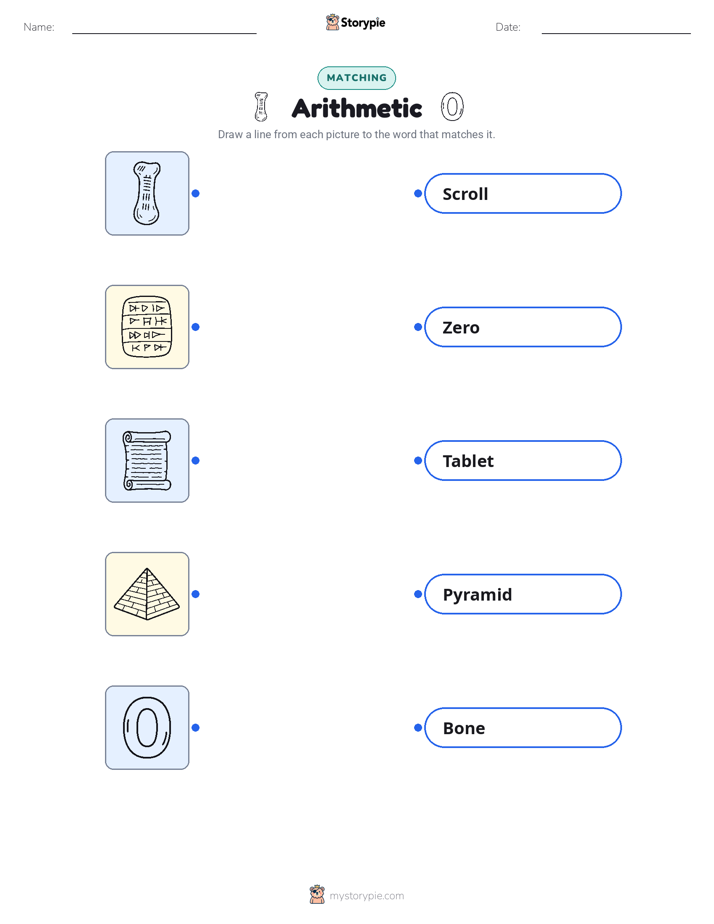
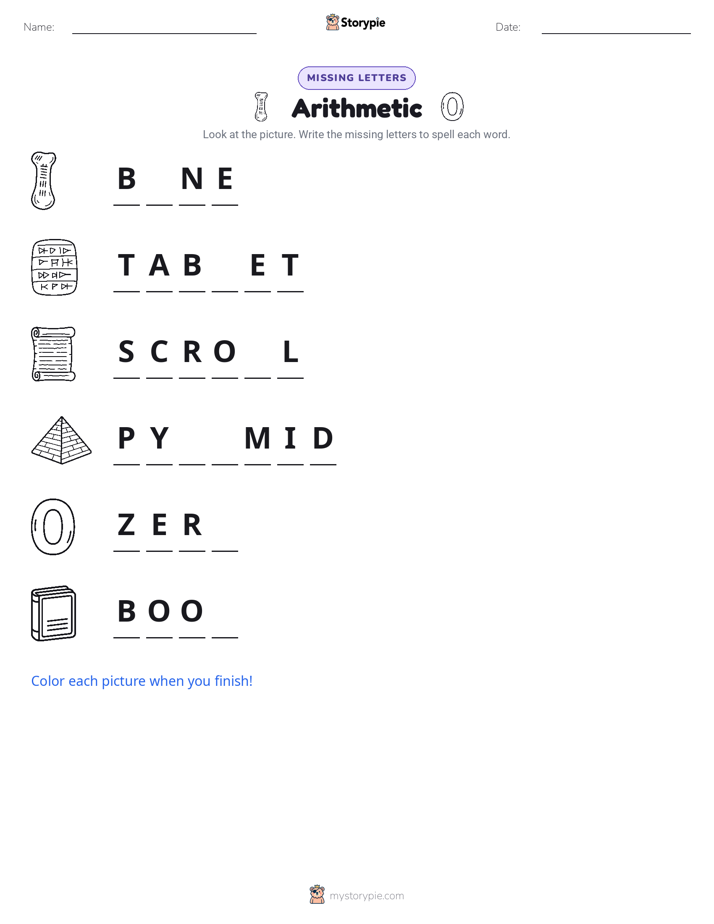
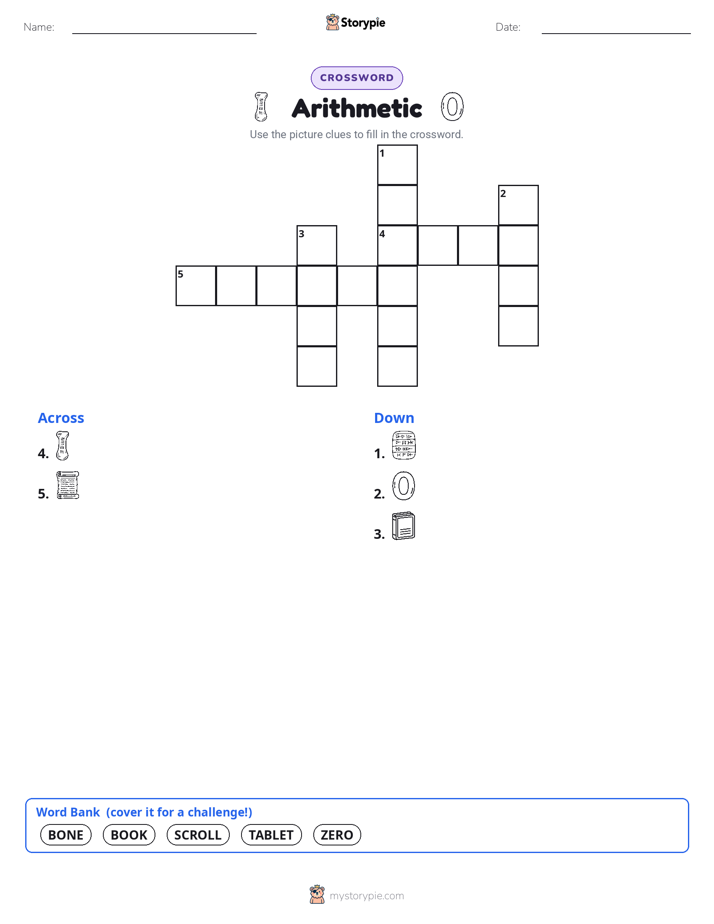
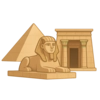
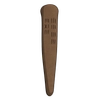
My story began long before I had a formal name, in the misty dawn of human history. I was there with your earliest ancestors, perhaps as far back as 20,000 BCE. You can see my first faint marks on ancient artifacts like the Ishango bone, found in Central Africa. Those simple, purposeful scratches were made by someone keeping track of something important—maybe the cycles of the moon or the number of animals in a herd. I was a tool for survival. Thousands of years later, around 3000 BCE, I traveled to the fertile lands of Mesopotamia. The clever Sumerians used me to manage their growing cities. They etched me onto soft clay tablets, creating some of the world's first multiplication tables to track grain harvests and trade goods. At nearly the same time, I was also hard at work in ancient Egypt, beginning around 2000 BCE. How do you think they built those magnificent pyramids? I was their guide. I helped engineers calculate the precise angles and count the millions of massive stone blocks needed for their construction. They wrote me down on delicate papyrus scrolls, like the famous Rhind Papyrus from around 1550 BCE, which is filled with practical problems they used me to solve.
The Story of Arithmetic: Your Invisible Helper
Have you ever wondered how each of your friends gets the exact same number of slices when you share a pizza? Or how you know precisely how many more weeks of saving your allowance it will take to buy that new video game? I am there, silently helping you figure it out. I am with you in the kitchen as you help your parents measure exactly two cups of flour for a birthday cake, making sure it comes out perfectly. When you sit down for a board game, I am the invisible scorekeeper, carefully tracking every point until a winner is declared. I bring order to the world, a sense of fairness to your games, and a plan for your goals. You have known me your whole life, relying on my logic and consistency every single day. I am the power of putting things together and taking them apart, of counting and sharing. I am Arithmetic.
My story began long before I had a formal name, in the misty dawn of human history. I was there with your earliest ancestors, perhaps as far back as 20,000 BCE. You can see my first faint marks on ancient artifacts like the Ishango bone, found in Central Africa. Those simple, purposeful scratches were made by someone keeping track of something important—maybe the cycles of the moon or the number of animals in a herd. I was a tool for survival. Thousands of years later, around 3000 BCE, I traveled to the fertile lands of Mesopotamia. The clever Sumerians used me to manage their growing cities. They etched me onto soft clay tablets, creating some of the world's first multiplication tables to track grain harvests and trade goods. At nearly the same time, I was also hard at work in ancient Egypt, beginning around 2000 BCE. How do you think they built those magnificent pyramids? I was their guide. I helped engineers calculate the precise angles and count the millions of massive stone blocks needed for their construction. They wrote me down on delicate papyrus scrolls, like the famous Rhind Papyrus from around 1550 BCE, which is filled with practical problems they used me to solve.
For most of my early life, I was powerful, but I had a weakness. People struggled to write down certain numbers. How would you write the number three hundred and seven? You might use a space, but it was confusing and led to mistakes. What people needed was a hero, a symbol for 'nothing' that could act as a placeholder. That hero finally arrived around the 5th century CE, thanks to brilliant mathematicians in India. They gave me one of my greatest gifts: the number zero. Suddenly, I was transformed. Zero made it simple to distinguish between 37, 307, and 370. Calculating became faster, more reliable, and more powerful than ever before. This incredible invention unlocked new possibilities. A remarkable Indian mathematician named Brahmagupta took things even further. In his book written in 628 CE, he laid out the first clear and complete rules for using me with zero. He even described how to work with negative numbers, an idea that was astonishingly advanced for its time. He treated me like a complete system, showing the world how positive, negative, and zero could all work together in perfect harmony.
With my new partner, zero, I was ready to see the world. My journey took me from India along bustling trade routes. I arrived in the magnificent city of Baghdad during the Islamic Golden Age, a time of incredible scientific and cultural discovery. It was there, around 820 CE, that a brilliant scholar named Al-Khwarizmi met me. He was so impressed with the Indian number system that he wrote a book explaining how to use me for addition, subtraction, multiplication, and division. His book was translated and read all over, spreading my knowledge far and wide. In fact, his name, Al-Khwarizmi, is where the modern word 'algorithm' comes from. From the Middle East, I traveled with merchants and scholars into Europe. For a long time, Europeans were still using clunky Roman numerals, which made tasks like bookkeeping and trade very difficult. Then, a man named Leonardo of Pisa, better known as Fibonacci, helped me make my grand entrance. In his famous book 'Liber Abaci,' published in 1202 CE, he showed merchants, bookkeepers, and mathematicians just how efficient and useful the Hindu-Arabic system was. He demonstrated how I could solve business problems with ease, and soon, Europe began to embrace my new form.
My long history is the foundation for the world you live in today. I am the quiet engine running inside so many other amazing ideas, like algebra, calculus, and computer science. Every time you tap on a smartphone, play a video game, or watch an animated movie, you are seeing me at work. I am in the code that runs your favorite apps and the calculations that send rockets into space. But I am not just for scientists and engineers. I help artists create breathtaking patterns and symmetry. I help musicians compose the rhythms and harmonies that make you want to dance. I even help doctors calculate the exact dose of medicine needed to make someone better. My story is a human story—one of curiosity, problem-solving, and sharing knowledge across cultures and centuries. I am more than just numbers on a page. I am a tool for understanding the universe, a language that connects people, and a partner in building a better future. And my story continues with you, every time you ask a question and use me to find the answer.
Wow facts
About
Arithmetic is a fundamental branch of mathematics concerned with the study of numbers and the properties of the traditional operations on them: addition, subtraction, multiplication, and division.
Take a Quiz
Question 1 of 5
What major problem in mathematics did the invention of the number zero solve?
Explore next




Want to do even more?
Go beyond exploring. Unlock tools that turn every story into real learning.

Storypie Plus for families
Full stories, quizzes, and printables. Nights and car rides, sorted.
- Unlimited audio stories
- Create Mode: your child stars in the story
- Offline downloads
- Printable worksheets & coloring pages

Why Storypie for Schools
Students engaged. Prep in seconds. Evenings back to you.
- Worksheets & Quizzes
- Classroom Management
- Formative Assessment
- Custom Curriculum & Lesson Plans
- 27 Languages

Why Storypie for Homeschool
Curriculum done. They'll ask for more. Hours back in your day.
- Worksheet Generator
- First-Person Audio Stories
- Built-in Comprehension Quizzes
- Custom Curriculum & Lesson Plans
- Print & Go Activities