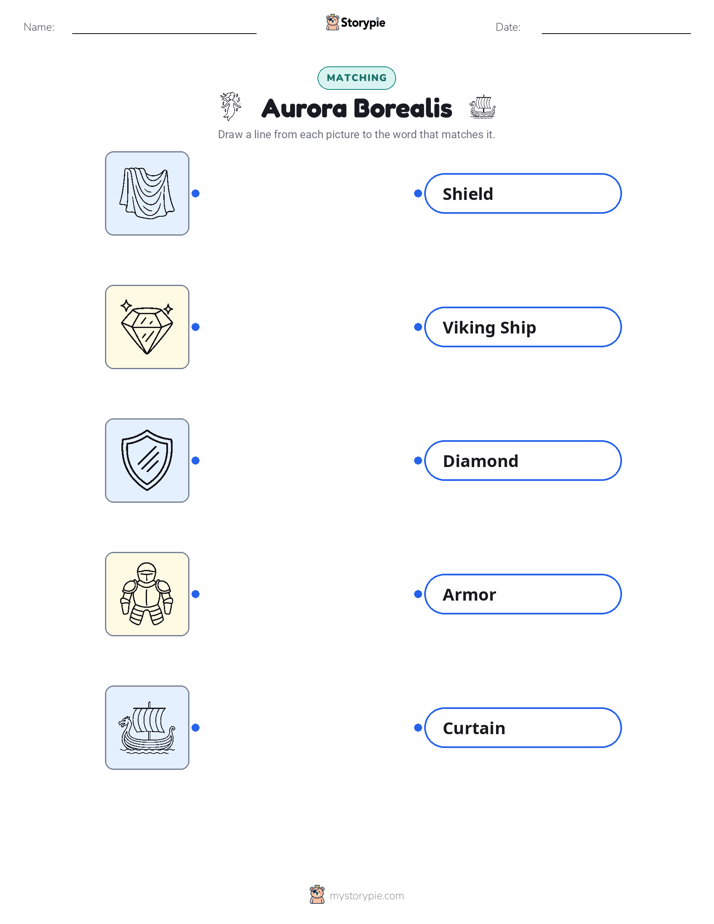
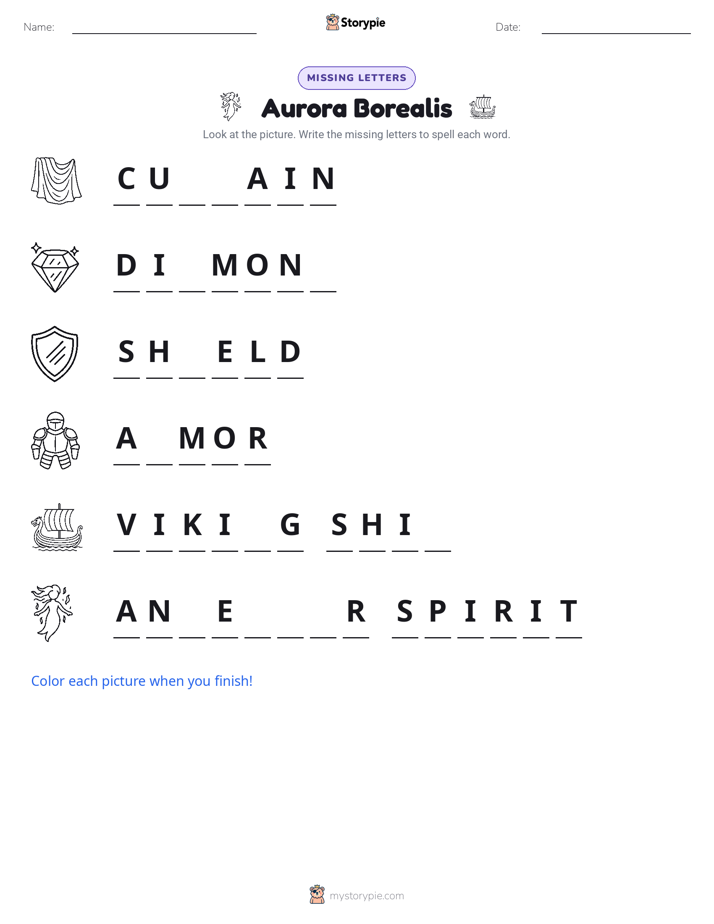
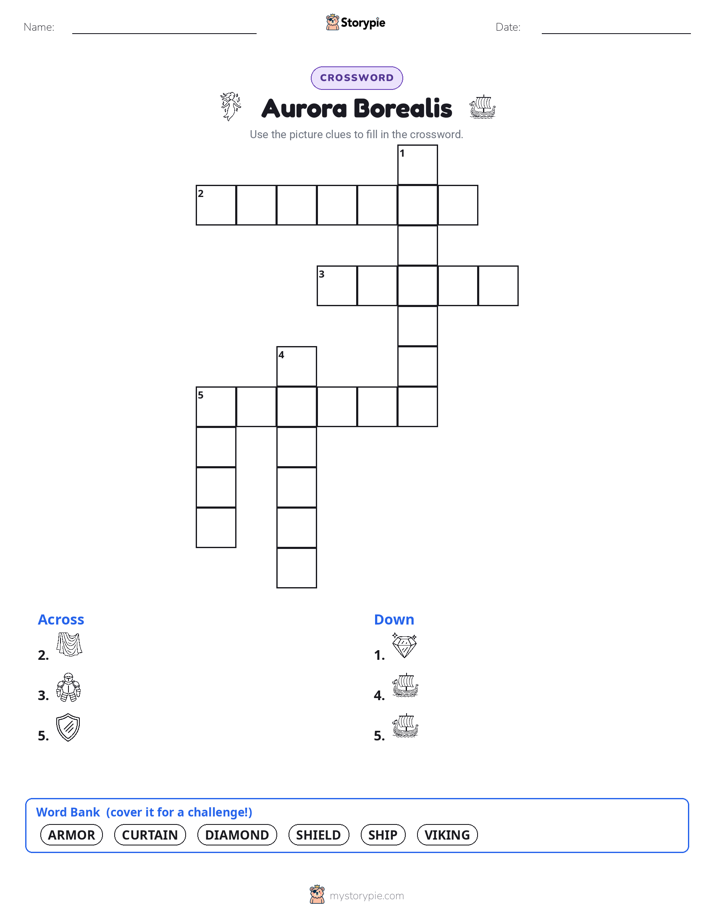
English


Aurora Borealis
The Aurora Borealis, or Northern Lights, is a natural light display in Earth's sky…
Reads at Grades 6–8 Listens at Grades 4–8
Print & create
Answer keys·No prep·Free with an account
28 worksheets · answer keys · full story · quiz · Ages 10-12 · CEFR B2
Plus adds 208,000+ more stories in 27 languages, audio for every one, and printables for all of them.
Just want Aurora Borealis?
Imagine the coldest, clearest night at the very top of the world. The stars are like tiny diamonds scattered on black velvet, and the air is so still you can almost hear the silence. Then, without a sound, a ribbon of pale green light begins to glow on the horizon. It grows and sways, like a giant silk curtain stirred by an invisible hand. Sometimes I blush with soft pinks at my edges, or shimmer with deep purples. I am a ghost in the sky, a silent dance of light that for thousands of years, no one could explain. I only appear in the planet’s most remote polar regions, a secret shared between the sky and those patient enough to watch. I am not magic, though I look like it. I am a message from the Sun, painted on the air itself. For centuries, humans looked up at me and asked: What are you?.
For a long, long time, your stories were the only answer you had. I am the Aurora Borealis, and that is just one of my many names. To the Norse Vikings, my flickering lights were the reflections from the shields and armor of the Valkyries, warrior maidens carrying fallen soldiers to their final resting place. The Cree people of North America saw me as the ‘Dance of the Spirits,’ the joyful souls of their ancestors dancing in the sky. Not all stories were so kind. In medieval Europe, my sudden appearance, especially if I glowed a deep red, was often seen as a frightening omen, a warning of war or disaster. The first person to try and look at me with the eyes of science was a Greek philosopher named Aristotle, way back around 340 BCE. He didn't have telescopes or satellites, only his own sharp mind. He called me ‘chasmata,’ or ‘chasms,’ and guessed that I was a kind of glowing gas escaping from cracks in the Earth. It wasn't the right answer, but it was a magnificent start—the first step from myth to measurement.
The Sun's Secret Whisper
Imagine the coldest, clearest night at the very top of the world. The stars are like tiny diamonds scattered on black velvet, and the air is so still you can almost hear the silence. Then, without a sound, a ribbon of pale green light begins to glow on the horizon. It grows and sways, like a giant silk curtain stirred by an invisible hand. Sometimes I blush with soft pinks at my edges, or shimmer with deep purples. I am a ghost in the sky, a silent dance of light that for thousands of years, no one could explain. I only appear in the planet’s most remote polar regions, a secret shared between the sky and those patient enough to watch. I am not magic, though I look like it. I am a message from the Sun, painted on the air itself. For centuries, humans looked up at me and asked: What are you?.
For a long, long time, your stories were the only answer you had. I am the Aurora Borealis, and that is just one of my many names. To the Norse Vikings, my flickering lights were the reflections from the shields and armor of the Valkyries, warrior maidens carrying fallen soldiers to their final resting place. The Cree people of North America saw me as the ‘Dance of the Spirits,’ the joyful souls of their ancestors dancing in the sky. Not all stories were so kind. In medieval Europe, my sudden appearance, especially if I glowed a deep red, was often seen as a frightening omen, a warning of war or disaster. The first person to try and look at me with the eyes of science was a Greek philosopher named Aristotle, way back around 340 BCE. He didn't have telescopes or satellites, only his own sharp mind. He called me ‘chasmata,’ or ‘chasms,’ and guessed that I was a kind of glowing gas escaping from cracks in the Earth. It wasn't the right answer, but it was a magnificent start—the first step from myth to measurement.
Centuries passed, and the age of superstition began to give way to an age of curiosity. The name you know me by today was officially given to me on September 2nd, 1621, by a French scientist and philosopher named Pierre Gassendi. He watched me glow above the skies of France and named me Aurora Borealis, which in Latin means ‘Dawn of the North.’ It’s a beautiful, poetic name, and it stuck. But a name is not an explanation. The next giant leap came over a century later. In 1716, the famous English astronomer Edmond Halley, the same man who has a comet named after him, noticed something brilliant. He observed that my flowing shapes and curtains of light seemed to line up perfectly with the direction a compass needle points. He proposed that I was somehow connected to Earth’s magnetic field, an invisible force that surrounds your entire planet. This was the first major clue that unlocked my secret. I wasn’t some random atmospheric event; I was part of a huge, planetary system, guided by forces no one could see.
But the biggest piece of the puzzle came from the Sun. For my true identity to be revealed, you needed the work of a determined Norwegian scientist named Kristian Birkeland. Around the year 1908, he wasn't content to just watch me from the ground. He wanted to recreate me. In his laboratory, he built a small, magnetized sphere inside a vacuum chamber to represent the Earth. He called it his 'Terrella,' which means 'little Earth.' Then, he fired a stream of electrons at it and watched in amazement as a beautiful glow appeared in rings around his model’s poles, just like me. He had proven it: I am born from the Sun. I am what happens when a constant stream of tiny, energetic particles, called the solar wind, makes the incredible 93-million-mile journey to your planet. Most of these particles are deflected by Earth’s magnetic shield, but some are captured and funneled down toward the North and South Poles. There, high in the atmosphere, they crash into atoms of gas, and that collision is what makes the air glow. The colors you see depend on which gas is hit. When the solar particles strike oxygen, I glow in my most common color, green, or sometimes a beautiful red. When they hit nitrogen, I flash with hints of blue and purple. I am the result of a cosmic collision, a solar storm made visible.
Today, you understand me better than ever before. You know I am more than just a beautiful light show; I am a visible sign of the powerful, invisible connection between your star and your home. Scientists study me with powerful rockets and satellites to understand what they call ‘space weather.’ The same solar energy that creates my light can sometimes interfere with your GPS signals, power grids, and communication satellites. So, by watching my dance, you learn how to protect your technology. But I hope you see me as more than that. I am a reminder that even the emptiest-looking night sky is bursting with energy and wonder. I am proof that your planet is part of a dynamic, interconnected universe. So keep looking up. Stay curious. There are always more secrets for you to discover, whispered on the solar wind.
Wow facts
About
The Aurora Borealis, or Northern Lights, is a natural light display in Earth's sky, predominantly seen in high-latitude regions. It is caused by energetic particles from the sun colliding with atoms in the upper atmosphere.
Take a Quiz
Question 1 of 5
Summarize the main steps that led scientists from seeing the aurora as a mystery to understanding it as a scientific phenomenon.
Explore next


Want to do even more?
Go beyond exploring. Unlock tools that turn every story into real learning.

Storypie Plus for families
Full stories, quizzes, and printables. Nights and car rides, sorted.
- Unlimited audio stories
- Create Mode: your child stars in the story
- Offline downloads
- Printable worksheets & coloring pages

Why Storypie for Schools
Students engaged. Prep in seconds. Evenings back to you.
- Worksheets & Quizzes
- Classroom Management
- Formative Assessment
- Custom Curriculum & Lesson Plans
- 27 Languages

Why Storypie for Homeschool
Curriculum done. They'll ask for more. Hours back in your day.
- Worksheet Generator
- First-Person Audio Stories
- Built-in Comprehension Quizzes
- Custom Curriculum & Lesson Plans
- Print & Go Activities