English

Being Bilingual (Bilingualism)
Bilingualism is the ability to speak and understand two languages fluently…
Reads at Grades 6–8 Listens at Grades 4–8
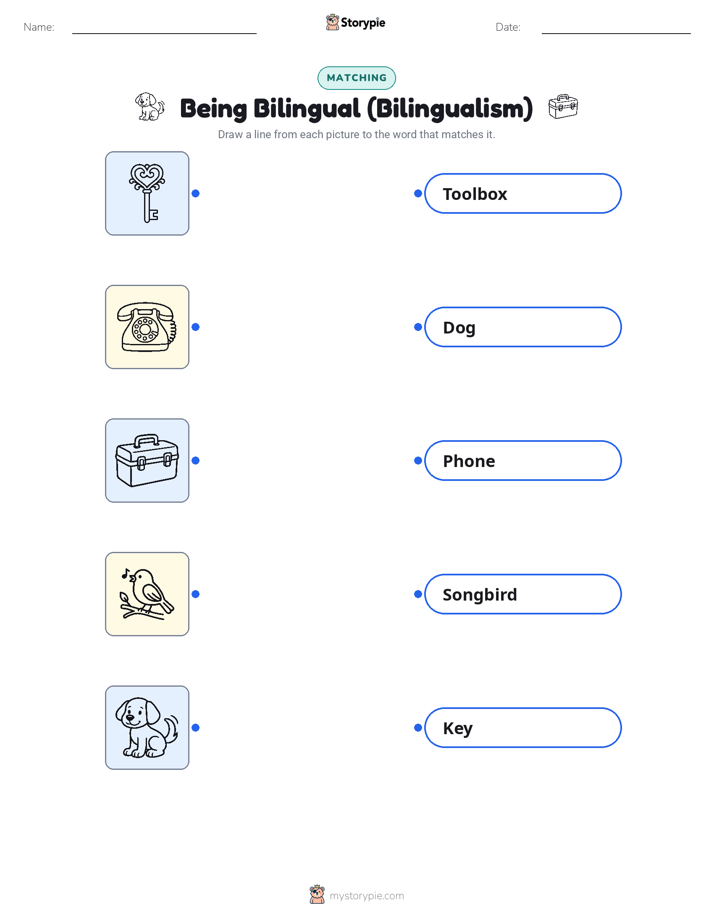
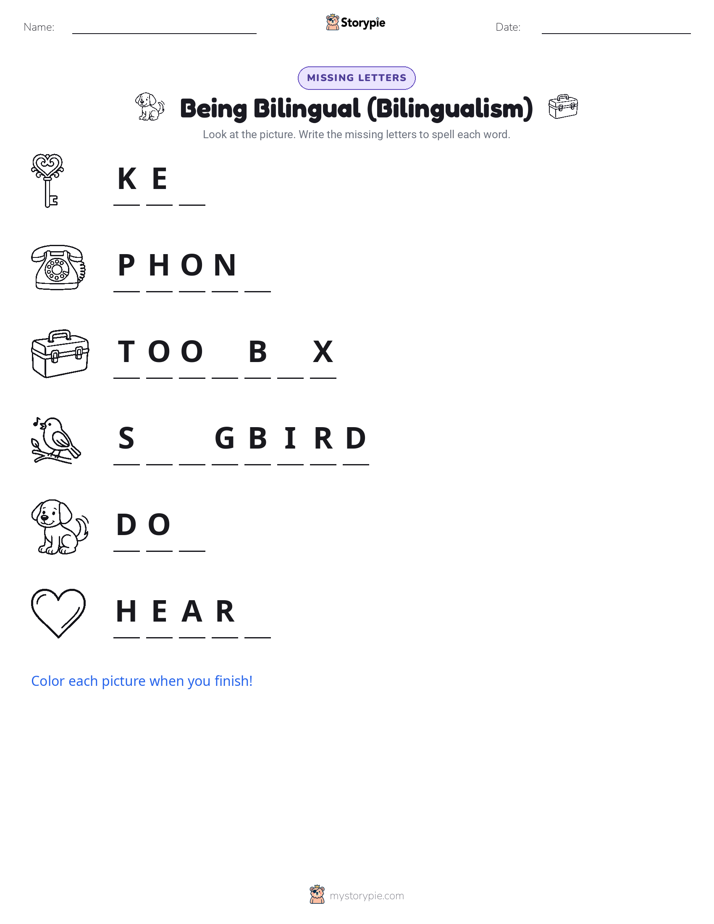
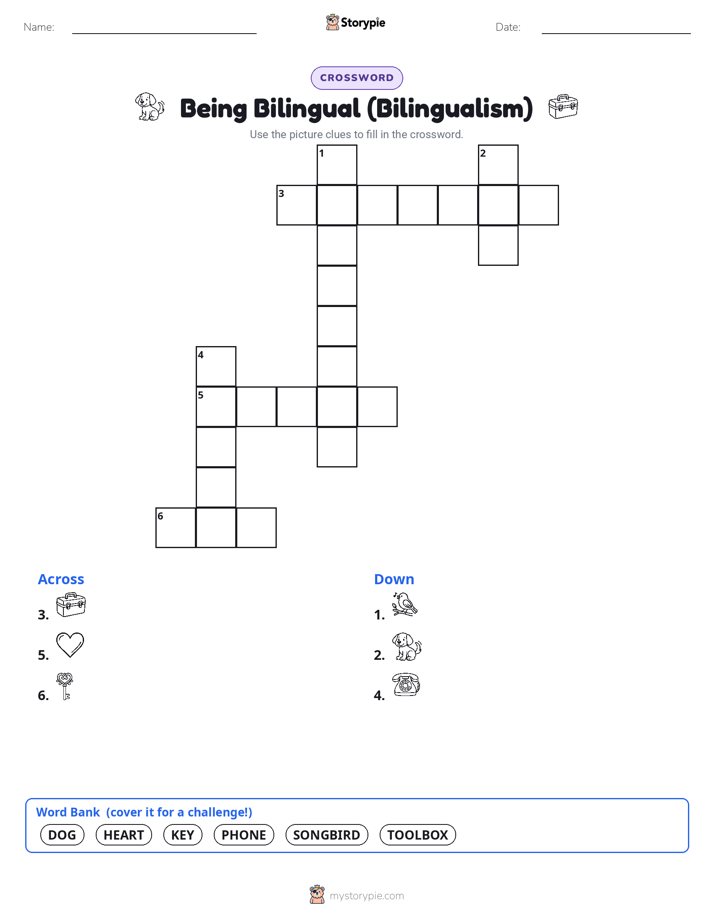
Print & create
Answer keys·No prep·Free with an account
28 worksheets · answer keys · full story · quiz · Ages 10-12 · CEFR B2
Plus adds 244,000+ more stories in 27 languages, audio for every one, and printables for all of them.
Just want Being Bilingual (Bilingualism)?
Imagine having a secret key that unlocks a second, hidden world. One moment you're talking to your friends at school, and the next, you're on the phone with your abuela, and a whole different set of words tumbles out of your mouth. It feels like having two toolboxes for your thoughts, or two different songs you can sing. I let you see one dog and call it 'dog' and 'perro.' I let you feel love and say 'I love you' and 'te amo.' For some people, I'm a bridge to their family's past. For others, I'm an adventure, a new way to explore books, movies, and friendships. I’m not a thing you can hold, but a skill you grow inside your mind, a special kind of knowing. People call me Bilingualism.
I’m not a new idea. In fact, I’m almost as old as human cities and stories. For thousands of years, living with me was completely normal. Think of ancient Mesopotamia, way back around 2000 BCE. The people who wrote on clay tablets, the scribes, often had to know two languages: Sumerian and Akkadian. It was just part of the job. Later, in the giant Roman Empire, many educated people spoke both Latin for government and law, and Greek for art and philosophy. Along the famous Silk Road, merchants who traveled from China to Europe had to know several languages to trade their goods. For most of history, nobody thought I was strange; I was just useful. I was the natural result of different people meeting, sharing ideas, and building new worlds together.
But then, something shifted. In the 19th and early 20th centuries, many new countries were formed, and leaders wanted everyone to feel united. They often decided that meant everyone should speak one single, official language. Suddenly, I was seen as a problem. Some people worried I would divide people's loyalties. A few scientists, with good intentions but flawed methods, did studies that made it seem like I confused children. They claimed that having two languages in one brain was like trying to fit two books onto a shelf built for one. For a while, many people believed them, and some families even stopped passing down their heritage language, thinking they were helping their children succeed. It was a lonely time for me, because I knew I wasn't a problem, but a power.
The Story of Bilingualism
Imagine having a secret key that unlocks a second, hidden world. One moment you're talking to your friends at school, and the next, you're on the phone with your abuela, and a whole different set of words tumbles out of your mouth. It feels like having two toolboxes for your thoughts, or two different songs you can sing. I let you see one dog and call it 'dog' and 'perro.' I let you feel love and say 'I love you' and 'te amo.' For some people, I'm a bridge to their family's past. For others, I'm an adventure, a new way to explore books, movies, and friendships. I’m not a thing you can hold, but a skill you grow inside your mind, a special kind of knowing. People call me Bilingualism.
I’m not a new idea. In fact, I’m almost as old as human cities and stories. For thousands of years, living with me was completely normal. Think of ancient Mesopotamia, way back around 2000 BCE. The people who wrote on clay tablets, the scribes, often had to know two languages: Sumerian and Akkadian. It was just part of the job. Later, in the giant Roman Empire, many educated people spoke both Latin for government and law, and Greek for art and philosophy. Along the famous Silk Road, merchants who traveled from China to Europe had to know several languages to trade their goods. For most of history, nobody thought I was strange; I was just useful. I was the natural result of different people meeting, sharing ideas, and building new worlds together.
But then, something shifted. In the 19th and early 20th centuries, many new countries were formed, and leaders wanted everyone to feel united. They often decided that meant everyone should speak one single, official language. Suddenly, I was seen as a problem. Some people worried I would divide people's loyalties. A few scientists, with good intentions but flawed methods, did studies that made it seem like I confused children. They claimed that having two languages in one brain was like trying to fit two books onto a shelf built for one. For a while, many people believed them, and some families even stopped passing down their heritage language, thinking they were helping their children succeed. It was a lonely time for me, because I knew I wasn't a problem, but a power.
Everything changed in a very important year, 1962. In Montreal, Canada, two brilliant researchers named Elizabeth Peal and Wallace Lambert decided to take a closer look at me. They compared kids who spoke only French with kids who spoke both French and English. Everyone expected the monolingual kids to do better on tests. But the results shocked them. The bilingual kids were not confused at all. In fact, they were better at solving certain kinds of puzzles and showed more mental flexibility. Their study opened the floodgates. Scientists all over the world started studying me and found that being bilingual is like a workout for your brain. It strengthens the parts that control attention, problem-solving, and switching between tasks. It can even help keep the brain healthy as it gets older. I was finally understood not as a weakness, but as a cognitive superpower.
Today, I am celebrated. I am the bridge that connects you to family members across the globe. I am the key that unlocks new cultures, new music, and new friends. I help you understand that there's more than one way to see the world, more than one word for the things you love. Having me in your life doesn't just make your brain stronger; it makes your heart bigger. I am a reminder that our differences can be our greatest strengths, connecting us in beautiful and surprising ways. So whether you are learning a second language or already speak one, know that you are part of a very old, very special human story—a story of connection, creativity, and understanding.
Wow facts
About
Bilingualism is the ability to speak and understand two languages fluently, a common human experience throughout history that offers cognitive and cultural benefits.
Take a Quiz
Question 1 of 5
What was the main 'problem' or misunderstanding about bilingualism in the 19th and 20th centuries, and how was it resolved?
Explore next






Want to do even more?
Go beyond exploring. Unlock tools that turn every story into real learning.

Storypie Plus for families
Full stories, quizzes, and printables. Nights and car rides, sorted.
- Unlimited audio stories
- Create Mode: your child stars in the story
- Offline downloads
- Printable worksheets & coloring pages

Why Storypie for Schools
Students engaged. Prep in seconds. Evenings back to you.
- Worksheets & Quizzes
- Classroom Management
- Formative Assessment
- Custom Curriculum & Lesson Plans
- 27 Languages

Why Storypie for Homeschool
Curriculum done. They'll ask for more. Hours back in your day.
- Worksheet Generator
- First-Person Audio Stories
- Built-in Comprehension Quizzes
- Custom Curriculum & Lesson Plans
- Print & Go Activities