English

Big and Small: Comparing Size
The fundamental concept of comparing size, scale, and magnitude…
Reads at Grades 6–8 Listens at Grades 4–8
Print & create
Answer keys·No prep·Free with an account
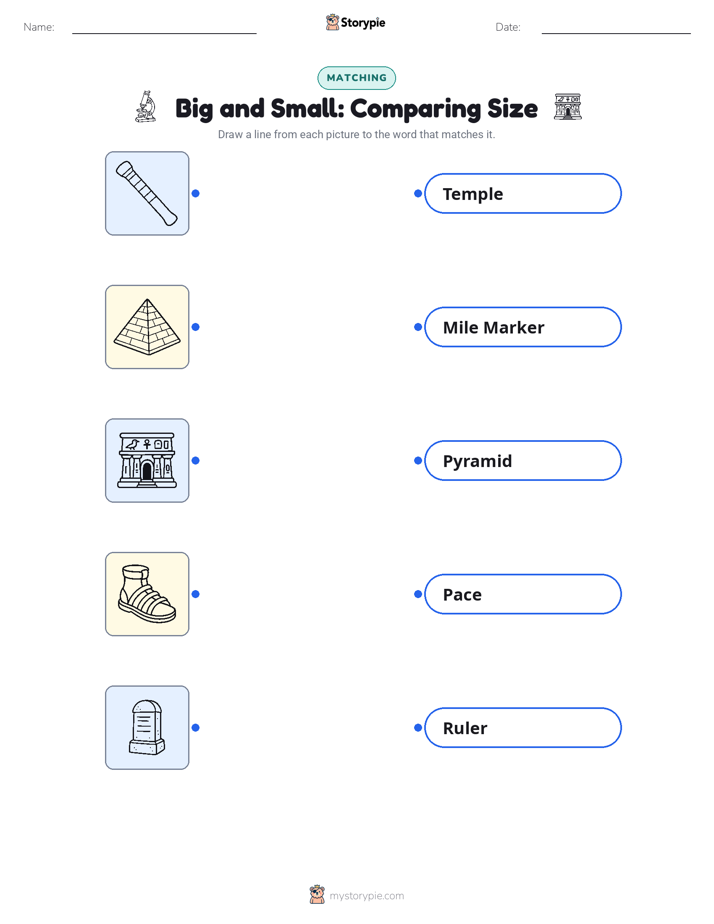
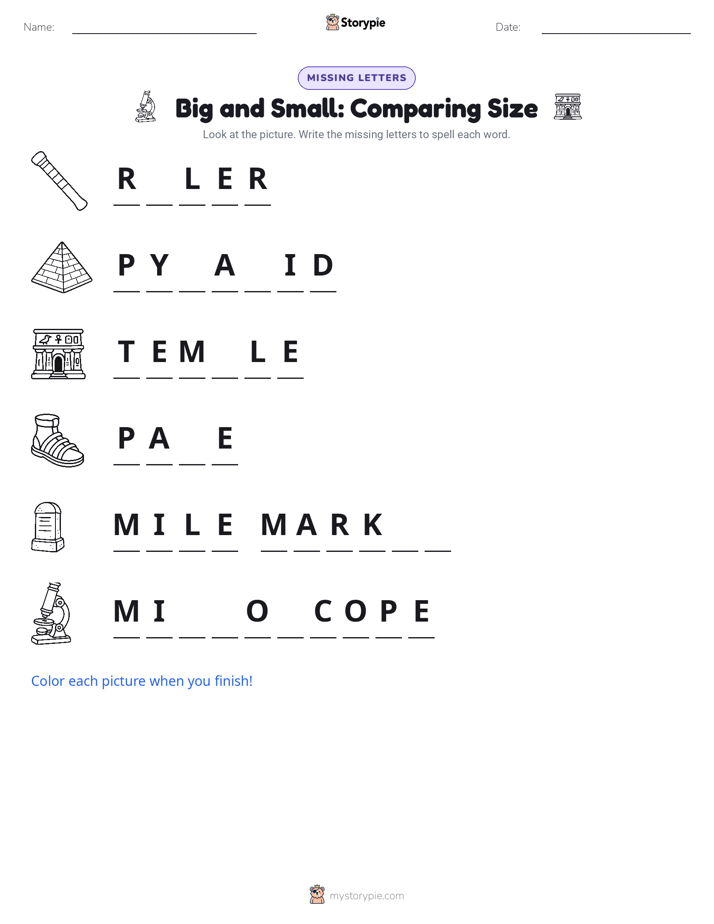
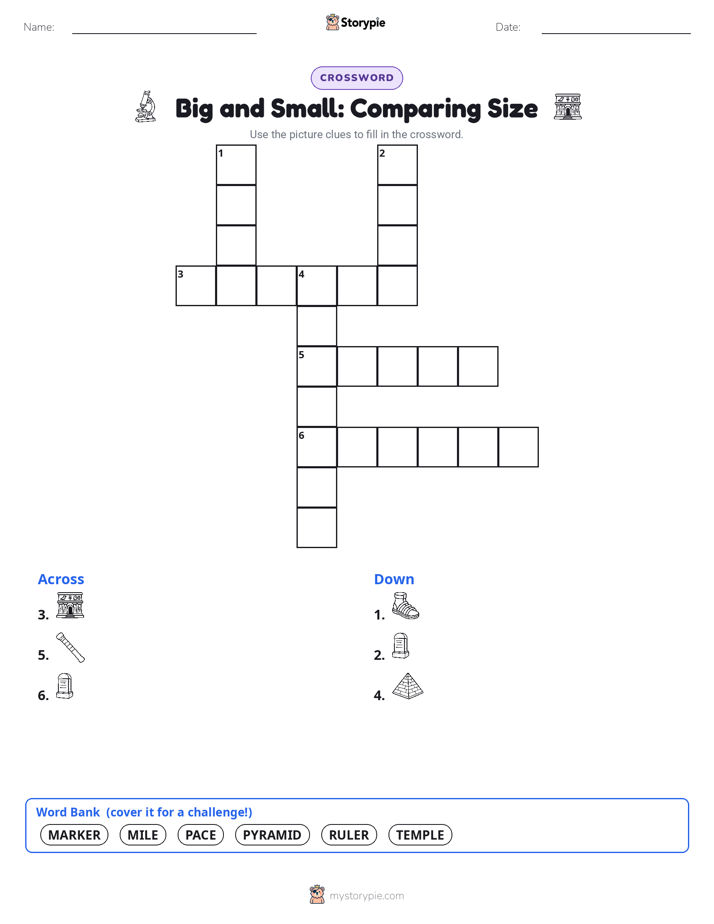
28 worksheets · answer keys · full story · quiz · Ages 10-12 · CEFR B2
Plus adds 244,000+ more stories in 27 languages, audio for every one, and printables for all of them.
Just want Big and Small: Comparing Size?

I am the reason you can tell a skyscraper from a dollhouse, a whale from a goldfish, or an ant from an elephant. I live in the questions you ask every day: How tall is that tree. How far away is the moon. For all of human history, I have been a silent guide, helping you make sense of your place in the universe, from the tiniest grain of sand to the biggest, brightest star. I am the invisible tool that helps you compare, build, and understand everything around you. Before you had a name for me, you felt my presence in the need to know how much, how big, and how far. I am the concept of Size, the grand idea of Measurement.
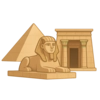
For a long, long time, humans needed a way to use me, but they didn't have rulers or tape measures. So, they used what they always had with them: their bodies. Around 3000 BCE, in the warm lands of ancient Egypt, people came up with one of the first standard units. They called it the 'royal cubit,' and it was based on the length of the pharaoh's forearm, from his elbow to the tip of his middle finger. This single idea allowed them to build their amazing pyramids and temples with incredible precision. Thousands of miles away, the ancient Romans also created systems to organize their vast empire. They measured long distances in 'paces,' the length of a single step. They established the 'mile' as one thousand paces, or 'mille passus' in their language. But there was a persistent problem. Not every pharaoh's arm was the same length, and not every soldier's pace was identical. This could cause a lot of confusion, especially when people from different places tried to trade goods or build things together.
The Measure of All Things
I am the reason you can tell a skyscraper from a dollhouse, a whale from a goldfish, or an ant from an elephant. I live in the questions you ask every day: How tall is that tree. How far away is the moon. For all of human history, I have been a silent guide, helping you make sense of your place in the universe, from the tiniest grain of sand to the biggest, brightest star. I am the invisible tool that helps you compare, build, and understand everything around you. Before you had a name for me, you felt my presence in the need to know how much, how big, and how far. I am the concept of Size, the grand idea of Measurement.
For a long, long time, humans needed a way to use me, but they didn't have rulers or tape measures. So, they used what they always had with them: their bodies. Around 3000 BCE, in the warm lands of ancient Egypt, people came up with one of the first standard units. They called it the 'royal cubit,' and it was based on the length of the pharaoh's forearm, from his elbow to the tip of his middle finger. This single idea allowed them to build their amazing pyramids and temples with incredible precision. Thousands of miles away, the ancient Romans also created systems to organize their vast empire. They measured long distances in 'paces,' the length of a single step. They established the 'mile' as one thousand paces, or 'mille passus' in their language. But there was a persistent problem. Not every pharaoh's arm was the same length, and not every soldier's pace was identical. This could cause a lot of confusion, especially when people from different places tried to trade goods or build things together.
As the world grew more connected through exploration and trade, people knew they needed a better, more consistent way to use me. A group of brilliant scientists in France during the 1790s, in a time of great change called the French Revolution, had a revolutionary idea. What if there was a system of measurement that everyone on Earth could use, one that was based not on a king's arm, but on nature itself. They created the metric system. The basic unit of length, the meter, was originally defined as one ten-millionth of the distance from the North Pole to the equator, passing right through Paris. Best of all, everything was based on the number ten, which made calculations for scientists, builders, and merchants super easy. This logical and elegant idea of a universal system began to spread, and on May 20th, 1875, seventeen nations signed the Treaty of the Metre. This historic agreement created the International Bureau of Weights and Measures to keep the standards consistent for the whole world.
My story doesn't stop with rulers and meters. Human curiosity is boundless, and you wanted to see things that were too small or too far away for your eyes alone. Around 1590, the invention of the microscope in the Netherlands opened up a whole new world. Suddenly, people could peer into a drop of pond water and see tiny living creatures. They could study the delicate, complex structures of a fly's wing. I was there, helping them measure these new worlds in tiny units. Then, just a few years later, around 1608, the telescope did the opposite. It brought the vastness of space closer than ever before. Humans could chart the craters on the Moon and track the paths of distant planets. My role expanded dramatically. Today, I help scientists measure the size of atoms in nanometers, which are a billionth of a meter, and the distance to faraway galaxies in light-years, the distance light travels in a whole year. I've grown from the length of an arm to the scale of the cosmos.
From the moment you build with blocks as a child to the day you might design a rocket to travel to Mars, I am always with you. I help engineers design sturdy bridges, doctors understand the size of cells, and artists create the illusion of depth in their paintings. I give you a powerful language to describe your world and share your incredible discoveries with others. Understanding me—understanding size and scale—isn't just about math class. It's about curiosity and developing a sense of wonder. I help you appreciate how a tiny seed can grow into a giant tree and how you are part of a universe so big it's hard to imagine. So keep measuring, keep comparing, and keep asking questions about the world. I'll always be here to help you find the answers.
Wow facts
About
The fundamental concept of comparing size, scale, and magnitude, which forms the basis of measurement and helps us understand the world from the microscopic to the cosmic.
Take a Quiz
Question 1 of 5
What was the main problem with using body parts like the 'royal cubit' for measurement?
Explore next


Want to do even more?
Go beyond exploring. Unlock tools that turn every story into real learning.

Storypie Plus for families
Full stories, quizzes, and printables. Nights and car rides, sorted.
- Unlimited audio stories
- Create Mode: your child stars in the story
- Offline downloads
- Printable worksheets & coloring pages

Why Storypie for Schools
Students engaged. Prep in seconds. Evenings back to you.
- Worksheets & Quizzes
- Classroom Management
- Formative Assessment
- Custom Curriculum & Lesson Plans
- 27 Languages

Why Storypie for Homeschool
Curriculum done. They'll ask for more. Hours back in your day.
- Worksheet Generator
- First-Person Audio Stories
- Built-in Comprehension Quizzes
- Custom Curriculum & Lesson Plans
- Print & Go Activities