English

Binary Code (How Computers Count)
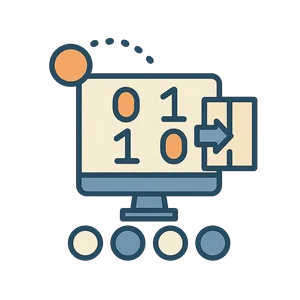
Binary code is a base-2 number system that uses only two symbols, 0 and 1, to represent information.
Reads at Grades 6–8 Listens at Grades 4–8
Print & create
Answer keys·No prep·Free with an account
28 worksheets · answer keys · full story · quiz · Ages 10-12 · CEFR B2
Plus adds 244,000+ more stories in 27 languages, audio for every one, and printables for all of them.
Just want Binary Code (How Computers Count)?
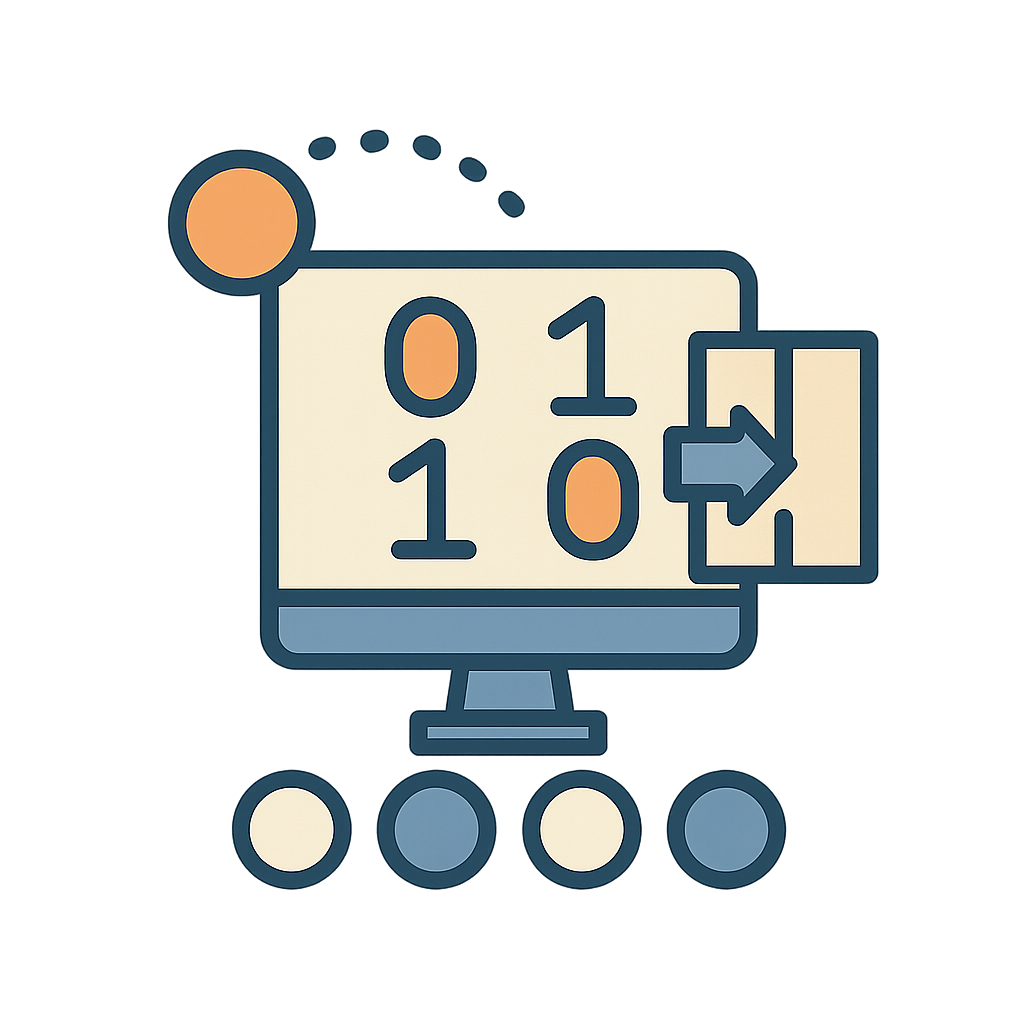
Have you ever wondered what happens inside your tablet when you swipe the screen, or how a video game creates an entire world from nothing. Have you thought about the magic that lets you talk to a friend across the ocean, their face appearing on your screen as if they were in the room. It feels like a miracle, but it’s all powered by a secret language, an invisible whisper that flows through wires and circuits at the speed of light. I am the secret heartbeat inside every digital device, from the most powerful supercomputer to the watch on your wrist. My language is the simplest one you could ever imagine. It has only two words, two signals, two ideas. You can think of them as on and off, yes and no, light and dark. In my world, everything is built from just these two pieces. I am the simple, powerful language that runs your world. I am Binary Code.
My core idea, however, is not new at all. My story began thousands of years ago, long before the first glowing screen. Travel back with me to ancient China, around the 9th century BCE. There, thinkers used a system called the I Ching, which created complex patterns using two simple types of lines: one solid and one broken. They used these patterns to understand the world, a system built entirely on two options, just like me. My spirit also echoed in ancient India, where a scholar named Pingala described mathematical concepts around the 3rd century BCE using patterns of short and long syllables. For centuries, I remained a whisper, a hint of a powerful idea. It wasn't until the late 17th century that a brilliant German mathematician named Gottfried Wilhelm Leibniz truly saw my potential. In 1703, he published a work called 'Explication de l'Arithmétique Binaire,' showing the world how any number imaginable could be written using only my two symbols: a one and a zero. He was fascinated by my elegance, even seeing me as a symbol for divine creation—how everything (1) could come from nothing (0).
The Secret Language of Everything
Have you ever wondered what happens inside your tablet when you swipe the screen, or how a video game creates an entire world from nothing. Have you thought about the magic that lets you talk to a friend across the ocean, their face appearing on your screen as if they were in the room. It feels like a miracle, but it’s all powered by a secret language, an invisible whisper that flows through wires and circuits at the speed of light. I am the secret heartbeat inside every digital device, from the most powerful supercomputer to the watch on your wrist. My language is the simplest one you could ever imagine. It has only two words, two signals, two ideas. You can think of them as on and off, yes and no, light and dark. In my world, everything is built from just these two pieces. I am the simple, powerful language that runs your world. I am Binary Code.
My core idea, however, is not new at all. My story began thousands of years ago, long before the first glowing screen. Travel back with me to ancient China, around the 9th century BCE. There, thinkers used a system called the I Ching, which created complex patterns using two simple types of lines: one solid and one broken. They used these patterns to understand the world, a system built entirely on two options, just like me. My spirit also echoed in ancient India, where a scholar named Pingala described mathematical concepts around the 3rd century BCE using patterns of short and long syllables. For centuries, I remained a whisper, a hint of a powerful idea. It wasn't until the late 17th century that a brilliant German mathematician named Gottfried Wilhelm Leibniz truly saw my potential. In 1703, he published a work called 'Explication de l'Arithmétique Binaire,' showing the world how any number imaginable could be written using only my two symbols: a one and a zero. He was fascinated by my elegance, even seeing me as a symbol for divine creation—how everything (1) could come from nothing (0).
For more than a century after Leibniz, I was mostly a fascinating concept for mathematicians, a clever way to think about numbers but not yet a tool for changing the world. That started to shift thanks to an English mathematician named George Boole. In 1854, he published his revolutionary ideas about logic. He realized my ones and zeros were perfect for representing more than just numbers. A '1' could stand for 'true,' and a '0' could stand for 'false.' This system, which became known as Boolean algebra, turned me into a powerful tool for solving complex logic problems. I could now answer questions with perfect certainty. But the single greatest leap in my entire history came in 1937 from a young American engineer studying at MIT named Claude Shannon. He had a groundbreaking realization. He saw that a simple electrical switch had two states, just like me. It could be on, or it could be off. In that flash of insight, Shannon connected my abstract world of true and false to the physical world of electronics. An 'on' switch could be a '1,' and an 'off' switch could be a '0.' He had discovered the way to make me think.
Shannon’s idea was the key that unlocked the digital age, but to build the powerful devices you use today, my ones and zeros needed a much smaller and faster home than a clunky mechanical switch. The next breakthrough came in 1947 at Bell Labs, with the invention of the transistor. A transistor is like a microscopic, lightning-fast electrical switch with no moving parts. This meant that instead of a few large switches, engineers could pack millions, and eventually billions, of tiny switches onto a single silicon chip. This is why your phone is so small yet so incredibly powerful. Every single one of those billions of transistors is working together, flicking on and off, to speak my language. I am the universal language inside all of your technology. Every photo you take, every song you stream, every email you send is, to the computer, just a very, very long and specific string of my ones and zeros. A computer doesn't see a picture of a cat; it sees a precise pattern of my digits that tells the screen which pixels should be which color to form the image of a cat.
From ancient patterns of lines in China to the engine running your favorite game, my journey has been a long and incredible one. It shows how a profoundly simple idea—using just two states—can grow over centuries to become the foundation of the modern world. I am proof that you don't always need complex tools to solve big problems. Sometimes, the most elegant solution is the simplest one. Today, when people learn to write computer programs, they are learning how to speak my language. They are learning how to arrange my ones and zeros into instructions that can create art, solve equations, connect people, and explore new worlds. I am more than just a code; I am a tool for creativity, a framework for logic, and a canvas for your imagination. My story is still being written, by people just like you. What amazing things will you build with just a one and a zero?
Wow facts
About
Binary code is a base-2 number system that uses only two symbols, 0 and 1, to represent information. It is the fundamental language used by computers and all digital devices to process instructions and store data.
Take a Quiz
Question 1 of 5
Which of the following best summarizes the journey of Binary Code from an ancient idea to a modern tool?
Explore next




Want to do even more?
Go beyond exploring. Unlock tools that turn every story into real learning.

Storypie Plus for families
Full stories, quizzes, and printables. Nights and car rides, sorted.
- Unlimited audio stories
- Create Mode: your child stars in the story
- Offline downloads
- Printable worksheets & coloring pages

Why Storypie for Schools
Students engaged. Prep in seconds. Evenings back to you.
- Worksheets & Quizzes
- Classroom Management
- Formative Assessment
- Custom Curriculum & Lesson Plans
- 27 Languages

Why Storypie for Homeschool
Curriculum done. They'll ask for more. Hours back in your day.
- Worksheet Generator
- First-Person Audio Stories
- Built-in Comprehension Quizzes
- Custom Curriculum & Lesson Plans
- Print & Go Activities