English

Binary Code (How Computers Count)
Binary code is a base-2 number system that uses only two symbols, 0 and 1, to represent information.
Reads at Grades 3–5 Listens at Grades 1–5
Print & create
Answer keys·No prep·Free with an account
28 worksheets · answer keys · full story · quiz · Ages 8-10 · CEFR B1
Plus adds 244,000+ more stories in 27 languages, audio for every one, and printables for all of them.
Just want Binary Code (How Computers Count)?
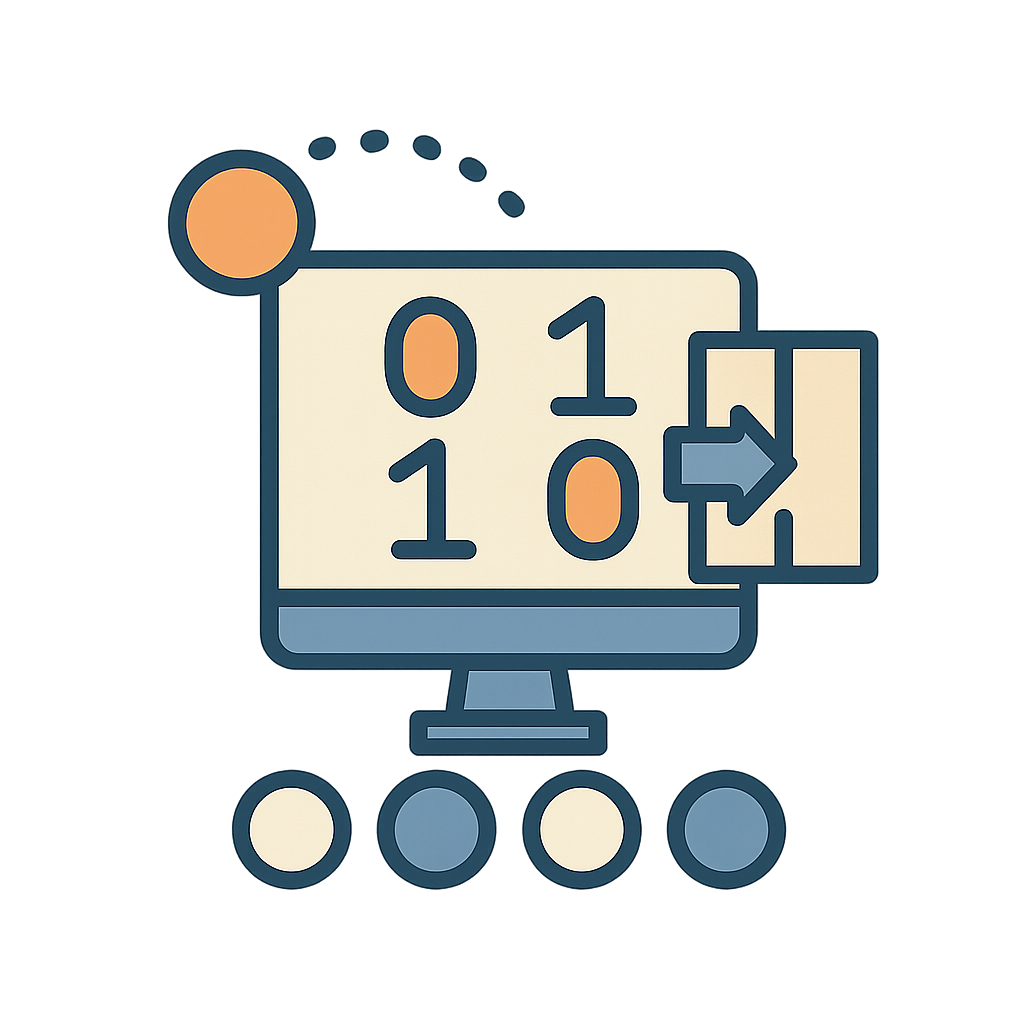
Have you ever wondered how your tablet knows which video to play, or how your computer opens your favorite game with just a click. It seems like magic, doesn't it. But it’s not magic, it’s a special kind of secret language, a language that I help them understand. Imagine a light switch. It can only be on, or it can be off. There are only two choices. My language is just like that. It’s made of only two simple things, like a 'yes' or a 'no,' an 'up' or a 'down.' With just those two little options, I can build entire worlds. I can arrange them in long strings to paint a picture on your screen, play a song through your headphones, or send a message to your friend on the other side of the planet. Every single thing a computer does starts with my simple two-part instructions. I am Binary Code, the simple, powerful language that helps machines think.
My main idea is much older than any computer you’ve ever seen. Can you imagine a world without video games or even electricity. That’s where my story begins. Thousands of years ago, around the 9th century BCE in ancient China, clever thinkers used something called the I Ching. It was a book of wisdom that used patterns of solid and broken lines to represent ideas. A solid line was like a 'yes,' and a broken line was like a 'no.' See. It was a system with two choices, just like me. Then, much later, around the 2nd century BCE in India, a brilliant scholar named Pingala studied poetry. He discovered a way to describe complicated mathematical patterns using short and long syllables. Again, it was a system with just two parts. For centuries, I was a fascinating puzzle for mathematicians and philosophers, a beautiful, simple way to show complex patterns using just two symbols. I was an idea waiting for my time to shine.
The Secret Language of Machines
Have you ever wondered how your tablet knows which video to play, or how your computer opens your favorite game with just a click. It seems like magic, doesn't it. But it’s not magic, it’s a special kind of secret language, a language that I help them understand. Imagine a light switch. It can only be on, or it can be off. There are only two choices. My language is just like that. It’s made of only two simple things, like a 'yes' or a 'no,' an 'up' or a 'down.' With just those two little options, I can build entire worlds. I can arrange them in long strings to paint a picture on your screen, play a song through your headphones, or send a message to your friend on the other side of the planet. Every single thing a computer does starts with my simple two-part instructions. I am Binary Code, the simple, powerful language that helps machines think.
My main idea is much older than any computer you’ve ever seen. Can you imagine a world without video games or even electricity. That’s where my story begins. Thousands of years ago, around the 9th century BCE in ancient China, clever thinkers used something called the I Ching. It was a book of wisdom that used patterns of solid and broken lines to represent ideas. A solid line was like a 'yes,' and a broken line was like a 'no.' See. It was a system with two choices, just like me. Then, much later, around the 2nd century BCE in India, a brilliant scholar named Pingala studied poetry. He discovered a way to describe complicated mathematical patterns using short and long syllables. Again, it was a system with just two parts. For centuries, I was a fascinating puzzle for mathematicians and philosophers, a beautiful, simple way to show complex patterns using just two symbols. I was an idea waiting for my time to shine.
For a long, long time, I was mostly an idea on paper. Then, a German mathematician named Gottfried Wilhelm Leibniz got very excited about me. In the year 1703, he wrote a famous paper showing the world how any number in existence could be written using just two symbols: a 1 and a 0. He thought it was amazing that something so simple could represent everything. My next big step came from something you might not expect: a machine for weaving cloth. In 1804, an inventor named Joseph Marie Jacquard created the Jacquard Loom. This amazing machine used special cards with holes punched in them. A hole was like a '1,' telling the loom to lift a certain thread. No hole was like a '0,' telling it to leave the thread down. By feeding the loom long chains of these cards, it could automatically weave the most beautiful and complicated patterns into fabric. Then, in 1854, a man named George Boole gave me a new superpower. He created a type of logic where every statement had to be either 'true' or 'false.' His system was a perfect match for my 1s and 0s. 'True' could be 1, and 'false' could be 0. Suddenly, I wasn't just for numbers or patterns, I could help a machine make a decision.
My journey from an ancient idea to the heart of your computer needed one more spark of genius. That spark came from an American engineer named Claude Shannon in 1937. He was studying electrical circuits and had a brilliant realization. An electrical switch can be 'on,' letting electricity flow, or 'off,' stopping it. He saw that this was just like my 1s and 0s. An 'on' switch could be a 1, and an 'off' switch could be a 0. This was the key that unlocked everything. People could now build machines with millions of tiny switches to do math, store information, and follow instructions using me. Today, I am everywhere. Every photo you take, every song you listen to, and every letter you type is really just a long, long pattern of my 1s and 0s. For example, when a computer sees the letter 'A', it really sees my secret pattern: 01000001. From ancient patterns in China to the phone in your hand, I am the simple secret that lets people build and share their biggest ideas with the world. And I can't wait to see what you'll create with me next.
Wow facts
About
Binary code is a base-2 number system that uses only two symbols, 0 and 1, to represent information. It is the fundamental language used by computers and all digital devices to process instructions and store data.
Take a Quiz
Question 1 of 5
In the story, the Jacquard Loom is described as an important step. The sentence said it used cards with holes to 'automatically weave beautiful, complicated patterns.' What does the word 'automatically' mean here?
Explore next

Want to do even more?
Go beyond exploring. Unlock tools that turn every story into real learning.

Storypie Plus for families
Full stories, quizzes, and printables. Nights and car rides, sorted.
- Unlimited audio stories
- Create Mode: your child stars in the story
- Offline downloads
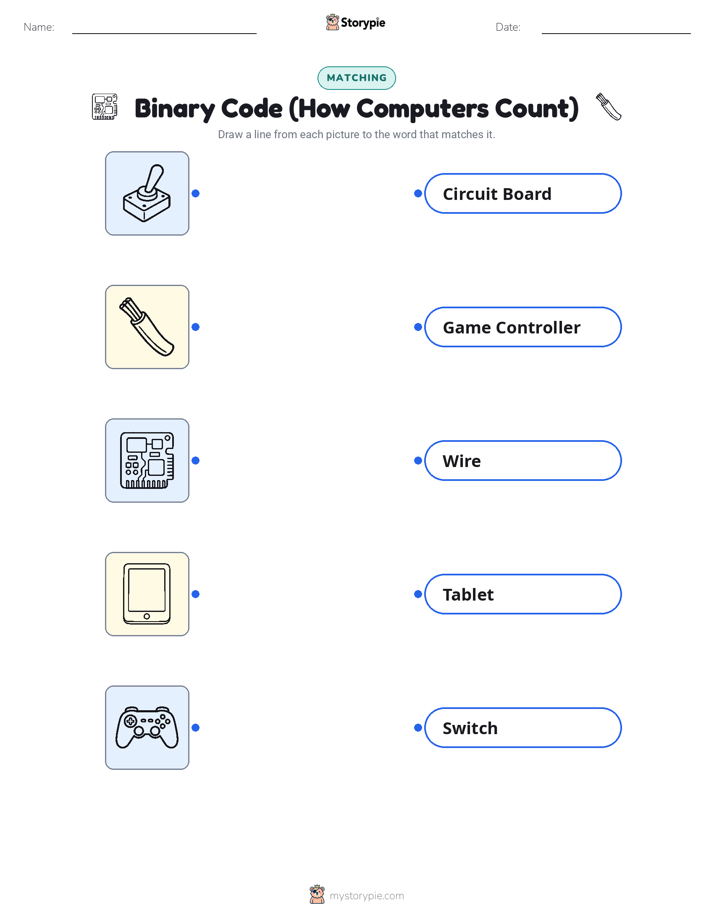
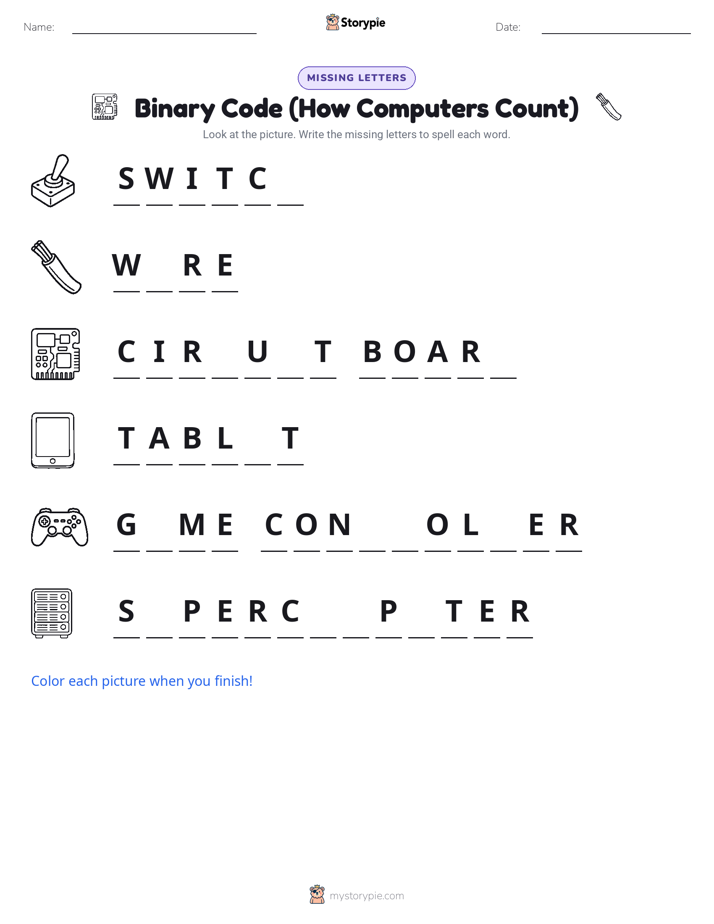
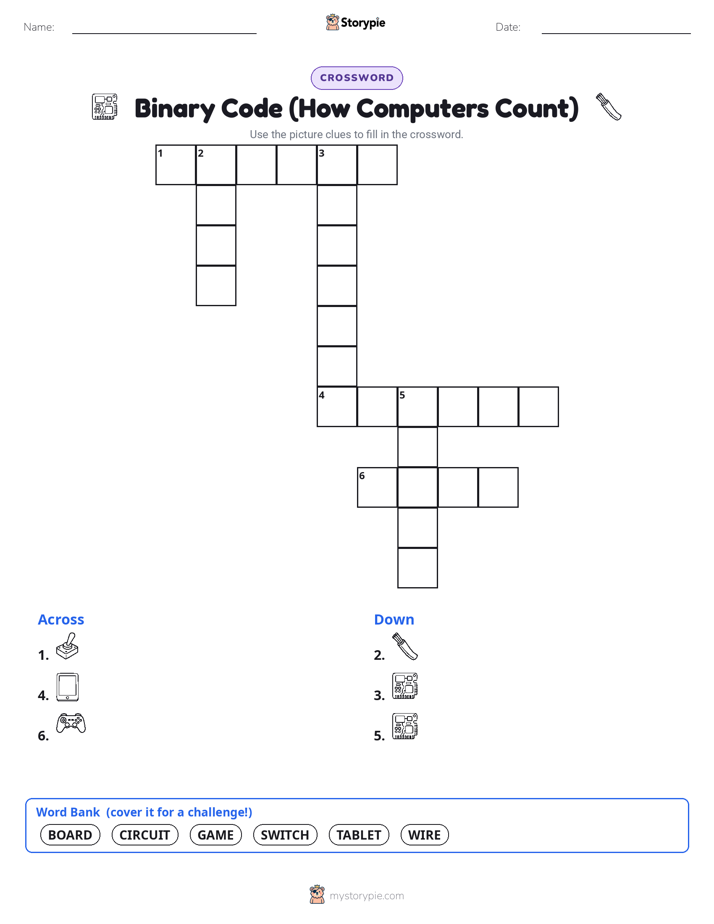
- Printable worksheets & coloring pages

Why Storypie for Schools
Students engaged. Prep in seconds. Evenings back to you.
- Worksheets & Quizzes
- Classroom Management
- Formative Assessment
- Custom Curriculum & Lesson Plans
- 27 Languages

Why Storypie for Homeschool
Curriculum done. They'll ask for more. Hours back in your day.
- Worksheet Generator
- First-Person Audio Stories
- Built-in Comprehension Quizzes
- Custom Curriculum & Lesson Plans
- Print & Go Activities